
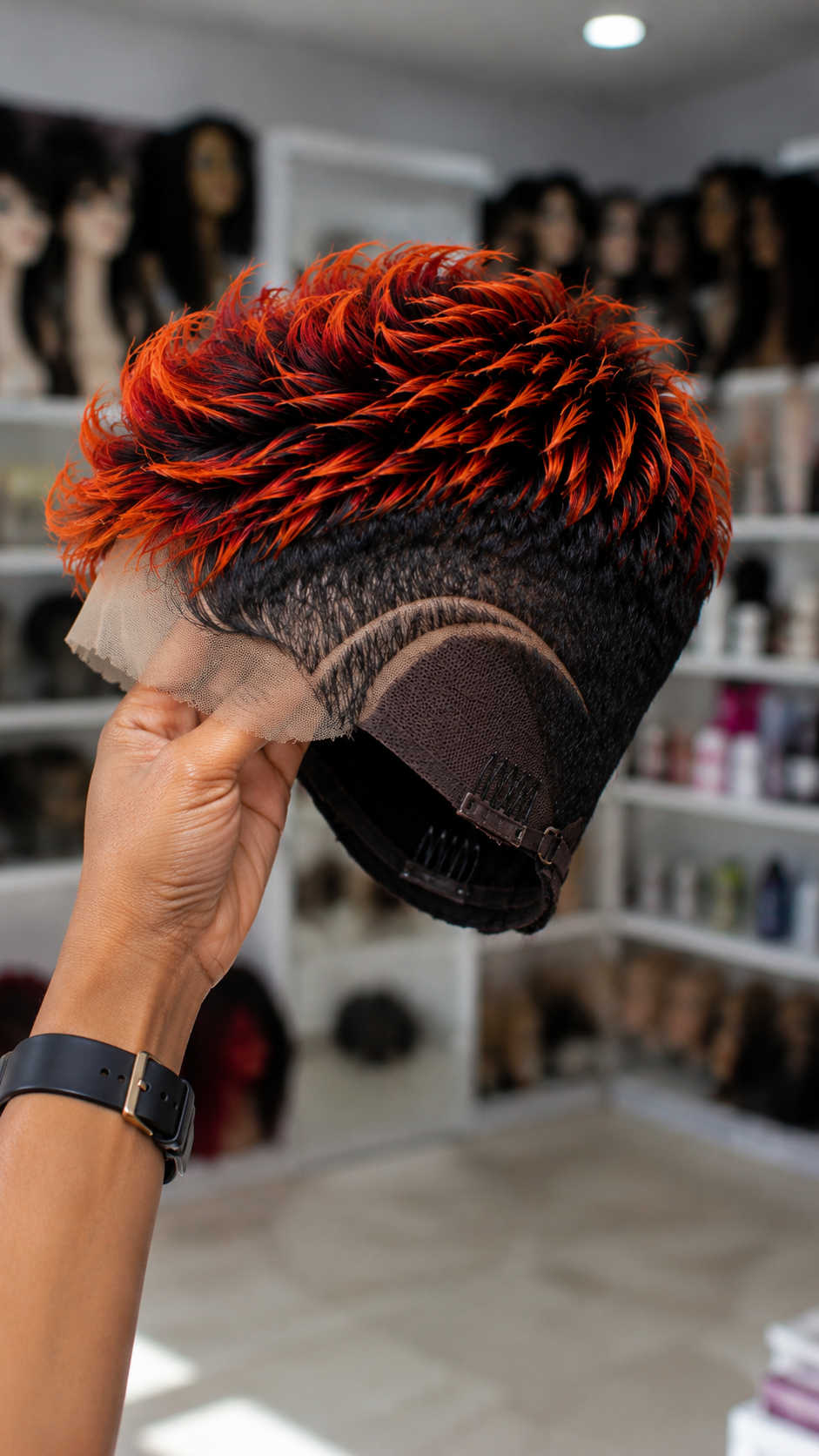
Run your eye across this unit and you notice each sharp, razored spike carries its own black-to-orange transition, dark at the base and bright at the tip, repeated piece by piece across the whole crown. That per-strand tip treatment is what gives this its flame-like, graphic effect, and it only works because of the texture underneath it. This is a colour placement technique built specifically for a razored, piecey cut, and understanding why it works here, and would not work the same way on a curled unit, is the key to judging it well.
The logic is straightforward once you see it. A root melt, the smooth, gradual colour transition used on curled units, relies on a continuous, flowing shape to carry a gentle gradient from dark to light. A razored, piecey texture has no such continuous shape, it is made of distinct, separated pieces with sharp ends, so a smooth root melt applied to it would blur across the choppy structure rather than reading cleanly. Instead, this unit uses a tip-dip approach, colour concentrated at the very ends of each individual piece, which works with the piecey structure rather than against it, creating dozens of small, sharp colour transitions instead of one large smooth one.
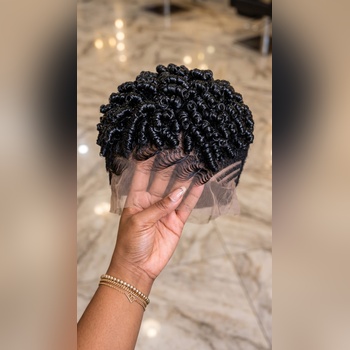
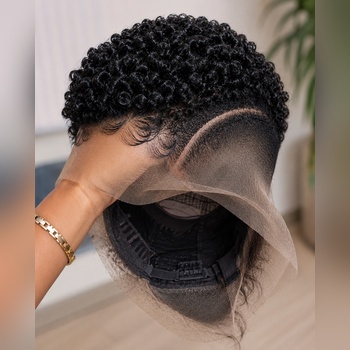
This is why colour placement is never one-size-fits-all, it has to be chosen for the specific cut or curl it sits on. A gentle root melt on a defined spiral curl looks natural and rooted. That same soft gradient on a razored, spiky texture would look muddy and indistinct, losing the crispness that makes the cut striking in the first place. Tip-dip colour, concentrated sharply at each piece’s end, is what makes a razored texture read as deliberately fiery rather than just messily two-toned. So when you are judging any coloured unit, ask not just whether the colour looks good, but whether the placement technique actually suits the texture it was applied to.
Where To Buy A Tip-Dipped, Razored Pixie Wig
Custom makers who understand that razored texture needs tip-dip rather than a smooth melt can execute this look properly, so ask specifically how the colour is placed relative to the piecey cut. A maker who explains tip-dipping each piece individually understands the technique; one who describes a generic root melt may not achieve the sharp, graphic effect this texture calls for.
Instagram and TikTok sellers who show flame or fire-coloured razored units should demonstrate the sharpness of each individual tip, so look closely at whether the colour transition is crisp per piece or blurred across the whole crown. A razored pixie wig with tip-dip colour is judged on that per-strand crispness, not on overall colour blending the way a curled unit would be.
Etsy works with makers who can describe matching colour technique to cut technique specifically. The risk is a maker applying the wrong placement style, a soft melt on a razored cut, which undercuts the texture’s sharpness. Read reviews for anyone describing the colour as crisp or graphic rather than blended.
Marketplaces like Amazon, AliExpress, and Temu carry two-tone razored units, but matching colour placement correctly to piecey texture takes real technique, so check close photos for whether each spike shows its own clean transition rather than an overall blurred effect.
Local beauty supply shops and salons let you see the individual tip-dip effect up close and compare it to how a smooth root melt looks on a curled unit, which helps you understand why the placement technique matters. You pay a premium in-store, but seeing both side by side clarifies the principle quickly.
Vendors and wholesalers direct ship standard colour techniques, so specify tip-dip or per-piece colour placement if you want this specific razored, flame-like effect rather than a generic two-tone.
Regionally, makers who match colour technique to texture, tip-dip for razored cuts, root melt for curls, are found across Lagos, Accra, Atlanta, London, and South Africa, and this attention to matching is easy to spot in close video of the finished piece.
Vet the seller the usual way: check the account age, look for real buyer photos showing the tip detail closely, time a plain question for a genuine reply, and ask whether the colour was placed specifically for a razored texture. A seller who understands this distinction is thinking about technique, not just applying colour generically.
Red flags: a blurred, muddy colour transition on a razored texture that should show sharp per-piece tips, colour placement clearly borrowed from curl styling without adaptation, and no close-up photos of individual pieces.
When you order, send your measurements and ask specifically for tip-dip colour placement suited to the razored cut, not a soft root melt. That tells the maker you understand the technique needs to match the texture.
Contact / order inquiries: WhatsApp [WhatsApp: +XX XXX XXX XX XX].
How Much It Costs
Tip-dip colour placement on a razored texture is skilled, detailed work, applying colour to many individual pieces rather than one continuous gradient, so it is priced as genuine fashion-colour work.
Tiered pricing. Human hair, full build with a razored, piecey cut and tip-dip flame colour, glueless with a fine lace: roughly $220 to $470, since the technique demands real precision across many individual pieces. Human hair, mid build: about $170 to $360. Human hair, basic cap: around $110 to $250. Good synthetic with a pre-set tip-dip effect: $70 to $160, and synthetic can hold this crisp colour separation well with less upkeep. Basic synthetic: $30 to $70.
What that includes and excludes. The price covers the unit, the razored cut, and the tip-dip colour work. It excludes shipping, any customs, and the colour-refresh products needed to keep bright tips like orange from fading dull.
Shipping and duty. These sit outside the price and change with where you live, so plan a realistic band and confirm your own country’s import rate.
Ongoing costs. Bright tip colours like vivid orange fade toward dull or brassy faster than darker base tones, so colour-depositing products focused specifically on the tips help maintain the sharp contrast that makes this style work. The razored cut itself needs no re-setting, only occasional trimming to keep the pieces sharp.
First-year total. A human unit with tip-dip colour plus shipping plus any customs plus targeted colour refresh tends to land above a solid-colour unit’s year, with the bright tip maintenance being the main ongoing task, while the cut itself stays low-maintenance.
Cost per wear. A crisp, well-matched tip-dip effect on a razored cut reads as sharp and intentional every wear, while a soft, blurred version undercuts both the colour work and the cut, so getting the placement technique right protects the value of both.
What a very low price signals. A very cheap unit attempting this look often blurs the colour across the whole crown rather than achieving crisp per-piece tips, since precise tip-dip work takes more careful application than a rushed, generic two-tone job.
Deposit structure. For custom coloured work, thirty to fifty percent down with the balance before shipping is standard. Use a method you can dispute, and ask for close-up tip photos before releasing the last part.
Shipping, Delivery, And What To Expect After Ordering
A tip-dipped razored unit arrives with its colour already placed, so check close up whether each piece shows its own sharp transition or whether the colour has blurred together. Ask that it ship so the piecey texture is not crushed, choose a tracked service, and confirm your country’s import charge before it lands. When it arrives, look at individual spikes near the crown and the perimeter to confirm the crisp tip-dip effect holds consistently. What you unbox is a technique whose success depends on colour respecting the cut’s separated structure.
Colour Placement Should Follow The Cut, Not Fight It
The core principle here is that a smooth, continuous colour technique like a root melt suits a smooth, continuous texture like a curl, while a sharp, piecey texture like this one needs colour applied in a way that respects its separated structure, tip by tip. Applying the wrong technique to the wrong texture, a soft melt on razored pieces or a hard tip-dip on flowing curls, undercuts what makes each style distinctive.
Per-Piece Precision Is What Creates The Flame Effect
The graphic, fire-like impression this unit gives comes from dozens of small, sharp transitions rather than one large gradual one, so precision at the level of individual pieces is what the whole effect depends on. A few blurred or inconsistent tips among otherwise sharp ones will read as a flaw precisely because the technique’s whole appeal is that crispness repeated throughout.
Bright Tips Need Their Own Colour Care
Because vivid tip colours like orange sit at the very ends of the hair, often the most porous and exposed section, they can fade toward dull faster than a base colour would. Targeted colour-depositing care specifically at the tips helps maintain the sharp contrast against the darker base that makes this flame effect work.
Before You Pay
- Does each individual piece show its own crisp tip-dip transition?
- Is the colour placement technique suited to this razored texture, not borrowed from curl styling?
- Have I seen close-up photos of individual pieces, not just the overall look?
- Am I ready to give the bright tips their own targeted colour care?
- Is the price consistent with the real precision this per-piece technique demands?
Trimming The Lace
The lace comes off the front the usual way, and on this style the front pieces should carry the same tip-dip effect as the rest of the crown, so check that the colour placement is consistent right up to the hairline. Trim in small offset steps and leave a shallow margin rather than cutting flush, in daylight where the black-to-orange transition reads true. If this is your first razored, coloured unit, let a stylist make the first pass, since matching a clean cut to a precise tip-dip finish at the hairline takes real skill.
Search Terms
tip dip razored pixie wig · flame colour piecey short wig · black orange spiky curl unit · razored fire tone pixie lace · dip dye razored short wig · orange tip black root pixie · piecey texture flame wig · sharp spike colour pixie unit
Final Thoughts
Every razored spike on this unit carries its own black-to-orange dip, and that per-piece precision, not a smooth overall gradient, is exactly what makes the flame effect read as sharp and intentional. Colour placement is never universal, a technique that suits a flowing curl does not suit a piecey, razored cut, and this unit shows what happens when the colour method is chosen to match the texture underneath it rather than applied generically.
Buy it by checking that crisp, per-piece transition close up, since the whole effect depends on precision repeated across dozens of individual pieces rather than one large gradient. Give the bright tips their own targeted colour care as they are the most exposed part and fade fastest. A tip-dipped, razored pixie wig proves that the best colour technique is not a fixed formula, it is whatever placement actually respects the structure of the cut it sits on.