
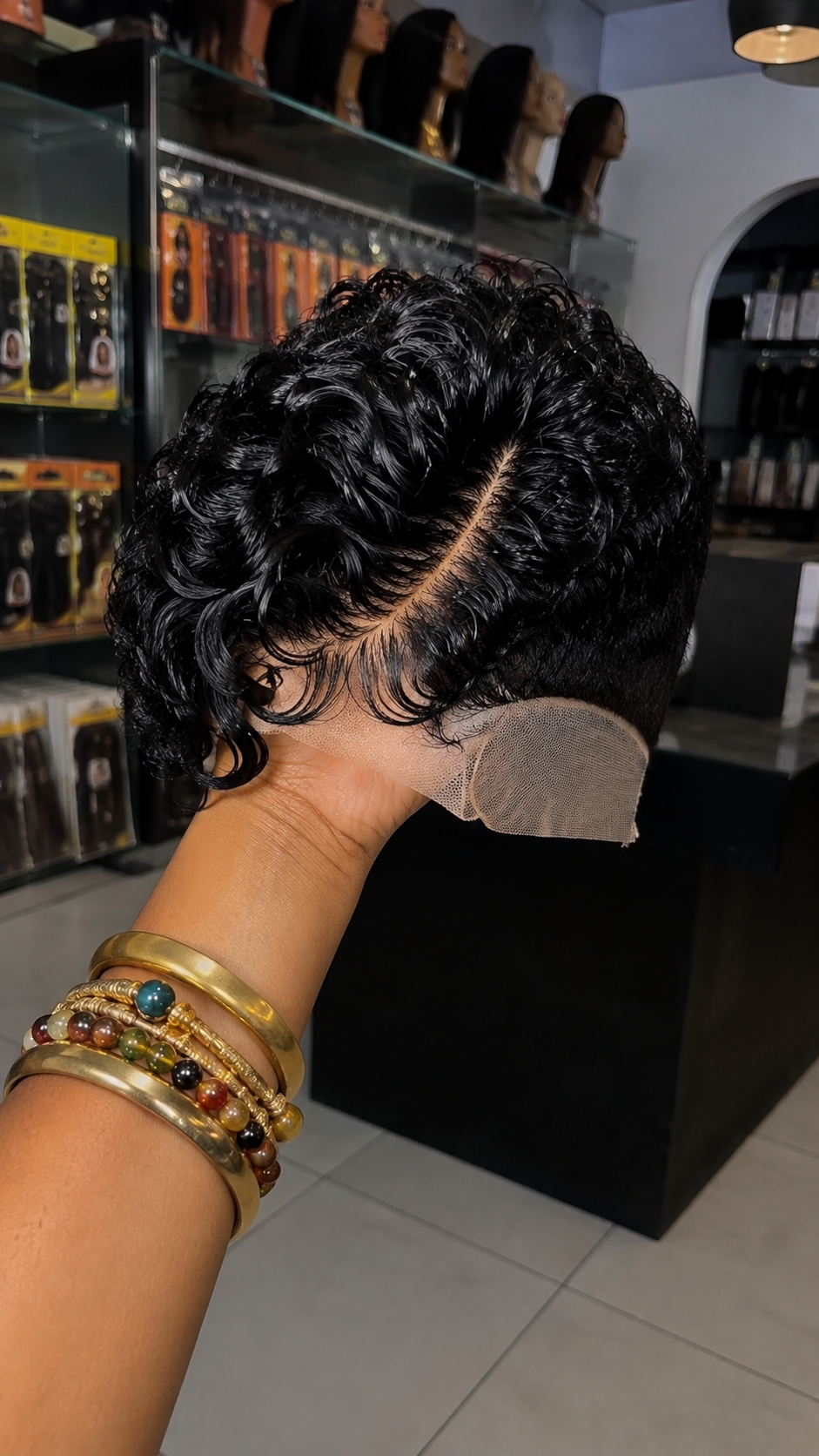
Ninety percent of what you are looking at in this photo will not survive the first blow-dry. The gloss, the tight coiled definition, the way every curl sits exactly where it was placed — that is a wet-set finish, and wet-set finishes are temporary by design. What is left underneath, once the water and product evaporate, is the actual unit you are buying.
This is a black curly pixie wig photographed mid-hold on a wrist, product boxes and mannequin heads stacked behind it on a shop shelf. It is not a studio shot. It is a retail-floor shot, and that matters, because it shows the unit in the exact state most buyers never think to ask about: freshly wet-set, lace edge left raw and untrimmed at the nape, a deep, slightly off-center part carved straight down the crown under a heavy layer of gel.
None of that is a flaw. It is simply the unfinished, in-between state a unit passes through between “just installed” and “ready to leave the shop.” Most photos skip this stage entirely. This one does not, and that gives you information a polished studio photo would hide.
Where To Buy This Wet-Set Curly Pixie Wig
Custom makers build this kind of tight wet-set curl to order, matching density and curl diameter to a reference photo rather than pulling a fixed size off a shelf. You pay more, but you get a say in how the curl is cut and set before it ever reaches you.
Instagram and TikTok sellers post exactly this kind of wet-look content because it photographs well — the gel makes every curl read clearly on camera. Ask for a dry-texture video before you commit; wet and dry can look like two different products.
Etsy has independent makers selling curly pixie units in this range, often with more transparent listing photos than social media, including combed-out or dry shots alongside the wet ones.
Marketplaces like Amazon, AliExpress, and Temu carry mass-produced versions at lower prices, usually synthetic or blended fiber. The wet-set look in the listing photo is frequently how the unit ships, pre-styled and pre-gelled, and will not hold that shape after a wash.
Local beauty supply shops and salons are worth checking in person specifically because of what this photo shows: you can ask the staff to rinse a display unit or run a wet strand through your fingers before buying, which you cannot do through a screen.
Vendors and wholesalers direct sell in bulk to salons and resellers, and this is often where units like the one photographed here actually originate before they are re-listed individually online at a markup.
Regionally, curly pixie stock in this cut and density shows up often in Lagos, Accra, Atlanta, London, and South African hair districts, where wet-set styling for display is a common finishing step before a unit goes on a mannequin or into a customer’s hands.
Vet the seller by asking for a video of the unit being combed out completely dry, not just a still photo. A seller who only shows wet, gelled photos may be doing so because the dry curl pattern is less impressive.
Red flags include listings that only ever show the wet-set version, no video of the curl being handled, no visible knots or lace close-up, and reluctance to show the unit under normal indoor lighting instead of a bright, glossy flash.
When you order, send a clear front-facing photo of your own hairline, your preferred part direction, and ask specifically whether the unit ships wet-set, dry, or unstyled — the difference changes what you will actually receive.
Contact / order inquiries: WhatsApp [WhatsApp: +XX XXX XXX XX XX]
How Much It Costs
Tiered pricing for a unit like this typically runs $150–$430 for human hair in black, depending on density and lace quality. Color premiums do not apply here since the base is black, but curl-pattern complexity can still add $20–$60 to a custom order. A good synthetic equivalent runs $60–$150, and a basic synthetic version can be found for $25–$70.
What that includes and excludes matters more than the sticker price. Base price usually covers the unit itself, not styling products, not a stand, and rarely a wig cap. A pre-styled wet-set finish for photos is sometimes a one-time seller service, not something you can recreate at home without buying the same gel.
Shipping and duty add $15–$60 depending on origin and destination, with international orders sometimes carrying additional customs charges that are not disclosed until the package clears.
Ongoing costs include the actual setting gel or mousse needed to recreate this look yourself, a wide-tooth comb for detangling wet curls without stripping the pattern, and a satin cap or pillowcase to protect the set overnight.
First-year total, including the unit, styling products, and at least one professional re-lace or trim, tends to land between $220 and $520 for a human hair version handled with reasonable care.
Cost per wear drops fast if this becomes a regular styling option rather than a one-time look — a $250 unit worn twice a week for a year works out to roughly $2.40 per wear, which reframes the upfront number considerably.
What a very low price signals on a unit photographed this glossy and well-defined is usually synthetic fiber holding a permanent curl, or a photo taken immediately after professional styling that will not be repeatable by the buyer at home.
Deposit structure for custom orders is commonly 30–50% upfront, with the remainder due before shipment. Keep that final payment on a method you can dispute if the delivered unit does not match what was shown.
Shipping, Delivery, And What To Expect After Ordering
Processing on a custom curly pixie order like this usually takes 5–12 business days before it even ships, longer if the maker is setting the curl pattern by hand rather than pulling from ready stock. International shipping adds another 7–21 days on top of that.
What arrives is almost never what you see in a wet-set promotional photo. Expect the unit to arrive dry, in its natural resting curl, which will look looser and larger than the tightly gelled version photographed for the listing. That is normal, not a defect — you are meant to re-wet and re-set it yourself if you want that exact look again.
Photograph the unit the moment it arrives, before you touch the lace or apply any product. If a dispute over curl pattern, lace quality, or density comes up later, that first, untouched photo is your reference point.
The Wet-Set Look Is A Styling Choice, Not The Curl’s Resting State
Every curl in this photo has been deliberately flattened, defined, and locked in place with a wet styling product — you can see it in the sheen along each ridge and the way individual coils hold sharp, separated edges instead of the softer, more blended look dry curls settle into. This is a finishing technique, applied specifically because it photographs cleanly.
The practical consequence is simple: the first time this unit gets wet again, whether from rain, humidity, or an actual wash, the gel releases and the curl reverts to whatever its true, unstyled shape is. That could be looser, could be frizzier, could be smaller in overall volume than what is pictured here. You are not buying this exact moment. You are buying the fiber and the base construction underneath it.
If a seller cannot or will not show you the same unit dry and combed out, treat the wet-set photo as a demonstration of technique, not a promise of permanent appearance.
The Deep, Off-Center Part Under The Gel
Running straight back from the crown is a deep, hand-carved part, pushed slightly off-center rather than dead-middle. On a wet-set unit like this, that part line is easy to see clearly because the gel has flattened the surrounding hair away from it — dry, it will be far less pronounced unless you re-style it the same way.
A deep part like this puts real stress on a small strip of the lace and the knots directly beneath it, since that section carries more exposed scalp-simulation area than a shallow or centered part would. Check that strip specifically for knot bleaching and lace color match, since it is the part of the unit most likely to be scrutinized up close.
The Untrimmed Lace Flap At The Nape
At the lower edge, near the nape, a visible flap of lace extends past where the hairline actually begins — unfinished, uncut, exactly as it left the base construction stage. This is completely normal for a unit at this point in its lifecycle and is not something to be concerned about on arrival.
What it tells you, though, is that this photo was taken before final customization. A finished, ready-to-wear unit would have that excess lace trimmed close to the hairline and either glued down or left for you to trim to your own edge. Seeing it raw here is a useful reminder that “photographed” and “wearable, day one” are not always the same state.
Before You Pay
- Has the seller shown you this unit dry, not just wet-set and gelled?
- Is the lace trimmed and finished, or still raw like the flap visible here?
- Does the part placement match a direction you can actually wear, or only the one photographed?
- What is the density measured against, and does it match your own hairline width?
- If the dry curl pattern looks different from the wet photo, is that disclosed anywhere in the listing?
Trimming The Lace
If your unit arrives with excess lace still attached, trim in small sections rather than one long cut, working from the center outward toward each temple. Leave roughly one-eighth of an inch of lace beyond the last row of knots — cutting flush against the hairline risks nicking the knots themselves and causing shedding.
Wet the lace lightly before trimming so it lies flat against a hard surface instead of shifting under the scissors. A curved, small-blade trimmer gives more control around the temple curves than standard fabric scissors, which tend to cut too straight a line for a natural-looking edge.
Search Terms
wet look curly pixie wig · gel set curl pixie wig · deep side part pixie wig · wet look lace front pixie · curly pixie wig salon display · untrimmed lace curly pixie · short curly wig wet finish · black curly pixie wig gel edges
Final Thoughts
A wig photographed mid-hold, on someone’s wrist, with mannequin heads and product boxes in the background, is closer to what you will actually get than a fully staged studio shot ever is. The wet-set curl, the raw lace edge, the deep part carved fresh under gel — none of it is finished, and none of it is meant to be. It is a unit caught between stages, and that is exactly why it is worth learning to read.
Buy the fiber and the base underneath the styling, not the fifteen minutes of gel work that made it photograph this well. Ask for the dry version. Ask about the part. Ask whether the lace ships trimmed or raw. Every one of those answers tells you more about what arrives at your door than the glossiest wet-set photo ever will.