
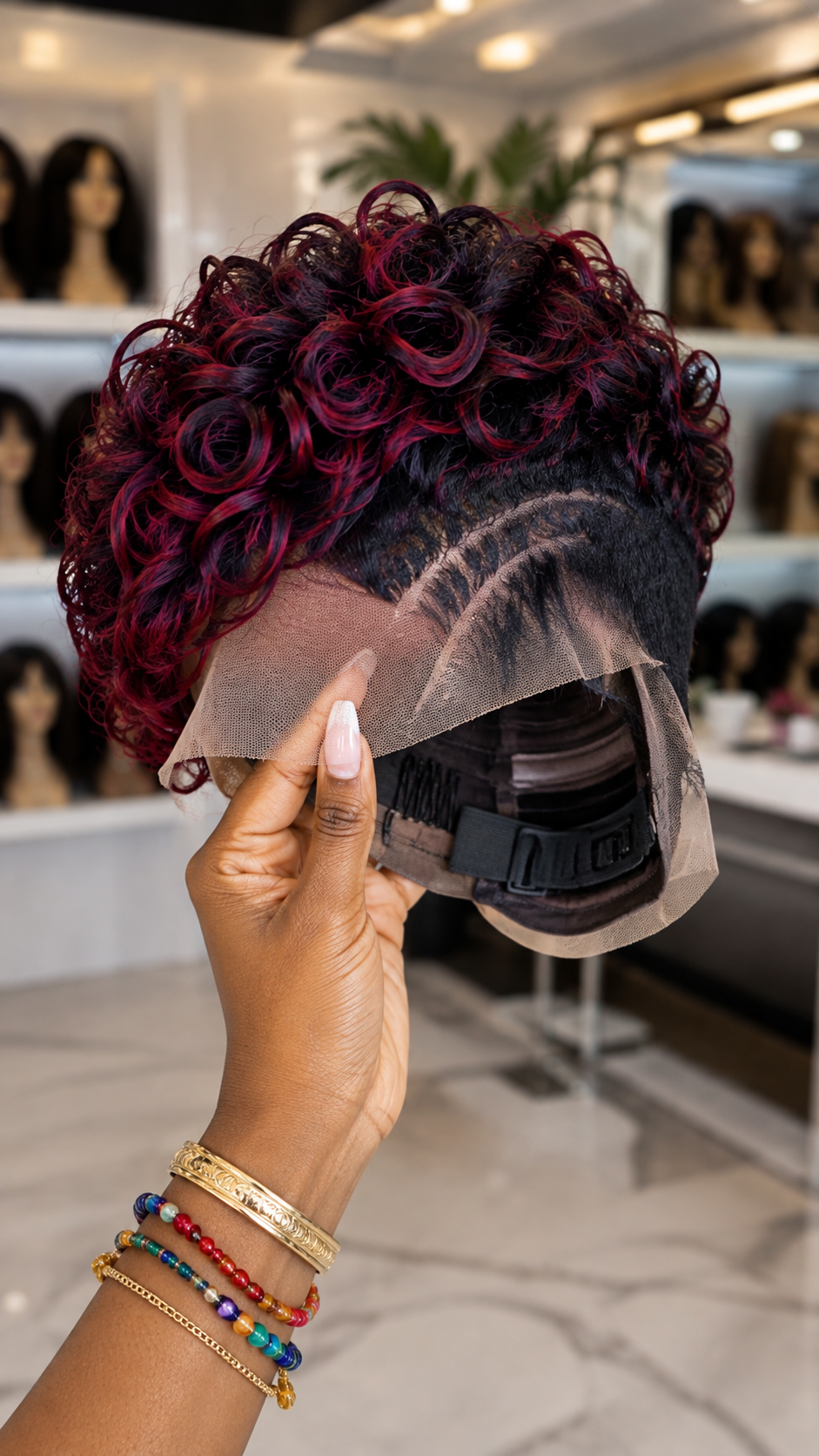
Look closely at this unit and the colour does not move the way a root melt does, gradually from dark at the crown to lighter at the ends, and it does not sit in placed streaks the way highlights do. Instead, individual curls throughout the crown carry different shades at random, some a deep, almost black-maroon, others a brighter, more vivid red, mixed through the mass without any obvious pattern. This is a different colouring technique entirely from the gradients and placements covered elsewhere, and it is worth understanding on its own terms before you judge whether it is done well.
Where a root melt creates dimension through a smooth, directional change and highlights create it through deliberately placed streaks, this random, strand-by-strand variation creates dimension through controlled chaos, curl to curl, with no predictable order to where the darker or brighter tones land. Done well, it reads as rich and alive, like firelight catching different depths of colour as the curls move, genuinely more dynamic than a flat single tone or even a smooth gradient. This is the appeal, and it is real.
But this technique walks a finer line than a clean gradient does. Because there is no pattern to check against, judging whether the randomness is intentional and well-balanced or simply uneven and patchy is harder than judging a root melt, where you can at least confirm the transition is smooth, or highlights, where you can check the placement makes sense. With randomly varied colour, the question is really about balance across the whole head: do the darker and brighter tones feel evenly distributed overall, even without a fixed pattern, or does one side or section look muddier or more concentrated than it should. This is worth checking from multiple angles, since a photo from one side can look beautifully balanced while another angle reveals the colour bunching unevenly.
Where To Buy A Pixie Wig With Randomly Varied Curl Colour
Custom makers who work with this kind of strand-level colour variation need a genuine eye for balance without a fixed pattern to follow, so ask to see the unit from multiple angles to judge whether the tones are distributed evenly overall. A maker skilled at this technique will show it confidently from several sides; one who is not may show only the most flattering angle.
Instagram and TikTok sellers who post units like this should show them turning or from multiple angles, since a single static shot cannot confirm the colour is balanced all the way around. A pixie wig with randomly varied red tones needs a fuller view than a style with a predictable pattern, since there is no pattern to check against from just one photo.
Etsy works with makers who can describe this as a deliberate strand-level technique rather than an accident of dye application. The risk is a listing that looks striking in one photo but reveals uneven, patchy colouring from another angle. Read reviews for anyone describing the colour as balanced or, conversely, uneven.
Marketplaces like Amazon, AliExpress, and Temu occasionally carry randomly varied colour units, though this is a less common technique than root melts or highlights, so check multiple photos carefully for consistency of balance across the whole head rather than trusting a single striking image.
Local beauty supply shops and salons let you turn a unit in your hands and check the colour balance from every side, which is genuinely the best way to judge a technique with no fixed pattern to verify. You pay a premium in-store, but this kind of colour work benefits enormously from an unhurried, all-angles look.
Vendors and wholesalers direct ship standard colour techniques, and randomly varied strand colour is less commonly stocked, so ask specifically if this is what you are looking for rather than assuming it is available.
Regionally, this kind of dimensional, strand-by-strand colour work is a specialty skill found among makers across Lagos, Accra, Atlanta, London, and South Africa, and it is worth seeking out a maker who names this technique specifically rather than describing it vaguely as dimensional.
Vet the seller the usual way: check the account age, look for real buyer photos from multiple angles, time a plain question for a genuine reply, and ask directly whether the colour is balanced evenly across the whole head, not just from the angle photographed. A seller who provides multiple views is confident the balance holds up.
Red flags: only a single angle shown for a randomly coloured unit, colour that looks concentrated or muddy in any one section when you can see it, and vague descriptions like “dimensional” without confirming the actual technique used.
When you order, send your measurements and ask for the varied colour to be balanced evenly across the whole head, requesting photos from multiple angles before shipping if possible. That signals you understand this technique needs checking differently from a patterned one.
Contact / order inquiries: WhatsApp [WhatsApp: +XX XXX XXX XX XX].
How Much It Costs
Randomly varied strand colour is a real colouring technique requiring a skilled eye for balance, so it typically costs in line with other fashion-colour work, and the real value lies in that balance holding up from every angle.
Tiered pricing. Human hair, full build with randomly varied red and maroon tones through a defined curl, glueless with a fine lace: roughly $220 to $470, since achieving convincing, balanced randomness is genuine skilled colour work. Human hair, mid build: about $170 to $360. Human hair, basic cap: around $110 to $250. Good synthetic with a pre-set varied colour pattern: $70 to $160. Basic synthetic: $30 to $70.
What that includes and excludes. The price covers the unit and the varied colour work. It excludes shipping, any customs, and the colour-refresh products needed to keep red tones from fading unevenly over time.
Shipping and duty. These sit outside the price and change with where you live, so plan a realistic band and confirm your own country’s import rate.
Ongoing costs. Red tones fade faster than most colours, and with randomly varied strand colour, uneven fading can actually shift the balance you originally liked, since different strands may fade at different rates. A colour-depositing conditioner across the whole head helps keep the variation looking intentional rather than patchy as it ages.
First-year total. A human unit with randomly varied colour plus shipping plus any customs plus colour-refresh upkeep tends to land above a solid-colour unit’s year, since maintaining balanced randomness as red fades takes more attentive care than topping up a single flat tone.
Cost per wear. A well-balanced, randomly varied colour reads as rich and alive every time you wear it, which can make it feel more special-occasion or statement-worthy than an everyday flat colour, so weigh how often you would actually reach for this level of visual interest.
What a very low price signals. A very cheap unit sold with this kind of colour variation risks looking patchy or accidental rather than deliberately balanced, since the skill required to do this well is real and rarely reflected in a bargain price.
Deposit structure. For custom coloured work, thirty to fifty percent down with the balance before shipping is standard. Use a method you can dispute, and ask for photos from multiple angles before releasing the last part.
Shipping, Delivery, And What To Expect After Ordering
A randomly coloured unit arrives with its varied tones set, and because there is no fixed pattern, checking the balance means looking at it from every side rather than a single glance. Ask that it ship so the curl and colour are protected, choose a tracked service, and confirm your country’s import charge before it lands. When it arrives, turn it slowly under good light and look for any section where the colour bunches darker or lighter than the rest. What you unbox is a colour technique that lives or dies on overall balance, and checking that balance thoroughly is the first thing to do.
There Is No Pattern To Check Against, Which Makes Balance Harder To Judge
With a root melt or highlights, you can check the pattern makes sense, root at the top, lighter at the ends, or streaks placed where they should be. With randomly varied colour, there is no such reference point, so judging quality means assessing overall balance and richness across the whole head rather than confirming any specific placement is correct. This is a genuinely different, and in some ways harder, thing to evaluate.
Multiple Angles Matter More Here Than On Any Patterned Colour
Because the variation has no predictable structure, a single photo cannot confirm the colour is balanced all the way around a unit. A patterned colour like a root melt can often be judged reasonably well from one clear shot, but randomly varied colour genuinely needs to be seen turning or from several angles to confirm there is no hidden unevenness on the side not shown.
Uneven Fading Can Shift The Balance Over Time
Because red pigments fade at different rates depending on how they were applied, randomly varied red and maroon tones can shift out of their original balance as the unit ages, with some strands lightening faster than others. Refreshing the colour across the whole head, not just touching up one area, helps keep the intentional variation from drifting into an unintentional, patchy fade.
Before You Pay
- Have I seen this unit’s colour from multiple angles, not just one?
- Does the variation look balanced overall, or concentrated in any section?
- Do I understand this is a different technique from a root melt or highlights?
- Am I ready to refresh the colour across the whole head as red fades unevenly?
- Is the price consistent with the real skill this balanced randomness requires?
Trimming The Lace
The lace comes off the front the usual way, and the varied colour at the hairline should carry the same balanced randomness as the rest of the unit, so check that the front does not look noticeably different in tone from the crown. Trim in small offset steps and leave a shallow margin rather than cutting flush, in daylight where the red and maroon tones read true. If this is your first unit with this kind of colour work, let a stylist make the first pass and confirm the front blends with the overall balance.
Search Terms
random colour curl pixie wig · dimensional red maroon curl unit · strand variation curl short wig · fire tone curl pixie lace · burgundy red mixed curl wig · chunky colour curl short wig · varied tone spiral curl pixie · dimensional red short curl unit
Final Thoughts
This unit’s colour does not follow a root melt’s gradient or a highlight’s placement, it varies randomly, curl by curl, deep maroon next to bright red with no fixed pattern, and that randomness creates a rich, dynamic dimension different from anything a smooth transition or placed streak can achieve. It is a genuine, skilled technique, and it deserves to be judged on its own terms.
Buy it by checking the balance from multiple angles, since there is no pattern to verify the way there would be with a root melt, only an overall sense of whether the variation feels rich and intentional or patchy and uneven. Budget for refreshing the colour across the whole head as red fades unevenly over time, since that uneven fade can shift the balance you originally chose. A pixie wig with randomly varied strand colour is genuinely striking when the balance holds, and genuinely worth the closer look it demands before you buy.