
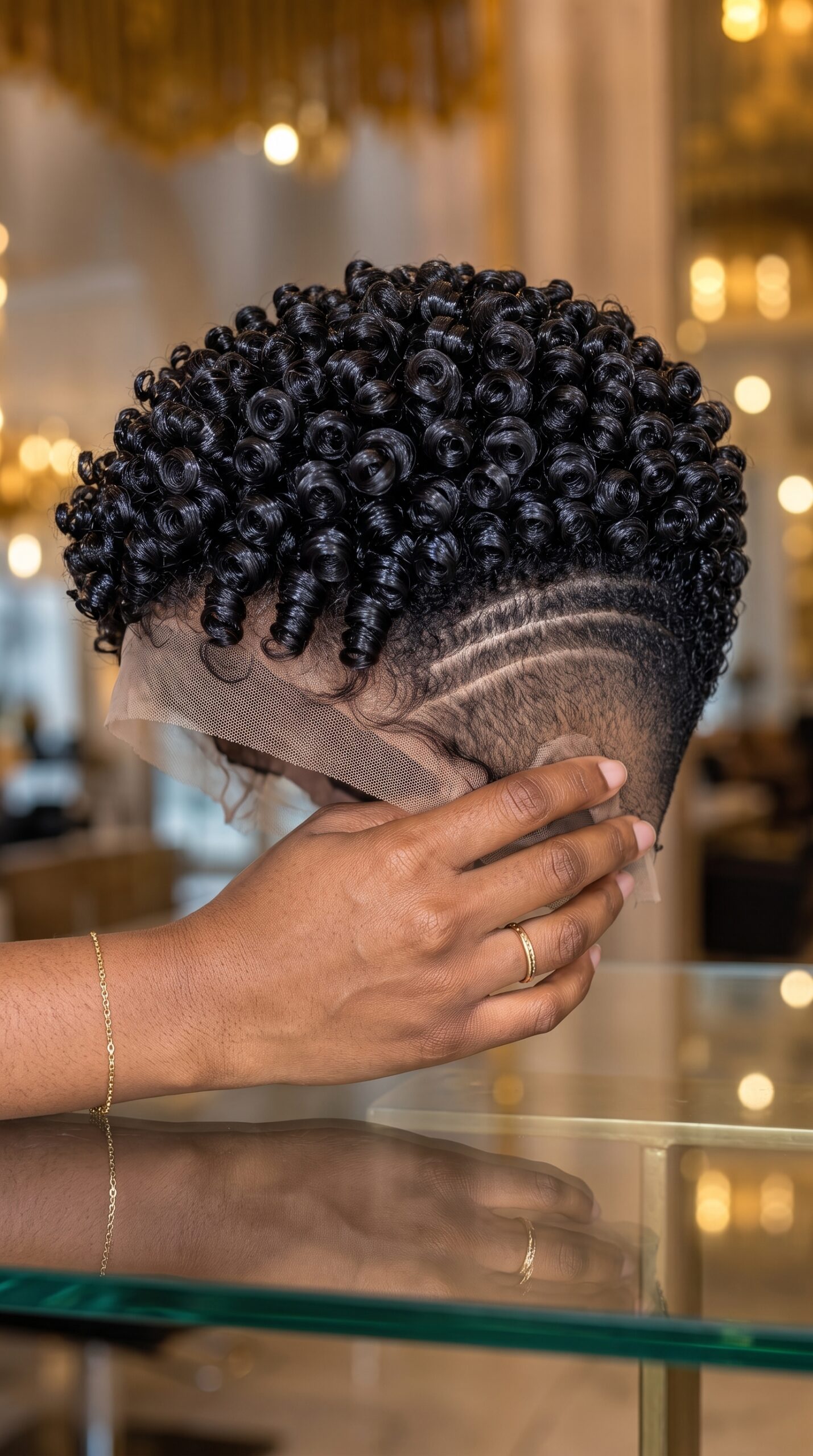
People assume a curl-and-fade unit is judged on the curls, but the join between them is what makes or breaks it. On this black unit, tight spiral curls sit up top and blend down into a shaved, faded side, and the whole barbered look depends on how cleanly those two very different textures meet. Get that transition right and it reads like a fresh barber cut; get it wrong and the curls sit on the fade like a lid, obviously separate. So the thing to judge here is not just how defined the spirals are or how smooth the fade is on its own, but how well the one flows into the other.
This matters because the top and the sides are opposite textures doing opposite jobs. The spirals are full, defined, and raised; the fade is short, flat, and graduated down to skin. Where they meet, there has to be a gradual blend, curls easing shorter into the fade rather than stopping in a hard line above it. A good unit tapers that boundary so the eye reads one continuous cut; a poor one leaves a visible shelf where the curls end and the fade begins, which instantly looks like a wig placed over a shaved side rather than hair cut into shape.
So when you judge a curl-to-fade unit, look straight at the transition zone. Does the curl length step down gradually into the fade, or drop off suddenly? Does the carved line, if there is one, sit cleanly within a smooth gradient? Is the perimeter texture blended so the shaved part looks like your own faded hair? The curls and the fade can each be excellent on their own and still fail if the join between them is abrupt, because on a barbered short style, the transition is the cut.
Where To Buy A Curl-And-Fade Pixie Wig
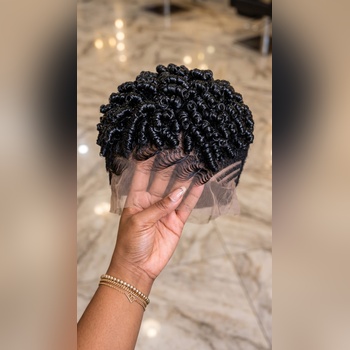
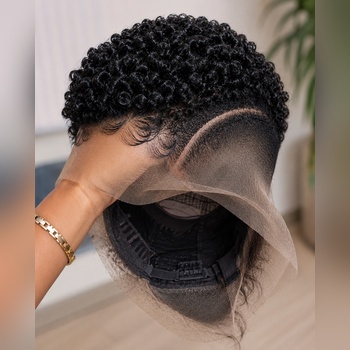
Custom makers who cut and fade in-house can blend the curl into the fade properly, so ask to see the transition zone up close, not just the top or the side alone. A maker who understands barbered units will show a smooth join; one who does not may leave a hard shelf where the textures meet.
Instagram and TikTok sellers show the finished barbered look, so ask for close video of where the curls meet the fade and how gradual it is. A curl-and-fade pixie wig lives or dies on that join, so the close-up of the transition matters more than the overall shot.
Etsy works with makers who show the fade and blend, with buyer photos. The risk is a unit sold on its curls with an abrupt join hidden in a distant photo. Read reviews for how clean the fade and transition looked worn.
Marketplaces like Amazon, AliExpress, and Temu carry curl-and-fade units, but the blend quality varies a lot, and a harsh join is very visible on a barbered style. Scrutinise the transition zone in close photos. A cheap unit often has curls stopping in a hard line above the fade.
Local beauty supply shops and salons let you see the transition in person and judge whether it flows, and a barber can even refine the blend. You pay a premium in-store, but a barbered unit is exactly where seeing the join up close pays off.
Vendors and wholesalers direct ship standard cuts of varying blend quality, so judge the transition. For a barbered look, the join matters as much as the curl or the fade.
Regionally, clean curl-and-fade work comes strongly out of Lagos, Accra, Atlanta, London, and across South Africa, where barbered short units are common and the blend is easy to see on video.
Vet the seller the usual way: check the account age, look for real buyer photos, time a plain question for a genuine reply, and ask for close images of where the curls meet the fade. A seller who shows the transition clearly understands what makes a barbered unit work.
Red flags: curls stopping in a hard line above the fade, an abrupt shelf between the textures, a fade shown only from a flattering angle, and no close view of the join.
When you order, send your measurements and ask for the curls to blend gradually into the fade, and to see the transition close up. That points the maker at the join that makes the barbered look read.
Contact / order inquiries: WhatsApp [WhatsApp: +XX XXX XXX XX XX].
How Much It Costs
A curl-and-fade unit involves both a set curl and a barbered fade, two kinds of work, so it can cost a little more than a plain curl, and the value is in the blend.
Tiered pricing. Human hair, full build with a spiral curl blended into a clean fade, glueless with a fine lace, in black: roughly $180 to $400, with the barbering and blend being real work. Human hair, mid build: about $140 to $300. Human hair, basic cap: around $70 to $170. Good synthetic that holds a curl and a defined fade: $60 to $140. Basic synthetic: $25 to $60.
What that includes and excludes. The price covers the unit, the curl, and the fade. It excludes shipping, any customs, and the products to keep the curl set and the edges laid, which sit on top.
Shipping and duty. These sit outside the price and change with where you live, so plan a realistic band and confirm your own country’s import rate.
Ongoing costs. The spiral curl needs re-setting as it relaxes, and the faded perimeter and any carved line need the edges kept clean to hold the barbered look. So the upkeep is a mix of curl maintenance and edge upkeep, more than a plain style but manageable.
First-year total. A curl-and-fade human unit plus shipping plus any customs plus upkeep tends to land between a low three-figure sum and roughly double the sticker, with the set and the edges being the running effort.
Cost per wear. A clean barbered unit that reads like a real cut gets worn with confidence, spreading its cost well. A unit with a harsh join reads as a wig and gets worn less, which is the poorer value.
What a very low price signals. A cheap curl-and-fade often has an abrupt join and a rough fade, both very visible on a barbered style. Judge the transition and the fade, since cheap work shows exactly there.
Deposit structure. For custom work, thirty to fifty percent down with the balance before shipping is standard. Use a method you can dispute, and ask for a close photo of the transition before releasing the last part.
Shipping, Delivery, And What To Expect After Ordering
A curl-and-fade unit arrives with its curl set and fade cut, so what you unbox is essentially the barbered look, and the join is there to judge on arrival. Ask that it ship so the curl is not crushed, choose a tracked service, and confirm your country’s import charge before it lands. When it arrives, look closely at where the curls meet the fade in daylight, and set up the curl and lay the edges to see the whole cut come together. What you unbox is a barbered style whose transition is its make-or-break feature.
The Transition Is The Cut
On a barbered short unit, the blend between the curl and the fade is not a detail, it is the cut itself, because that is what makes two textures read as one continuous style. A smooth, tapered join looks like a barber shaped the hair; a hard line looks like a wig on a shaved side. So the transition carries the whole barbered illusion, which is why it deserves more attention than either the curl or the fade alone.
Both Textures Must Be Good, And Blended
A great curl over a rough fade fails, and a clean fade under a poor curl fails too, so both textures have to be good and, crucially, blended into each other. It is the combination that reads as barbered, not either part in isolation. So judge the curl, the fade, and the join between them together, since a weakness in any one shows on a style this exposed.
Edges And Carved Lines Sit Within The Blend
If there is a carved line or laid edges, they have to sit cleanly within the fade and the transition, not fight them, so the whole perimeter reads as one intentional cut. A carved line across a smooth fade looks sharp; the same line across a patchy blend looks messy. So the edges and any design are part of the transition, and they only work when the blend beneath them is clean.
Before You Pay
- Do the curls blend gradually into the fade, or stop in a hard line?
- Have I seen the transition zone close up, not just the top or side?
- Are both the curl and the fade good, and blended into each other?
- Does any carved line or edge sit cleanly within the fade?
- Am I judging the join, since that is what makes it look barbered?
Trimming The Lace
The lace comes off the front the usual way, and on a curl-and-fade unit the front blends into the faded perimeter, so cut to preserve the transition and the edges rather than flattening them. Trim in small offset steps and leave a shallow margin rather than cutting flush, in daylight. If this is your first barbered unit, let a stylist or barber make the first pass and refine the blend, since the transition is what makes the cut and takes a skilled hand.
Search Terms
curl and fade pixie wig · spiral curl fade short wig · barbered pixie unit · black curl taper short wig · faded perimeter pixie lace · carved fade curl pixie wig · short spiral fade wig · tapered curl pixie wig
Final Thoughts
This unit pairs tight spiral curls with a shaved fade, and the feature that decides whether it looks barbered or looks like a wig is the join between them. Two opposite textures, full raised curls and short graduated fade, have to blend gradually into one another, so the curls ease down into the fade rather than stopping in a hard line above it. Done well, it reads as a fresh barber cut; done poorly, the curls sit on the fade like a lid.
Buy it by looking straight at the transition zone: judge whether the curl length steps down smoothly into the fade, whether both textures are good, and whether any carved line sits cleanly within the blend. The curls and the fade can each be excellent and still fail if the join is abrupt, because on a barbered short style, the transition is the cut. Judge the blend, and you judge the unit.