
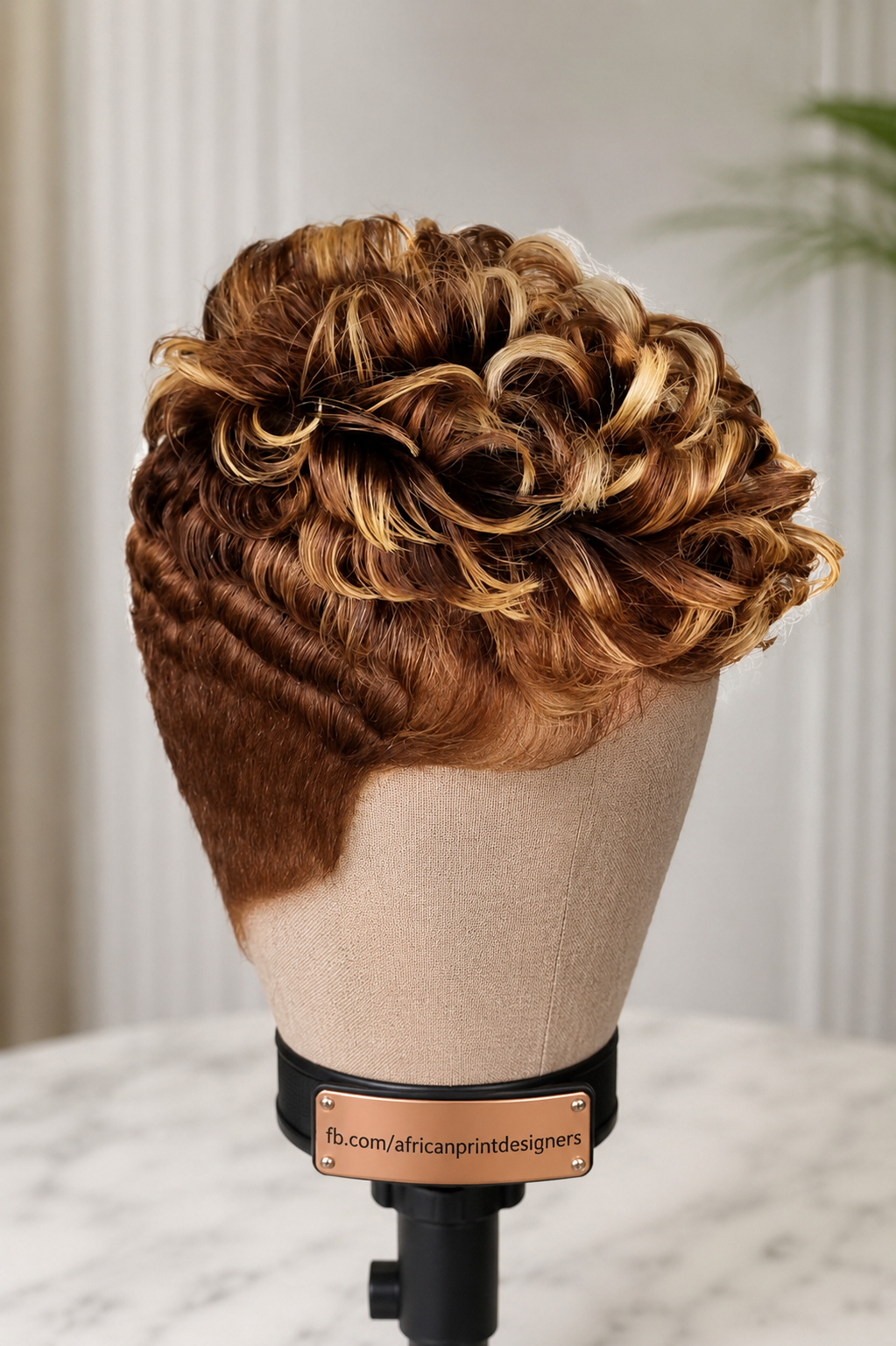
If the colour change and the texture change land at the same line, every flaw doubles.
This auburn and blonde curly pixie wig carries three tones at once: a dark auburn base through the pressed sides and nape, a lighter warm brown through the mid-section, and blonde highlights woven into the loose barrel curls on top. The back view shows where all three meet — curled hair turning into pressed hair, light tones turning into dark, and a boundary that has to handle both shifts simultaneously without looking like a seam.
Where To Buy An Auburn And Blonde Curly Pixie Wig
Multi-tone short units are a colour specialist’s build, and the back is where they succeed or fail.
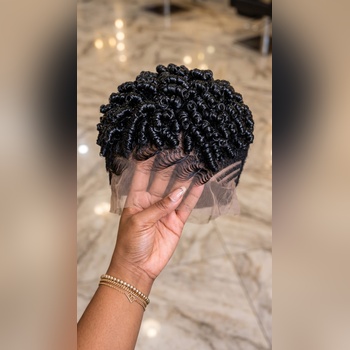
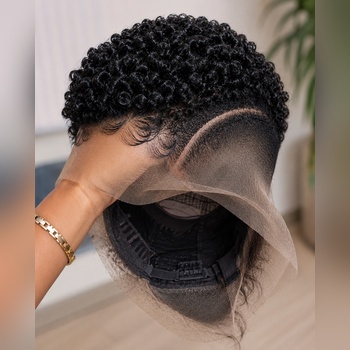
Custom makers and lace studios. The route for controlled multi-tone work. One or two people working to order over WhatsApp or direct message, four to six weeks, deposit up front. Worth it because three tones meeting at a texture boundary need a colour plan, not guesswork, and a maker building to order can map where each shade sits before knotting.
Instagram and TikTok sellers. The widest choice. Search the terms below plus your city, and ask specifically for a back view, since multi-tone is judged at the transition and front shots hide it. A maker who shows the back of a three-tone piece is confident the boundary is clean.
Etsy. Workable for made-to-order, usually shows the front. Request a back photo and read buyer images, which more often show the transition honestly.
Marketplaces such as Amazon, AliExpress and Temu. Synthetic multi-tone pieces exist cheaply and hold their colour permanently, which is a genuine advantage on a three-shade build, since fading affects each tone differently. The colour will not shift, though the transition will be less refined than on hand-placed human hair.
Local beauty supply shops and salons. Useful for seeing the transition under normal light and from every angle before paying. Prices run about a third above online. Some salons order custom and handle the colour map.
Vendor or wholesale direct. Minimums of five to ten identical units, relevant only for resale.
Regional note. Independent makers of multi-tone short units are concentrated in Nigeria, Ghana, South Africa, the United States and the United Kingdom, with the busiest Instagram communities in Lagos, Accra, Atlanta and London. Ordering internationally adds shipping and duty.
Vetting a seller. Continuous posting history. A back view of the three-tone transition on request. Buyer photographs. A clear answer on how the tones were placed. Returns position in writing.
Red flags. Only ever showing the front of multi-tone pieces. The same image across several shops. No answer on colour placement. A price well under the ranges below for multi-tone human hair. Payment only by irreversible transfer.
What to send when you enquire. A reference photograph, your head circumference, your crown-to-nape measurement, and your deadline. Ask for a back view showing the transition.
Paying safely. Thirty to fifty percent deposit, balance before shipping. Insist on the back photograph before releasing the balance, since it is the view that shows whether the three tones blend.
Contact / Order Inquiries: WhatsApp is where most independent makers take orders. [WhatsApp: +XX XXX XXX XX XX] — ask for a back view and how the three tones were placed.
Why Three Tones Fail At The Back
Two tones meeting at a texture boundary is one problem. Three tones meeting there is two problems layered on one line.
A colour transition has to be gradual to look grown. A texture transition has to be clean to look cut. When both happen at the same place, a messy colour boundary blurs the texture line and a messy texture boundary chops the colour gradient. Each flaw amplifies the other.
On this piece the pressed auburn nape flows up into lighter curled hair carrying blonde highlights. If the auburn stops too abruptly, you see a stripe. If the pressed hair turns curly too suddenly, you see a seam. And if both happen at the same height, you see a line across the back of the head that announces the wig from across a room.
A well-built version eases both: the colour shifts gradually through the mid-section and the texture loosens progressively from flat to wave to curl. Neither change is sudden and neither happens at exactly the same line as the other, which is why staggering the two transitions is a deliberate design choice.
What To Check At The Back
Colour gradient first. Follow the darkest auburn at the nape upward. It should warm and lighten through a mid-tone before the blonde appears in the curls. Two tones with no bridge between them read as a split rather than a gradient.
Texture change second. The pressed section should loosen into a broader wave before the first full curl, rather than going from flat to curled in one row. A staggered transition reads as one style; a sudden one reads as two styles combined.
Stagger between the two. The colour shift and the texture shift should not land at exactly the same height. Slight offset is what makes the boundary look intentional.
The Blonde Through The Curls
The blonde highlights here sit in the curled section, not in the pressed one. That is correct. Blonde in the pressed nape would compete with the auburn and flatten the gradient, while blonde in the curls lifts the top and adds dimension where it is most visible.
Check that the blonde sits on the outer curve of the curls rather than buried inside them, which would mean the colour was applied before setting and landed randomly. Blonde placed on the visible surface is the version that photographs and wears.
The Pressed Nape
The auburn sides and nape are smoothed flat and ridged into shallow finger waves, tapering to a point at the back.
Judge the ridges on even depth and direction, and check they flow into the transition rather than stopping abruptly where the curls begin.
Pressed sections are set and product-held. The wave pattern washes out; the colour and knotting beneath are what last.
How Much It Costs
Three tones and a texture transition are the most labour-intensive colour build on a short unit.
The unit itself
Human hair auburn and blonde curly pixie wig, three tones, pressed wave nape, barrel curl crown, sheer lace, glueless: $300–$620
The same curly pixie wig in two tones rather than three: $260–$540
Human hair pixie wig, single auburn, same construction: $220–$460
Quality synthetic multi-tone curly pixie wig: $90–$190
Basic synthetic short wig: $30–$70
Three tones cost more than two because each shade is a separate process and the transitions between them are the slowest part.
What is usually included, and what is not
Included in most quotes: cap, hair, standard knotting, standard lace.
Charged separately by many makers: a third tone over two ($30–$60), HD or fine lace over standard ($20–$50), bleached knots across the full lace ($15–$40), a colour-depositing conditioner ($15–$30), pre-trimmed lace ($25–$50), rush build ($40–$100).
Ask how many tones are inside the quoted figure. A quote for two may need adjusting for three.
Shipping and duty
Tracked international shipping on a single short unit generally runs $25–$60. Import charges vary by country on declared value; allow ten to thirty percent of the item price and check your own rates.
The costs that come after
Canvas block and stand: $25–$60 once
Satin cover: $5–$15
Purple toning treatment for the blonde sections: $25–$50 per year
Colour-safe wash products: $30–$50 per year
Professional first lace trim: $30–$80 once
Professional reset of the barrel curls: $40–$90 per visit, two to four times a year
Professional colour refresh when tones drift: $60–$130, likely once a year
First year, all in
A mid-range human hair version at $400, plus $45 shipping, plus roughly $65 duty, plus $50 of storage kit, plus $70 in toning and wash products, plus one $50 trim, two $60 resets and one $90 colour refresh, comes to around $890 across twelve months.
The synthetic equivalent at $140, with no toning or resets, comes to around $200, and holds all three tones without any of the drift.
Cost per wear
Worn three times a week over a year, the human hair piece lands near $5.70 per wear. The synthetic sits near $1.30 per wear and keeps its three tones without maintenance.
What an unusually low price means
Three-tone human hair with a pressed nape and barrel curl top is hard to produce under about $160. Below that the colour is likely printed or sprayed rather than processed, the pressed nape is a wefted back, or the piece is a fibre blend.
Deposit structure
Thirty to fifty percent up front, balance before shipping. The back photograph, showing all three tones and the transition, is the single most important pre-payment image on a build like this.
Before You Pay
Can you send a back view showing where all three tones meet?
Is the colour shift gradual through a mid-tone, or a two-step split?
Does the texture change stagger from the colour change?
Is the blonde placed on the outer curve of the curls or inside them?
Do the pressed nape ridges flow into the curled section?
Trimming The Lace
Work along your own hairline at the front with short angled cuts, leaving a margin rather than trimming flush.
On a multi-tone piece check which colour sits at the lace before cutting. Where lighter hair meets the lace, a cut that is too deep exposes knots under pale strands, which shows more than the same cut under auburn.
Have the first cut done by someone experienced, with the piece on a block.
Search Terms
auburn and blonde pixie wig · three tone curly pixie wig human hair · pressed wave nape pixie wig · multi tone short wig · auburn pixie wig with blonde highlights · barrel curl pixie wig · three colour pixie wig where to buy
Final Thoughts
Two tones on a short unit are one boundary to manage. Three tones are two, and on this build both land where the texture also changes, which stacks every imperfection.
Ask for the back view before anything else. The front shows curls and colour. The back shows whether those curls and that colour were built to meet cleanly, which is the entire question on a three-tone piece.