
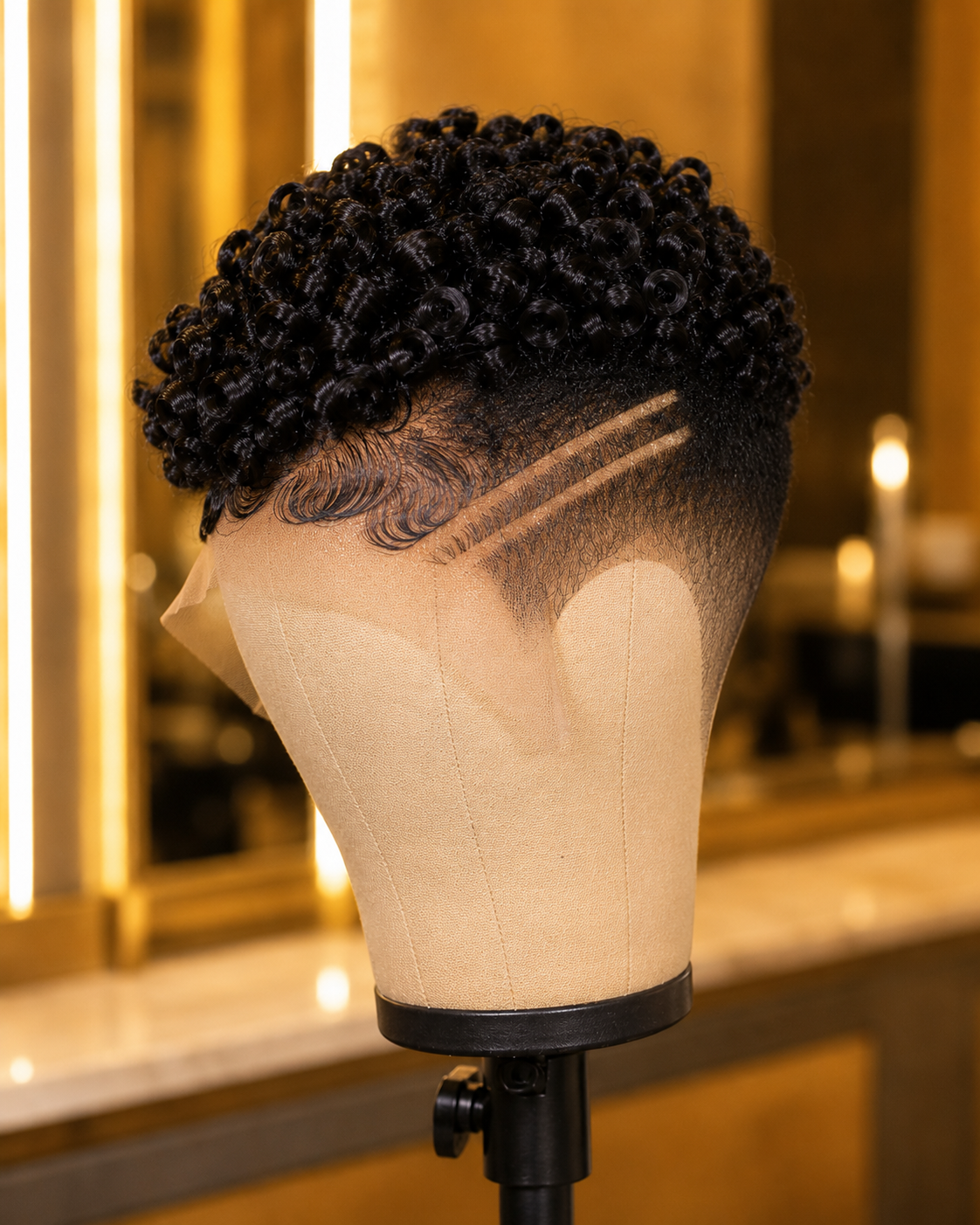
Presented on a canvas display block under warm salon lighting, this wig gives a very useful view of how the style is built. The top is filled with glossy jet-black finger coils arranged into a rounded cropped crown. Along the front perimeter, the hairline has been worked into layered finger-wave baby hairs. At the right temple, two parallel shaved-style lines cut across a closely tapered side. The lace remains untrimmed and visible on both sides, which makes the piece easier to judge before installation.
What immediately separates this unit from a basic short curly wig is the relationship between the three main elements: the compact coiled crown, the waved front edge, and the double-line side design. None of them would carry the style alone. The coils create the volume. The perimeter gives the front a finished look. The side pattern adds the barber-inspired character. Put together, they push the piece much closer to the appearance of a shaped haircut rather than a generic short wig.
The display angle is also useful because it shows how disciplined the silhouette is. The crown sits high enough to feel full, but not so high that the piece starts to look oversized. The side has been taken down close to the head, helping the line work remain visible. On short wigs, proportion is everything. A slightly bulky side or a hairline that is too heavy can weaken the entire result.
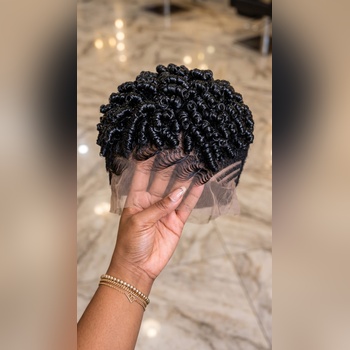
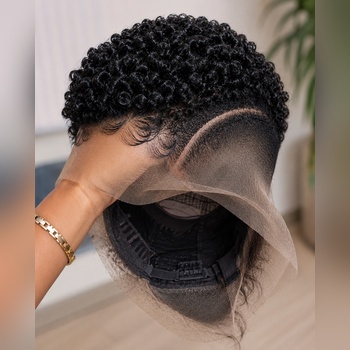
Where To Buy A Wig Like This
A wig like this is usually best sourced from custom wig makers, lace specialists, and short-style wig sellers who already have experience with barber-inspired pixie units. The reason is simple: you are not only buying a short curly wig. You are buying a short curly wig with a shaped perimeter, a visible temple design, and a controlled crown profile.
Instagram and TikTok are two of the strongest places to start because many wig specialists use video to show how a piece behaves from multiple angles. That matters with a wig like this. A front-only photo is not enough. You want to see whether the double temple lines stay balanced from the side, whether the hairline sits lightly, and whether the crown keeps its shape when touched.
Etsy can also be useful when the seller clearly offers made-to-order customisation. If you use Etsy, look carefully at buyer photos and written feedback. A polished sample image can sometimes hide the fact that the shipped piece is far more basic. For a short pixie, the differences show quickly.
Search with specific terms instead of broad ones. Helpful phrases include:
- “finger coil pixie wig with double side lines”
- “short lace pixie wig with temple design”
- “jet black coily pixie wig human hair”
- “curly pixie wig with sculpted baby hairs”
- “custom short wig with shaved line design”
- “HD lace finger coil pixie with tapered sides”
The more specific your search language, the more likely you are to find sellers who actually work in this niche rather than sellers offering a one-size-fits-all pixie.
Contact / Order Inquiries
Independent makers often move serious order conversations to WhatsApp once the initial contact has been made.
[WhatsApp: +XX XXX XXX XX XX]
A practical message would be:
“Can you recreate this exact short pixie with the rounded finger-coil top, layered wave hairline, double temple lines, tapered side, and lace front?”
That wording matters because it identifies the features that make the piece special. If you only ask for a “curly pixie wig,” a seller may assume you want a general short curly unit and ignore the double-line temple detail or the front wave work.
Before paying, ask the maker to send:
- a close-up of the front hairline
- a true side profile
- a back view
- a short video of the crown
- a lace close-up in neutral light
- an interior cap photo
- cap sizing details
- production time estimates
It is also smart to ask whether the exact photographed styling arrives ready to wear or whether the buyer will need to refine the perimeter and coils after delivery.
How Much It Costs
Although the wig is black and does not involve elaborate colouring, it still sits above entry-level pricing because the labour is concentrated in the styling and structure. The finger coils, the waved front edge, the side taper, and the double temple lines all add time and skill.
Typical price ranges may look like this:
- 100% human hair, lace front, compact finger-coil crown, shaped front waves, double temple lines, tapered sides, and custom finishing: $220–$450
- 100% human hair with a similar coiled top but a simpler front edge and no double-line side detail: $150–$320
- Human-hair short curly wig with a standard hairline and basic pixie outline: $85–$210
- Higher-quality synthetic with a comparable shape and side design: $65–$150
- Basic synthetic short curly pixie: $20–$60
The main reason for the price gap is handwork. The maker is not just supplying short hair. They are shaping the silhouette, placing the shorter side area carefully, building a believable front edge, and arranging the two temple lines so they read clearly without looking harsh.
If the wig is human hair, also ask whether the curls are created by setting, finger coiling, rods, or texture processing. That affects both price and maintenance.
Shipping, Delivery, And What To Expect After Ordering
For a style like this, a made-to-order timeline is more realistic than instant shipping unless the seller is offering the exact sample piece. Short custom wigs often require more hand-finishing than buyers expect.
A common production window is two to four weeks, though it can be longer if the seller is working through a busy queue or customising the cap size. Ask whether that timing includes final styling or only construction.
Before sending payment, confirm:
- whether the wig is made after the order is placed
- whether tracked shipping is included
- whether the lace arrives untrimmed
- whether customs charges may apply
- whether returns are accepted on custom units
- whether a final approval video is available
- how the wig is packed to protect the crown shape
Because the lace is untrimmed in the image, assume that the final lace cut will be your responsibility or your stylist’s responsibility unless the seller says otherwise.
The Coiled Crown
The crown is the visual anchor of the wig. The coils are small, glossy, and tightly arranged, creating a compact rounded top. They are not loose enough to read as open curls, and they are not so tiny that the crown looks fuzzy. That balance is important because it helps the wig resemble a cropped salon finish rather than a loose curly cap.
When assessing this area, ask:
- Will the coils return after washing?
- Are they created from the natural texture of the hair or styled into place?
- How much separation is expected during wear?
- What products are recommended to refresh them?
- Can the buyer re-coil sections at home?
With short styles, the top shape has very little room to hide inconsistency. If the coils collapse, expand too far, or separate badly, the silhouette changes quickly.
The Layered Front Perimeter
The front edge has been styled into a row of waved baby hairs that move across the forehead area and into the temple. That detail plays an important role because short wigs expose the hairline much more than longer ones do. There is no fringe or longer front section to disguise a weak lace edge.
A strong perimeter should show:
- a lighter transition at the very front
- wave placement that feels deliberate
- continuity from front to side
- softness at the edge without looking heavy
- enough structure to frame the crown
Ask the maker whether these waves are pre-styled before shipping and what product they use to re-shape them later. Beautiful perimeter work is only valuable if the wearer can maintain it.
The Double Temple Lines
The right side carries two parallel lines that sweep backward through the tapered temple. This is one of the most striking features of the piece. Using two lines instead of one gives the side extra movement, but it also increases the need for accuracy. Both lines must stay even, their spacing must remain balanced, and the surrounding density must be low enough for them to stay visible.
Important questions to ask:
- Can you replicate the same double-line layout?
- How are the lines created?
- Can I see past examples of similar side work?
- Will the pattern remain visible once the wig is worn?
- Can you provide an opposite-side and rear-angle reference?
Temple designs can look strong in one studio angle and much less convincing from another. Always request more than one view.
The Tapered Side And Overall Silhouette
The side beneath the lines appears closely tapered, which is exactly what helps the wig read as a barbered pixie. A common weakness in short wigs is excess bulk around the side and lower back. When that happens, the piece loses its haircut illusion and begins to look like a rounded cap of curls.
A good taper on a wig depends on both hair length and density control. It is not enough for the fibres to be short. They also need to sit flatter and closer to the head. Ask for back and side photos so you can judge whether the whole perimeter carries the same discipline.
The Lace And What This Photo Cannot Prove
The untrimmed lace is clearly visible from the front corners, which is useful for judging placement and working room. It suggests a lace-front build, but the image alone cannot confirm every technical detail.
You still need to ask:
- What exact lace type is used?
- Are the knots bleached?
- Is the hairline pre-plucked?
- What lace shades are available?
- Can the seller show the lace against skin in natural light?
These details matter because a short wig exposes the front and temple area constantly. If the lace is too visible or the knots are too dark, the realism drops quickly.
The Display Block And Why It Helps
Showing the wig on a canvas block rather than on a model removes a layer of distraction. There is no makeup, no face framing, and no styling pose to influence your judgment. That can actually be useful for buying decisions. You can study the crown shape, the lace distribution, the temple design, and the side density with fewer visual distractions.
At the same time, remember what the block does not tell you. It does not show cap comfort, security, or movement on a real head. That is why exterior beauty shots should always be paired with technical questions.
Before You Pay
Before placing an order, send a checklist like this:
- Is the wig human hair, synthetic, or a blend?
- Can you recreate the same compact finger-coil crown?
- Will the curls return after washing?
- Can you reproduce the layered front wave pattern?
- Can you match the double temple lines exactly?
- What lace type and lace tone do you use?
- Are the knots bleached?
- Is the hairline pre-plucked?
- Can I see the cap interior?
- Does the cap include combs, straps, or an elastic band?
- Can the cap be made to my measurements?
- Will the wig arrive fully styled?
- Can you send a final video before shipping?
- What is the return or alteration policy?
A seller who can answer these clearly is usually a safer bet than one who keeps everything vague.
Trimming The Lace And Handling The First Install
Because the lace has not been cut yet, position the wig first and trim later. Use small staggered snips rather than one long straight cut. Leave a slight margin at first; you can always remove more, but you cannot undo an overly deep cut.
Be careful around the front wave area. Separate those hairs before trimming so you do not accidentally cut into the shaped perimeter. If you are new to short lace pixies, a professional first install is often worth the cost. A short style exposes mistakes faster than a long one.
Search Terms
finger coil pixie wig with double lines · short curly pixie wig with lace front · jet black coily pixie wig human hair · custom pixie wig with temple design · short lace wig with sculpted baby hairs · where to buy finger coil pixie wigs · tapered pixie wig with side lines · HD lace curly pixie with barber design
Final Thoughts
The appeal of this piece comes from its balance. The coiled crown provides body, the perimeter adds polish, and the double temple lines supply the strongest visual accent. None of those elements feels random. They are working together to give the wig a compact, salon-finished identity.
It is also a good example of why short wigs need careful buying decisions. With a longer unit, construction problems can sometimes hide inside the extra hair. With a pixie, nearly every choice is visible: the front edge, the side density, the line spacing, the crown shape, and the lace handling.
If you want a unit like this, focus on the full package rather than just the curls. Confirm the front perimeter, the temple design, the lace details, and the cap build before you pay. That is the difference between receiving a true custom-looking pixie and receiving a much more ordinary short wig.