
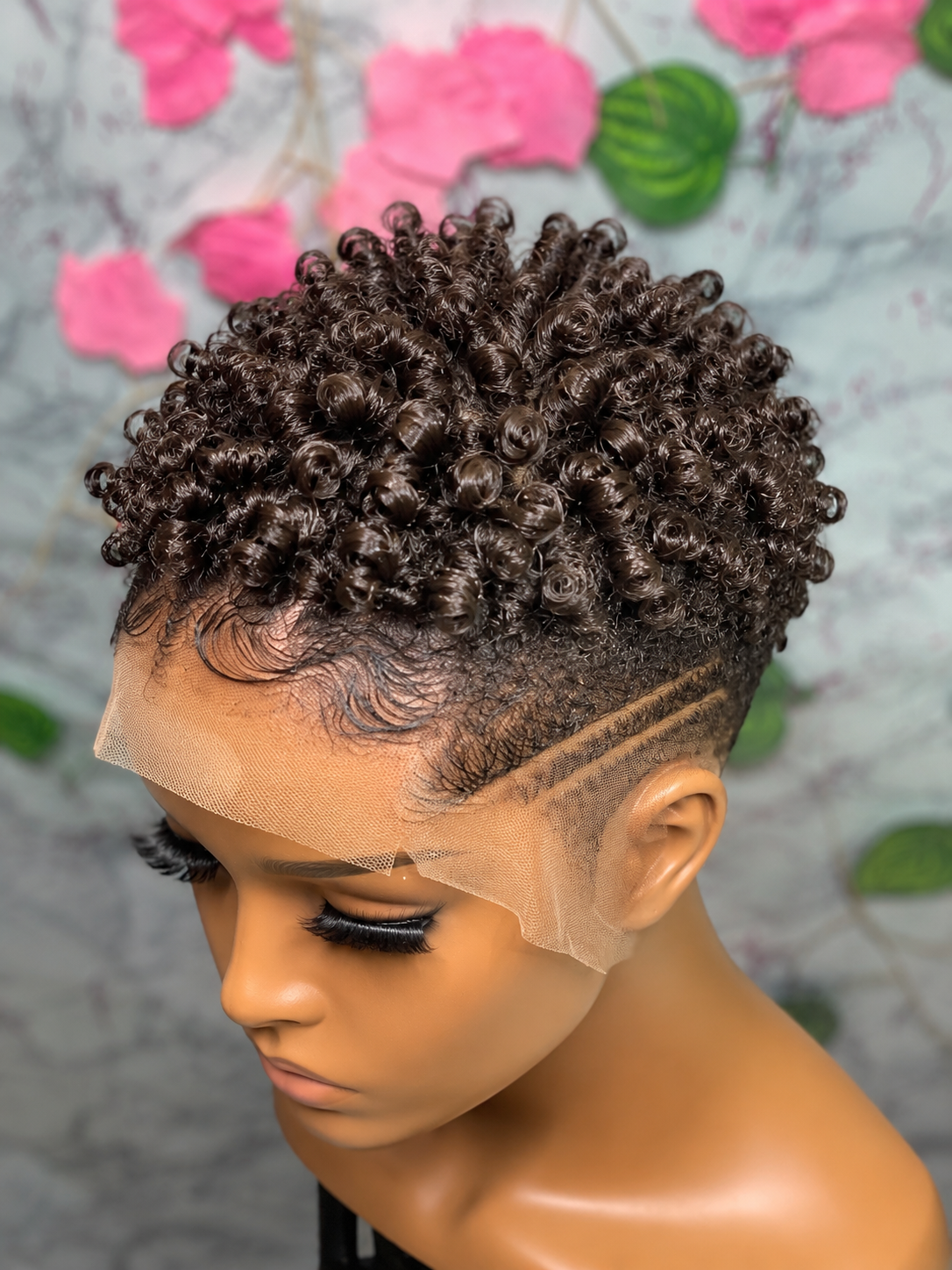
Displayed on a mannequin, lace fanned forward over the face, untrimmed. Espresso brown coils sitting tight and springy across the crown. Molded swirls laid along the front hairline. A carved part cut into the faded side.
Look at where the lace meets the mannequin’s plastic, though. The lace is a pale beige; the mannequin is a warm tan. They do not match, and you can see exactly where one ends and the other begins. On a display head that hardly matters — but it is a preview of the single most common reason a beautiful wig still looks like a wig on a real person.
Where To Buy A Wig Like This
Lace tone is the thing to ask about, and almost nobody does. Most makers stock two or three lace shades at most, and many stock one. If your skin is deeper or lighter than their default, the hairline will sit visibly on top of your skin no matter how good the knotting is.
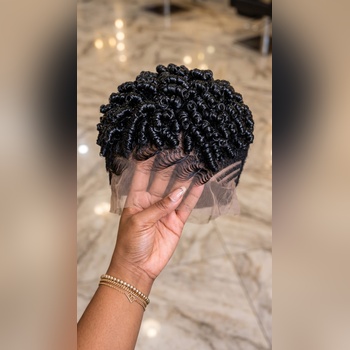
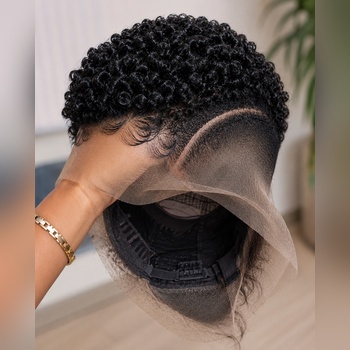
Custom wig makers and lace studios are the main route. Search with construction-specific vocabulary rather than style terms: “brown curly pixie wig human hair,” “HD lace pixie wig custom lace tone,” “espresso curly pixie lace wig,” “molded edge brown pixie wig.” A maker who offers a lace tone choice at all is already ahead of most.
Instagram and TikTok wig specialists are the richest source. Look at their grid for pieces photographed on real people with a range of skin tones, not just on mannequins. A maker who only ever shows units on the same plastic head is not demonstrating anything about how the lace behaves on skin.
Etsy works for made-to-order pieces. Message before ordering and ask which lace tones they carry. Buyer-uploaded photos are especially useful here, because they show the lace against real skin in ordinary light.
Contact / Order Inquiries: WhatsApp is the standard channel for independent makers. [WhatsApp: +XX XXX XXX XX XX] — send this exact photo as a reference and ask directly: “What lace tones do you offer, and can you tint the lace to match my skin before shipping?” That question alone tells you how customised the piece really is.
How Much It Costs
Espresso brown is a moderate lift from black, so the colour premium here is smaller than on copper or blonde.
100% human hair, brown, sheer lace with tone matching, bleached knots, molded edges, carved part, glueless cap: generally $240–$470
The same piece in solid black with identical finishing: typically $200–$430
100% human hair, brown, basic cap, no edge or part work: typically $110–$240
High-quality synthetic in a comparable brown with similar finishing: usually $70–$150
Basic synthetic brown curly pixie: often $25–$60
The arithmetic worth knowing: brown adds roughly $40–$90 over black, well below what copper or blonde costs, because it needs a moderate lift rather than several levels of processing. Custom lace tinting, if a maker offers it, usually adds $15–$40 — a small amount relative to how much it changes the finished result. It is one of the cheapest meaningful upgrades available and one of the least advertised.
Shipping, Delivery, And What To Expect After Ordering
Made-to-order timing. Colouring plus molded edges and a carved part is slow work. Expect two to four weeks rather than a few days, and add time if the lace is being tinted to your tone.
Lace arrives untrimmed, exactly as shown here, hanging well past the hairline over the display head. That excess is your margin to cut along your own hairline rather than a factory’s average.
International shipping is normal with Instagram, TikTok, and Etsy sellers, though delivery windows and customs fees vary by country. Ask about tracked shipping before you pay.
Returns are usually limited on custom pieces. Get the policy in writing.
Cap fit is the most common regret. A mannequin head is a standard size, so the way a unit sits on the display tells you nothing about how it will fit you. Send your head measurement and ask whether they build to it.
Getting The Lace Tone Right
Lace is manufactured in a range of tones — usually described as light, medium, and dark brown, sometimes with a transparent option. The goal is for the mesh to disappear against your scalp, and that only happens when the tone is close to your skin.
What goes wrong when it is not: lace lighter than your skin reads as a pale film at the hairline, particularly in daylight and particularly on camera. Lace darker than your skin reads as a shadow or a grey cast. Either way the eye catches the boundary, which is exactly what the whole lace construction exists to prevent.
The fixes, in order of preference. Best is buying the correct tone from the start — ask before ordering rather than after. Next best is having the maker tint it for you, which some offer as a paid service. Last is tinting it yourself with lace tint spray or a diluted foundation matched to your skin, applied lightly to the underside and built up gradually rather than in one heavy coat. Home tinting works, but it is easy to overdo and impossible to reverse.
One detail worth knowing: bleached knots and correct lace tone do different jobs. Bleached knots stop the individual hair knots reading as dark dots. Lace tone stops the mesh itself reading as a film. A piece can have one and not the other, and both are needed for a hairline that genuinely disappears.
What A Mannequin Photo Shows And Hides
A display shot sits between a held unit and a worn photo, and it is worth knowing which parts to trust.
It does show the silhouette honestly — the volume of the crown, the shape of the fade, where the carved part falls relative to the ear. That is real information about proportion.
It does not show fit. Mannequin heads are a standard circumference and hard plastic, so a cap that would gap at your nape sits perfectly here.
It does not show lace tone against skin, for the reason visible in this photo. Plastic is not skin, and the tan of a display head is not the tone of any particular buyer.
It does not show movement, density under handling, or shedding. Ask for a short video.
The Molded Edges, The Carved Part, And The Fade
The edges here are molded into swirls along the front hairline — shaped individually, controlled in size and spacing, soft rather than lacquered. This is what blends the front into skin once the lace is trimmed. Judge it on uniformity, an even band width, and a continuous run with no gaps.
The honest problem: molded edges will not survive the week. They loosen with wear, washing, humidity, and sleep, and you will be re-laying them. Ask your maker how, and with what products, and be realistic about whether you will do it.
The carved part cut into the side is a single line rather than a pattern, which leaves it exposed — every millimetre is the design, it has to stay even in width, follow the head’s curve smoothly, and there is no un-carving it. Judge it on cleanness and confidence.
The fade beneath is the quiet mark of a careful maker: full coils graduating down through shorter lengths into stubble that dissolves into the lace, every hair hand-knotted at a decreasing length. A bad fade stops in a hard line; a good one melts.
The Coils And Colour Care
The coils are tight, individually defined spirals with real spring. Tight coils show thinness immediately, so density has to be genuinely full for the crown to read right. Each ring should be similar in diameter, glossy without looking lacquered, and cleanly separated. Ask for a short video, because a still cannot tell you whether coils bounce or sag.
Brown needs less maintenance than copper or blonde, but it is still processed hair. Sulfate-free colour-safe products, cool rinses, and minimal heat will keep it from dulling and losing definition. Compared with a lightened piece, this is a comparatively easy colour to live with — which is part of its appeal.
Before You Pay
What lace tones do you offer, and can you tint the lace to match my skin?
Are the knots bleached as well as the lace being tone-matched?
Can you send a photo of this unit on a real person rather than a mannequin?
Can you build the cap to my head measurement rather than a standard size?
How do I re-lay the molded edges, and with what products?
Trimming The Lace
Cut slowly and follow your natural hairline. Leave a small margin instead of going flush, and use small staggered cuts rather than one straight line. If you are tinting the lace, do it before the final trim so you can see the true boundary against your skin as you cut. On a piece with molded edges the lace and the swirls have to work together — the shaped hairs sit on top of the lace and disguise its edge, so a rough trim undoes hours of hand-work. If you are new to lace, pay a stylist for the first cut and copy what they do.
Search Terms
brown curly pixie wig human hair · espresso curly pixie lace wig · HD lace pixie wig custom lace tone · molded edge brown pixie wig · lace tint for wig hairline · where to buy brown curly pixie wigs
Final Thoughts
Study this photo for the gap between the lace and the plastic beneath it. On a display head it is harmless. On your head it is the difference between a hairline that disappears and one that announces itself.
Everything else on this piece is well made — tight defined coils, molded swirls at the front, a clean carved part, a fade that melts into the lace. But none of that work survives a lace tone that does not match your skin, because the eye goes straight to the boundary and stops there.
So ask about lace tones before you ask about anything else, and ask for a photo on real skin rather than plastic. It is the cheapest fix available and the one most buyers discover too late. Decide honestly, then buy accordingly.