
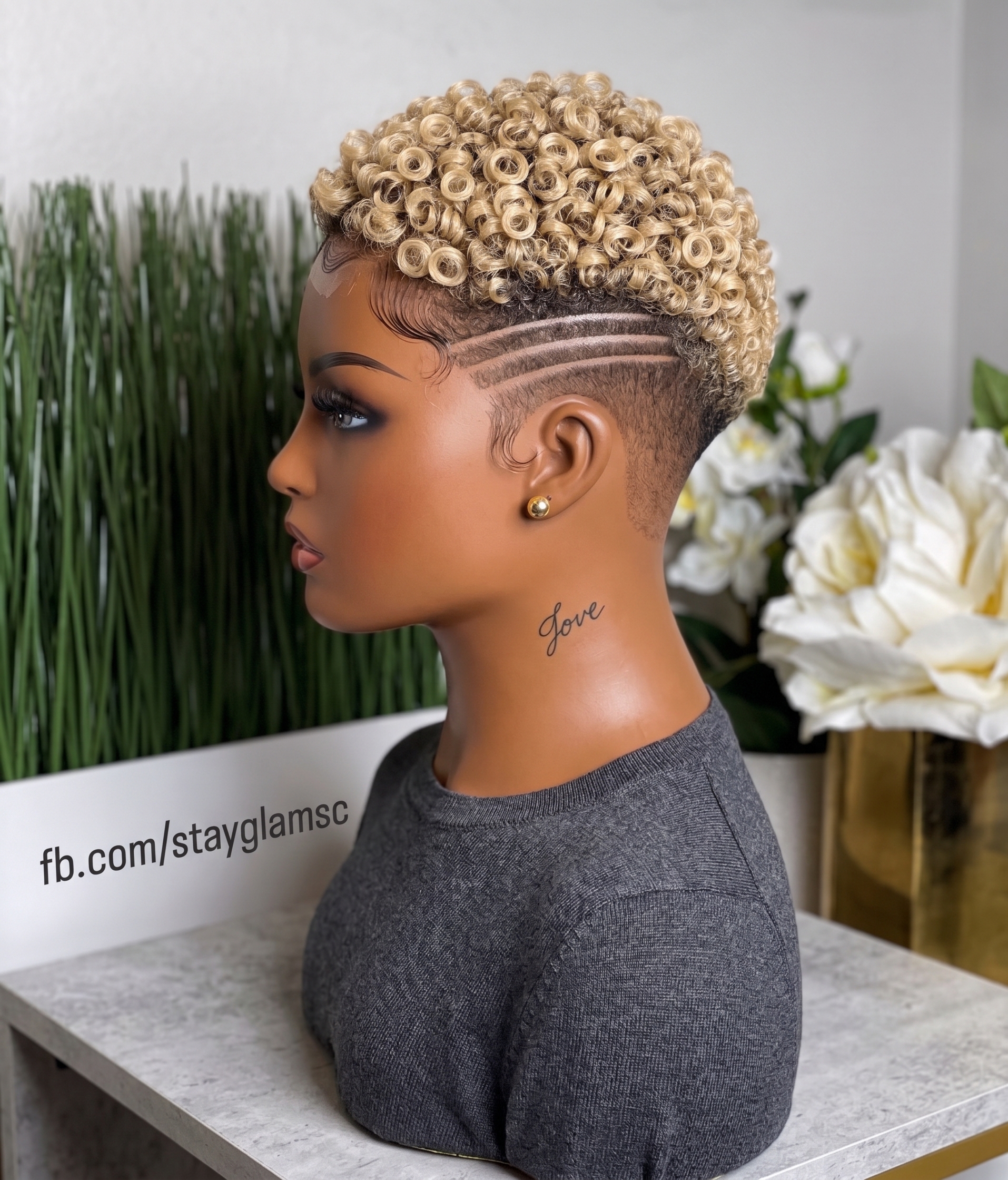
On a mannequin, side profile, honey blonde ringlets stacked high and tight across the crown. Look closely at where the coils meet the lace, though, and the colour is not one flat shade. It darkens noticeably at the root before opening up into the full blonde. Two carved lines run parallel down the side, ending near a small curl detail by the ear.
That darker root is not an accident or a sign of patchy colour. It is a technique — usually called rooting — and it is the single most practical decision a maker can make on a blonde curly piece, because it is what stands between you and a visible demarcation line a few weeks into wearing it.
Where To Buy A Wig Like This
Rooted colour work is what to search for specifically, and it is not the same as just “blonde.” Plenty of makers can lift hair to an even, one-tone blonde. Fewer can blend a natural-looking root shadow into it, which requires controlling two colour zones instead of one and making the transition between them gradual rather than a hard line.
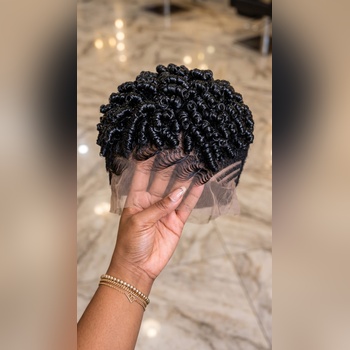
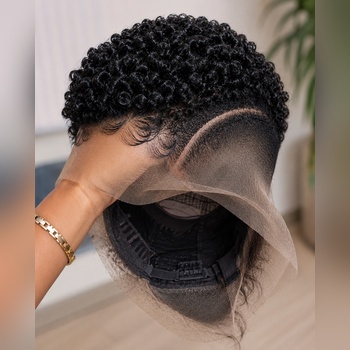
Custom wig makers and lace studios are the main route. Search with technique-specific vocabulary rather than generic terms: “rooted blonde curly pixie wig,” “shadow root curly wig human hair,” “dark root honey blonde pixie,” “HD lace curly pixie with root shadow.” A maker who names rooting specifically, rather than just listing a colour, understands why it matters.
Instagram and TikTok wig specialists are the richest source. Look at their grid for close-up shots of the parting and crown, where a root shadow is easiest to judge. A maker proud of a clean root blend photographs that transition deliberately, often from directly above.
Etsy works for made-to-order pieces. Read buyer-uploaded photos rather than seller staging, and ask specifically whether the colour is rooted or single-process before ordering — listings often show only the overall shade in the title.
Contact / Order Inquiries: WhatsApp is the standard channel for independent makers. [WhatsApp: +XX XXX XXX XX XX] — send this exact photo as a reference and ask directly: “Is this colour rooted, and how far down does the darker section run before it opens into the blonde?” That single question tells you whether the piece was built to age well or just to look good on day one.
How Much It Costs
Rooted blonde requires two colour zones to be controlled rather than one, and that technique adds to the usual blonde premium.
100% human hair, rooted honey blonde, sheer lace, bleached knots, carved parallel lines, glueless cap: generally $300–$580
The same piece in a single-process flat blonde: typically $260–$500
The same piece in solid black with identical finishing: typically $200–$430
High-quality synthetic in a comparable rooted blonde: usually $80–$170
Basic synthetic blonde curly pixie, unrooted: often $25–$65
The arithmetic worth knowing: rooting typically adds $30–$70 over a flat single-process blonde, on top of the usual $70–$140 that blonde already adds over black. It sounds like a small extra cost for a lot of practical benefit — a rooted piece hides new growth and colour settling for far longer than a flat blonde does, which is money saved on touch-ups down the line, not just an aesthetic choice.
Why Rooted Colour Actually Matters
A single-process blonde is one even shade from the base of the hair to the tip, including right at the parting. That looks flawless on day one, but any regrowth, any slight fading, or any unevenness at the root shows up immediately as a visible line, because there is no gradual transition to hide it in.
A rooted piece is built with that problem solved in advance. The colour darkens naturally toward the base, so the boundary between “root” and “rest of the hair” is soft rather than sharp. It mimics how blonde grows out on natural hair, which is exactly why it reads as more realistic even freshly made — and why it stays looking intentional for far longer as the piece ages and gets handled.
What to check: the transition should be gradual, with no hard line between the dark and light sections; the root shade should look like a natural shadow rather than an obviously different colour blocked in; and the darkening should follow the same pattern all across the crown rather than looking heavier in some spots than others.
The Parallel Carved Lines
Two lines run down the side, staying an even distance apart from crown to ear rather than converging or fanning. Parallel lines are the more forgiving version of carved line work — the stylist can use the first line as a spacing guide for the second — but forgiving does not mean easy. Both lines still have to stay identical in width along their full length, follow the same curve through the taper, and end together rather than drifting apart at the tips.
Judge it on matching: the two lines should look like a genuine pair, not a main line with a rough echo beside it. The small curl left near the ear, where the lines end, is a deliberate softening touch that keeps a geometric design from looking too severe against the face.
The Tight Ringlet Coils
The coils are small, tight, and densely packed — true ringlets rather than loose spirals. Tight coils show thinness immediately, so density has to be genuinely full for the crown to read right, and on a lightened piece the ends are where trouble shows first. Judge the coils at the tips, not just at the crown: over-processed hair loses curl definition there before anywhere else, going soft and frizzy while the roots still look fine.
Ask for a short video rather than relying on a still photo, since blonde in particular tends to photograph glossier than it actually moves.
Colour Care For A Rooted Piece
Rooted colour is more forgiving day to day than a flat blonde, but the blonde sections still need real care. Sulfate-free, colour-safe products, a purple or blue toning treatment on a schedule to stop brassiness in the lightened areas, minimal heat, and regular conditioning are all still necessary — rooting reduces how often you need to touch up the colour itself, but it does not reduce how much upkeep the hair fibre needs.
The Lace, The Knots, And The Cap
The lace sits at the crown here rather than being pulled forward, so check the knots specifically at the parting, where a rooted piece puts the most visual pressure on the lace to look like scalp. On a careful unit the knots are bleached regardless of the hair colour above them.
This shot does not show the cap interior, so ask before you buy: is the cap glueless, with combs and an adjustable strap? A glueless cap secures mechanically — no adhesive on your skin, no removers, no slow traction damage to your own edges. But glueless only works if the fit is right. Measure your head with a soft tape — from the front hairline, around above the ears, around the nape, and back to the start. Most caps run 21.5–22.5 inches, but real heads vary, so ask whether the maker builds to your measurement.
Before You Pay
Is this colour rooted, and how far down does the root shadow run before opening into the blonde?
How does a rooted piece compare to flat blonde for touch-up frequency?
Can you carve two matched parallel lines like this, and how do I keep them looking even as the fade grows out?
Are the knots bleached at the parting specifically?
Is the cap glueless — combs and an adjustable strap — and can it be built to my head measurement?
Trimming The Lace
Cut slowly and follow your natural hairline. Leave a small margin instead of going flush, and use small staggered cuts rather than one straight line. On a rooted piece, take extra care not to trim into the darker root section if the lace runs close to it — cutting through a colour transition can leave a visibly uneven edge. If you are new to lace, pay a stylist for the first cut and copy what they do.
Search Terms
rooted blonde curly pixie wig · shadow root curly wig human hair · dark root honey blonde pixie wig · parallel line design curly pixie · HD lace curly pixie with root shadow · where to buy rooted blonde curly pixie wigs
Final Thoughts
Study this piece for the root, not just the blonde. A flat single-process blonde looks perfect for a shorter window and then announces every bit of regrowth. A rooted piece costs a little more up front and pays that back in weeks of looking intentional that a flat blonde simply cannot match.
Everything else here is solid supporting work — a well-matched pair of parallel lines, dense tight ringlets, a soft curl detail by the ear. But the root technique is the decision that determines how this piece looks a month from now, not just today. Ask about it before anything else, and buy accordingly.