
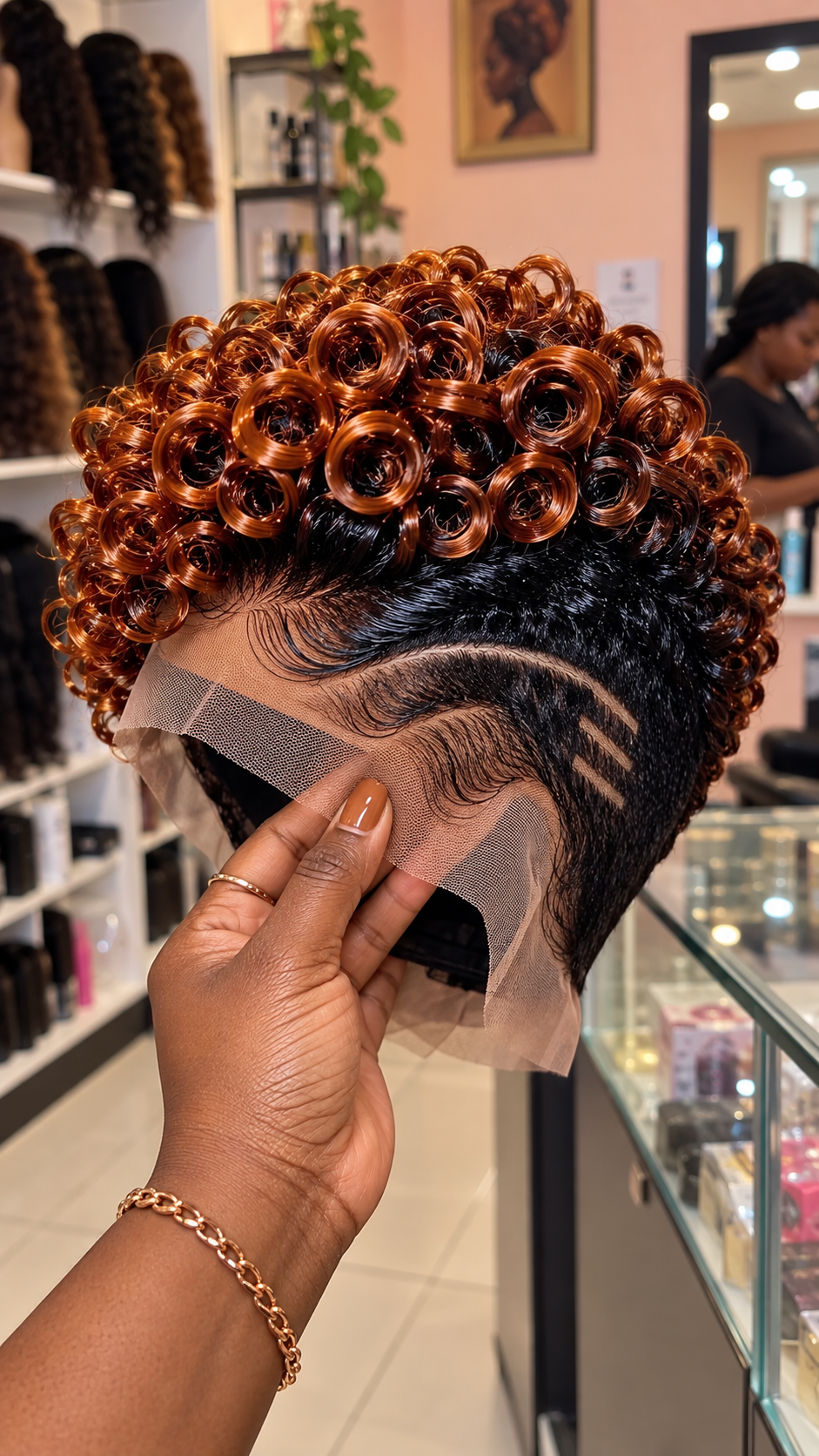
A copper ring curl pixie like the one shown in this image is built around contrast. The crown is packed with glossy circular curls in a bright burnt-copper shade, while the lower side area remains deep black. Between those two zones, the hair is arranged into sweeping black sections that visually connect the crown to the sculpted side. The combination gives the wig a completely different personality from an ordinary curled pixie: the color is concentrated where it attracts the most attention, while the darker foundation makes every copper ring stand out individually.
The side profile deserves just as much attention as the curls. A broad curved separation line travels above the ear area, followed by three smaller diagonal marks toward the back. Large finger-wave shapes frame the temple and front perimeter, creating movement below the tightly packed crown. The visible lace extends beyond the hairline in the photograph, showing that the piece has not yet been fully fitted or trimmed. Because the image does not establish a specific commercial lace grade, buyers should confirm the exact lace material with the seller instead of assuming that it is HD lace.
For anyone trying to purchase or commission this look, simply searching for a copper pixie may produce very different results. The recognizable identity comes from the copper ring curl crown, black foundation, sweeping temple waves, curved side separation and three-line accent. Those details should be communicated individually when contacting a wig maker.
Why the Crown Is the Main Attraction
The crown is composed of numerous circular curls that resemble polished rings. They are not loose spirals hanging away from the head. Instead, each curl is arranged close to the surface and positioned beside neighboring rings, creating a dense rounded canopy. Several curl sizes are visible, which prevents the crown from looking mechanically uniform.
The larger rings attract the eye first because their hollow centers remain clearly visible. Smaller curls occupy spaces around them and help maintain coverage. This balance is important when recreating the wig. Making every curl identical can produce an artificial grid-like appearance, while curls that vary too dramatically may destroy the compact silhouette.
The copper tone also changes according to the direction of the strands. Areas facing the light appear fiery and reflective, whereas the interior of each ring becomes deeper reddish copper. This natural light-and-shadow effect is one reason the curl construction works particularly well with a warm metallic-looking color.
A Two-Zone Color Strategy Instead of All-Over Copper
Although copper dominates the crown, this is not simply an all-copper hairstyle. Black remains highly visible underneath. The darker area creates a visual foundation around the temple, side and lower perimeter, while copper occupies the elevated curl zone.
This placement can be useful for buyers who want a vivid color without covering the entire wig in one bright shade. The black sections anchor the design and create a stronger border around the copper curls. They also make the wave work along the temple easier to see.
When discussing the color with a stylist, photographs are more reliable than shade names alone. Words such as copper, ginger, auburn and cinnamon can describe very different colors depending on the seller. In this image, the upper curls lean toward a bright burnt copper with reddish warmth rather than pale golden blonde. Ask to see the actual fiber or hair color before production whenever possible.
The Side Artwork Changes the Entire Profile
The right side of the wig contains a bold curved separation that follows the contour above the ear. Beneath and behind it are three narrow diagonal line accents. Their placement creates the impression of custom barber work while remaining integrated into the wig construction.
The main curved line is especially important because it separates the upper wave area from the lower dark section. Rather than running perfectly straight, it follows the head shape. That curve makes the design feel connected to the silhouette instead of looking like a line added afterward.
The three smaller marks provide a second layer of detail. They are compact and positioned toward the rear side rather than stretching across the entire wig. If you want this exact visual language, tell the wig maker that the side should include one long curved separation plus three smaller diagonal accents. A generic request for “lines on the side” leaves too much room for interpretation.
Temple Waves Add a Softer Counterpoint
The ring curls and side lines are strong geometric elements, but the hair around the temple moves differently. Here, black strands are laid into broad curved waves that sweep toward the face and ear. These waves soften the transition between the circular crown and the carved-looking side design.
The front wave extends across the lace area in a deliberate curved pattern. Another pronounced wave appears around the temple. Because these sections sit close to the perimeter, their placement will strongly influence the finished appearance once the wig is fitted.
If ordering a custom piece, discuss whether the stylist will pre-style these waves or leave final positioning to the installer. Pre-styled perimeter work can make the initial appearance easier to reproduce, but installation may still require small adjustments according to the wearer’s hairline and head shape.
What the Visible Lace Tells a Buyer
The photograph provides an unusually useful view because the wig is being held before installation. Lace is clearly visible around the front and side perimeter. This gives potential buyers an opportunity to examine where the hair begins and how the sculpted side relates to the lace edge.
What cannot be confirmed from the photograph is the manufacturer’s technical name for that lace. Therefore, descriptions such as HD lace, Swiss lace or a particular lace dimension should only be used after verification from the seller. The safest purchasing approach is to ask for the exact specification in writing.
Also ask whether the lace arrives uncut, partially trimmed or ready for installation. Buyers who are unfamiliar with lace customization may prefer professional fitting rather than attempting to cut around such detailed temple work themselves.
Finding a Stylist Who Can Actually Reproduce the Design
This wig requires more than basic curling ability. The stylist must be comfortable building structured ring curls, laying sculpted waves and planning side-line placement. Search portfolios for examples of pixie wigs with molded curls, finger-wave work and decorative side patterns.
Useful searches include custom ring curl pixie wig stylist, copper pixie wig maker, sculpted pixie wig salon and finger wave wig specialist. Add your city or region when looking for an appointment nearby.
Do not rely solely on a stylist’s follower count. Examine close photographs of previous work. Look at the spacing between curls, the consistency of the hair direction and the workmanship around the perimeter. A stylist who produces beautiful long wigs may still have limited experience with this type of highly structured pixie construction.
What to Send When Requesting a Custom Quote
Begin with the reference photograph, but accompany it with written instructions. Identify the elements you consider non-negotiable. For this particular design, that list might include the bright copper ring curls, black lower foundation, large temple waves, curved side division and three diagonal accents.
Then provide your required cap size according to the maker’s measuring system. Custom wig businesses may request head circumference, ear-to-ear measurement, front-to-nape distance and other dimensions. Follow their instructions carefully because an accurately styled wig can still be uncomfortable if the cap does not fit correctly.
Ask whether the quoted price includes coloring, curl construction, side detailing and final styling. Some wig makers price the base unit separately from customization. Knowing exactly what is included prevents unexpected charges later.
Color Matching Deserves Its Own Consultation
Copper hair can photograph very differently under warm salon lights, daylight and phone-camera processing. For that reason, selecting the color from a single photograph can be risky. Ask the stylist to show available copper shades beside a black or very dark brown base.
If you want maximum contrast, choose a brighter copper for the ring curls while preserving the dark side section. For a more blended appearance, a deeper auburn-copper can reduce the difference between the crown and foundation.
Another option is to request several related copper shades within the crown rather than one perfectly uniform color. However, that would be a customization rather than an exact recreation of what is visible here. Make this distinction clear when discussing changes with the wig maker.
How to Evaluate the Ring Curls Before Shipping
For a custom online order, request final photographs before the wig is dispatched. The crown should be photographed from above as well as from the side. A front-only photograph will not show whether the ring pattern remains consistent across the entire upper area.
Check that the curls retain visible circular openings and that they are not compressed into an indistinguishable mass. Inspect the transition between copper and black. The color boundary should support the hairstyle rather than appearing accidental.
Next, inspect the side. Confirm that the long curved line follows the intended path and that all three smaller accents are present. Finally, request a photograph of the interior cap and lace perimeter. These images can reveal construction details that beauty shots often hide.
Price Expectations for This Level of Custom Work
| Category | Estimated Range | What May Affect the Quote |
|---|---|---|
| Premium Custom | $450–$900+ | Custom measurements, advanced color work, individually arranged ring curls, perimeter styling and detailed side artwork |
| Standard Custom | $275–$475 | Copper coloring, structured crown styling, customized side pattern and fitting options |
| Basic Human Hair | $160–$320 | Hair origin, density, lace specification, processing and amount of finishing work |
| Premium Synthetic | $90–$190 | Fiber quality, curl retention, cap construction and complexity of the color placement |
| Basic Synthetic | $45–$110 | Fiber type, pre-styling, cap fit and durability of the sculpted curl pattern |
These ranges are general shopping estimates rather than prices for the exact wig in the photograph. Custom labor, location, hair material and stylist experience can substantially change the final quote.
Protecting Circular Curls Between Wears
A ring-curl crown should not be maintained like loose everyday curls. Brushing through the top can dismantle the circular arrangement that gives the wig its identity. Instead, handle individual rings only when necessary and avoid pulling them apart simply to create additional volume.
Storage is equally important. Use a wig head that supports the cap without stretching it and make sure nothing presses against the crown. A tight storage bag can flatten the rings and force the stylist to reconstruct them later.
If a few curls begin to lose their shape, professional restyling is preferable when the original construction is complicated. Before using heat yourself, confirm whether the wig is human hair or heat-resistant synthetic fiber and follow the temperature guidance provided by the manufacturer.
Installation Should Preserve the Side Composition
A successful installation should not hide the design that made the wig attractive in the first place. Because the side lines and temple waves are major visual elements, positioning the cap incorrectly can shift them too high, too low or too far backward.
Before the lace is permanently trimmed or secured, check the wig from the front and both profiles. The curved side division should sit naturally in relation to the temple and ear. The copper crown should remain centered according to the intended shape.
If you are uncomfortable customizing lace yourself, book an appointment with a wig installer. Send the installer a photograph beforehand so they understand that preserving the side composition is part of the job rather than treating the wig as a generic unit.
A Better Way to Compare Ready-Made Alternatives
When comparing similar wigs online, ignore broad product names at first and compare the construction visually. One seller may call a wig a copper pixie even though it uses tiny coils, while another may use large ring curls like those visible here. Those are not interchangeable designs.
Compare four areas separately: crown curl size, color placement, perimeter wave work and side detailing. A less expensive unit may be worthwhile if three of those elements already match and only minor professional customization is needed. On the other hand, buying a completely different base wig and paying to rebuild every section may cost more than commissioning the correct design from the beginning.
Search Terms
Copper Ring Curl Pixie Wig · Burnt Copper Circle Curl Wig · Black and Copper Sculpted Pixie · Copper Crown Wig With Side Lines · Ringlet Pixie With Finger Waves · Copper Loop Crown Lace Wig · Black Base Copper Curl Wig · Triple Line Copper Pixie Wig
Before You Confirm the Order
Ask the seller for a side photograph rather than approving the wig from the crown alone. The copper curls may attract attention first, but the side construction is responsible for much of this design’s character. Verify the long curved separation, three smaller accents and sweeping black temple waves individually.
Then confirm the practical specifications: cap size, hair or fiber type, lace material, adjustment method, production time, shipping schedule and return conditions. If the unit is custom colored or styled specifically for you, ask whether customized orders can be returned or altered after completion.
This design works because the crown and side tell two different visual stories. The upper area is bright, circular and densely arranged; the lower area is dark, directional and graphic. Keeping those contrasts intact is the key to recreating the look successfully. A skilled wig stylist should understand that the goal is not merely to produce copper curls, but to reproduce the relationship between burnt-copper rings, black sculpted waves, a curved side division and three compact line accents. With those specifications agreed upon before production, buyers have a much better chance of receiving a wig that actually resembles the reference rather than a generic copper pixie.