
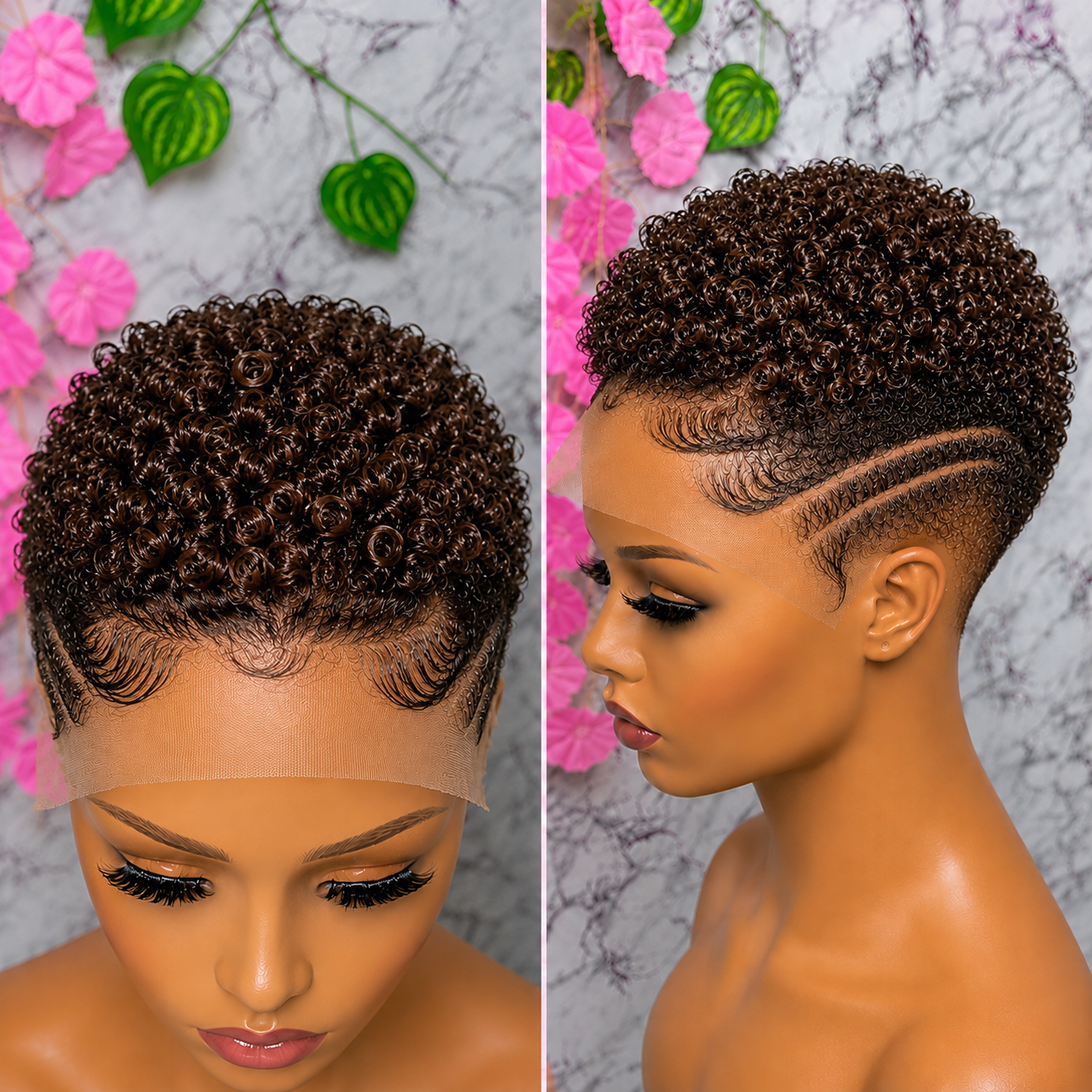
Most buyers look at a sheet of lace this size and assume it means the hairline can go wherever they want it.
It does not. Lace is trimmable, knots are not. On this chestnut afro coil pixie wig the hair begins at one fixed line across the crown, and the enormous bare panel hanging below it is simply material waiting to be cut away. Where those first knots sit is where your hairline will be, and no amount of scissors changes that.
Where To Buy A Wig Like This
Hairline placement is set during construction and is almost never mentioned in a listing, which makes it one of the more common reasons a piece fits badly for reasons the buyer cannot name.
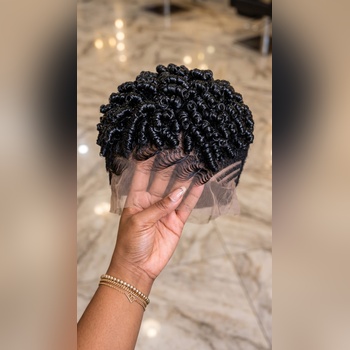
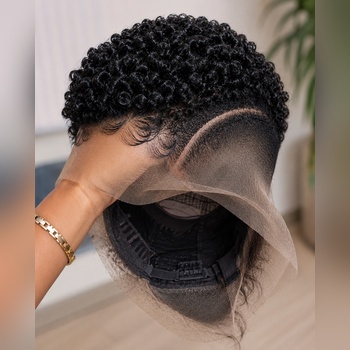
Independent makers and lace studios build to a placement if you give them one. Search phrasing that finds them: “chestnut afro coil pixie wig,” “brown curly pixie wig human hair,” “kinky curly pixie wig short,” “untrimmed lace pixie wig,” “custom hairline placement wig.” Sellers who ask for your hairline measurement rather than only your head circumference are building rather than shipping stock.
Instagram and TikTok makers photograph short units with the lace untrimmed, exactly as here, which shows you the knot line clearly if you know to look for it. Find where the hair starts and ignore everything below it.
Etsy listings will not tell you this. Send your own measurement and ask whether it can be matched.
Contact / Order Inquiries: WhatsApp is where most independent makers take orders. [WhatsApp: +XX XXX XXX XX XX] — ask for the distance from the first row of knots to the crown of the cap. That single number tells you where the piece will sit on you.
Measuring Your Own Hairline
Two measurements, taken with a soft tape.
The first is from the centre of your natural hairline, straight back over the top of your head, to the point where your crown starts to curve down. That gives you the depth of your own front section.
The second is from the centre of your hairline down to the top of your eyebrows, which tells you how much forehead you have showing.
Send both. A maker who knows those numbers can place the knot line so the piece lands on your hairline rather than in front of it or behind it.
What Goes Wrong Without Them
Three failure modes, all common.
Knots placed too far back. The wig sits correctly on the head but the hairline lands behind your own, leaving a strip of forehead that reads as a receded hairline. Pulling the piece forward to cover it drags the cap off the crown and the nape lifts.
Knots placed too far forward. The hairline sits low on the forehead, which shortens the face and looks like a wig pulled down. Pushing it back exposes the cap edge behind the lace.
Correct placement, wrong depth. The line is in the right place but the front section is shallow, so the hair starts and immediately stops, and the crown volume sits too far back on the head.
None of these are fixable after knotting. All of them are avoidable with two numbers sent before the build.
How Much It Costs
Custom placement adds very little in materials and a moderate amount in attention.
Human hair chestnut afro coil pixie wig, hairline knotted to a measurement you provide, sheer lace, glueless cap: $250–$520
The same brown curly pixie wig built to a standard hairline position: $220–$460
Human hair kinky curly pixie wig, basic cap, no placement customisation: $150–$320
Quality synthetic curly pixie wig, standard placement: $80–$170
Basic synthetic short curly wig: $25–$60
The gap between the first two lines is roughly what a maker charges for building to a person instead of to an average. On short units it is worth more than it is on long ones, because there is no hair falling forward to disguise a misplaced hairline.
Reading The Knot Line In A Photo
Ignore the lace entirely. Find the first row of hair and follow it across.
That line should curve gently rather than running straight. Real hairlines are not level, and a knot line cut across the head in a flat band looks wrong even after trimming.
It should also be irregular in density along its length, thinner at the temples and fuller at the centre, matching how hair actually grows.
Check both temples in the same image. Asymmetric placement is common and shows up as one side of the fringe sitting higher than the other once worn.
Why Extra Lace Is Still Useful
The panel is not wasted, even though it does not move anything.
It gives you room to cut a shape that follows your own hairline rather than a factory curve, which is the whole point of trimming rather than buying pre-cut.
It also lets the lace extend past your hairline onto skin, where it can be pressed flat and blended, instead of ending exactly at the knot line where the edge would be obvious.
And it gives you second and third attempts. A trimmed lace can be cut back further; it cannot be extended.
The Afro Coil Texture
The coils here are small, dense, and matte rather than glossy, which reads as natural texture rather than a set.
Judge density at the knot line specifically. This is where makers economise, because the crown gets photographed and the front row does not. A hairline that is visibly sparser than the crown looks thin exactly where it matters.
Ask whether the curl is the hair’s own pattern or a permanent set. On a coil this tight, the answer changes what happens after the first wash.
The Carved Lines At The Side
The lines running back through the fade sit below the hairline and are knotted separately.
Check where they begin relative to the temple. Lines starting too close to the front cut into the section that frames the face, which makes the hairline look like it has a notch taken out of it once the piece is worn.
Before You Pay
How far is the first row of knots from the crown of the cap?
Will you build the hairline to a measurement I send?
Does the knot line curve, or does it run straight across?
Is the density at the front row the same as at the crown?
Where do the carved lines begin relative to the temple?
Trimming The Lace
Work outward from the centre in short angled cuts, following the shape of your own hairline rather than a smooth arc, and stop before you reach the knots.
Put the piece on and mark where your hairline actually falls before cutting anything. On a unit with this much excess it is easy to remove far more than you need and discover the trimmed edge sits behind your own hairline.
Take less than you think on the first pass. You can always cut again.
Search Terms
chestnut afro coil pixie wig · brown curly pixie wig human hair · kinky curly pixie wig short · untrimmed lace pixie wig · custom hairline placement wig · hairline measurement short wig · afro pixie wig where to buy
Final Thoughts
A large lace panel looks like flexibility and is not. It gives you freedom to cut a good shape, nothing more. The hairline itself was decided when the first row of knots went in.
Two measurements sent before the build will do more for how a short unit looks on you than any amount of trimming afterwards.
Find the knot line in the photo, ask how far back it sits, and compare it to your own. That comparison is the whole fit question on a piece this short.