
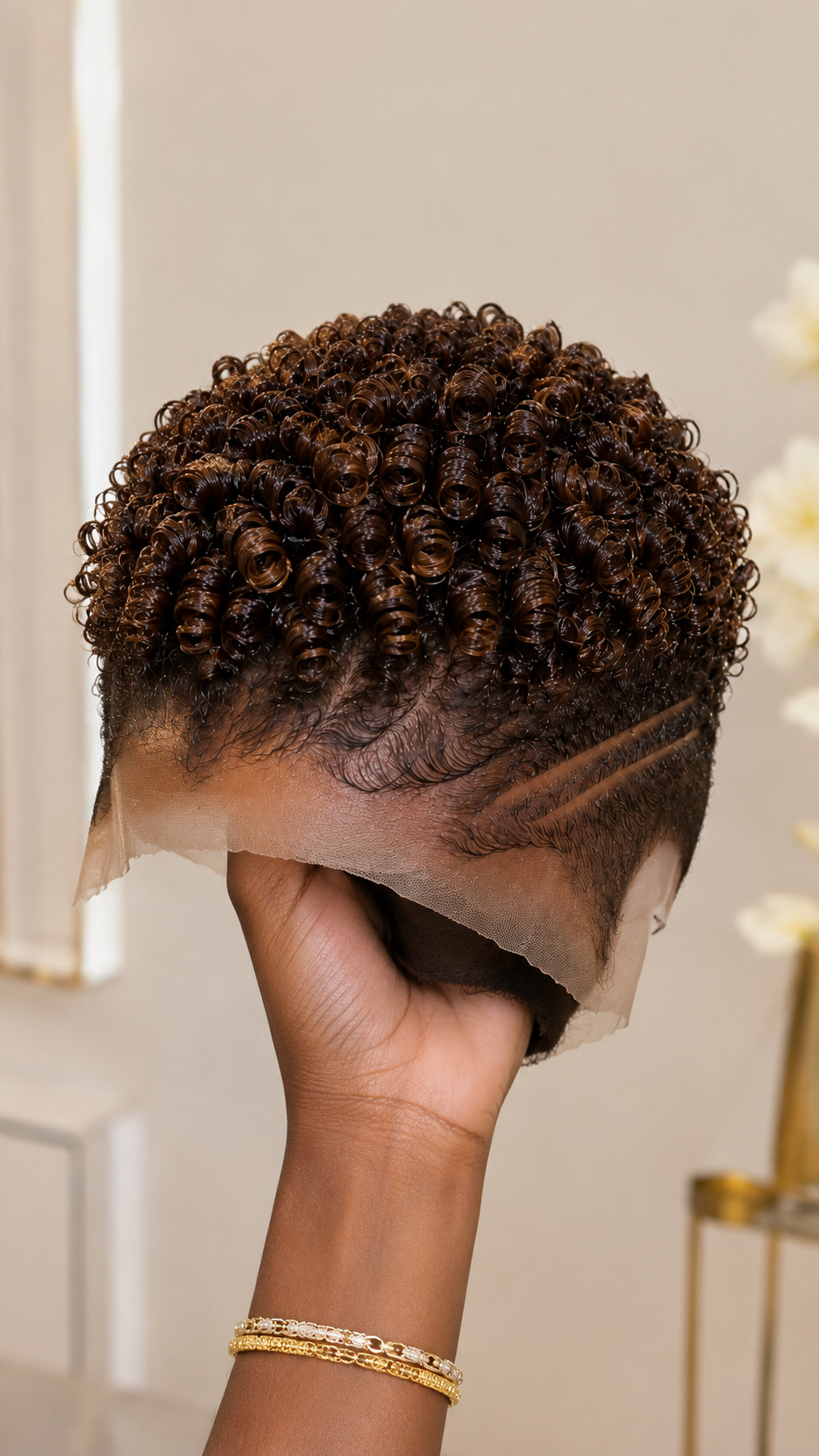
The hair at the front of this piece is not the same hair as the rest of it.
Run your eye along the hairline of this chestnut coil pixie wig. Above it, dense auburn spirals with real weight to them. Below it, a wide band of much finer strands, softer, barely curled, swept into a laid pattern across the lace. Two different materials, knotted into one unit, chosen deliberately.
That band is the most convincing part of the wig and the first part that will wear out.
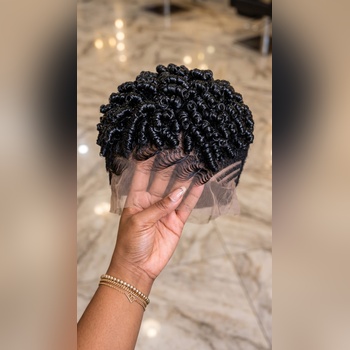
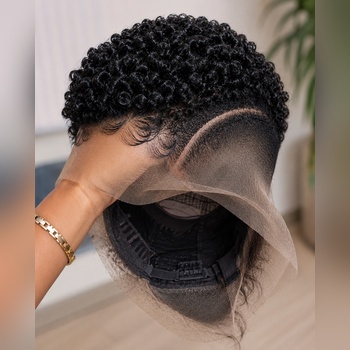
Where To Buy A Wig Like This
Edge work separates makers more reliably than curl pattern does, because it is the one section that cannot be fixed later.
Independent makers and lace studios build these to order. Search phrasing that finds them: “baby hair pixie wig,” “laid edges curly pixie wig,” “chestnut coil pixie wig human hair,” “auburn curly pixie wig,” “pre plucked hairline short wig.” Sellers describing the edge hair as a separate grade know why it matters.
Instagram and TikTok makers photograph edges freshly laid and set, which is when they look their best and tell you least. A photo taken a week into wear is worth more than ten styled ones.
Etsy listings mention baby hairs frequently and edge hair grade almost never. Ask directly.
Contact / Order Inquiries: WhatsApp is where most independent makers take orders. [WhatsApp: +XX XXX XXX XX XX] — send this photo and ask what hair the edges are knotted from, and whether it is finer than the body of the wig.
Why The Edge Hair Is Different
On a real head, the hair at the hairline is genuinely different from the hair on your crown. It is finer, shorter, often less curled, and it grows in a softer direction.
A maker who knots the same hair everywhere produces a hairline that looks like a fringe. The strands are too thick, they sit too heavily, and the transition from skin to hair happens abruptly instead of gradually.
So the edges get built from a lighter grade. Thinner strands, sometimes a looser curl pattern, knotted more sparsely so light passes between them the way it does at a real hairline.
That choice is what makes the front convincing. It is also what makes it fragile.
The Lifespan Problem
Fine hair breaks before coarse hair does. Every time.
The edges sit at the front where they take the most contact: pushed back with a hand, flattened by a hood, rubbed by a pillow, wet with product and dried again every few days.
They are also knotted more sparsely by design, so losing a handful of strands removes a visible proportion of them rather than disappearing into surrounding density.
Realistically, on a piece worn regularly, the edges thin noticeably before anything else does. And once they are gone, they are gone. Re-knotting a hairline is skilled work that costs a significant fraction of a new unit, which is why almost nobody has it done.
How Much It Costs
Edge work is priced into the unit rather than listed separately, but the difference between a piece with proper edges and one without is large.
Human hair chestnut coil pixie wig, finer-grade knotted edges, sheer lace, glueless cap: $250–$520
The same auburn curly pixie wig with edges knotted from the same hair as the crown: $190–$400
Human hair coil pixie wig with no edge work, hairline starting straight into full-weight hair: $150–$320
Quality synthetic curly pixie wig with fine edge fibre: $80–$170
Basic synthetic short curly wig, uniform fibre throughout: $25–$60
The gap between the first two lines buys a second hair source, finer knotting, and considerably more time. It is the least visible upgrade on a spec sheet and the most visible one on a head.
Making Them Last
Four things extend edge life meaningfully.
Lay them less often. Every wetting and drying cycle costs strands. Twice a week rather than daily roughly doubles the life of the section.
Use something light. Heavy gels grip the hair and pull it out when they set hard and get brushed. A light mousse or a mist holds well enough at this length.
Never brush the edges dry. Damp only, with fingers or the softest brush you own, in the direction they were laid.
Sleep with the front protected. A satin scarf tied loosely over the hairline removes most of the nightly friction.
Judging Edge Work Before You Buy
Density gradient first. The edges should thin out as they approach the perimeter, with the outermost hairs scattered rather than forming a line. A solid edge of uniform density reads as a border.
Then thickness. Compare a strand at the hairline to a strand from the crown in any close photograph. If they look the same weight, the maker used one hair for the whole piece.
Then direction. Real edges do not all point the same way. Some sweep, some sit against the grain, a few stand up. Perfectly uniform direction is a styling artefact that will not survive the first wash, and what remains underneath is what you actually bought.
Ask for a photo of the edges unstyled and dry. That is the state they will spend most of their life in.
What The Laid Pattern Hides
The swept shape across the lace here was set with product and dried in place. It will not survive washing, and it was never meant to.
That is fine, but it means the pattern in the listing photo is not a feature of the wig. It is a demonstration of what the edges can be made to do, by someone who does it professionally, with the piece flat on a table.
Judge the hair, not the shape it has been put into.
The Carved Line At The Side
The single line running back through the fade sits below the edge band and is knotted separately.
Check that it does not cut into the edge section. Where a carved line runs too close to the hairline, the gap in knotting removes edge hair that was doing structural work, and the front starts looking sparse on that side only.
Before You Pay
What hair are the edges knotted from, and is it finer than the crown?
Can you send a photo of the edges dry and unstyled?
How sparsely are the outermost hairs knotted?
Does the carved line cut into the edge section anywhere?
Do you offer re-knotting of the hairline later, and roughly what does it cost?
Trimming The Lace
Go slowly along your own hairline, taking small angled cuts rather than one continuous pass, and stop short of the hair rather than flush against it.
The specific risk on this build: the edge band sits close to the lace boundary, and cutting even a few millimetres too far back removes finer hairs you cannot get back. Leave more margin than feels necessary on the first attempt and reduce it later if you need to.
A stylist should do the first cut on any unit with knotted edges. The mistake here is permanent in a way it is not elsewhere.
Search Terms
baby hair pixie wig · laid edges curly pixie wig · chestnut coil pixie wig human hair · auburn curly pixie wig · pre plucked hairline short wig · fine edge hair wig · curly pixie wig with baby hairs
Final Thoughts
Everything else on a short unit can be maintained. Curls can be reset, colour can be toned, caps can be adjusted, lace can be replaced by a good technician.
The hairline cannot, in any practical sense. It is built from finer hair than the rest of the piece, it sits where the most handling happens, and it is knotted sparsely enough that losing strands shows immediately.
Ask what it is made from before you buy, and then treat it as the part of the wig with a clock on it. How you handle the first three months decides how long the piece stays convincing.