
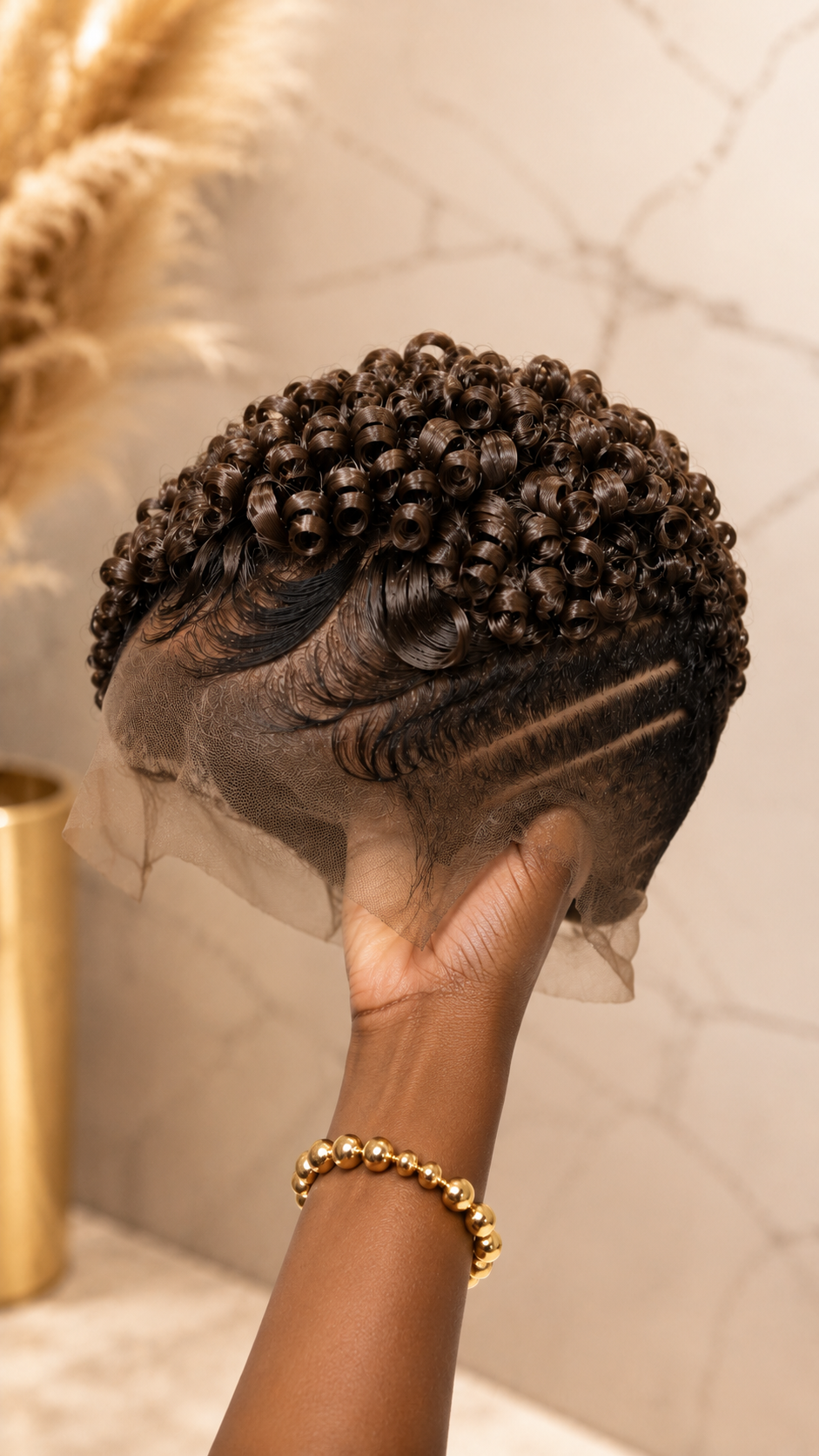
Held up in one hand with the lace draping loose. This is a chestnut brown curly pixie wig: tight coils packed across the crown, and below them a fade running down the side with two carved lines cutting through it.
Look closely at that fade. It is not cut hair. It is lace, with extremely short hairs knotted into it at decreasing density, and the carved lines are not shaved at all. They are gaps where the maker simply did not knot anything.
Where To Buy A Wig Like This
Knotted fades are the difference between a short unit that reads as a haircut and one that reads as hair sitting on a cap. Not every maker attempts them.


Independent makers and lace studios build these. Search phrasing that finds them: “knotted fade pixie wig,” “brown curly pixie wig human hair,” “carved line pixie wig lace,” “hand knotted fade wig,” “chestnut pixie wig glueless.” Sellers describing the fade as knotted rather than cut know what they are selling.
Instagram and TikTok makers rarely explain this. Ask for a photo of the fade area with the lace held up to light, the way it is held here, since that is when the construction becomes visible.
Etsy listings almost never mention it. A short unit described as having a fade may have hair cut short over a solid cap instead, which looks completely different.
Contact / Order Inquiries: WhatsApp handles most independent orders. [WhatsApp: +XX XXX XXX XX XX] — send this photo and ask whether the fade is knotted into lace or cut hair over a cap, and whether the carved lines are unknotted gaps or shaved.
Why This Changes What You Are Buying
On a real head, a fade is subtractive. Hair grows everywhere and a barber removes it in a gradient.
On a wig it is additive. The maker starts with bare lace and adds hair, shorter and sparser as they go down, until there is nothing. The gradient is built rather than cut.
That reversal has consequences.
The lines are permanent. On a real head a carved line grows out and gets recut wherever you like. On a knotted unit the line is an absence of knots, so it cannot be moved, widened, or removed. What you order is what you keep.
The bare lace is the design. In a real fade you are looking at scalp through stubble. Here you are looking at lace through knots, which means the lace tone is doing the job scalp does. Wrong tone and the whole illusion fails.
Short hair is harder to knot. The stubble at the bottom of a fade is a fraction of a centimetre long, which gives the knot almost nothing to hold. This is the part of a wig most likely to shed.
How Much It Costs
A knotted fade is slow, fiddly work and it prices accordingly.
Human hair brown curly pixie wig, fully knotted fade with carved line gaps, sheer lace, glueless cap: $260–$540
The same chestnut pixie wig with hair cut short over a solid cap instead of a knotted fade: $170–$350
Human hair pixie wig, no fade, hair to the perimeter: $150–$310
Quality synthetic pixie wig with a knotted fade: $90–$190
Basic synthetic short wig, cut fade over cap: $25–$60
The gap between the first two lines is the whole subject of this article. Both get called a fade. One is thousands of individual knots at decreasing length, the other is a pair of scissors.
Shipping, Delivery, And What To Expect After Ordering
Four to six weeks. The fade section alone can take as long as the rest of the piece, because the knots get smaller and more numerous as the hair gets shorter.
The lace arrives untrimmed and the fade will look sparser in hand than it does on a head, since it has no curved surface to sit against.
Confirm tracked shipping and check import charges for your country.
Ask about returns before paying.
Send a head measurement and ask where the fade will begin relative to your ear, since that boundary is fixed once knotted.
Judging A Knotted Fade
Hold any photo up and look at the gradient rather than the hair.
Density should fall off smoothly. The best fades have no step in them, just a continuous thinning from full coils to nothing.
The last centimetre matters most. Rushed work stops the knotting abruptly and leaves a visible edge where the lace becomes empty. A proper fade thins to single scattered hairs before it ends.
Look at the direction of the shortest hairs. In a good fade they lie flat against the lace, mimicking stubble. If they stick out at angles, the knots were tied too loose or the hair was too coarse for that length.
The Carved Lines As Negative Space
The two lines running through the fade here are gaps in the knotting rather than cuts.
Judge them on edge cleanliness. The knotted hair on either side should stop cleanly rather than trailing stray strands into the gap. Strays are the giveaway that the maker knotted first and tried to clear a line afterwards.
Judge them on width consistency along their whole length, since a gap cannot be widened later to even it out.
And judge the lace inside the gap. It is on display permanently, so knot residue, glue marks, or discolouration in that strip will always be visible.
Shedding At The Bottom Of The Fade
This is the practical failure point on this construction.
Very short knotted hairs have almost no length to grip with. Friction from collars, pillows, or a hand run over the nape pulls them out faster than anywhere else on the piece.
Ask the maker whether the fade knots are sealed on the underside. Some seal the whole lace, some seal only the perimeter, and the difference shows up after a few months as a thinning fade.
Handle that area as little as possible. Avoid running your hand up the fade against the direction of the hair, which is the most common way people strip it.
Before You Pay
Is the fade knotted into lace or cut hair over a cap?
Are the carved lines unknotted gaps or shaved into knotted hair?
Are the knots in the fade sealed underneath?
How gradually does the density fall off at the bottom edge?
Where does the fade begin relative to my ear?
Trimming The Lace
Cut along your own hairline in small staggered snips, leaving a shallow margin rather than going flush.
Do not trim the lace inside or around the fade. That lace is part of the design, showing through the knots to read as scalp. Cutting it back removes the surface the fade is built on.
If it is your first lace piece, have a stylist do the front and leave the fade area completely alone.
Search Terms
knotted fade pixie wig · brown curly pixie wig human hair · carved line pixie wig lace · hand knotted fade wig · chestnut pixie wig glueless · tapered fade short wig · knotted fade vs cut fade wig
Final Thoughts
The word fade covers two completely different things in short wigs, and the price gap between them is large enough that it explains most of the confusing listings in this category.
One is thousands of tiny knots placed at decreasing length until the lace runs empty. The other is hair cut short with scissors over a cap edge.
Ask which you are being sold. Then ask whether the carved lines are gaps or cuts, because if they are gaps, they are permanent.