
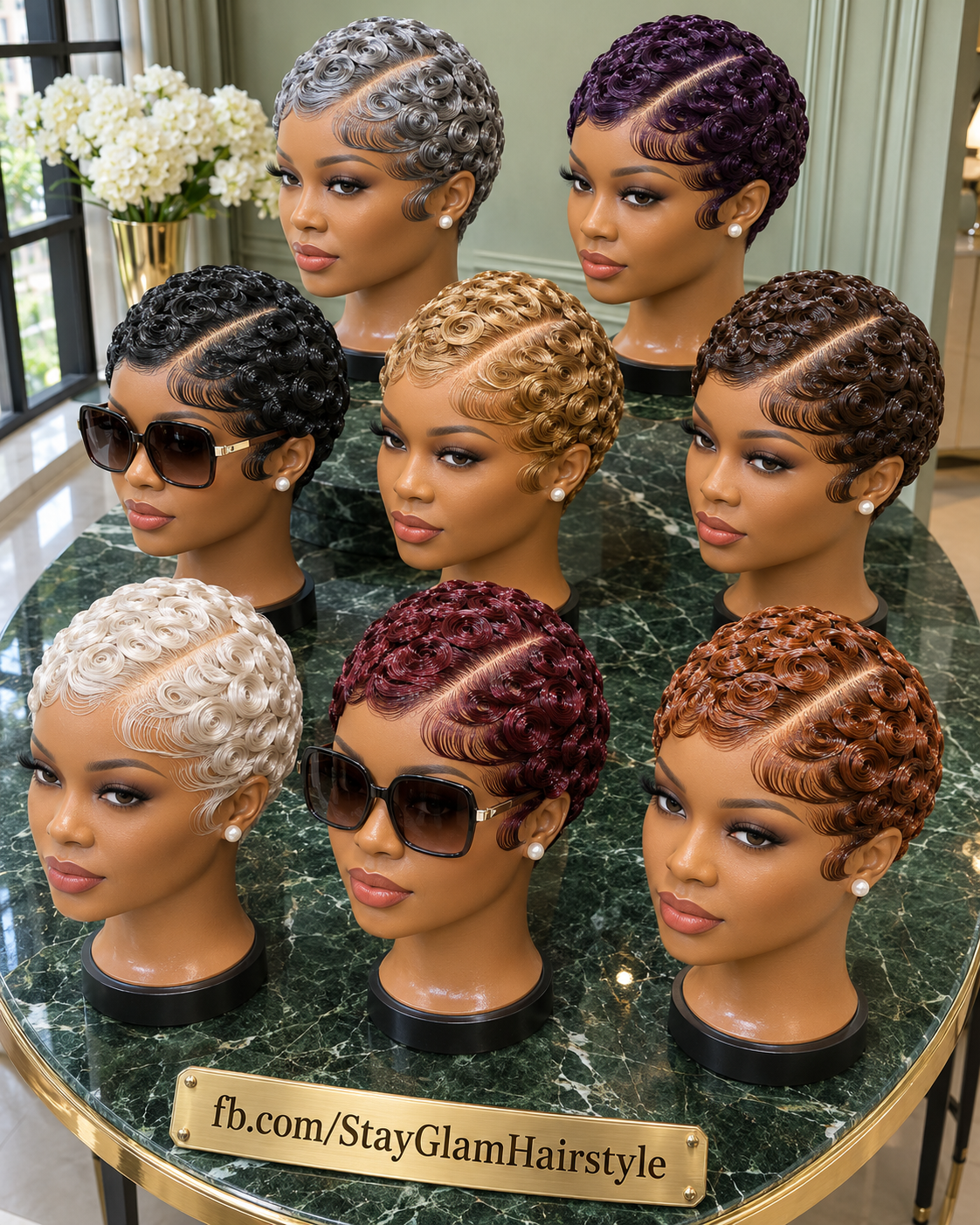
Small, glossy coils cover the crown of these short pixie wigs, each wound into a rounded shape that resembles a miniature rosette. A diagonal side part cuts through the arrangement and gives the eye a clear path from the front hairline toward the crown. Across the forehead and around the visible temple, fine strands curve into shallow waves before the fuller coils take over. Those changes in shape give the pixie its character, from the flat sweep above the brow to the little rings that catch the light higher on the head.
The mannequin display shows how much a shade can change the impression of a short haircut. The black unit gives the silhouette a striking outline, while the silver and pearl-platinum versions bring the individual coil ridges into view. Honey blonde and copper put a warm cast on the same styling, and the chocolate brown offers a quieter version of that warmth. Deep burgundy and dark plum give the curls a richer color that becomes particularly apparent where the coils turn toward the light.
For anyone shopping for a short rosette curl wig, the details worth carrying into a consultation are the low crown, the narrow angled part and the curved finish beside the ear. A wig maker can use those details to shape a custom unit, and a stylist familiar with short hair can use the image as a reference for a salon set. Either route benefits from deciding where the part and front sweep should sit on the person who will actually wear the style.


How the Rosettes and Waves Fit Together
The rosettes sit close enough to form a continuous surface, with the circular centers of individual curls still visible. Some are broad enough to show several concentric ridges, while smaller coils fill in around them. At the front, the hair opens into a wider sweep that lies close to the forehead. The marks left by the arranged strands make that sweep readable from a distance. If you show the image to a stylist, point out both the circular crown curls and the flatter front section, since each calls for a different shape during setting.
The diagonal part gives the arrangement a sense of direction even though most of the curls are round. Its angle creates a wider field of curls on one side and a narrower section on the other. A narrow line helps preserve that effect. If a ready-made wig has a much wider part, the exposed area will draw more attention and the crown may read as two separate blocks. When comparing units online, look for a straight-on photo and a view from slightly above. The overhead angle makes it easier to judge where the part ends and how neatly the nearby curls are placed.
At the visible temple, a smaller curved section follows the hairline and ends close to the ear. The side hugs the head, which leaves the ear area open and keeps the profile compact. That curve is especially easy to follow on the copper, pearl-platinum and chocolate brown units in the foreground and middle of the display. On a person, its position will depend on the wig fit and the natural shape of the hairline. Ask for a side view during a fitting so you can see where the curl lands when your head is upright and when you turn.
Choosing Among Silver, Plum, Copper and the Other Shades
Silver and pearl platinum are the two lightest options in the display, and each shows the styling differently. The silver has a cool grey cast, with darker-looking shadows tucked between the coils. Pearl platinum appears lighter and creamier, especially along the front waves, where the thin lines stand out against the forehead. If you are ordering either shade, ask for a daylight photo of the hair beside the actual parting material. The contrast between a pale fiber and the material beneath it is often easier to assess in that photo than in a styled boutique shot.
The darker units reward a look from more than one angle. On the black wig, reflections help separate curls that might otherwise merge visually under softer lighting. Chocolate brown keeps a deep base with warmer reflections, particularly around the crown. Plum shows a violet cast, while burgundy leans red. Sellers use color names differently, so request a short video in indirect daylight if you are deciding between two closely related shades. A slow turn is enough to show how much of the color appears in the lower-light areas between the coils.
Honey blonde and copper bring warmth to different parts of the display. The honey shade reads as golden and gives the ridges around the part a softer contrast. Copper leans toward a reddish brown, with warm reflections around the circles and along the forehead sweep. If you plan to wear either color regularly, try viewing a swatch against your skin and alongside a few items you wear often. For a custom order, confirm whether you want a consistent color across the part, front and crown. The shade alone may provide all the contrast you want in such a detailed set.
How To Order This Style
Start with custom wig studios, short-wig specialists or beauty supply stores that carry styled pixie units. Useful search phrases include side-part pin curl pixie wig and short wig with sculpted waves. Some sellers use “finger wave pixie” for a style made mostly of continuous S-shaped waves. Others apply the term to short wigs that also have circular curls. Send the image with your inquiry and point out the rosettes across the crown, the diagonal part and the curve by the ear. Those three details will help the seller identify the shape you want.
For a custom unit, include your preferred shade, the side on which you wear your part and whether you want the style to sit tight against the head. Use your own left and right when explaining part placement and attach a marked reference if the direction matters. A photo can be mirrored, and a maker may describe the side from the viewer’s perspective. If you wear glasses, mention that too. The temple sweep and wig edge should leave room for the arms to sit comfortably without pushing the curl away from your face.
Request a front photo, a photo from each side and a clear view of the nape and inside of the cap before paying. A short unfiltered video can show how the color shifts and how the curls sit when the unit is turned. Ask the seller to identify the fiber, explain how the part is made and confirm the cap size range. For a custom order, get the production time, deposit terms, shipping cost and any limits on alterations in writing. If curl placement is important to you, ask whether the maker sends a photo for approval before shipping.
To have a wig installed or reshaped locally, look for a wig stylist who shows short cuts, lace fittings and sculpted waves in their portfolio. Book a consultation or send photos before reserving a full appointment so the stylist can tell whether the unit needs fitting, a curl reset or both. If you want a similar finish on your own hair, ask a salon that works with short pixies and molded waves to assess how much length you have across the crown and at the temples. Confirm whether the price covers the haircut, the set and any follow-up styling separately.
Cap Construction and the First Fitting
A lace-front wig can suit this design if the lace area extends far enough to support the intended diagonal part. Some lace-front units provide a broader section across the front, while others have a shallower area and a fixed part. Ask for the dimensions of the usable parting space and a photo with the curls moved aside. The image shows the styled surface clearly, so use the seller’s cap photos to make decisions about construction. You can also ask whether the finished style sits comfortably on your preferred side before committing to alterations.
A closure can be a practical choice when you plan to keep the same part every time. The maker needs to position the closure so the angle falls where you want it and the part ends within the usable area. A frontal offers more room to adjust the front outline and the hair near the temples, which can help when you want a particular curve around the ear. Full lace may suit a buyer who expects to restyle the unit in other ways, though a fixed rosette set can be ordered on a simpler cap if the front and part already sit as intended.
For a glueless fit, ask how the adjustable straps, elastic band or other attachment components hold the unit in place. Take the measurements requested by the maker, which may include head circumference, front to nape and ear to ear. A comfortable cap should stay in position when you turn your head without pulling at the temples. Adhesive-based installation is another option when a lace edge needs more hold. If a stylist is applying the wig, ask them to show you where the edge sits and explain how to release it before you take the unit home.
Check the part and front sweep together at the fitting. A shift in the cap can change how high the curve sits above the brow or bring the temple detail closer to the ear than intended. Wear your usual glasses or sunglasses if they affect how the sides feel. Before any permanent trimming, have the stylist show you the fit from the front, profile and back. The display gives a clear view of the crown and visible side, so discuss separately how short you want the nape and how closely you want it to follow your neckline.
Choosing Length and Density for a Low Crown
Ask about finished curl size and crown height when you compare units. The hair needed to form a circular curl is longer than the finished shape suggests once the strand is wound and set. A maker can leave enough length on the crown for the rosettes while trimming the sides so the wig stays close around the ears. If you are buying online, ask for a side photo of the finished set on a head form in your cap size. That view will tell you more about the height you will be wearing than a listing that gives only the length of the hair.
Density matters most where the coils meet. Too much hair in that area can close the gaps between the rosettes, cover the narrow part or make the sides stand out. A lighter front can make the small waves easier to place, while the crown still needs enough coverage to support the circles. Ask the maker how they distribute the hair across those areas. If you prefer a fuller shape, request a little more height through the crown first. Keeping the hair close around the temples and ears will preserve the profile that makes the reference recognizable.
Illustrative Price Ranges for a Rosette Pixie Wig
Use these USD ranges to compare what different orders might include. Actual prices vary with the fiber, cap, color work, level of customization, location and supplier. Ask for separate amounts for shipping, fitting, installation and future curl resetting, since a quoted wig price may cover only the unit and its initial styling.
| Category | Illustrative Price Range | Potential Scope |
|---|---|---|
| Premium Custom | USD 280–550+ | Made-to-measure cap, custom color, detailed rosette placement and individually shaped hairline waves. |
| Standard Custom | USD 160–280 | Standard cap with a requested part direction, adjusted pixie shape and a sculpted curl set. |
| Basic Human Hair | USD 95–165 | Short human-hair unit that may need a separate cut, fitting or curl appointment to match the reference. |
| Premium Synthetic | USD 45–95 | Pre-styled short wig with more detailed curls or parting, depending on the model. |
| Basic Synthetic | USD 20–45 | Ready-made pixie with a fixed part and simpler curl or wave placement. |
Compare the price of the finished result. An inexpensive unit can be a reasonable starting point if it already has the shape and part you want. If the stylist needs to reshape the sides, recreate the whole crown and adjust the front, ask for that service estimate before ordering. For custom color, confirm whether the quote includes a swatch or shade approval. That can be particularly helpful when you want a specific pearl, silver or plum tone and have limited options for returns.
Keeping the Coils and Hairline Waves in Place
When putting on or removing the wig, hold the sturdier sides of the cap and keep your fingers clear of the front wave. Check the temple area after wearing glasses, headphones or anything else that touches the sides. If a curl has lifted, press it gently back along its existing curve. A wide brush across the crown can pull several circles together, so work on the individual curl only when it needs attention. Use styling products sparingly and choose ones the maker recommends for the fiber and the original set.
Base your wash schedule on wear, perspiration, product buildup and the maker’s care instructions. If you wear the unit frequently, inspect the inside of the cap and the front edge weekly so you can see when cleaning is needed. After washing, blot gently with a towel and support the wig on a suitable stand while it dries. Keep the front waves free of pressure and avoid rubbing the rosettes together. For a lace unit worn with adhesive, ask which remover suits the product used and clean the loosened residue from the underside with gentle handling.
A human-hair unit can often be reshaped with a wet set or an appropriate styling tool, depending on its condition and any color processing. Ask your stylist to show you the direction of the curl before you try resetting it. Synthetic wigs may hold a factory-set shape through routine care, but their heat tolerance depends on the specific fiber. Check the maker’s directions before using a heated tool or steam. If several rosettes collapse at once, or if the front wave lifts along the part, book a reset so the stylist can restore the relationship between the crown and the flatter hairline.
Store the wig on a stand that supports the cap without stretching it. Keep colored pieces away from prolonged direct sunlight and use fiber-appropriate care products, especially for pale platinum or silver, where residue can be noticeable. For travel, use a roomy box or case with enough support inside the cap to prevent it from folding. Leave space above the crown so a lid cannot press against the coils. On arrival, put the wig on its stand and check the forehead sweep and temple curl before wearing it.
What to Consider Before Choosing This Pixie
The compact cut keeps the hair clear of the shoulders and leaves room for earrings to show. The angled part and front sweep give the style a distinct shape with very little length, and the broad color selection lets you change the overall impression while keeping that shape. If you plan to wear the wig daily, try it under the lighting you spend the most time in. In dimmer rooms, the lighter shades may show the circles more clearly, while the outline and front wave may be the details you notice first on black or dark brown.
The trade-off is that the individual curls and precise hairline take care to preserve. Frequent friction at the temple can loosen the small curve, and regular washing may eventually call for professional reshaping. A fixed part also gives you fewer options if you like to change the direction of your fringe. At a fitting, ask to see the wig after a few turns of the head and try taking it off and putting it back on. A well-positioned part and an easy-to-reproduce fit will help you keep the sculpted shape looking the way you ordered it.
Search Terms
rosette curl pixie wig · diagonal side part pixie wig · glossy pin curl short wig · silver rosette curl pixie · pearl platinum finger wave wig · copper pixie with temple waves · burgundy sculpted curl wig · honey blonde short pin curls