
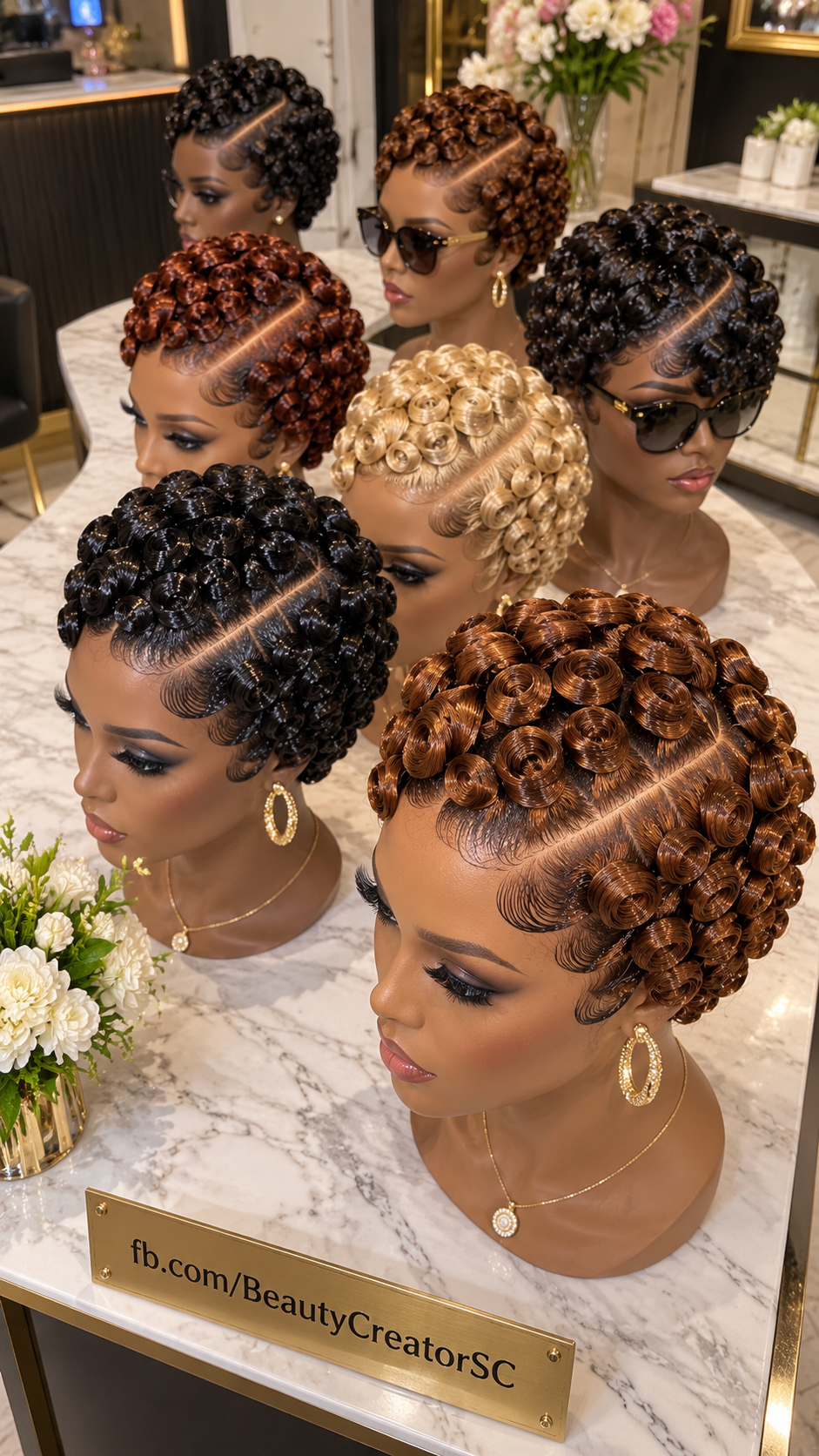
The second image presents seven compact pixie wigs built around polished coil formations, sharply visible slanted parting and layered sweeping strands around the frontal sides. The color selection includes glossy black, rich copper, dark chocolate, golden blonde and other warm brown variations. Unlike styles that rely on shaved side patterns, these wigs create most of their structure through curl placement, exposed parting and directional perimeter styling.
The front copper unit makes the construction particularly easy to study. Large circular coils occupy the upper crown and continue toward the side, while a long exposed diagonal division separates them from a broad panel of fine hair. Those strands curve toward the temple before connecting with smaller perimeter curls.
Large Polished Coils Give This Collection More Visual Weight
The curls in this image appear slightly broader and more open in several areas than those in many tightly packed ringlet designs. Individual circular formations are therefore highly visible across the crown.


The coils remain compact enough to preserve the pixie silhouette, but their larger openings create a bolder texture. Smaller curls fill the gaps and help maintain density around the rear and perimeter.
When ordering this construction, provide the image as a curl-size reference. Simply requesting ringlets may result in much smaller coils than those visible on the prominent copper unit.
The Slanted Part Creates a Strong Visual Axis
A clean diagonal part travels across the crown of several wigs. It begins near the frontal area and continues backward, dividing the upper curls from the sculpted side section.
Because the line is relatively long and exposed, it becomes a major component of the hairstyle rather than a minor styling detail. Curl placement follows its direction throughout the crown.
The part should therefore be established early in the styling process. Its angle determines how much hair remains available for both the ringlet crown and frontal sweep.
Layered Temple Sweeps Replace a Traditional Flat Side
Beneath the part, fine strands are arranged into several elongated curves. These waves overlap visually and travel in a coordinated direction toward the temple.
The result is a layered feathered panel rather than a simple slicked section. Individual hairs remain visible within the larger shapes, which gives the side considerable detail even though it sits close to the head.
Ask for layered sculpted temple sweeps if commissioning the design. That description separates this construction from ordinary edge styling.
The Front Copper Unit Shows the Architecture Clearly
The foreground copper wig offers one of the clearest examples of the overall structure. Large polished coils dominate the crown, a diagonal part cuts through the upper side and several broad wave formations travel beneath it.
Smaller curls remain around the ear, creating a gradual transition instead of ending the larger crown texture abruptly.
The copper color further emphasizes the construction because highlights move strongly around every circular curl and along the fine wave strands.
Black Versions Depend on Reflection for Definition
The jet black wigs contain little tonal contrast, so their texture is revealed primarily by the reflective surface. Bright narrow highlights outline the outer edge of each circular curl.
Deep shadows remain inside the coils and between neighboring sections, producing considerable dimensional depth despite the monochromatic color.
Lightweight finishing products can help preserve this effect without causing adjacent curls to stick together.
Golden Blonde Creates a Brighter Curl Map
The blonde unit near the center uses a warm golden direction rather than a cool silver tone. The light color makes the circular coil pattern extremely visible.
Darker shadow remains within the curl interiors and close to the foundation, helping prevent the crown from looking flat. The sculpted frontal strands also become easy to distinguish against the mannequin complexion.
If recreating the shade in human hair, discuss how much lightening will be required and how the hair should be maintained after processing.
Rich Copper Produces Multiple Warm Reflections
The copper units range from medium warm brown to brighter reddish copper depending on the light. Raised curl surfaces appear brighter while the recessed areas retain deeper brown tones.
This natural variation works particularly well with the broad circular curls because each coil presents multiple angles to the light.
For ordering purposes, request dimensional copper brown rather than one uniform orange shade.
Dark Chocolate Provides a Deeper Warm Alternative
Several wigs appear darker than the bright copper examples while remaining visibly brown under direct lighting. These shades sit closer to espresso or dark chocolate.
The deeper color gives the crown a richer appearance while still allowing the glossy curl pattern to remain visible. It can be a useful choice for someone who wants warmth without moving into strong red or blonde territory.
Curl Placement Changes Around the Forehead
The crown curls are larger and more circular, while the sections nearest the forehead become flatter and more directional. This change prevents the frontal area from becoming excessively bulky.
Fine strands sweep alongside the part and gradually connect with smaller curls around the temple. This creates a deliberate progression from flat wave to raised ringlet.
A successful recreation should preserve this difference rather than applying one curl size across every section.
The Rear Density Supports the Rounded Shape
Although the frontal curls receive most of the attention, the visible units retain substantial texture toward the back. This prevents the crown from appearing front-heavy.
The rear curls can be slightly tighter and more compressed while maintaining the same polished appearance. From a three-quarter view, the silhouette should remain balanced from front to back.
Reflective Strands Are Central to the Finished Look
The hair has a mirror-like glossy finish, silky reflective surface, healthy wet-look shine, individually visible strands and ultra-defined texture. These characteristics allow both the circular coils and flatter temple sections to remain visually distinct.
The copper and blonde units show the strongest tonal reflection, while the black versions rely on thin highlights to reveal individual curls.
Avoid saturating the hair with heavy oils because excessive product can reduce separation and make the curls appear clumped.
How to Brief a Stylist for This Specific Shape
Request a compact pixie crown with medium circular coils rather than very tiny curls. Explain that the crown should remain dense but each major coil needs to retain a visible center.
Add a long slanted part through the frontal side and request layered sculpted strands beneath it. Smaller curls should connect the wave panel with the area around the ear.
Choose one specific mannequin as the color reference so the stylist does not combine several different shades from the collection.
Choosing the Right Salon or Wig Specialist
A stylist experienced with molded pixie wigs, ringlet setting and finger-wave techniques is best suited to this construction. Review close-up examples of their previous work before booking.
Send this reference image in advance and ask whether the complete design can be produced on a custom unit or whether you need to purchase a suitable base wig first.
If a local barber or second stylist will assist with perimeter shaping, confirm that before the appointment so the finished proportions remain coordinated.
Where to Search for a Comparable Unit
Look at specialist pixie wig boutiques, independent custom wig makers and salons selling finished units. Product photographs should show more than the front because the parting and side transition are important components of this design.
Ask whether the listed wig includes the final curl setting and sculpted side work. A generic curly pixie may require significant additional customization to reach the appearance shown here.
Placing a Custom Order Without Missing Key Details
Start with cap measurements, hair material and your chosen color. Next, specify which side should carry the long diagonal part and provide a close crop of the preferred unit.
Discuss curl diameter and crown density separately. Then confirm the size and direction of the temple sweeps