
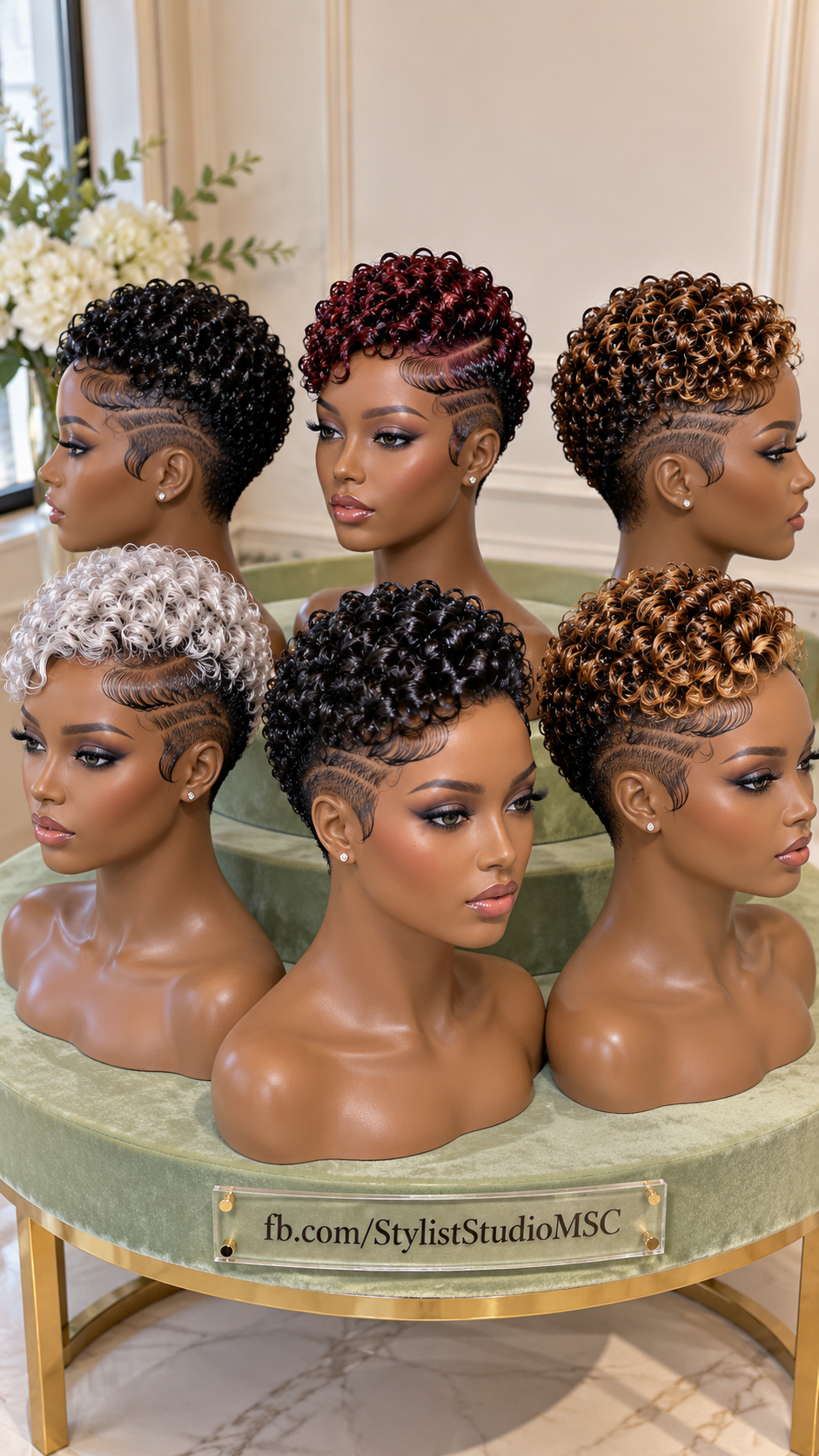
This six-piece pixie wig collection brings together compact loop curls, carefully directed front sections and artistic side-line work in a coordinated salon display. The wigs share the same recognizable silhouette while using different color directions, including deep natural black, wine burgundy, warm caramel brown, copper brown and pale pearl silver. That combination makes the collection useful for customers who like one hairstyle construction but want enough color variety to choose something that matches their personal look.
The first detail that stands out is the density of the curled crown. Instead of loose spirals falling around the face, the hair has been arranged into numerous compact loops that sit close together and create controlled height. The curls continue from the front toward the back while the sides remain considerably lower. This difference in height is what gives the pixie its strong profile and makes the carved side sections visible.
The side work is equally important. Several wigs show multiple narrow lines traveling backward from the temple, while the front edges are shaped into sweeping curved sections. These elements give the hairstyle a recognizable identity from profile angles rather than making the crown the only point of interest. For customers ordering this design from a wig stylist, both the curl arrangement and the side construction should be discussed before production.
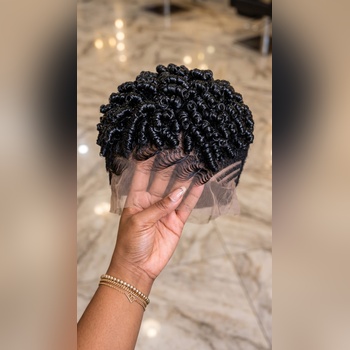
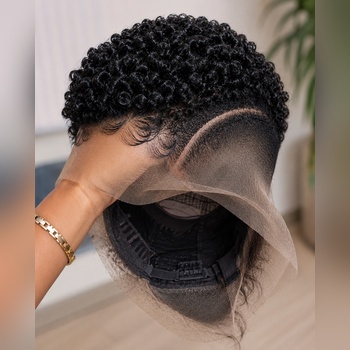
Compact Loop Curls Give the Crown Its Signature Shape
The crown is constructed around closely packed circular curls. Each loop remains visually separate enough to reflect light around its curved surface, creating depth across the upper section. The curl size is relatively consistent, which helps the overall silhouette look intentional rather than randomly curled.
Another important detail is the direction of the loops. They are not simply stacked vertically. The curls gradually follow the shape of the head, allowing the upper section to maintain volume while transitioning naturally toward the lower sides and back. This controlled placement is particularly important in a pixie wig because there is less length available to disguise inconsistencies in the construction.
Anyone requesting this hairstyle should show the stylist a close reference of the crown. Ask for compact sculpted loop curls with visible separation and a rounded profile. Curl diameter matters: larger curls can make the crown appear more open, while much smaller curls can produce a denser appearance. Matching the reference requires attention to both curl size and placement.
The Side Sweep Creates a Strong Transition Around the Temple
The front-to-side transition is one of the most distinctive areas of this collection. Hair near the forehead moves into a broad sweeping curve before meeting the lower side section. Fine directional strands are used to form layered arcs around the temple, giving the hairstyle movement even though the overall length remains compact.
This sweep also creates a useful visual separation between the curled crown and the carved side area. Instead of having the curls end abruptly above the temple, the curved section connects the two zones. From a three-quarter angle, this produces an especially attractive profile because the viewer can see the crown volume, sweeping strands and side lines simultaneously.
When ordering, customers should specify how prominent they want this section to be. A wider sweep becomes a major focal point, while a narrower version gives more visual space to the carved lines underneath. Sending both front and side reference photographs can prevent misunderstandings.
Carved Side Lines Add Detail Without Competing With the Curls
Several wigs in the display use multiple parallel side lines positioned above the ear area. These lines travel backward at a slight angle and sit beneath the fuller crown. Because the surrounding hair is kept close to the head, the separation remains clearly visible.
The line placement is particularly effective because it follows the direction established by the sweeping front section. The hairstyle therefore has a continuous visual flow from the forehead toward the back. This makes the side pattern feel integrated into the design rather than added as an unrelated decoration.
Customers can ask a stylist to reproduce the reference pattern or create a personalized variation. Before choosing a different pattern, consider how it will interact with the curl direction above it. Two or three narrow lines can give a different impression from one broad curved line, even when the crown remains identical.
Natural Black Keeps Attention on the Sculpted Curl Work
The deep natural black versions place the greatest emphasis on shape. With little color contrast competing for attention, the circular curls, sweeping temple sections and carved lines become the dominant elements. Salon lighting creates narrow reflections along the loops, helping individual curls remain visible despite the dark shade.
This color direction can be useful for customers who want a versatile wig while still choosing an elaborate construction. Natural black pairs easily with different clothing colors and accessories, while the sculpted crown provides enough visual interest to keep the hairstyle distinctive.
When discussing the shade with a wig maker, ask whether the hair is natural black, soft black or another dark tone. These colors can photograph similarly under artificial lighting but may look different in daylight.
Wine Burgundy Gives the Pixie a Deeper Red Direction
The burgundy variation adds a rich wine-red tone to the compact curls. Because the hair contains many curved surfaces, the color appears darker inside the loops and brighter across the raised areas. This creates natural variation throughout the crown without requiring contrasting streaks.
The burgundy shade also works well beside the darker side section. The difference between the red crown and deeper foundation makes the transition easier to see, especially around the sweeping temple area. It provides a stronger color statement while preserving the original construction of the hairstyle.
Customers should remember that burgundy can look different under warm indoor lighting and daylight. Ask the seller for unfiltered photographs whenever possible. If the unit is human hair, discuss color maintenance before purchasing because red-based shades may require periodic refreshing.
Caramel Brown Brings Light Through the Circular Curl Pattern
The warm caramel-brown variations show how effectively dimensional color can work with loop curls. Lighter brown reflections appear along the outside of each curl while darker areas remain visible beneath. This makes individual loops easier to distinguish and gives the crown greater visual depth.
The darker foundation underneath the warmer curls is especially useful because it prevents the color from appearing uniform. Customers who like highlighted wigs but do not want traditional long streaks may find this approach appealing. The color variation is distributed naturally through the compact curls instead.
When requesting a similar color, send the reference image and discuss the balance between dark brown and caramel. Simply requesting “brown highlights” is too broad because the stylist may choose a completely different placement or tone.
Pearl Silver Creates the Brightest Contrast in the Collection
The pale silver version produces the strongest contrast against the deeper side area. The loop curls appear almost pearl-like under the light, while the darker foundation provides visual depth underneath. This combination makes the curl structure immediately noticeable from a distance.
The shade appears closer to pearl silver or pale icy blonde than a warm blonde. Those descriptions can still vary between sellers, so the photograph should remain the main color reference when placing an order. Ask for daylight photographs before approving a custom-colored unit.
If the wig is human hair, ask how the pale shade was achieved and what maintenance products are recommended. If it is synthetic, confirm whether the fiber can tolerate heat before attempting any curl restoration at home.
Why the Hairline Placement Needs Professional Attention
The front of this hairstyle contains several small directional sections that need to sit in the correct position around the forehead. If the wig is placed too far forward, the sweeping side area may sit too low. If it is positioned too far back, the intended front silhouette can change considerably.
A professional wig stylist can position the unit first and then decide whether any minor adjustment is necessary. This is preferable to cutting the front immediately after receiving the wig. Once lace or hair has been removed, restoring the original construction can be difficult.
Customers purchasing online should request measurements and confirm cap sizing before ordering. Correct sizing is particularly important for a hairstyle with visible side detailing because rotation of the wig can move the carved sections away from their intended position.
What the Display Does and Does Not Confirm About the Wig Construction
The photographs clearly show styled pixie wigs with compact loop curls, sculpted side sections and detailed hairline work. However, appearance alone does not confirm the exact lace specification, hair origin, density percentage or material used for every unit.
For that reason, buyers should avoid assuming that a particular lace type or hair grade is included. Ask the seller to provide photographs of the inside of the exact unit. Check the cap structure, adjustable components, combs or clips if included, and the amount of lace that needs to be customized during installation.
Also confirm whether the side design is permanently incorporated into the wig or requires additional salon work after purchase. This is particularly important when comparing prices between sellers because two visually similar listings may include very different levels of preparation.
How to Order This Pixie Design From a Wig Stylist
Start by sending the complete reference image rather than describing the wig from memory. Tell the stylist that the crown should contain compact circular loop curls with controlled height. Point out that the curls should remain individually recognizable instead of blending into one large curled mass.
Next, discuss the sweeping front and temple section. Explain where you want the broad curved strands to begin and how far they should travel toward the side. Then choose the side-line arrangement. If the stylist offers alternative patterns, ask to see photographs before approving one.
Select the color only after the construction has been discussed. Natural black, burgundy, caramel brown, copper brown and pearl silver can all produce very different results even when the underlying hairstyle remains the same.
Before paying the final balance, confirm the cap size, material, color, production time, shipping method and adjustment policy. For custom work, request photographs of the finished wig from the front, both sides, crown and back before dispatch.
Questions Worth Asking Before You Book the Appointment
A consultation can prevent many problems that are difficult to correct later. Ask whether the stylist regularly works with sculpted pixie wigs and whether the curls arrive pre-styled or are created after the wig is constructed. Also ask whether future maintenance appointments are available.
Confirm how the side-line work is created and whether its position can be adjusted to suit your head measurements. Ask how much customization is included in the quoted price and whether installation is charged separately.
If you are ordering a colored version, request a color sample or recent photograph whenever possible. Burgundy, caramel and silver shades can vary significantly between suppliers, especially under different lighting conditions.
Premium Custom to Basic Synthetic Price Guide
The exact wigs shown do not display retail pricing, so the figures below are general shopping estimates rather than confirmed prices for these specific units. Actual costs depend on material, coloring, cap construction, labor, location and the amount of hand styling required.
| Wig Category | Estimated Price Range | What Buyers May Expect |
|---|---|---|
| Premium Custom | $320–$700+ | Higher-grade human hair, personalized sizing, advanced coloring, detailed loop placement and extensive side customization |
| Standard Custom | $190–$380 | Customized crown curls, selected color, fitted side work and salon preparation |
| Basic Human Hair | $120–$260 | Human-hair foundation with varying levels of pre-styling and customization |
| Premium Synthetic | $75–$170 | Higher-quality fiber, pre-shaped curls and selected factory color choices |
| Basic Synthetic | $35–$95 | Lower-cost option with fewer personalized construction and color choices |
Human Hair or Synthetic Fiber Should Be Confirmed Before Purchase
The image itself does not establish whether every displayed wig is human hair or synthetic fiber. Both materials can be used to produce compact pixie constructions, but their maintenance requirements differ considerably.
Human hair generally offers more flexibility for professional recoloring and reshaping. However, highly arranged loop curls may need to be reset after washing. Buyers should ask whether the stylist provides maintenance services or instructions for recreating the original curl placement.
Synthetic fiber can retain pre-formed curls effectively, depending on the quality and construction. Heat resistance varies by product, so curling irons or other heated tools should only be used after checking the manufacturer’s instructions.
Protecting the Loop Curls Between Salon Visits
The crown should be protected from pressure when the wig is not being worn. Store the unit on a properly sized mannequin head or wig stand where the curls will not be compressed. Avoid placing other wigs, clothing or storage boxes directly over the crown.
Heavy brushing is not appropriate for a hairstyle arranged into individual loop curls. Pulling a brush through the crown can separate the loops and alter their direction. Small adjustments should be made carefully, and extensive restoration is better handled by a stylist who can work from reference photographs.
Product buildup can also reduce the visual separation between curls. Use only products recommended for the confirmed hair or fiber type and apply them sparingly. The glossy appearance should come from healthy, properly arranged strands rather than layers of heavy product.
Check Every Angle Before Taking the Wig Home
At the final fitting, inspect the wig from the front, both profiles, three-quarter angles and the back. The crown should maintain a balanced rounded shape without leaning heavily toward one side. The sweeping temple section should connect naturally with the upper curls, and the carved lines should remain clearly positioned above the side area.
Take photographs after the final adjustment. These become valuable references if the wig later needs maintenance. A stylist can use them to recreate the original curl direction, crown height and side placement more accurately.
If the wig is being shipped rather than collected in person, request the same photographic coverage before dispatch. A single front photograph is not enough for a hairstyle where much of the design appears around the sides.
Building a Coordinated Color Collection for Wig Customers
For wig businesses, this style works particularly well as a collection because the core construction can remain recognizable while the colors change. A customer who likes the silhouette can compare a deep natural black option with warmer caramel or copper versions, a richer burgundy alternative and a high-contrast pearl silver choice.
This approach also makes product photography more useful. Displaying several colors together helps buyers understand that the hairstyle itself remains consistent. Separate close-ups can then show the crown curls, temple sweep and side-line work in greater detail.
Rather than offering numerous unrelated designs, a salon can build variations around one successful silhouette. Color placement, side-line arrangement and crown density can provide enough customization for customers while preserving the recognizable character of the original pixie.
A Pixie Wig Designed to Look Interesting From Every Direction
The strength of this collection comes from the relationship between its different sections. Compact loop curls provide volume across the crown, sweeping strands guide the eye toward the temple, and carved lines add structure along the lower side. None of those elements needs to carry the entire hairstyle alone.
The different colors demonstrate how much the appearance can change without redesigning the basic silhouette. Natural black emphasizes construction, burgundy adds deep red richness, caramel and copper shades reveal more variation inside the curls, and pearl silver produces dramatic contrast against the darker foundation.
For buyers, the most reliable ordering method is to treat the photograph as a detailed visual specification. Discuss curl size, crown height, side sweep, line placement, cap sizing and color separately. Confirm the material and internal construction directly with the seller rather than assuming details that cannot be verified from the photograph. With those points agreed in advance, a wig stylist has a much clearer reference for recreating the intended look.
Search Terms
Loop Curl Pixie Wig · Sculpted Side Line Pixie Wig · Burgundy Curl Pixie Wig · Pearl Silver Pixie Wig · Caramel Brown Loop Curl Wig · Copper Brown Pixie Wig · Sweeping Side Curl Wig · Natural Black Loop Curl Wig