
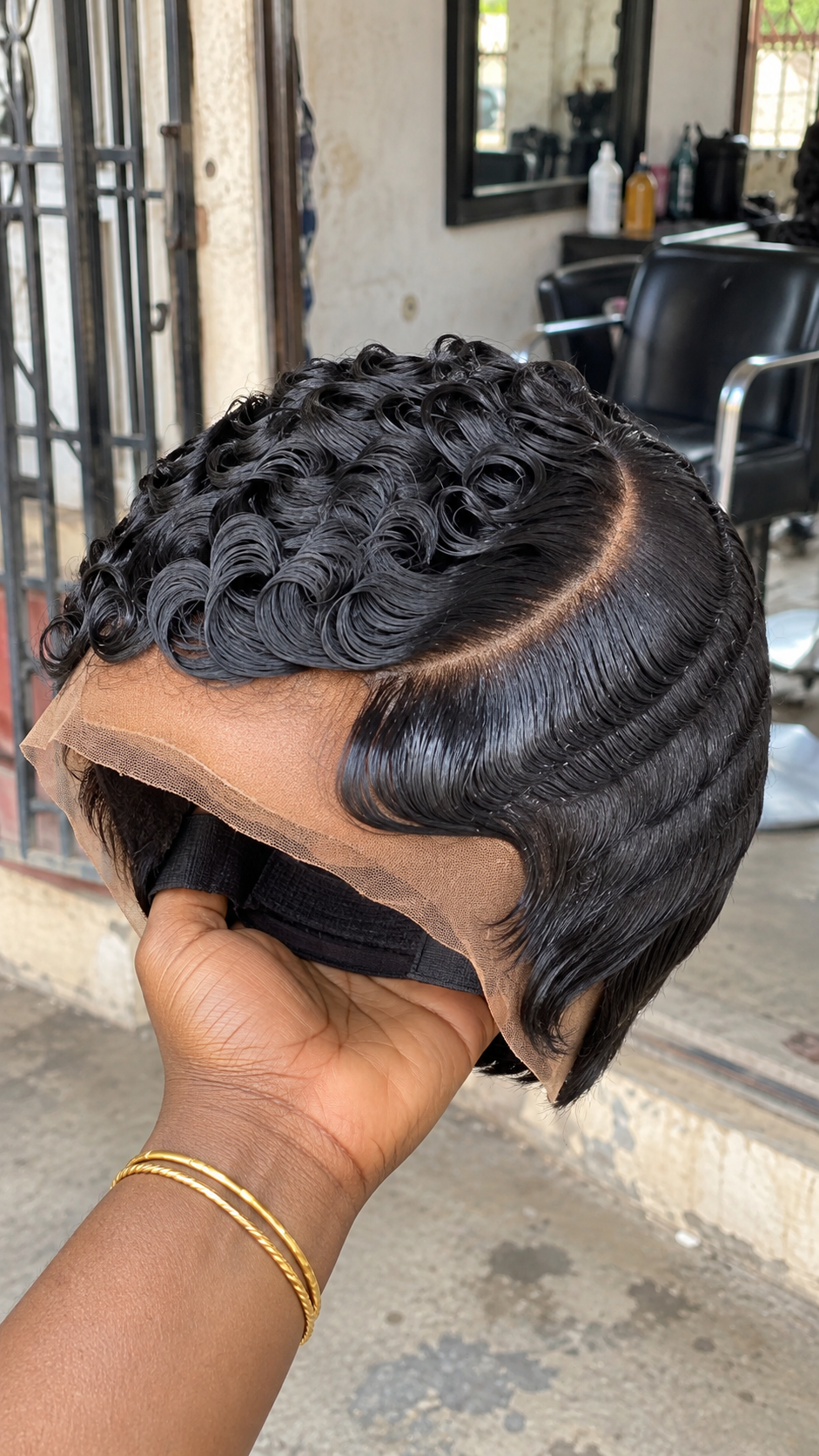
The character of a beautifully styled black pixie wig is often revealed through movement rather than color. In this distinctive hairpiece, the crown is arranged into overlapping sculpted curls, while the opposite side follows a sequence of sleek, elongated finger waves. A deeply curved parting separates the two sections, giving the hairstyle a pronounced asymmetric silhouette. The result combines the character of classic Marcel waves with the compact proportions of a carefully shaped pixie wig.
The photograph shows the wig held in one hand outside a working hair salon. Its front and side are visible from a slightly elevated angle, revealing the curved crown part, broad waves and closely arranged lower perimeter. Beige-toned lace extends beyond the hair-bearing edge, while part of the black cap foundation is visible underneath. The exterior styling appears substantially completed, but the lace has not yet been trimmed for an individual wearer.
Unlike wigs covered entirely in small corkscrew curls, this design uses larger, more open formations concentrated on one side of the crown. The neighboring section is comparatively flat, with glossy strands following long curved paths toward the rear. The two styling approaches create contrast without requiring blonde highlights, decorative shaved stripes or excessive crown height.


The photograph provides useful information about the hairstyle’s visible construction. However, it does not confirm the exact fiber composition, commercial lace grade or complete cap attachment system. Buyers should verify those specifications before ordering.
The Asymmetric Arrangement Is the Foundation of the Hairstyle
The wig is intentionally divided into two different styling zones. On one side, rolled curls occupy much of the crown and extend toward the forehead. On the other, the hair is arranged into elongated waves that follow the rounded foundation.
This contrast creates the hairstyle’s identity. The curled portion appears raised and dimensional, while the flowing side remains closer to the head.
The result is not a conventional center-parted curly pixie. Its balance depends on the placement of the curved division and the direction of the surrounding strands.
A custom wig maker should establish the asymmetry before beginning the final curl setting. Attempting to distribute the curls evenly across both sides would produce a substantially different appearance.
The Crown Uses Rolled Curls With Soft Circular Openings
The upper curled section contains numerous broad formations with visible loops and partially open centers. Several curls overlap, producing a layered appearance rather than a tightly packed arrangement of identical spirals.
The strands follow rounded paths, with some curls folding inward and others turning toward the front.
These formations differ from narrow spring-shaped corkscrews. Their wider curves create a sculpted appearance with relatively moderate volume.
For a faithful reproduction, the stylist should preserve the broad curl structure rather than replacing it with dense, tiny finger coils.
The Forward Curls Form a Distinct Sweeping Fringe
Near the forehead, several curls bend forward and create a decorative fringe. Their strands remain closely arranged, forming broad loops that sit above the untrimmed lace.
The fringe is not a straight section of hair covering the forehead. Instead, individual curled formations overlap and follow a controlled direction.
This gives the front a softer appearance while maintaining the sculpted character of the crown.
A custom stylist should reproduce the position of the forward curls without allowing them to hang excessively low or obscure the intended hairline.
The Curl Sizes Change Across the Upper Section
The upper hair does not use one identical curl diameter throughout. Some sections form broad rolled arches, while others create smaller inward loops.
This difference adds depth and helps the hairstyle follow the rounded shape of the foundation.
The larger curls provide visual interest toward the front, while smaller sections continue toward the upper rear.
For custom production, mixed curl sizes should be specified as part of the design rather than leaving the crown to a uniform setting technique.
Midnight Black Emphasizes the Arrangement of Individual Strands
The hair appears consistently deep black, with narrow charcoal reflections across the curved surfaces. No clearly separate colored highlight pattern is visible.
The monochromatic color places emphasis on the shape and direction of the styling.
The rolled curls reflect light along their outer edges, while the wave ridges on the opposite side display longer, continuous reflections.
For customers who want the photographed appearance, a rich natural-black or midnight-black shade is appropriate. The actual color should be confirmed through a neutral-light photograph before purchase.
The Curved Side Part Creates a Strong Visual Boundary
A prominent scalp-toned part travels diagonally from the forward upper section toward the rear. Its gently curved route separates the rolled crown from the flatter wave panel.
This division is a structural element rather than a decorative barber stripe.
The angle determines the amount of hair assigned to each styling zone and influences the overall asymmetry.
A maker should position this part before completing the curls and waves. Changing it substantially afterward could require extensive restyling.
The Side Part Should Remain Narrow and Consistent
The exposed separation is clearly visible, but it does not occupy an excessively broad area. Dark hair remains on both sides, emphasizing the contrast between the styling zones.
Widening the part unnecessarily could reduce the amount of hair available for the neighboring waves and curls.
For a custom unit, the maker should preserve the intended parting width and curvature.
Because hair removed from a wig does not naturally regrow, permanent alterations should be planned conservatively.
The Swept Side Uses Broad Marcel-Inspired Waves
The visible side contains several long wave ridges formed from closely aligned black strands. The waves travel backward and downward, following the rounded contour of the foundation.
Their broad reflective surfaces create a flowing appearance that contrasts with the raised crown curls.
The wave pattern has the character of classic Marcel styling, with successive curved sections producing controlled movement.
A professional recreation should preserve these elongated ridges rather than turning the entire side into additional circular curls.
The Wave Pattern Changes Direction Gradually
The side styling does not consist of isolated, identical waves. Instead, the strands travel through related curves that become more compact as they approach the lower perimeter.
This gradual transition creates continuity from the upper parting to the lower side.
The hairstyle gains much of its elegance from the way the waves follow the same general direction while varying in scale.
A custom stylist should reproduce the continuous movement rather than arranging separate disconnected curls.
The Lower Side Remains Closely Arranged
Beneath the broad wave panel, the hair becomes shorter in appearance and follows the cap more closely. This creates a compact lower silhouette without exposing the entire foundation.
The lower area still contains visible black strands and should not be treated as completely shaved.
This reduced volume allows the upper waves and curls to remain prominent.
A custom maker should preserve sufficient hair density while preventing the lower side from becoming overly bulky.
The Side Finishes With a Small Curved Strand
Near the lower front of the visible side, a narrow strand bends inward toward the lace perimeter. This curled accent provides a delicate endpoint for the broader wave arrangement.
Its scale remains smaller than the upper rolled curls and elongated side waves.
A professional should preserve the strand’s position and restrained shape rather than enlarging it into a prominent circular ornament.
The Back Requires a Separate Quality Check
The photograph shows the forward crown and much of one side, but the complete rear is not visible.
Before approving a custom order, request a rear photograph showing how the curls and waves continue toward the nape.
The rear should maintain the compact proportions of the hairstyle without creating an unexpected increase in volume.
A rear three-quarter image is also useful for confirming that the styling transitions coherently around the head.
The Lace Remains Extended for Final Installation
Beige-toned mesh extends beyond the front and side hair-bearing areas. The wig has not yet been trimmed to fit an individual wearer.
This provides flexibility during professional installation. The stylist can establish the cap position, examine the fringe and evaluate the side waves before removing excess lace.
The photograph does not verify HD lace or another specific commercial grade.
Buyers should request the actual lace specification and available shades from the supplier.
The Interior Cap Is Partially Exposed
The open underside reveals a dark foundation with stitched fabric sections. However, the complete attachment and adjustment arrangement cannot be established from the photograph.
Before purchasing, ask for a full underside photograph of the actual unit.
The seller should confirm cap dimensions, available fastening options and recommended installation methods.
Visible lace alone does not guarantee adhesive-free suitability.
Cap Measurements Influence the Side Part’s Placement
The curved division, crown curls and side waves are fixed to the wig foundation. Their positions change if the cap sits too far forward or backward.
Correct sizing therefore affects both visual accuracy and comfort.
For made-to-order construction, follow the manufacturer’s measurement guide. Depending on the cap, circumference, front-to-nape and ear-to-ear measurements may be required.
A professional wig stylist can assist with sizing before production begins.
Finding a Stylist Experienced With Vintage Wave Setting
This design requires experience with broad rolled curls and elongated Marcel-inspired waves. The two techniques must be coordinated to maintain the asymmetric silhouette.
Custom lace-wig studios, specialist wig makers and salons experienced with vintage-inspired pixie styling are practical places to begin.
When reviewing portfolios, look for examples showing large sculpted curls alongside closely arranged side waves.
A stylist experienced only with ordinary loose curls may not reproduce the directional styling accurately.
Where to Buy a Comparable Black Wave Pixie Wig
Specialist wig makers, custom hairpiece studios and beauty supply retailers offering reference-based styling may be able to supply a similar design.
A ready-made black curly wig may provide a foundation, but it might not reproduce the exact asymmetric curl placement and broad wave panel.
Custom production offers greater control over curl diameter, parting position and side-wave direction.
Before purchasing, confirm whether the quoted price includes the completed styling or only the base wig.
Booking the Right Salon Service
The required appointment depends on whether the wig arrives fully styled.
A completed unit may require fitting and minor wave restoration. An unfinished foundation could need extensive curl setting, directional side styling and lace preparation.
When booking, explain that the hairstyle combines broad rolled curls with smooth Marcel-inspired waves.
Provide the reference photograph so the salon can evaluate the necessary techniques.
Preparing a Custom Production Brief
The crown should contain broad overlapping black curls with several open centers, concentrated toward the forward side.
The curved diagonal part should separate the rolled crown from the flatter wave panel.
The side should contain elongated backward-sweeping waves that gradually become smaller toward the lower perimeter.
The hairstyle should remain entirely within the black color family without unrelated highlights or decorative carved stripes.
Finally, confirm hair material, cap dimensions, lace options and attachment preferences.
Approval Photographs Should Document the Asymmetry
A frontal photograph should show the curled fringe and its position above the hairline.
An elevated crown view should reveal the arrangement of the broad curls and the curved part.
A direct side image should show the continuous wave ridges and the compact lower hair.
A rear photograph should confirm the full silhouette, while an underside image should establish the cap construction.
The Cost Reflects Directional Styling and Construction
The wig’s compact length and single black color do not necessarily make it inexpensive. Creating broad rolled curls and continuous Marcel-inspired waves may require substantial professional styling.
Cap preparation, lace materials and fitting services can also influence the price.
Estimated Pricing for Black Marcel Wave Pixie Wigs
| Category | Illustrative Price Range | Potential Scope |
|---|---|---|
| Premium Custom | $320–$595+ | Higher-grade hair, personalized cap sizing, hand-arranged rolled curls, precision curved parting, sculpted Marcel-inspired waves and lace preparation. |
| Standard Custom | $195–$355 | Prepared black curl crown, established side-wave styling and standardized cap options. |
| Basic Human Hair | $115–$215 | A human-hair foundation requiring curl setting, side-wave construction and professional fitting. |
| Premium Synthetic | $80–$160 | A quality pre-set alternative that may maintain the sculpted wave pattern with relatively limited daily styling. |
| Basic Synthetic | $40–$95 | A budget interpretation where curl arrangement, wave precision or cap construction may be simpler. |
These ranges are illustrative budgeting estimates rather than verified prices for the photographed wig. Actual quotations depend on material, supplier, location, styling labor, cap construction, shipping and installation.
When comparing sellers, confirm whether the quoted amount includes the complete curled crown, side waves and lace preparation.
Human Hair May Allow Professional Wave Restoration
A human-hair version may allow selected curls and side waves to be reset when they lose their original shape, depending on the condition of the strands.
Professional restoration can focus on displaced sections rather than rebuilding the entire hairstyle.
Heat should be selected according to the actual hair quality and processing history.
Premium Synthetic May Retain Pre-Set Waves
A quality synthetic version may preserve its curled crown and elongated side-wave arrangement with comparatively limited manipulation.
However, heat tolerance varies by fiber, and conventional permanent coloring should not be assumed suitable.
The actual material specification should guide styling and maintenance decisions.
Washing Should Follow the Direction of the Waves
Before washing, photograph the wig from above and from the side to document the original curl and wave placement.
During cleansing, avoid aggressive rubbing that can disturb the broad rolled curls or intertwine the side strands.
Use care products suitable for the confirmed material and allow the wig to dry without compressing its sculpted sections.
Restore displaced curls and waves individually when needed.
Maintain the Curled Fringe Separately
The forward curls should retain their broad overlapping shapes rather than being brushed into a flat fringe.
If a curl becomes displaced, targeted restoration may be appropriate.
Avoid excessive pulling or heavy product buildup near the lace, where the finer strands provide a gradual hairline transition.
The Marcel-Inspired Side Requires Directional Care
The elongated wave ridges should remain aligned with the original backward movement.
Using a curling method intended for circular ringlets could disrupt the smooth wave structure.
A professional should restore the side using methods appropriate for the actual fiber and the original styling technique.
Keep the Parting Consistent
The curved side part is an important structural boundary and does not need to be widened during routine maintenance.
If fine strands move across the division, careful repositioning may restore its appearance without cutting.
Unnecessary removal can permanently alter the balance between the curled and waved sections.
Avoid Heavy Product on the Black Hair
The glossy strands already reflect light strongly. Excess oils or waxes can cause neighboring curls to adhere together and reduce their individual shapes.
Product buildup can also obscure the smooth direction of the side waves.
Use appropriate products conservatively and follow the fiber manufacturer’s care recommendations.
Installation Should Preserve the Curved Separation
When the wig arrives, inspect the curled crown, diagonal part, side waves, lace and cap before permanent alterations.
The installer should establish the intended wearing position and verify the relationship between the fringe and forehead.
Only after the alignment is approved should excess lace be trimmed and optional adjustments considered.
Storage Should Protect the Rolled Crown
A suitable wig stand or mannequin head can help preserve the sculpted curls between wears.
The waved side should remain free from pressure that could flatten the ridges.
Make sure the hair and cap are completely dry before storage.
For transportation, select packaging that provides sufficient clearance around the curled crown.
The Design’s Strength Comes From Balanced Asymmetry
This midnight-black wig combines broad rolled crown curls, a gracefully curved diagonal part, continuous Marcel-inspired finger waves and a compact lower silhouette. Its monochromatic palette allows the arrangement of the strands to remain the primary visual attraction.
For buyers, the essential quality checks are curl diameter, fringe position, parting curvature, wave direction, lower hair density, lace condition and cap suitability.
For wig businesses, detailed side and crown photographs can communicate the craftsmanship more accurately than a generic black curly-wig description. Verified fiber and construction specifications help customers understand the finished product.
A faithful recreation should maintain the asymmetrical balance between the raised crown and flowing side without adding unnecessary highlights, excessive volume or unrelated shaved designs. The hairstyle’s identity depends on the precise direction of its broad curls and smooth waves.
Search Terms
midnight black Marcel wave wig · asymmetrical curly pixie lace wig · curved side part black hairpiece · rolled black fringe curls · sweeping vintage finger wave wig · sculpted black wave panel · compact asymmetric pixie wig · classic black curled crown