
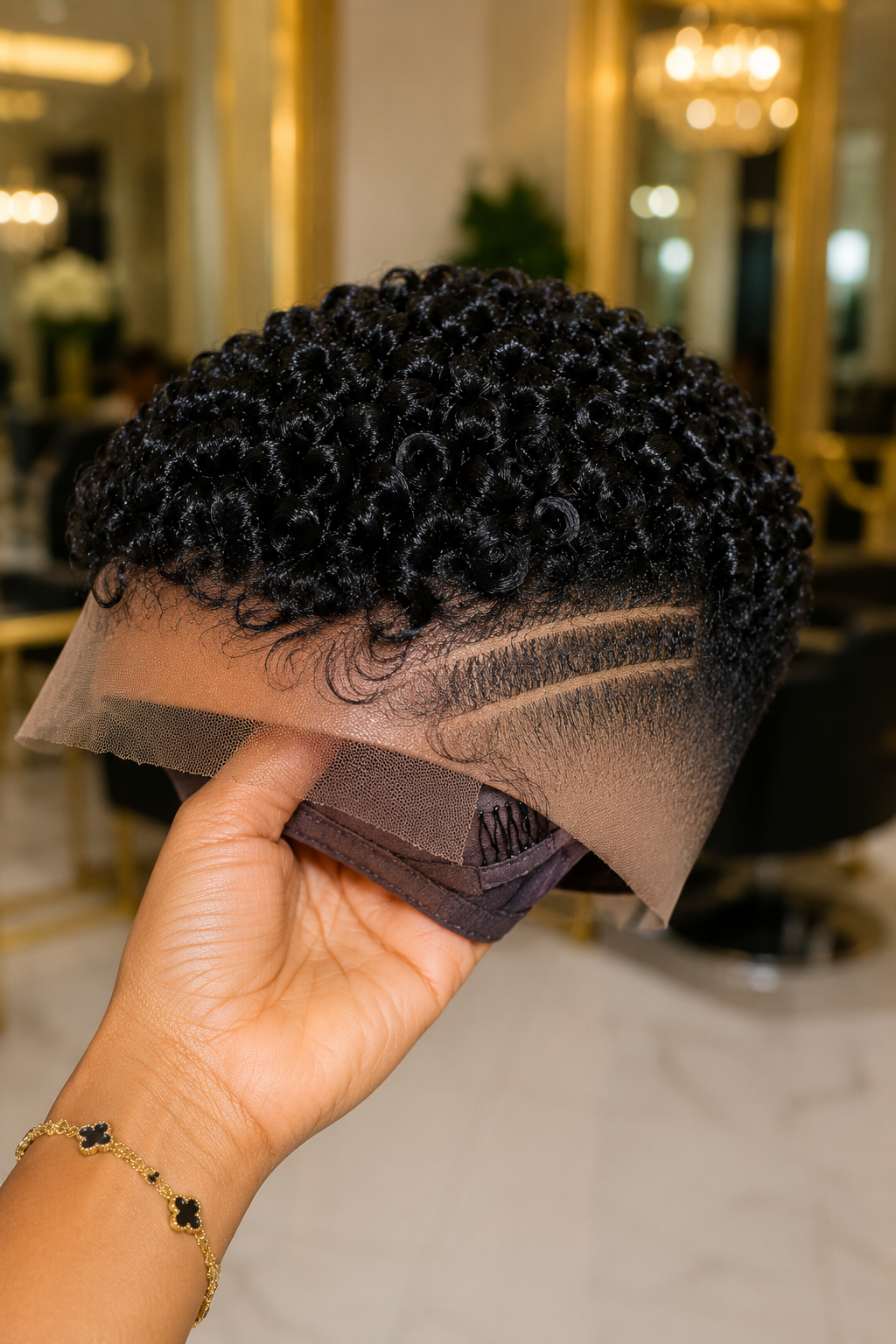
Held up in a gold-lit salon, the lace fanned wide across the hand. Tight defined coils packed high on the crown. A carved part with a small wedge cut into the side. And then the thing that should actually stop you: the sheer size of the lace panel. It runs from the front hairline back past the temple and down the side, and almost all of it has hair knotted into it — full coils at the top, then shorter lengths, then stubble, then nothing.
On a long wig, lace is a small strip at the front and the rest is cap. On a short faded pixie like this one, lace is most of what you are looking at. That ratio is not a design detail. It is the price.
Where To Buy A Wig Like This
A large knotted lace panel is the thing to search for, and it is not what most listings advertise. Plenty of makers sell a “lace front pixie” that is a narrow strip of lace at the hairline with a wefted cap starting an inch behind it — which cannot produce a fade at all, because there is nowhere to knot the short hairs into.
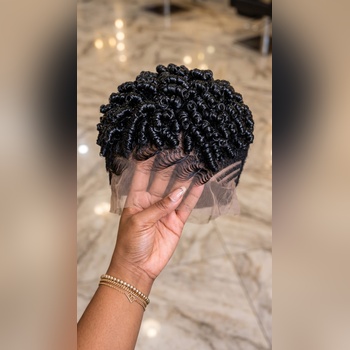
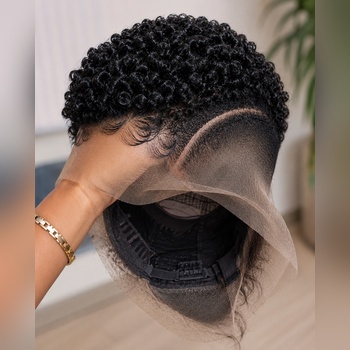
Custom wig makers and lace studios are the main route. Search with construction-specific vocabulary rather than style terms: “full lace fade pixie wig,” “hand knotted fade lace wig,” “large lace panel curly pixie,” “HD lace pixie with combs.” A maker who describes the lace area rather than just saying “lace front” understands what they are selling.
Instagram and TikTok wig specialists are the richest source. Skip the styled head shots and go straight to held-unit photos like this one — you are looking for how far the lace extends and whether hair is knotted into all of it. Makers proud of their knotting hold the piece open exactly this way.
Etsy works for made-to-order pieces. Read buyer-uploaded photos rather than seller staging, and message to ask the lace dimensions before ordering. Listings routinely say “lace front” for wildly different constructions.
Contact / Order Inquiries: WhatsApp is the standard channel for independent makers. [WhatsApp: +XX XXX XXX XX XX] — send this exact photo as a reference and ask directly: “How far back does the lace run, and is the entire fade hand-knotted into lace or is there weft behind it?” That one question separates the real thing from the imitation.
How Much It Costs
Solid black, no lifting or toning, so every dollar above a basic unit is buying knotting hours, not colour.
100% human hair, large hand-knotted lace panel, full stubble fade, bleached knots, carved part, glueless cap with combs: generally $220–$460
100% human hair with a standard narrow lace front and a wefted cap behind it: typically $130–$280
100% human hair, basic cap, no fade or design work: typically $70–$180
High-quality synthetic with comparable finishing: usually $60–$140
Basic synthetic curly pixie: often $20–$55
The arithmetic worth knowing: knotting is priced by the hour, and hours scale with lace area. Every single hair in that panel — including thousands of stubble-length hairs that produce no visible volume at all — was tied by hand, one at a time. The shortest hairs are the slowest to tie and the most fiddly to keep even, and they contribute nothing to the look except the fade. That is why a properly knotted fade unit costs roughly double a pixie with the same hair on a wefted cap: you are paying for hair that exists purely to disappear.
Shipping, Delivery, And What To Expect After Ordering
Made-to-order timing. A lace panel this size is many hours of knotting. Expect two to four weeks rather than a few days, and do not be surprised by longer on a busy maker.
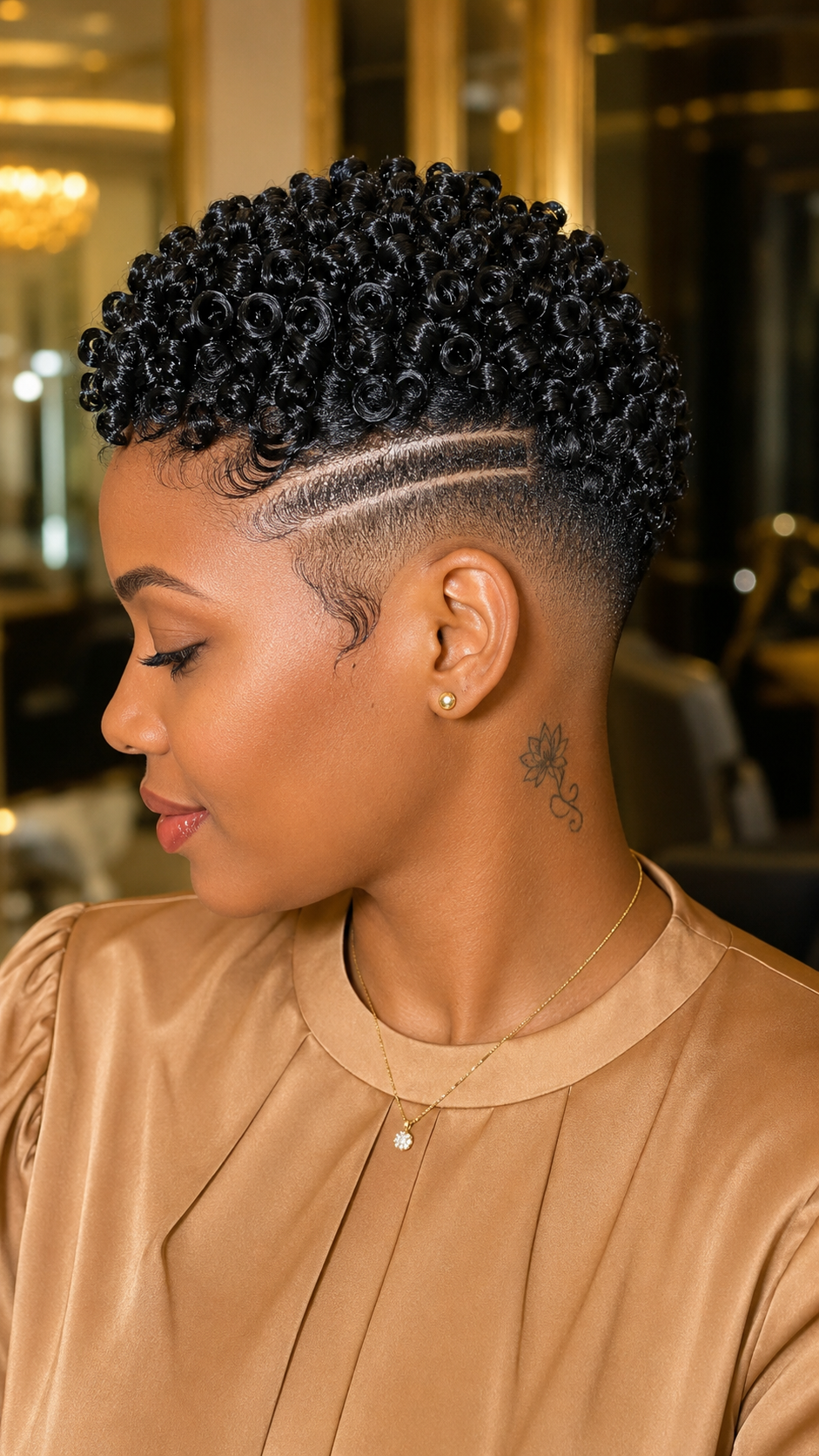
Lace arrives untrimmed, exactly as shown here, extending well past where you will cut. That excess is intentional — it is your margin to cut along your own hairline instead of a factory’s average.
International shipping is normal with Instagram, TikTok, and Etsy sellers, though delivery windows and customs fees vary by country. Ask about tracked shipping before you pay.
Returns are usually limited on custom pieces. Get the policy in writing.
Cap fit is the most common regret. Send your head measurement and ask whether they build to it.
Reading The Lace Panel
Hold the piece the way it is held here and look at what the lace is doing.
At the top of the panel, full coils are knotted in. Move down and the lengths shorten. Further down they become stubble — visible as fine dark dots and short hairs tied directly into the mesh. Below that, bare lace.
That gradient is the fade, and it exists only because there is lace to knot it into. A wefted cap cannot do this: wefts are rows of hair sewn onto fabric, and there is no way to sew a row of stubble. This is why cheap “faded” pixies look wrong — the fade is either printed on, painted with a marker, or simply absent, with the hair stopping in a hard line.
What to check: the density should decrease smoothly rather than in visible steps; there should be no bald patches in the middle of the gradient; the stubble region should look evenly distributed rather than clustered; and the transition from stubble to bare lace should be gradual rather than a straight edge.
The Carved Part And Wedge
Cut into the side is a single carved part with a small wedge shape at one end. Restrained rather than busy, which suits a piece where the fade is already doing the visual work.
A single line is more exposed than a pattern — with three lines the eye reads the group and small errors get absorbed; with one, every millimetre is the design. It has to stay even in width along its whole length, follow the curve of the head smoothly, and end cleanly rather than trailing off. The wedge adds a second thing to get right: its angles have to be crisp and symmetrical, and there is no un-carving it.
Judge it on confidence — a line that looks cut in one motion rather than corrected into shape.
The Lace, The Knots, And The Baby Hairs
The lace is fine and sheer, and worth judging on its own. Hold it toward light: good lace is fine enough to see through clearly and has a matte, skin-like tone rather than a shiny or grey cast. The finer it is, the better it disappears — but finer lace also tears more easily, so handle it gently, especially around the ends where you cut.
Check the knots along the hairline. On a careful unit they are bleached so the lace reads as scalp rather than a scatter of dark dots. This matters more on a piece with a large lace panel than on a narrow lace front, simply because there is more of it on show.
At the front, fine baby hairs are knotted in individually and left soft rather than laid into a shape. That is the raw material for whatever edge style you want — it can be combed into a swoop or molded into waves after fitting, but it has to be knotted in at the factory. A piece with no baby hairs at the hairline can never be given a soft edge later.
The Tight Coils And The Cap
The coils are tight, defined spirals — compact separated rings rather than loose barrels. Tight coils show thinness immediately, so density has to be genuinely full for the crown to read right. Each ring should be similar in diameter, springy, and cleanly defined. Ask for a short video: a still photo cannot tell you whether coils bounce back or sit limp.
The cap is visible beneath the lace here, with a comb sewn in. That points to a glueless build — it secures mechanically, with no adhesive on your skin, no removers, and no slow traction damage to your own edges. Ask whether there is also an adjustable strap. But glueless only works if the fit is right. Measure your head with a soft tape — from the front hairline, around above the ears, around the nape, and back to the start. Most caps run 21.5–22.5 inches, but real heads vary, so ask whether the maker builds to your measurement.
Before You Pay
How far back does the lace panel run, and is the entire fade hand-knotted into lace?
Is there any weft behind the fade region, or is it lace all the way?
Are the knots bleached, and what lace type and tone are you using?
Are baby hairs knotted in at the hairline?
Is the cap glueless — combs and an adjustable strap — and can it be built to my head measurement?
Trimming The Lace
This is the one place a large lace panel works against you: there is more of it to cut, and more chance of going wrong. Cut slowly and follow your natural hairline. Leave a small margin instead of going flush, and use small staggered cuts rather than one straight line. Remember that the lace on the sides sits over the fade region, so trimming there affects how the taper meets your skin, not just the front. If you are new to lace, pay a stylist for the first cut and copy what they do — on a piece like this the first cut is genuinely the highest-stakes moment of ownership.
Search Terms
full lace fade pixie wig · hand knotted fade lace wig · large lace panel curly pixie · carved part pixie lace wig · HD lace tight coil pixie with combs · where to buy hand knotted fade pixie wigs
Final Thoughts
Study this piece if you want a single test for whether a short curly wig is worth its price. Ignore the curls for a moment and look at the lace: how far does it run, and is there hair knotted into all of it?
That answer is the whole story. A large hand-knotted panel means someone spent hours tying stubble that produces no volume and exists only so the hair can disappear into your skin. A narrow lace strip with weft behind it means the fade is a suggestion rather than a construction, and it will read that way on your head.
No colour, no gimmick here — just the difference between a piece built to dissolve at the edges and one that stops in a line. Ask for the held photo, look at the lace, and buy accordingly.