
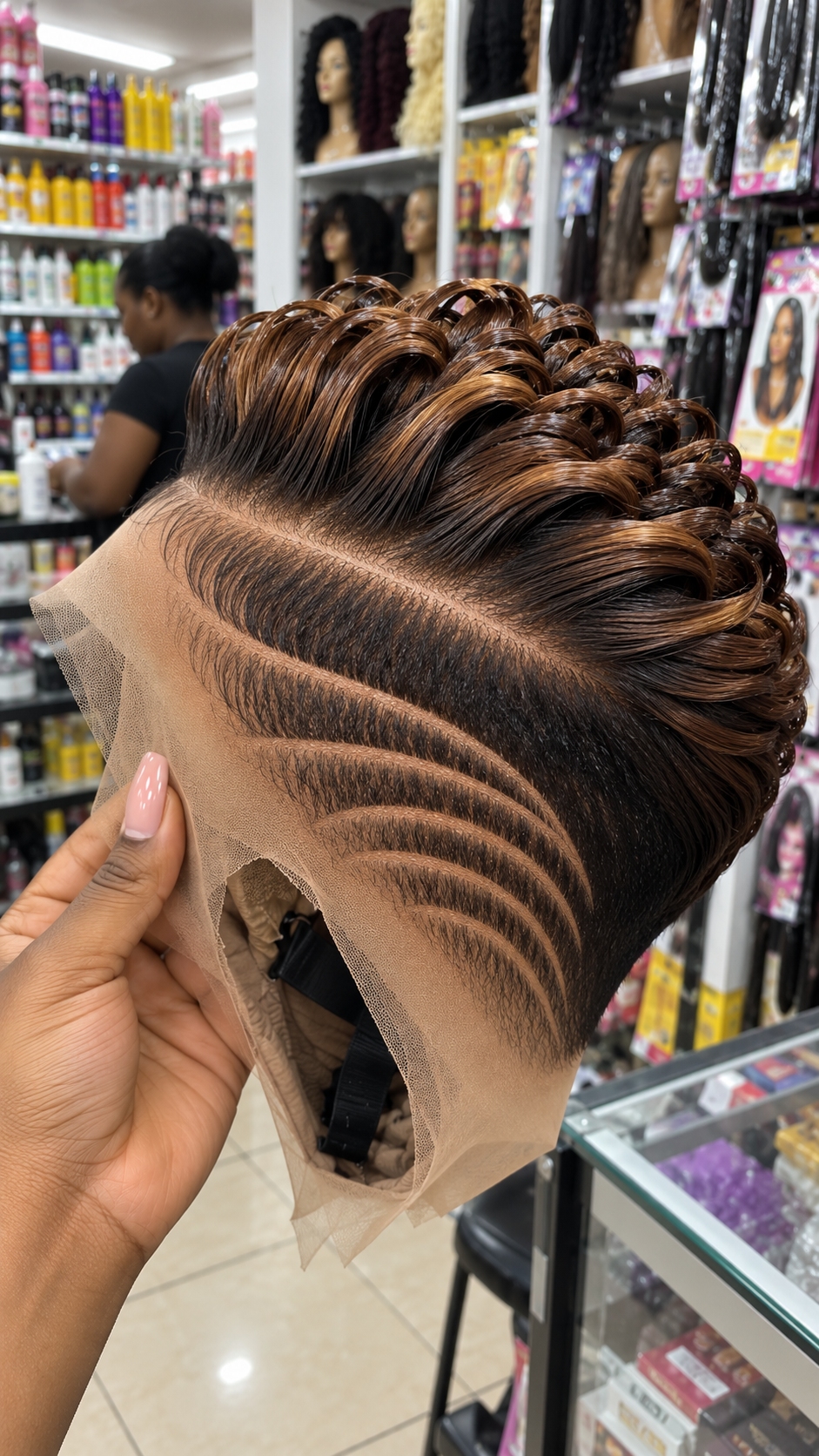
What makes this wig distinctive is not simply the caramel-brown color or the sculpted crown. Its strongest idea is progression. The upper hair begins with tall ribbon-like sections, develops into broader interlocking loops through the middle, and becomes increasingly compact toward the back. The side follows a similar principle: a large dark panel sits beneath the crown, while several curved channels become progressively narrower and shorter as they descend. Instead of placing unrelated decorative elements on one wig, the construction repeatedly moves from large forms into smaller ones.
The color supports that architecture. Warm caramel and medium brown reflections travel across the raised portions of the crown, while considerably darker roots and recessed strands remain visible underneath. Because the lighter brown follows the direction of the loops, it helps reveal their shape rather than behaving like random highlighting. The photograph also shows generous untrimmed lace and portions of the interior cap. Lace construction is clearly visible, but nothing in the image proves that the material is specifically HD lace, so that designation should only be used if a seller can verify it.
Read the Crown From Front to Rear, Not as One Hairstyle
The crown makes more sense when viewed as a sequence. Near the front, long sections rise almost vertically before bending backward. These pieces have relatively open interiors, allowing the darker foundation to remain visible between them. Their purpose is to establish height and begin the backward direction of the hairstyle.
The middle changes the rhythm. Here, the bends become broader and overlap more noticeably. Individual ribbons still remain readable, but their curves interact with neighboring sections. Warm brown surfaces catch the light while the darker undersides create shadow. This produces much of the dimensional appearance seen in the photograph.
At the rear, the design tightens again. Smaller loops gather closer together and follow the rounded contour of the wig. This prevents the back from becoming excessively bulky. A recreation that uses identical loops from front to back would miss this gradual shift in scale.
For a custom order, this progression should be one of the first requirements discussed. A seller may be able to reproduce the color while using a simpler crown arrangement. Asking for front, overhead and rear three-quarter photographs before shipment is a practical way to check whether all three zones have actually been created.
The Brown Placement Acts Like a Guide Through Each Loop
The visible brown is neither a uniform all-over shade nor a collection of isolated bright streaks. Dark roots dominate the lower portions of many sections, while warmer caramel-brown tones become prominent as the hair rises and bends. On several crown ribbons, the lighter surface continues around the curve, making the direction of the loop particularly easy to see.
This placement gives the color a structural purpose. If the same caramel tone were scattered randomly through the wig, the palette might remain similar but the crown would lose much of its visual organization. Likewise, coloring every strand the same light brown would remove the dark recesses that currently separate neighboring sections.
When requesting this effect, buyers should show the reference and explain that they want a dark foundation with warm brown concentrated through the visible crown ribbons. The goal is not maximum brightness. The dark-to-warm relationship is what creates depth.
The Side Is Built Around Graduated Spacing
The lower side has its own hierarchy. Directly beneath the crown sits a long exposed separation. Below that is a substantial panel of close dark hair. Farther down, several sweeping channels create a layered pattern, with dark strands deliberately retained between them.
The channels are not identical copies. Their lengths and curvature change as they descend, creating a nested effect. One travels farther around the side, while the lower paths terminate earlier and curve more tightly. This graduation echoes what happens in the crown, where large forward forms eventually become smaller rear loops.
That relationship is easy to destroy through over-cutting. Widening every channel to the same measurement would remove the differences between them. Adding another line simply because there appears to be available space would also change the balance. The design already has enough movement; successful customization depends on preserving the existing spacing.
The Dark Side Panels Are Part of the Artwork
It is tempting to focus only on the exposed channels, but the dark hair between them is equally important. These areas provide the contrast necessary for each curve to remain visible. They also connect the lower portion visually with the dark roots of the crown.
A barber working on the unit should therefore think in terms of preserving panels rather than merely carving lines. The amount of hair left between one path and the next determines whether the pattern looks layered or begins to merge into one broad exposed area.
This becomes especially important during future maintenance. Wig hair does not regenerate after cutting. Repeatedly widening the channels at every appointment can gradually consume the dark panels until the original geometry is impossible to recover. Refinement should be conservative and based on the original reference.
Why the Untrimmed Lace Is Useful at This Stage
The visible lace extends well beyond the front and side hair-bearing areas. For a buyer planning professional installation, that extra material provides options. The stylist can place the wig on the wearer, evaluate where the crown begins, check the location of the side design and only then establish the final perimeter.
Fine strands are visible near portions of the front transition. Their density is substantially lighter than the crown behind them. They should not automatically be removed simply to produce a sharper edge. Once the wig is positioned, a stylist can determine which strands contribute positively to the final hairline.
Lace shade should be selected through the seller’s actual options rather than guessed from this photograph. Store lighting and camera processing can change the apparent tone of mesh considerably. The same caution applies to transparency: visible lace in a close photograph is not enough evidence to assign a particular commercial lace grade.
Turn the Photograph Into a Commission Sheet
Instead of sending the picture with a message saying “I want this wig,” a buyer can divide the order into several non-negotiable points. The foundation should remain dark. Warm caramel-to-brown color should travel through selected crown ribbons. The front crown should contain elongated raised loops, the middle should become broader and more interlocked, and the rear should tighten into smaller formations.
The side brief should be equally precise. It needs the long separation beneath the crown, a substantial close-hair panel and a group of graduated sweeping channels below. The maker should understand that the dark spaces between those channels must remain intact.
After the appearance has been agreed upon, practical specifications can be added: cap measurements, available lace shade, whether the lace should remain uncut and whether final side refinement is included in the quoted service.
This method makes substitutions easier to identify. If the finished wig has random caramel streaks, equal-sized crown loops or three straight side lines, the customer can point to a specific difference rather than debating whether the overall hairstyle looks “close enough.”
Decide Where the Final Barber Work Should Happen
There is a useful question to settle before ordering: should the side pattern be completely finished by the wig maker, or should part of it be refined after fitting? The answer depends on the buyer’s access to a skilled local professional.
Completing everything before shipment can be convenient, especially when the maker has a strong portfolio of similar work. However, the fixed side design will arrive positioned according to the cap rather than the customer’s actual head. Accurate measurements become particularly important.
Leaving conservative final refinement for a local barber gives more control over placement. A wig stylist can first position the cap and trim the lace. The barber can then evaluate how the sweeping channels sit relative to the temple and ear before making any irreversible adjustments.
Neither route is automatically superior. The important point is to decide in advance which professional is responsible for each stage. Otherwise, a seller may assume the local stylist will complete the detailing while the customer assumes the pictured side design is included.
Judge the Quote by Completed Labor
A compact wig can be deceptive when comparing prices. There is less overall length than on a long unit, but this construction concentrates labor into relatively small areas. Color placement, crown sectioning, loop formation, density control, side geometry, lace preparation and cap work can all influence the quotation.
| Category | Estimated Price Range | Reason for the Difference |
|---|---|---|
| Premium Custom | $330–$570+ | Higher-grade hair, individualized sizing, planned caramel placement, hand-arranged crown progression, precision side work and detailed lace preparation. |
| Standard Custom | $205–$350 | Prepared brown ribbon crown and established side geometry with more standardized cap and fitting options. |
| Basic Human Hair | $125–$225 | A restylable foundation that may still need professional coloring, crown construction and barber customization. |
| Premium Synthetic | $85–$160 | A quality pre-set alternative where the loop arrangement may retain its shape with less frequent resetting. |
| Basic Synthetic | $40–$95 | A lower-cost interpretation that may simplify color distribution, side precision, crown complexity or lace construction. |
These are broad planning ranges rather than guaranteed selling prices. Hair source, fiber, country, labor, cap construction, lace choice, coloring and shipping can change the total significantly. Salon installation and later barber maintenance may also be separate expenses.
The better comparison is based on completed work. If one quotation includes the brown placement, full crown setting and side design while another covers only a basic human-hair unit, the two prices represent very different products. Ask sellers to state what will already be finished when the package leaves their hands.
Use Approval Photos as Quality Control Before Delivery
For a commissioned wig, approval photography should be treated as part of the ordering process rather than an optional extra. A side image can verify the graduated channels and the amount of dark hair retained between them. An elevated image can show whether the caramel ribbons actually follow the crown loops. A rear three-quarter image can confirm that the styling becomes tighter toward the back.
Look at the actual unit being shipped whenever the seller offers this service. Inspiration photographs demonstrate the requested design; they do not prove that the commissioned wig has been constructed the same way.
It is also sensible to inspect the lace before asking the seller to trim it. Once lace has been cut or additional hair has been removed, correction options become more limited. If the wig arrives unaltered, inspect it again at home before taking it to the salon.
Maintenance Should Preserve the Color Map
The warm brown sections provide a convenient visual map for crown maintenance. Before the first wash, photograph the wig from above and both rear angles. Record where the caramel ribbons rise, where they bend and which sections remain predominantly dark.
During cleaning, avoid scrubbing several crown loops together. Once neighboring sections become tangled, restoring their original placement becomes more difficult. Products should be selected according to whether the unit is human hair or synthetic fiber, and colored human hair should be treated with its processing history in mind.
If a human-hair version eventually needs heat resetting, the goal should be to rebuild the existing loop directions rather than inventing new curls. Excessive heat can also affect processed brown strands, so temperature should be kept within the range recommended for the particular hair.
Synthetic fiber requires a different approach. Some fibers accept controlled heat while others do not. Never assume heat resistance based on appearance alone; confirm the fiber specification first.
Protect the Rear From Compression Between Wears
The smaller rear loops are more vulnerable to being crushed than the large forward ribbons. Storing the wig flat underneath other units can compress this area and disturb the gradual crown progression.
A suitable wig stand or mannequin head gives the rear enough clearance to maintain its rounded arrangement. The lace and cap should be completely dry before storage, and adhesive residue should be removed with methods appropriate for the material.
When transporting the wig, allow enough space around the crown rather than forcing it into a shallow container. Preserving the structure physically is usually easier and less expensive than repeatedly paying a stylist to reconstruct it.
Refresh the Side by Restoring Visibility, Not Removing More Hair
The side channels may eventually appear less distinct as fine strands shift over their edges. That does not necessarily mean they need to be cut again. First reposition the surrounding hair and compare the result with the original side photograph.
If barber work is genuinely necessary, the reference should remain visible throughout the appointment. The professional can compare the width, spacing and endpoints of the channels before removing anything. The aim is to return the design to its previous proportions rather than making every line deeper with each visit.
This preservation-first approach is particularly valuable for the lowest channels because their dark separating panels are relatively narrow. Once too much material has been removed, rebuilding the original nested effect may require much more extensive wig work.
Book Installation Only After the Unit Passes Inspection
When buying online, wait until the actual wig arrives before committing to irreversible installation work. Compare the brown distribution, crown progression and side pattern with the approved order. Check the cap and inspect the lace for damage or unexpected alterations.
If everything is correct, the first professional step should be fitting. Once the wig stylist establishes the final position, the lace can be prepared according to the wearer’s needs. Any remaining barber adjustment should follow that placement rather than precede it.
Customers sourcing the unit locally can use an initial consultation to establish measurements and responsibilities before construction begins. This is especially useful when one professional will handle the wig and another will handle the precision side work.
The Best Match Will Reproduce the Progression, Not Merely the Palette
A brown wig with carved lines can resemble this reference at a glance and still miss what makes it interesting. The real signature is the controlled progression running through the entire design. Tall forward ribbons lead into broader caramel loops, those loops become smaller toward the rear, and the side channels repeat the same large-to-small logic below.
That gives buyers a useful standard when comparing potential purchases. Check whether the warm brown follows the crown movement, whether dark roots remain visible, whether the rear becomes more compact, and whether the side paths retain graduated lengths with sufficient dark hair between them. Those observations are more reliable than searching for a single marketing name.
For wig businesses, detailed side and overhead photography can communicate this craftsmanship clearly. Accurate descriptions of fiber, lace, cap options and included customization should accompany those images. When the construction itself is the selling point, showing exactly how the wig has been built is far more persuasive than attaching an unsupported premium label to it.
Search Terms
caramel brown ribbon crown wig · dark root caramel loop wig · graduated side sweep wig · layered curved channel wig · warm brown lace crown wig · interlocking caramel loop hairpiece · nested side arc wig · untrimmed lace brown wig