
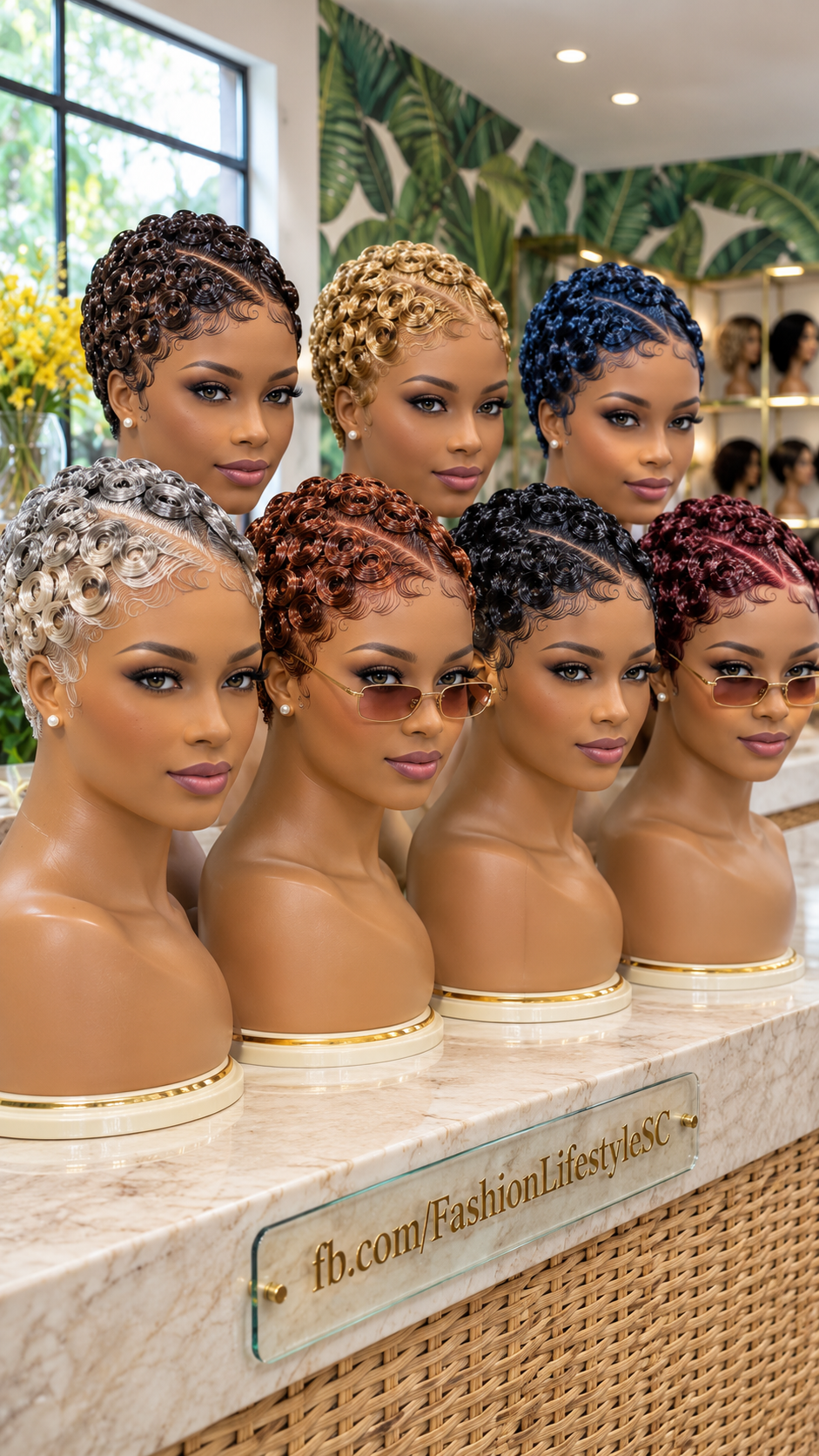
Some hairstyle collections make color the main attraction. Others invite a closer look at the craftsmanship behind every curl. This salon display brings both qualities together through a coordinated selection of compact pixie wigs featuring sculpted circular coils, diagonal side partings, and delicate finger-wave hairlines. The visible shades include rich chocolate brown, golden blonde, midnight blue, pearl silver, copper, jet black, and deep burgundy.
The wigs are displayed on seven warm caramel-brown mannequin busts inside a bright boutique with tropical leaf wallpaper, large windows, and a cream marble-style counter. Three mannequins are positioned behind four in the front row. Although the display looks cohesive, the individual wigs are not identical in every respect. Their coil sizes, front wave arrangements, and visible parting positions vary subtly from one color to another.
These differences matter to customers because the most attractive color is not necessarily attached to their preferred curl arrangement. A shopper might love the warmth of the golden blonde wig but prefer the more compact front coils of the black version. Another buyer may favor the deep blue shade while wanting the side-swept hairline visible on the chocolate-brown unit.


The photograph provides a useful visual reference for comparing these possibilities. It does not, however, establish the fiber composition, cap construction, lace grade, or fastening system of any displayed wig. Those product details should be verified directly with a seller before purchasing.
What Makes the Collection Recognizable
The shared design language begins with compact circular curls arranged across the crown. Many of the coils form miniature rosettes, with strands curving around visible central openings. Instead of hanging downward like conventional ringlets, the curls remain close to the head, producing a rounded pixie silhouette.
The front sections are equally important. Fine strands follow the forehead in sculpted waves, often creating elongated curves beneath a diagonal parting. These waves are flatter than the raised curls above them, allowing the two styling techniques to remain visually distinct.
Several wigs also display small curls near the temples. These formations connect the circular crown with the front hairline without introducing long bangs or dramatic side volume.
Because the upper curls are relatively compact, the hairstyles retain a close-fitting appearance. The visual interest comes from the circular construction and wave direction rather than excessive height.
When evaluating a similar wig, the buyer should consider three separate characteristics: the appearance of the crown coils, the placement of the diagonal part, and the direction of the finger waves. Matching only one of these details may not reproduce the desired result.
Chocolate Brown Curls Create a Rich Opening
The upper-left mannequin displays a deep chocolate-brown pixie with tightly arranged circular curls. The color appears dark and warm, with subtle brown reflections along the curved strands.
Several prominent coils sit near the upper front, while smaller circular formations continue toward the crown and sides. A diagonal separation introduces a lighter channel between the raised curls and the fine hairline styling.
Near the forehead, strands are arranged into sweeping waves that curve toward the temple. Their position gives the compact hairstyle a directional appearance without requiring longer hair.
Chocolate brown offers an appealing alternative for customers who prefer a darker shade but want warmer reflections than pure black.
Distinguishing Chocolate Brown From Espresso
Dark chocolate and espresso may look similar in indoor photographs, but natural daylight can reveal important differences. Chocolate brown often displays more warmth, while espresso can appear closer to black.
The photographed wig has noticeable brown reflections in the raised curls. Buyers should request a daylight photograph of the actual product rather than relying solely on a color name.
It is also useful to ask whether the color is consistent throughout the unit or contains intentional tonal variation.
Golden Blonde Makes the Circular Coils Stand Out
The upper-center mannequin wears a warm golden blonde pixie with densely arranged rosette curls. Its lighter color makes the individual circular openings particularly visible.
Several curls near the crown reflect bright gold, while neighboring sections appear slightly deeper and more honey-toned. The variation creates dimension without introducing clearly separated dark highlights.
A diagonal part is visible near the upper front. Beneath it, fine golden strands follow gentle curves across the forehead and toward the temple.
Golden blonde is especially effective for displaying sculpted curls because shadows inside the circular formations create contrast against the lighter outer strands.
This option may appeal to customers who prefer warm blonde shades rather than cool platinum or silver.
Golden Blonde Versus Honey and Caramel
Golden blonde, honey blonde, and caramel can overlap in wig catalogs, but the actual shades may differ considerably.
The pictured unit appears predominantly warm golden blonde, with deeper golden reflections inside the curls.
When ordering, request actual product photographs under neutral daylight. If the seller provides color samples, compare the proposed shade against the reference rather than selecting solely by its label.
The photograph does not establish whether the color was manufactured into the fibers or created through chemical processing.
Midnight Blue Adds a Distinctive Fashion Color
The upper-right mannequin wears a rich midnight-blue pixie with compact circular curls and a sculpted front hairline.
The color appears deep navy blue, with brighter blue reflections along several curls. Unlike electric blue, the shade remains relatively dark, particularly in the spaces between neighboring coils.
The diagonal part introduces a clear separation across the upper front, while small decorative waves follow the forehead and temple.
Midnight blue provides a striking contrast to the warm brown and blonde wigs nearby, yet the hairstyle remains recognizable because of its compact circular curls.
Why Deep Blue Requires a Real Color Reference
Blue wigs can vary from bright cobalt to navy, royal blue, and blue-black. Those shades may produce very different appearances in everyday lighting.
The photograph shows a deep saturated blue with darker areas rather than a uniformly bright electric shade.
Before ordering, ask the supplier for photographs under both daylight and indoor lighting. Strong reflections may exaggerate the apparent brightness of blue strands.
If the unit is synthetic, confirm whether the color is incorporated during manufacturing. If it is human hair, ask about the coloring process and maintenance requirements.
Pearl Silver Brings a Light Metallic Contrast
The front-left mannequin wears a pale silver pixie with compact rosette curls arranged across the crown. Its color appears silver-white, with cool gray reflections visible in some sections.
The circular coils remain closely grouped, creating a rounded silhouette. Several prominent curls near the front are positioned above a diagonal parting, while fine strands sweep across the forehead.
The light color makes the individual curl openings especially easy to identify. Subtle shadows between the loops help distinguish their layered structure.
The overall effect differs from the warmer golden blonde unit behind it. Silver produces a cooler appearance, while the blonde emphasizes yellow-gold warmth.
Silver, Platinum, and Pearl White Are Different Choices
Some wig catalogs group silver, platinum blonde, and pearl white under similar product descriptions. However, the actual colors can differ in gray, beige, or ivory undertones.
The pictured front-left wig appears silver-white rather than strongly golden.
Customers should request an actual color sample when possible, especially if they want to avoid an unexpectedly yellow or gray result.
Light-colored wigs may also reveal styling-product residue more readily than darker units.
Copper Rosette Curls Bring Warmth to the Front Row
The front-center-left mannequin displays a rich copper pixie with glossy circular curls and carefully arranged front waves.
The upper hair contains warm reddish-orange reflections, with deeper auburn tones appearing between the rosettes. Several prominent circular formations are visible near the front, while smaller curls continue around the crown.
The diagonal part guides the styling direction, and fine strands curve across the forehead into decorative finger waves.
The mannequin wears tinted sunglasses, adding another element to the retail presentation. These glasses should not be assumed to be included with a wig purchase.
Copper creates a noticeably warmer appearance than chocolate brown or midnight blue. It may appeal to customers who enjoy red-based hair colors without choosing a deeper burgundy shade.
Copper Versus Auburn and Ginger
Copper often emphasizes reddish-orange warmth, while auburn generally includes more brown. Ginger may describe a range of lighter orange shades.
The photographed wig appears to belong to a rich copper family, with warm red-brown depth inside the curls.
Request an actual product photograph under daylight before confirming the shade. The color should be evaluated across the full hairstyle, not just in a small fiber sample.
Jet Black Offers a Classic Sculpted Pixie
The front-center-right mannequin wears a glossy black pixie with densely arranged circular curls. The deep black color emphasizes the shapes of the rosettes through reflected light rather than contrasting highlights.
Several curls near the upper front form recognizable circular openings. The diagonal part remains visible against the dark hair, and fine finger waves curve along the forehead.
The compact silhouette makes the styling appear deliberate without introducing excessive crown height.
For customers who prefer a dark hairstyle that works with different clothing and accessories, black provides a versatile option.
Why Shine Is Not Proof of Fiber Quality
The black curls reflect the salon lighting strongly, creating a polished appearance. However, shine does not establish whether the wig contains human hair or synthetic fibers.
Both material categories can produce glossy surfaces under favorable lighting.
Buyers should ask for the exact fiber specification, curl maintenance instructions, and details about the cap rather than judging quality from reflections alone.
Burgundy Completes the Collection With Deep Red Color
The front-right mannequin wears a rich burgundy pixie with compact circular curls and decorative front waves.
The color contains dark wine-red reflections, particularly along the outer surfaces of the rosettes. Deeper red and plum tones appear in shaded areas between the curls.
A diagonal part travels across the upper front, while the fine hairline strands follow curved paths toward the temple.
The mannequin wears tinted sunglasses, creating a fashion-oriented presentation while maintaining the same compact hairstyle family.
Burgundy provides a deeper alternative to copper. Customers who prefer red-based colors without strong orange warmth may find it appealing.
Choosing a Wine-Red Shade
Burgundy may describe several colors, ranging from plum red to dark cherry and wine brown.
The photographed wig appears deep and richly saturated, with visible red-purple undertones.
Ask for photographs under different lighting conditions before purchasing. Deep burgundy can appear almost black in dim environments but reveal stronger red reflections outdoors.
The Diagonal Parting Links the Different Colors
Across the collection, diagonal partings provide a shared structural element. These exposed separations run through the upper front rather than dividing the hair evenly down the middle.
The parting direction creates asymmetry while separating the raised circular curls from the flatter finger-wave sections.
Its visibility changes with color. In dark wigs, the contrast between the hair and underlying scalp-like surface is pronounced. In lighter wigs, the transition appears softer.
When commissioning a custom unit, specify the preferred parting direction rather than requesting an unspecified side part.
The photograph does not establish how each separation was constructed. Some methods may rely on hair placement, while others may involve additional styling.
Finger Waves Shape the Forehead and Temples
The fine front strands are arranged into curved ridges that follow the forehead and continue toward the temples.
These finger-wave sections lie closer to the mannequin heads than the circular crown curls.
The contrast creates two recognizable styling zones within the same compact hairstyle.
Several wigs have small decorative curls near the temples, while others display slightly broader waves along the front.
This variation means buyers should evaluate the specific hairline arrangement of the selected wig instead of assuming that every color has identical styling.
Why Hairline Arrangement Matters After Installation
A beautifully sculpted hairline can appear different once a wig is fitted to a person.
The final position depends on cap size, forehead proportions, and the intended installation method.
For custom orders, ask whether the front waves can be arranged to suit the wearer’s measurements.
Any permanent trimming should be completed only after fitting because cutting too much hair may remove the length needed for the decorative curves.
The Mannequins Do Not Reveal the Cap Construction
Although the display clearly presents the finished hairstyles, the cap interiors are concealed.
The photograph cannot establish whether the wigs use lace fronts, closures, full-lace construction, or other cap types.
There is also insufficient evidence to determine whether the units are human hair, synthetic, or blended.
Cap circumference, fastening components, and adhesive requirements remain unknown.
Buyers should request complete underside photographs and written specifications before purchasing.
Choosing Between Closure, Frontal, and Glueless Options
Similar sculpted pixie hairstyles may be offered with different cap constructions depending on the supplier.
Closure units generally provide a smaller lace area, while frontal construction may allow broader hairline coverage.
Glueless compatibility depends on the complete cap design and fastening system.
A sculpted front hairline does not prove that a wig can be worn securely without adhesive.
Customers should choose the construction based on cap comfort, intended use, and the preferred installation process.
How To Order This Style From a Wig Maker
Begin by selecting the preferred color and specific mannequin from the photograph.
Provide the supplier with a cropped reference image showing the curl arrangement and front hairline.
Describe the hairstyle as a compact pixie with closely arranged circular rosette curls, a diagonal part, and sculpted finger waves around the forehead.
Specify the preferred color and ask whether the same curl arrangement can be reproduced.
Confirm the fiber type, cap measurements, lace specifications if applicable, and intended installation method.
For custom orders, request photographs of the finished unit before shipment.
Ask whether the hairstyle arrives fully arranged or requires additional salon work.
Where to Find Similar Sculpted Pixie Wigs
The photograph includes a plaque reading fb.com/FashionLifestyleSC. This is visible display text but does not independently establish that the page is the current seller or manufacturer.
Customers can look for similar hairstyles through local wig boutiques, online hair retailers, and specialist wig makers.
When searching, combine the desired color with descriptions such as circular rosette pixie, sculpted finger waves, and diagonal side part.
Prioritize actual product photographs rather than generic catalog descriptions.
Local salons may also provide customization services when a buyer wants the front waves or curl arrangement adjusted.
Ready-Made Pixies Versus Custom Orders
Ready-made wigs can be a practical choice when the preferred color and curl arrangement are already available.
However, customers seeking a specific coil diameter, parting direction, or decorative hairline may benefit from custom production.
A specialist wig maker can potentially coordinate these details during construction.
Before commissioning a unit, request examples of previous sculpted pixie hairstyles and clarify the revision policy.
The best option depends on how closely the buyer wants to match the reference and how much additional salon work would otherwise be required.
Illustrative Pricing for Sculpted Pixie Curl Wigs
The following USD amounts are illustrative planning ranges, not verified current prices. The actual materials, selling prices, and availability of the displayed wigs are unknown.
| Wig Category | Illustrative USD Range | Potential Cost Considerations |
|---|---|---|
| Premium Custom | $300–$760+ | Personalized cap sizing, individually arranged rosette curls, detailed front wave styling, and selected color production. |
| Standard Custom | $165–$395 | Selected cap options with customized curl placement and coordinated hairline design. |
| Basic Human Hair | $95–$260 | A human-hair starting unit that may require professional coloring, coil arrangement, and front styling. |
| Premium Synthetic | $70–$185 | A manufactured pixie with preformed circular curls and available color choices. |
| Basic Synthetic | $25–$90 | A lower-cost curly pixie that may offer fewer options for curl placement and cap customization. |
The total price may depend on the hair material, cap construction, curl density, color availability, and amount of specialist styling required.
Custom finger-wave hairlines can increase labor costs when the design must match a particular reference.
Unusual colors such as midnight blue do not automatically cost more than black. Manufacturing processes and supplier availability influence pricing.
Shipping, taxes, installation, and future maintenance may be charged separately.
Ask for an itemized quotation before comparing suppliers.
Booking a Salon Appointment for Installation
Once the selected wig arrives, the first appointment should begin with inspecting the cap and checking the fit.
A professional wig stylist can assess whether the diagonal part and front waves sit correctly against the forehead.
If the unit contains lace, its placement should be established before trimming any excess material.
The circular curls should be handled carefully during fitting to avoid disturbing their arrangement.
If the hairstyle has been compressed during shipping, restoration should follow the manufacturer’s instructions for the confirmed fiber.
Heat styling should not be applied automatically.
Maintaining the Circular Curls Between Wears
The main maintenance challenge is preserving the compact rosette formations.
Repeated brushing may separate individual coils and reduce their carefully arranged appearance.
Handle the curls gently and avoid unnecessary pulling.
If the wig contains human hair, professional resetting may be possible using suitable techniques.
If it contains synthetic fibers, follow the manufacturer’s heat and washing instructions.
Heavy styling-product buildup can collect between neighboring curls and reduce their visible separation.
Protecting the Front Finger Waves
The fine strands around the forehead require separate handling from the circular crown curls.
Their appearance depends on maintaining the direction and spacing of the curved ridges.
Aggressive brushing can disturb the decorative wave arrangement.
If the hairline loses its shape, consult a stylist experienced in finger-wave styling.
Unnecessary cutting should be avoided because the existing strand lengths contribute to the curves.
Color Care for the Different Shades
Maintenance requirements may vary depending on the actual fiber and coloring method.
Dark colors such as black and chocolate brown may show subtler color changes, while pale silver can reveal residue more readily.
Bright shades such as copper, midnight blue, and burgundy may require particular attention if produced through chemical coloring.
For human-hair wigs, ask about processing history and recommended washing products.
For synthetic units, conventional human-hair dyes may not be suitable.
Do not attempt recoloring without confirming material compatibility.
Storage and Travel for Compact Pixie Wigs
Use appropriately sized wig stands to support the hairstyles between wears.
Avoid stacking multiple wigs directly on top of one another because pressure may flatten the circular curls.
For travel, choose protective packaging that leaves enough space around the crown.
If the units contain lace, protect the mesh from snagging and unnecessary folding.
Customers who own several colors may find it helpful to store each wig separately.
Choosing the Most Suitable Color
Each option offers a different interpretation of the same compact pixie hairstyle.
Chocolate brown provides rich natural-looking depth, golden blonde offers bright warmth, and midnight blue creates a distinctive fashion-color statement.
Pearl silver introduces a cool metallic appearance, while copper provides reddish-orange reflections.
Jet black emphasizes the circular curl structure, and burgundy adds deep wine-red richness.
The best choice depends on personal color preferences, intended use, cap comfort, and maintenance expectations.
Before purchasing, verify the actual material, construction, installation method, and whether the selected wig matches its display photograph.
A Collection Built Around Beautiful Curl Detail
The most appealing quality of this display is the relationship between compact circular curls and carefully sculpted front waves.
The diagonal partings give each hairstyle direction, while the rosette formations create a rounded crown that remains close to the head.
The colors add variety without requiring major changes to the overall silhouette.
For buyers comparing sculpted pixie wigs, the photograph provides a useful visual reference, but verified product information remains essential.
Request actual photographs, confirm materials and cap measurements, and establish the complete purchase cost before ordering.
A successful choice should preserve the circular curl arrangement, diagonal parting, and delicate front hairline that make these pixie styles distinctive.
Search Terms
Golden finger coil pixie hairstyles · Chocolate brown rosette curl wig · Honey blonde circular coil pixie · Midnight blue sculpted pixie curls · Pearl silver finger wave hairstyle · Copper rosette curl pixie wig · Jet black glossy circular coils · Burgundy diagonal part finger curls