
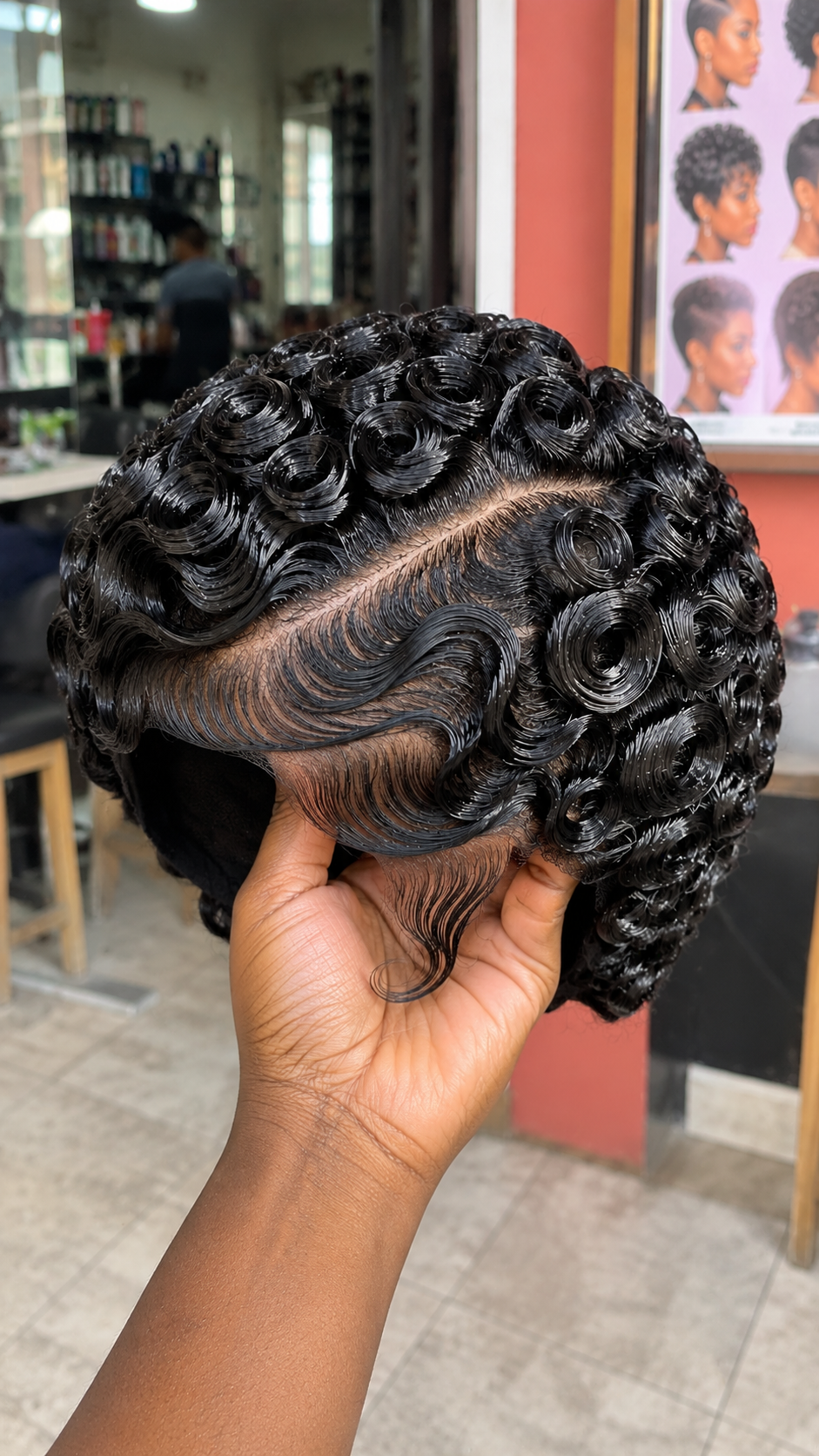
A single sweeping curve can give a curly pixie an entirely different personality. In this hairstyle, the most expressive detail is not simply the collection of glossy black curls covering the upper head. It is the dramatic S-shaped wave that moves beneath a diagonal parting, curves around the temple, and finishes in a delicate hanging spiral. Together, these elements create a beautifully coordinated hairstyle that combines rounded curls with an artistic hairline.
The photograph presents a black lace wig held in one hand outside a working neighborhood salon. The hair is arranged into prominent circular coils across the upper and outer sections, while a broad side panel contains carefully directed finger waves. The visible front hairline includes fine strands lying across a lace foundation, and part of the dark interior cap can be seen beneath the styled hair.
Although the hairstyle appears compact, its construction is visually elaborate. The upper curls form open circular rings, some of which sit higher than their neighbors. Beneath them, the hair changes direction into an extended wave that follows the visible temple. The contrast between rounded curls and flowing strands gives the pixie its distinctive identity.


The hair appears consistently deep black, with bright reflections across the curls and waves. No contrasting blonde, copper, burgundy, or silver sections are visible. Instead, the design creates depth through the placement of the circular curls, the exposed diagonal parting, and the direction of the hair around the temple.
For customers considering a black curly pixie wig, this particular design demonstrates why the hairline and side styling deserve just as much attention as the crown. Finding an ordinary black curly wig may be straightforward, but reproducing these sculpted curls and dramatic S-waves requires more specific styling skills.
The Dramatic S-Wave Is the Hairstyle’s Signature
The most distinctive element sits across the visible front-side section. A broad wave begins beneath the diagonal parting and travels toward the temple, following a graceful curved path.
Unlike a conventional finger-wave arrangement made entirely from repeated narrow curves, this hairstyle includes one particularly prominent wave that bends into a larger S-shaped formation.
The strands are closely aligned, creating a reflective surface with noticeable directional movement. Individual hairs remain visible within the larger wave, especially where the strands turn downward.
The wave gradually narrows as it approaches the lower side, connecting visually with a smaller curved section beneath it.
This arrangement gives the hairstyle an expressive side profile without requiring decorative shaved-looking lines or additional hair colors.
Why the Wave Should Remain Proportional
The broad S-shaped formation works because it occupies enough space to be recognizable without overwhelming the circular crown.
If the wave were made too narrow, the hairstyle could lose its most distinctive feature. If it were excessively enlarged, the front might appear disproportionate to the rest of the pixie.
A custom stylist should study the reference photograph and preserve the relative width, curvature, and placement of the wave.
The strand direction is particularly important. Brushing the hair straight backward would not reproduce the same flowing appearance.
The photograph does not establish which styling products or setting methods were used. Buyers should ask the maker how the wave will be maintained after washing and normal wear.
The Hanging Temple Spiral Adds a Beautiful Finishing Detail
Near the lower temple, a narrow strand extends downward before curling inward into a small spiral.
This detail contrasts with the compact curls covering the crown because it projects below the surrounding hairline.
The strand follows the movement of the larger S-wave above, creating a coordinated finishing shape.
Its delicate appearance depends on maintaining the intended direction and length.
Because the wig is photographed before installation, the final position of this spiral against a wearer’s skin cannot be confirmed.
A professional stylist should establish the correct wig position before making permanent adjustments to the hanging strand.
Protecting the Lower Curl During Installation
The hanging spiral sits close to the lace perimeter, making it vulnerable to unnecessary handling during fitting.
A stylist should avoid pulling the strand or trimming the surrounding lace without first determining how the hairline will sit.
The curl should remain recognizable after the wig is installed, rather than being flattened into the surrounding temple hair.
Customers commissioning a similar hairstyle should specifically request this lower spiral detail.
Without it, the hairstyle would have a different finishing appearance despite retaining the upper curls and broad side wave.
The Rounded Crown Contains Beautiful Circular Coils
The upper hair is filled with numerous glossy circular curls arranged in overlapping sections.
Several prominent coils have clearly visible openings, with black strands circling inward around darker centers.
Some curls resemble compact rosettes, while others form slightly broader loops that rise above neighboring sections.
The arrangement creates a rounded upper silhouette with considerable visual depth.
Near the central crown, several circular curls sit prominently above the surrounding hair. Toward the outer side, smaller curls fill the spaces between larger formations.
This variation prevents the upper hair from appearing like a repetitive collection of identical rings.
The hairstyle remains compact despite the full crown. The curls do not extend into long hanging spirals around the face.
The Importance of Open Curl Centers
The openings inside the circular curls contribute significantly to the hairstyle’s appearance.
The glossy outer strands reflect light, while the centers appear darker, creating contrast within each coil.
If the curls were compressed excessively, their openings might become difficult to distinguish.
If placed too far apart, the crown could appear sparse.
A custom wig maker should balance curl diameter, placement, and density to preserve the rounded arrangement.
The exact method used to create the coils cannot be established from the photograph.
The Diagonal Parting Organizes the Curls and Waves
A prominent diagonal parting travels through the upper front-side section, creating a visible separation between neighboring groups of curls.
The exposed channel appears lighter than the surrounding black strands, making its path easy to follow.
Above the parting, circular coils gather across the crown. Beneath it, the hair follows the broad S-shaped wave toward the temple.
This arrangement creates a directional contrast that gives the hairstyle structure.
The parting is not positioned as a conventional straight center separation. Its diagonal path produces a gently asymmetrical appearance.
A custom stylist should establish the parting position before arranging the curls and front waves.
Choosing the Correct Side for the Parting
Because the wig is being held at an angle, the photograph does not automatically establish which side the design should occupy when worn.
Customers should confirm whether they want the parting and dramatic wave on the left or right side.
The position should also be considered in relation to the wearer’s forehead and temple.
Moving the parting too far toward the center could change the wave’s proportions. Positioning it too close to the temple might reduce the available styling space.
The intended direction should be agreed upon before permanent customization begins.
The Jet Black Color Keeps the Styling in Focus
The hair appears consistently deep black throughout the crown, side curls, and front waves.
Bright reflections create charcoal-gray highlights along the outer strands, particularly where the circular curls face the light.
These reflective areas should not automatically be interpreted as deliberately colored gray or silver highlights.
No separate blonde, copper, brown, or burgundy sections are clearly visible.
The hairstyle’s depth comes from the contrast between the circular curl openings, exposed parting, and directional waves.
Customers seeking a faithful reproduction should begin with natural black or deep jet black hair.
Gloss Does Not Confirm Fiber Composition
The reflective appearance does not prove that the wig contains human hair.
Synthetic fibers and blends can also produce strong shine depending on their surface finish, styling products, and lighting.
The photograph does not confirm the manufacturer, fiber composition, or processing history.
Buyers should request accurate material information and appropriate care instructions before purchasing.
The Outer Side Continues the Circular Curl Arrangement
Along the visible outer side, several prominent circular curls continue beneath the upper crown.
Some have large open centers, while smaller spirals fill the surrounding areas.
The curls become more compact toward the lower edge, helping maintain a rounded pixie silhouette.
The hair remains relatively close to the cap rather than hanging into long curls.
This arrangement balances the broad front wave and prevents the hairstyle from appearing excessively full around the lower side.
The photograph does not show the complete back, so the exact continuation of the curls around the nape cannot be confirmed.
A buyer seeking a close reproduction should request additional photographs from the rear and opposite side.
What the Visible Lace Reveals Before Installation
The photograph shows a visible lace perimeter beneath the carefully arranged front hairline.
Fine black strands lie across the mesh, forming the broad S-wave and smaller curved sections.
The wig is being displayed before installation, and part of the lace remains untrimmed.
A dark interior cap is visible beneath the styled hair, although the complete construction and attachment system cannot be examined from this angle.
The exact lace grade cannot be established from appearance alone.
A fine-looking mesh does not prove that the material is HD lace or another specialized commercial type.
Why the Cap Should Be Inspected Before Purchase
Buyers should request a complete underside photograph showing the cap foundation, stitching, lace dimensions, and available attachment components.
Confirm whether the unit includes adjustment straps, combs, or other fitting hardware.
The cap measurements should also be discussed before ordering.
The visible photograph does not establish whether the wig is suitable for adhesive-free installation.
The appropriate method depends on the actual construction and the wearer’s needs.
Where To Buy This Style
Women interested in similar hairstyles can begin with specialist wig salons, independent wig makers, beauty supply businesses, and online retailers offering sculpted curly pixie wigs.
Useful search descriptions include black circular curl pixie wigs, sculpted finger-wave wigs, and black lace pixies with dramatic side waves.
However, not every black curly wig contains the same circular crown and broad S-shaped temple arrangement.
When contacting a seller, send the reference photograph and identify the essential details: deep black curls, a diagonal parting, a large sweeping S-wave, and a delicate hanging temple spiral.
Ask whether the business offers a ready-made unit with comparable styling or accepts custom orders.
No verified supplier, current inventory listing, or live retail price can be established from the photograph alone.
Finding a Stylist for Dramatic Finger Waves
Creating a hairstyle like this requires experience with circular pin curls and carefully arranged directional waves.
A stylist who specializes only in ordinary curly wigs may not necessarily reproduce the large S-shaped formation accurately.
Look for portfolios containing compact rosette curls, sculpted hairlines, and detailed finger-wave styling.
Close-up photographs can reveal whether the maker understands strand direction and the relationship between neighboring curls.
During the consultation, discuss the desired curl diameter, crown density, parting position, and the size of the broad side wave.
Preparing a Clear Custom Order
Confirm whether the wig will arrive fully styled or require additional salon work.
Ask about the proposed hair material and whether it can support the circular curls and S-shaped wave.
Request photographs of the actual finished wig from the front, sides, rear, and underside.
Discuss the cap measurements, lace coverage, and available fitting components.
For online orders, obtain written confirmation of the agreed design, production time, shipping arrangements, and revision policy.
Ready-Made or Custom Black Pixie Wig?
A ready-made black curly pixie may offer a similar general silhouette at a lower initial cost.
However, ordinary ready-made wigs frequently contain loose curls rather than individually arranged circular coils.
They may also lack the diagonal parting and dramatic side wave.
A custom order can offer greater control over curl placement, crown height, front-wave direction, and temple styling.
Before purchasing an unstyled base wig, ask whether its hair length, density, and material can support the desired customization.
Not every fiber can be extensively restyled using heat or conventional setting techniques.
Closure, Frontal, and Glueless Installation Options
The appropriate cap construction depends on the desired hairline coverage and fitting requirements.
A closure may provide a more limited lace area, while a frontal construction can offer additional coverage across the front and temples.
Whether either option can support the dramatic wave arrangement depends on the actual cap and hair placement.
Glueless wear requires suitable sizing and retention components. It should not be assumed simply because a wig contains lace or adjustment hardware.
Before ordering, customers should provide accurate head measurements according to the wig maker’s instructions.
During fitting, the stylist should establish the correct hairline position before trimming the lace or adjusting the hanging temple curl.
Estimated Prices for Black Circular Curl Pixie Wigs
The cost of a comparable wig may depend on the selected material, cap construction, curl placement, lace preparation, and specialized finger-wave styling.
The following USD amounts are illustrative planning estimates only. They are not verified live retail prices or quotations for the photographed wig.
| Wig Category | Illustrative USD Range | Purchasing Considerations |
|---|---|---|
| Premium Custom | $370–$875+ | Individual circular curl placement, detailed dramatic S-wave styling, custom cap fitting, and precise temple finishing. |
| Standard Custom | $185–$440 | Custom rosette curls and broad front-wave preparation on a suitable wig foundation. |
| Basic Human Hair | $100–$280 | A possible base unit requiring additional curl setting, hairline customization, and fitting services. |
| Premium Synthetic | $70–$205 | A potential pre-styled black curly pixie, depending on fiber properties and the ability to maintain the wave arrangement. |
| Basic Synthetic | $25–$95 | An economical curly wig that may not reproduce the individual circular curls or dramatic side wave. |
These categories describe possible purchasing options rather than verified characteristics of the photographed unit.
Additional expenses may include shipping, cap adjustments, professional installation, lace trimming, and later styling restoration.
Customers should request an itemized quotation explaining which services are included before paying.
Maintaining the Rounded Circular Curls
The upper curls depend on retaining their rounded shapes and visible openings.
Repeated brushing or unnecessary handling may disturb their arrangement and change the hairstyle’s appearance.
Customers should avoid pulling the curls apart simply to increase volume.
Ask the wig maker whether the circular arrangement can be refreshed at home or whether professional restyling is recommended after washing.
If the wig contains human hair, its care routine should account for any previous setting techniques or styling products.
If synthetic fiber is used, follow the manufacturer’s instructions and confirm heat compatibility before attempting to restyle the curls.
Protecting the Dramatic S-Wave
The large side wave requires careful handling because its appearance depends on fine strands remaining aligned along a specific curved path.
Repeated rubbing, excessive combing, or heavy product application may disturb the arrangement.
The diagonal parting should remain visible, with neighboring hair kept in the intended direction.
The hanging temple curl should also be protected from unnecessary pulling or flattening.
A professional stylist can explain how to refresh these details without altering the rounded crown.
Advantages and Limitations of This Sculpted Pixie
The compact silhouette provides decorative curls without requiring long hair.
The deep black color offers flexibility for different outfits and accessories, while the dramatic side wave gives the hairstyle a distinctive character.
The circular curls create visual fullness, and the closely arranged lower side keeps the overall proportions balanced.
However, the sculpted wave and hanging temple spiral may require more maintenance than an ordinary loose curly hairstyle.
Restoring the original shape after washing may involve specialist styling, depending on the hair material.
Customers planning frequent wear should consider cap comfort, maintenance requirements, and the availability of professional restyling services.
Inspecting the Finished Wig Before Installation
When the completed wig arrives, compare the circular curls with the approved reference photograph.
The upper coils should retain their recognizable openings, and the crown should remain compact.
The diagonal parting should follow the intended direction, while the broad S-wave should maintain its distinctive curvature.
Check that the hanging temple spiral remains intact and positioned as agreed.
Inspect the lace and interior cap before trimming or making permanent adjustments.
If the wig was custom-made, significant differences should be discussed with the seller before alterations are made.
A Beautiful Black Pixie with Dramatic Movement
This hairstyle demonstrates how one consistent black shade can become visually striking through carefully arranged curls and flowing waves.
The circular crown creates depth and fullness, while the diagonal parting introduces direction. Beneath it, a dramatic S-shaped wave travels toward the temple and finishes in a delicate hanging spiral.
The visible lace also highlights the importance of proper fitting and construction verification before installation.
For women seeking a faithful reproduction, the most important priorities are the rounded circular curls, the diagonal parting, the large side wave, and the lower temple spiral.
With suitable styling and thoughtful maintenance, this black pixie wig can provide a distinctive combination of glossy coils, artistic hairline movement, and detailed salon craftsmanship.
Search Terms
Black coil pixie with S-waves · Dramatic finger wave lace wig · Jet black circular curl crown · Diagonal part black spiral wig · Glossy rosette curls with side wave · Hanging temple spiral pixie · Black lace front sweeping wave hairstyle · Compact black ringlets with sculpted hairline