
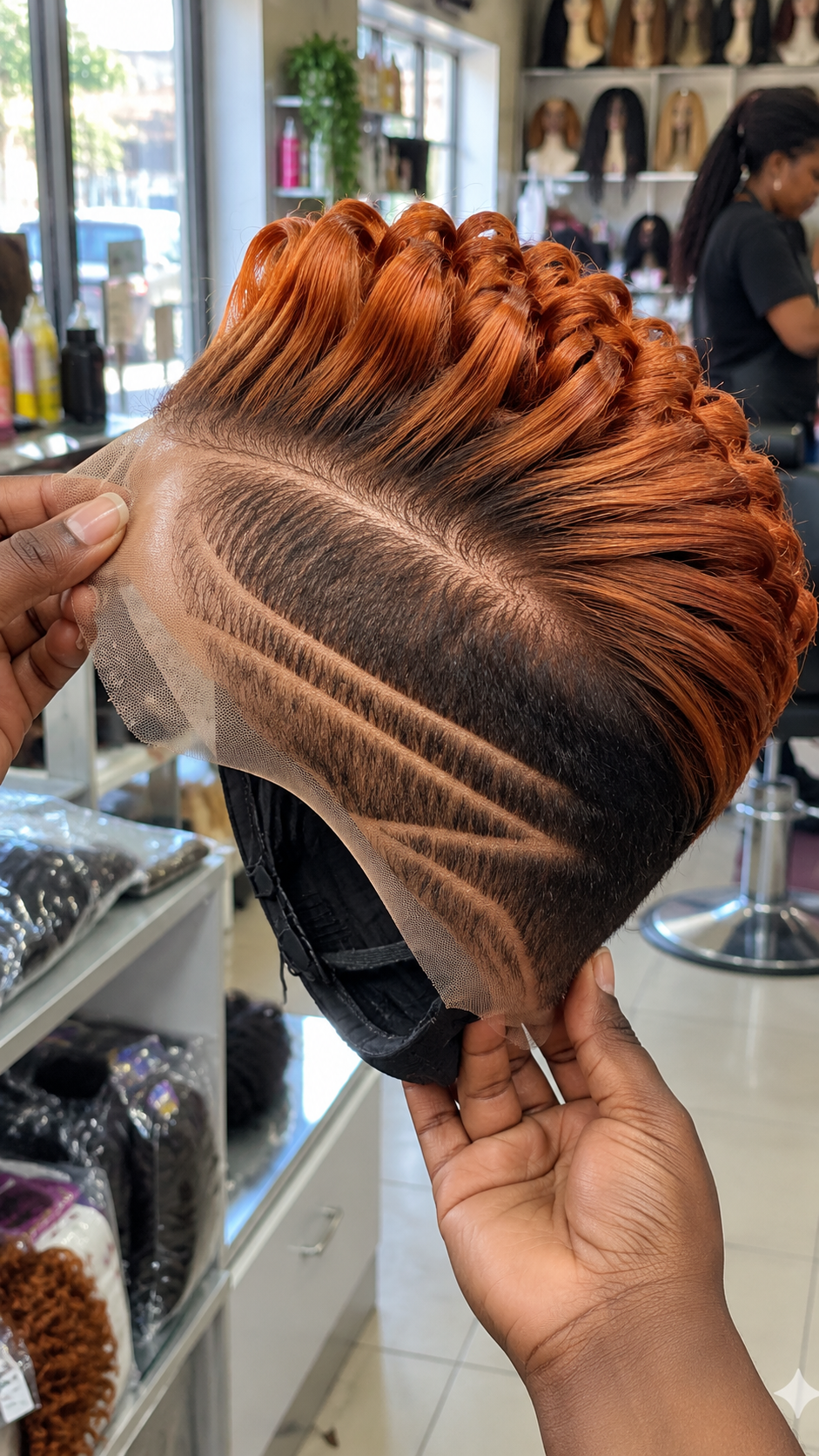
A rich copper color can completely change the personality of a pixie wig, especially when the color is paired with sculpted loops, a deep directional part and artistic side detailing. This Fiery Copper Loop Curl Pixie Wig brings those elements together in a design that looks highly customized rather than like an ordinary ready-made unit. The upper section carries a warm copper tone with deeper roots, while the sides stay considerably darker to create contrast around the carved line work. The result is a bold salon-inspired wig for women who want a compact hairstyle with plenty of visual detail.
The photograph also gives an unusually useful look at the construction of the unit. The lace extends around the front and side area, the interior cap is visible, and an adjustable strap can be seen underneath. This matters when shopping for a similar wig because the appearance of the hairstyle is only one part of the purchase. Buyers should also ask how the unit is constructed, how the lace is intended to be fitted and whether the side detailing shown in the reference can actually be reproduced on the wig they are ordering.
The Copper Color Placement Creates the Main Visual Impact
The first detail that attracts attention is the copper color concentrated through the upper hair. Rather than presenting one completely uniform shade from top to bottom, the wig uses a darker foundation beneath the copper. The contrast gives the looped strands greater dimension and allows individual sections to remain visible even where several loops overlap.
The copper itself sits in the fiery copper and warm auburn family. Under salon lighting it produces brighter cinnamon and burnt-orange reflections, while deeper areas appear closer to rich auburn brown. Anyone ordering this look from a stylist should therefore avoid relying on a generic description such as “brown wig.” Reference photographs are much more useful because copper formulas can range from subtle chestnut to vivid orange-red.
The darker root area is equally important. It visually anchors the brighter upper section and connects it with the darker side panels. Asking a colorist to preserve that root depth can prevent the finished unit from becoming too bright or flat. The transition should remain deliberate so the copper loops appear to rise naturally from the darker foundation.
Looped Crown Styling Gives the Wig Its Signature Shape
The upper portion is arranged into large sculpted loops rather than loose everyday curls. Each section bends backward and around the crown, producing a layered pattern that gives the hairstyle height without requiring long hair. Smaller curled sections become visible toward the rear, helping the larger front loops blend into the rest of the design.
This type of arrangement depends heavily on strand placement. If the loops are made too loose, the crown can collapse and lose the structured silhouette visible in the photograph. If they are packed too tightly, the individual curved sections disappear into one dense mass. A stylist recreating the look should use the reference to judge the height, direction and spacing of each loop instead of simply requesting “curly hair.”
The polished surface of the strands also contributes to the appearance. Light travels along each curved section, emphasizing the copper color and the rounded shape of the loops. For customers commissioning the unit, photographs taken from the side and above can be particularly useful during approval because they reveal whether the crown has retained the intended profile.
The Deep Side Part Separates Two Very Different Hair Zones
One of the strongest elements in this design is the long diagonal part running between the looped upper section and the darker side panel. The part is deliberately visible and acts almost like an architectural boundary within the hairstyle. Above it, the hair rises into copper loops. Below it, the hair stays close to the head and follows a much flatter direction.
This contrast is important when recreating the wig. Simply adding copper curls to a pixie unit will not produce the same appearance. The directional part, the darker side section and the upper loops need to work together. When contacting a wig maker, buyers can specifically request a deep diagonal side part with a low-profile side panel and raised loop curls above it.
The part also provides a practical visual advantage: it keeps the design organized. Even though the upper section contains numerous loops, the strong separation prevents the hairstyle from appearing overcrowded. This is one reason the unit photographs well from a three-quarter angle.
Carved Side Lines Turn the Pixie Into a Custom Statement
The side detailing is another major characteristic of this wig. Several narrow parallel lines travel across the darker side area, creating the appearance of precision barber work. These lines are not random decoration. Their spacing and direction follow the overall geometry of the hairstyle and complement the longer diagonal part above them.
When ordering a recreation, this area deserves its own reference image. Side patterns can vary significantly between wig makers. A customer who wants the same appearance should specify the number and approximate direction of the lines rather than requesting an unspecified “side design.” The lines should remain visible once the wig is positioned on the head and should not be hidden by the upper loops.
The darker surrounding hair makes these carved channels easier to see. That contrast is particularly effective beside the fiery copper crown. It gives the unit two distinct visual levels: color and curl provide drama above, while precision line work adds detail below.
What the Visible Lace and Cap Tell Buyers
The photograph shows lace extending beyond the hairline area, which indicates that the unit is photographed before final trimming and installation. Because the exact lace specification cannot be confirmed from the image alone, shoppers should ask the seller what lace type is actually being supplied rather than assuming a particular grade.
The interior construction is also partially visible. A cap sits beneath the styled hair and an adjustable strap appears toward the back. That strap can help with circumference adjustment, although the correct cap size is still important. Buyers should provide accurate head measurements whenever a wig maker offers custom sizing.
Before paying, ask whether the lace arrives uncut, whether the side design is already completed, whether the unit is pre-styled into the loop pattern and whether additional fitting by a local wig stylist will be required. These questions are especially useful when ordering online because two wigs that look similar in promotional photographs may arrive at very different stages of preparation.
Who Can Recreate This Look Professionally?
This is the type of wig that benefits from a stylist who understands both wig customization and precision pixie work. The copper coloring, loop placement, side part and carved detailing all require different skills. A general wig retailer may be able to supply a base unit, but a custom wig stylist or stylist working with a barber may be better suited to reproducing the full reference.
When contacting a salon, send the reference photograph before booking. Ask whether they have previously created sculpted pixie units with carved side details. Request photographs of their own work rather than relying only on catalog images. If the salon plans to source the base wig separately, confirm which elements will be completed before your appointment and which will be customized during the fitting.
A consultation is also the best time to discuss whether the fiery copper shade suits the desired result or whether a slightly deeper cinnamon-copper variation would be preferred. Keeping the dark foundation visible is recommended when the goal is to preserve the strong contrast seen in the reference.
How To Order a Similar Custom Wig
Start by saving clear photographs of the front, side, crown and interior whenever they are available. This particular image is especially useful because it shows the side construction, lace, cap, color transition and upper styling in one frame. Send the reference to the wig maker and state that the important elements are the fiery copper looped crown, dark foundation, diagonal part, sculpted side panel and multiple parallel line details.
Next, confirm the hair type and cap construction. Human hair generally provides greater flexibility for professional coloring and restyling, while synthetic options can be more affordable when the factory has already created the desired shape and color. Buyers should not assume that every synthetic fiber can tolerate heat, so the seller should provide the permitted temperature range when heat styling is relevant.
After that, request a color confirmation. Copper shades can photograph differently under warm and cool lighting. A daylight photograph or video from the seller can help show whether the shade leans toward orange copper, auburn, cinnamon or brown. For this reference, the target should remain a rich fiery copper rather than a pale blonde-copper shade.
Finally, confirm the total price, production time, shipping cost and whether styling is included. Custom work involving coloring and carved side patterns may be priced separately from the base wig. Getting those details in writing before payment makes it easier to compare offers from several stylists.
Estimated Price Range for a Custom Version
Actual pricing varies by country, hair source, density, cap construction and the amount of hand customization required. The ranges below are general shopping estimates rather than a price for the exact wig shown in the photograph.
| Wig Option | Typical Estimated Range | What May Be Included |
|---|---|---|
| Premium Custom | $300–$600+ | Higher-grade human hair, custom coloring, detailed loop styling, side pattern work and professional fitting preparation |
| Standard Custom | $180–$350 | Human hair or blended construction with personalized color and salon styling |
| Basic Human Hair | $120–$250 | Human-hair base unit that may require separate coloring, cutting and styling |
| Premium Synthetic | $70–$160 | Higher-quality fiber with factory color and pre-shaped curl pattern |
| Basic Synthetic | $35–$90 | Budget-friendly base unit with fewer customization options |
What To Confirm Before Sending Payment
Ask for current photographs or a video of the actual unit whenever possible. Catalog photographs are useful for choosing a style, but they do not always show the specific wig that will be shipped. If the seller is making the unit after purchase, request progress photographs after coloring and again after the side pattern and loop styling have been completed.
Confirm whether the lace will arrive trimmed or untrimmed. The image shows excess lace around the perimeter, so a finished customer unit may require trimming and fitting before wear. If you are not comfortable doing this yourself, arrange an appointment with a wig stylist and bring the unit unaltered so the professional can position it correctly before removing excess lace.
Also confirm the return policy before requesting extensive customization. Personalized color, cutting and side detailing can make a wig non-returnable. The seller should explain this before production begins.
Maintaining the Sculpted Copper Loops
The loop formation is the centerpiece of the hairstyle, so maintenance should focus on preserving that shape. Avoid repeatedly combing through the loops with a standard brush. Instead, separate and reposition individual sections carefully when needed. The correct maintenance products depend on whether the unit is human hair or synthetic fiber, so follow the fiber-specific instructions supplied by the maker.
When the wig is not being worn, store it on an appropriate wig stand or mannequin head so the upper loops are not crushed. Keep heavy objects away from the crown during storage and transportation. If the wig becomes flattened, professional restyling may be safer than attempting to rebuild every loop at home.
For human-hair versions, excessive product buildup can reduce the visible separation between the sculpted sections. Use products sparingly and ask the stylist which holding product was originally used. Synthetic versions should only be exposed to heat if the manufacturer specifically identifies the fiber as heat-resistant.
Why This Design Works So Well as a Custom Wig
This design succeeds because every visible section has a purpose. The fiery copper upper layer supplies color, the loop formation provides height, the dark foundation adds contrast, the diagonal part establishes direction and the carved side lines create a distinctive profile. None of those elements needs extreme length or oversized volume to attract attention.
It is also a useful reference for customers who want a pixie silhouette but do not want a basic all-over curl pattern. From the front, the loops provide a polished sculpted appearance. From the side, the dark panel and parallel lines completely change the character of the hairstyle. The result offers several visual details within a compact silhouette.
For the closest recreation, the reference photograph should remain the central guide throughout the ordering process. Ask the stylist to match the placement of the copper, the direction of the upper loops, the deep diagonal separation and the side-line configuration rather than interpreting the request as a generic curly pixie. Those details are what make this particular wig recognizable.
Search Terms
Fiery Copper Loop Curl Pixie Wig · Copper Sculpted Curl Wig · Dark Root Copper Pixie Wig · Side Line Pixie Wig · Lace Front Copper Pixie Wig · Deep Side Part Curly Wig · Auburn Copper Loop Wig · Carved Side Design Pixie Wig