
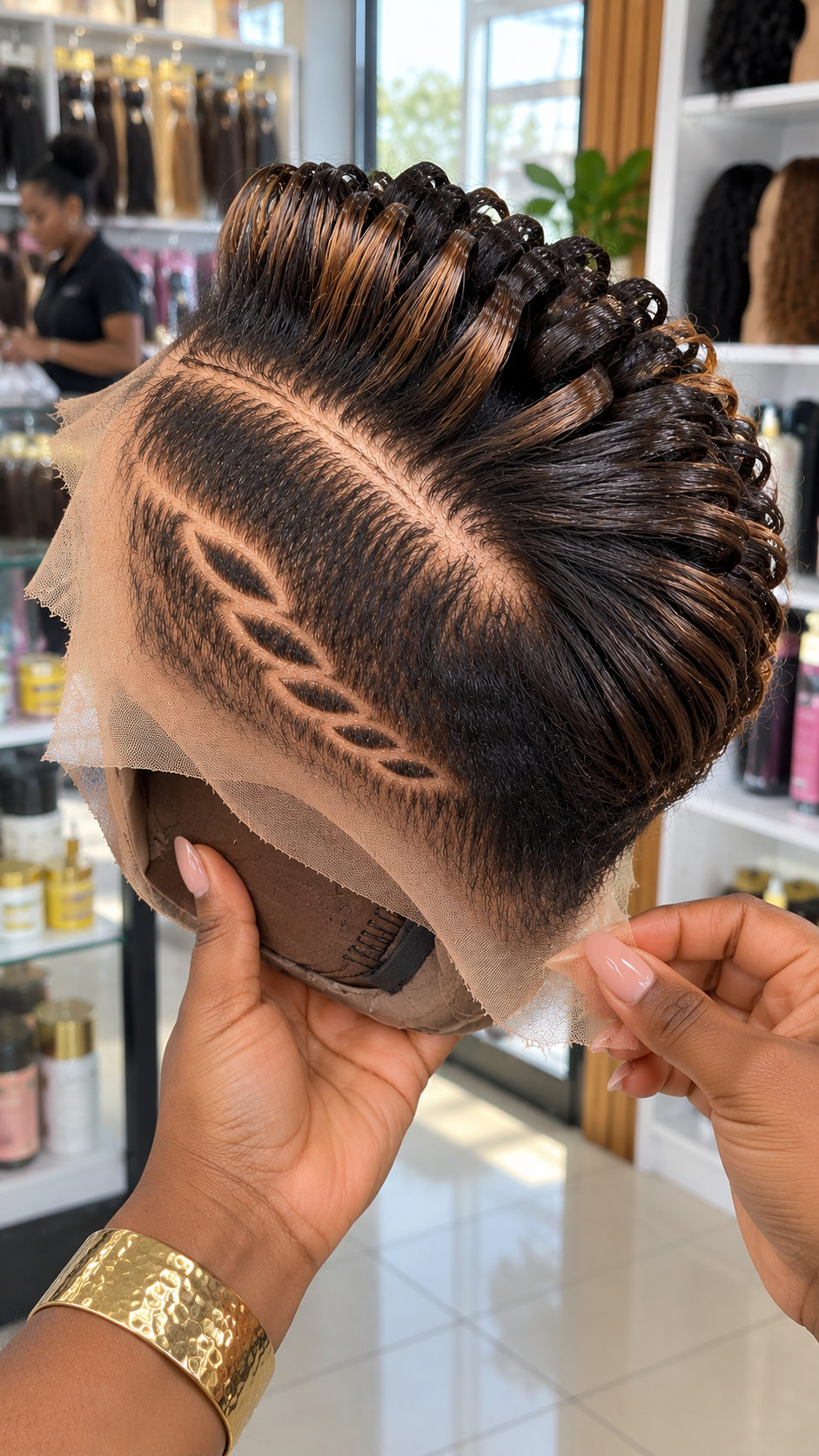
This espresso brown pixie wig combines large swept loop curls, a dark tapered side panel and an eye-catching leaf-inspired carved pattern. The upper hair is arranged in broad glossy sections that rise from the foundation before folding backward, while the lower side remains much closer to the head. Warm brown highlights run through the loops and become especially visible wherever the strands curve toward the light.
The side artwork is what immediately separates this unit from a standard sculpted pixie. Instead of using ordinary parallel lines, the close section contains a sequence of pointed leaf-shaped openings arranged along a curved path. That detail creates a recognizable signature without competing with the substantial loop work above it.
Espresso Brown Provides a Deep Base for the Warm Highlights
The overall color reads as a very dark espresso brown with warmer chestnut and caramel-brown reflections across the longer upper strands. The color is not distributed as chunky contrasting streaks. Instead, the lighter tones appear integrated into selected sections of the swept loops.
This placement allows the raised curves to catch more light while the deeper foundation remains dark. The result creates dimensional movement without turning the entire wig into a bright highlighted style.
When requesting a similar color, a useful description is deep espresso brown with warm chestnut ribbons through the sculpted crown. A reference photograph should still be supplied because brown highlight terminology varies significantly between sellers.
Broad Ribbon Loops Build Height Across the Crown
The longer hair is separated into wide, polished sections rather than being divided into numerous tiny curls. Each section rises upward, bends backward and forms an open loop before joining the surrounding crown.
This produces a ribbon-like appearance. The loops have enough width for individual strands to remain visible, and their openings create shadowed spaces that add dimension between neighboring sections.
The front loops stand higher while those farther toward the back become more integrated with the rounded shape. This gradual change keeps the silhouette balanced instead of creating the same height across the entire crown.
The Hair Moves Backward in a Consistent Direction
Directional flow is essential to this design. Most of the longer sections travel away from the frontal area and toward the back of the head. Even where the loops overlap, their movement remains coordinated.
This consistency gives the crown an organized appearance despite its substantial volume. Randomly oriented loops would produce a completely different result.
When commissioning the style, ask the stylist to establish a backward sweep before setting the individual loops. The underlying direction should remain visible between the larger sections.
The Leaf Carving Becomes the Signature Side Detail
The close side contains several pointed openings arranged one after another. Each shape resembles a narrow leaf or eye and follows the same gently curved path through the tapered section.
The design is more decorative than a conventional single or double side line. Small areas of darker hair remain between the carved openings, allowing every shape to stay individually recognizable.
If this element is important to the custom order, send a close side reference. Asking only for “lines on the side” could easily result in ordinary stripes rather than the distinctive leaf pattern shown here.
The Carved Pattern Follows the Head Shape
The placement of the leaf motifs is just as important as their shape. They are not stacked vertically or arranged in a perfectly straight horizontal row. Instead, the sequence curves gently backward along the side.
This allows the artwork to complement the rounded crown above it. The shapes become slightly smaller as the pattern travels toward the rear, which helps the design transition naturally into the darker tapered section.
A barber or wig stylist reproducing the detail should plan the full curve before creating the individual openings so the final sequence remains balanced.
A Deep Separation Divides the Crown From the Close Side
Above the carved panel, a clearly visible separation runs beneath the longer hair. This line creates a visual boundary between the sculpted crown and the compact lower section.
The longer strands emerge above this division and immediately sweep upward into the loops. Below it, the hair stays extremely close. This contrast gives the design much of its dramatic side profile.
The separation should remain crisp without becoming excessively wide. If it is enlarged too much, it can overpower the smaller leaf pattern underneath.
The Tapered Lower Section Controls the Overall Silhouette
Although the crown has considerable volume, the wig remains recognizably compact because the lower side contains very little bulk. Hair becomes progressively closer toward the perimeter and lower back.
This reduction keeps visual weight concentrated on the upper portion. It also provides the dark background necessary for the carved design to remain clearly visible.
For custom work, specify that the lower side should stay close rather than merely being shorter than the crown. The difference in density is an important part of the finished proportions.
The Glossy Finish Makes Every Loop Easier to Read
The hair has a mirror-like glossy surface, silky reflective finish, healthy wet-look shine, individually visible strands and highly separated sculpted sections. Narrow highlights travel across the brown ribbons as they curve around each loop.
This finish is particularly effective on the highlighted sections because the warm tones become brighter along the raised surfaces while deeper espresso shades remain visible underneath.
Heavy oil should not be used simply to imitate the photographed shine. Too much product can make neighboring strands stick together and reduce the crisp ribbon-like appearance.
The Lace Is Still Visible Before Installation
The photograph shows excess lace extending beyond the styled perimeter. The unit is therefore presented before final lace trimming and fitting, allowing more of the construction to remain visible.
This is useful when discussing customization with a stylist because the close side work and crown transition can be examined before the lace edge disappears during installation.
The exact lace specification cannot be confirmed from the photograph alone. Buyers should ask the seller about lace coverage, cap construction and whether trimming or fitting services are included.
How to Explain This Wig to a Custom Stylist
Break the design into several separate instructions. Request an espresso-brown foundation, warm chestnut highlights through selected upper strands, broad backward-swept loop curls, a closely tapered side and a curved sequence of leaf-shaped carved details.
Emphasize that the top should use large loops rather than small circular ringlets. Also specify that the highlights should follow the longer strands rather than appearing randomly throughout the close side section.
Provide this side photograph during the consultation because both the carving and the transition between the two hair lengths are clearly visible from this angle.
Which Professional Should Recreate the Side Artwork?
A wig stylist experienced with sculpted pixies can handle the crown construction, while the precision side design may benefit from someone comfortable with detailed barber-style pattern work on wigs.
Some professionals perform both services. If two specialists will be involved, discuss the sequence beforehand so the side artwork and upper styling do not interfere with one another.
Before booking, show the reference and ask specifically whether the stylist has previously created carved patterns on custom wig units. Photographs of comparable work are useful for evaluating precision.
Choosing a Suitable Base Wig
The foundation needs sufficient length across the upper portion to form the broad loops. At the same time, the lower side must contain enough workable hair to create the dark tapered panel and carved pattern.
A uniformly cropped base may not provide enough length for the crown, while an excessively dense unit could require substantial thinning around the perimeter.
If you already own a wig, send photographs to the stylist before booking. They can determine whether its current length distribution is appropriate for this construction.
Ordering a Similar Wig From an Online Seller
Search for businesses offering custom pixie wigs and hand-styled units rather than relying exclusively on generic ready-made wig listings. Send the reference image directly and identify the details that must be preserved.
Ask whether the seller can provide the swept loop crown and decorative side pattern as part of the finished unit. Confirm the hair material, color combination, cap size, lace construction and level of customization included in the quotation.
If the wig is made to order, request side-view approval photographs before shipment whenever possible. A frontal photograph alone will not show whether the leaf pattern and taper have been reproduced accurately.
Booking a Salon for Final Customization
If you purchase a suitable base unit separately, book a consultation with a wig stylist before requesting the full transformation. Send the reference in advance so the salon can assess whether additional cutting, coloring or density adjustment will be required.
Explain that you need both sculpted loop setting and precision side work. Ask whether these services are completed during one appointment or require separate sessions.
For color customization, confirm whether the warm brown ribbons will be added before the final loop setting. Completing major color work first generally gives the stylist greater freedom when arranging the highlighted sections.
Estimated Pricing for Comparable Custom Work
| Category | Estimated Range | Typical Configuration |
|---|---|---|
| Premium Custom | $475–$950+ | Premium human hair, dimensional brown coloring, hand-sculpted loops, precision taper and detailed side artwork |
| Standard Custom | $275–$525 | Human-hair unit with customized loop crown, warm highlights and carved side detailing |
| Basic Human Hair | $150–$310 | Human-hair pixie foundation requiring some additional salon sculpting or pattern work |
| Premium Synthetic | $90–$195 | Higher-grade fiber with structured upper loops and stronger shape retention |
| Basic Synthetic | $45–$105 | Lower-cost pre-shaped option with simpler crown and side customization |
These figures are broad market estimates rather than prices for the exact unit pictured. Hair material, coloring, cap construction, stylist experience, location and the complexity of the side carving can all influence the final price.
Check the Side Design Before Accepting the Wig
Begin by examining the carved pattern. Each leaf-shaped opening should remain clearly recognizable and the complete sequence should follow a controlled curve.
Then inspect the separation above the design. It should create a crisp boundary without becoming disproportionately wide. Finally, look at the transition into the upper loops and make sure the crown begins gaining length gradually.
For an online custom order, ask for a photograph taken directly from the decorated side. Angled beauty shots may hide inaccuracies in the carving.
Maintaining the Swept Loop Crown
The large loops depend on their original direction and should not be routinely brushed through. Handle individual sections only when necessary and avoid pulling them apart to increase volume.
Store the wig upright on a suitable stand with enough clearance around the crown. Pressure from a storage box or neighboring wigs can flatten the loops and alter their backward sweep.
If several loops loosen, professional resetting can restore the structure while preserving the intended highlighted placement.
Protecting the Precision Side Pattern
The close side artwork should be kept free from heavy product accumulation. Thick gels and oils can reduce the contrast between the dark hair and the carved openings.
When handling the wig, avoid repeatedly rubbing the decorated panel. If the surrounding strands shift over time, a stylist familiar with precision pixie work can refresh the pattern and taper.
Keep the original side photograph for future maintenance appointments. It provides a clear blueprint for the curve, spacing and shape of the leaf motifs.
Search Terms
Espresso Brown Swept Loop Wig · Chestnut Highlight Loop Crown · Leaf Carved Pixie Side · Brown Ribbon Loop Curls · Curved Leaf Hair Design · Dark Tapered Pixie Side · Glossy Espresso Crown Loops · Warm Brown Sculpted Wig