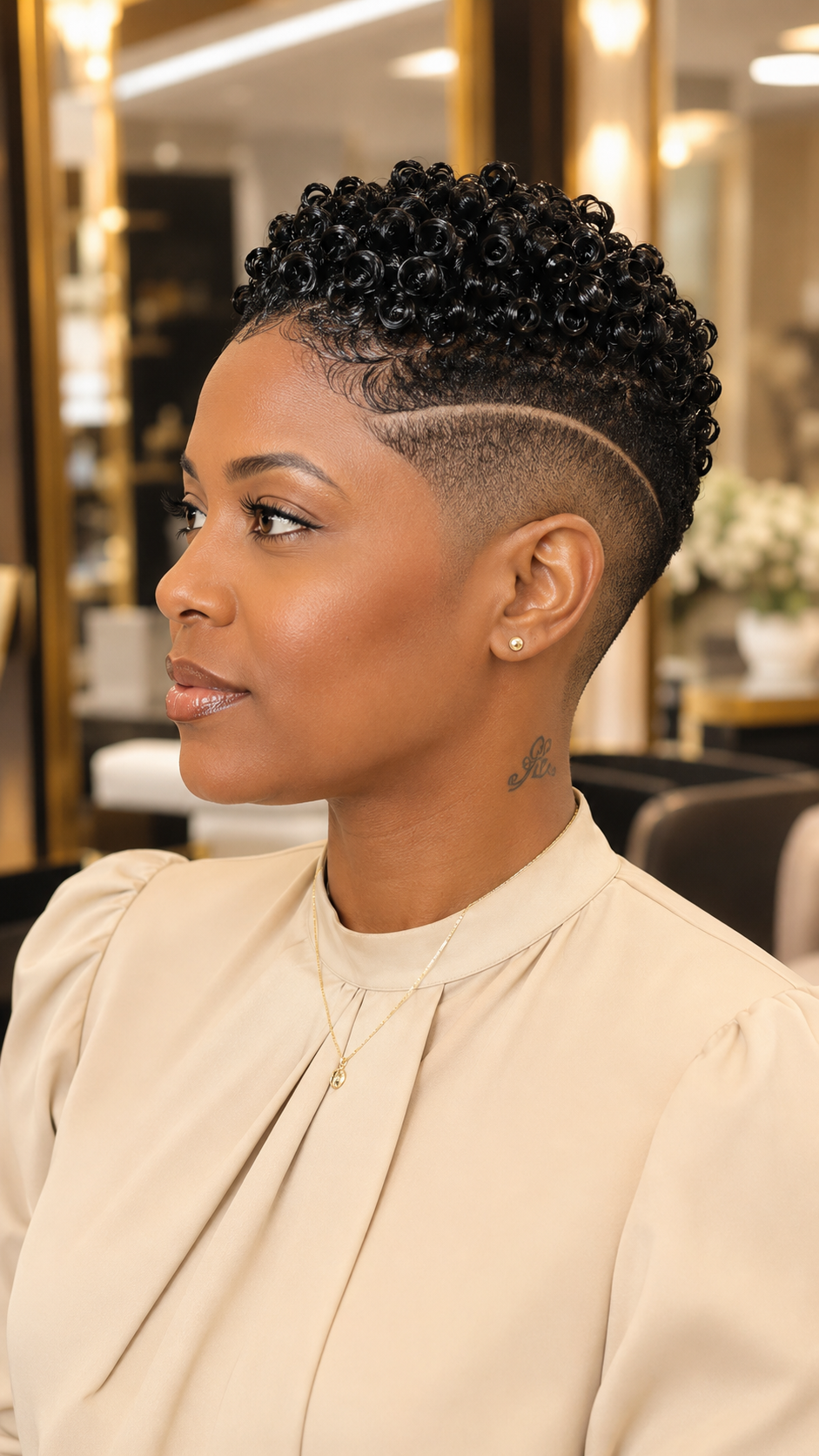
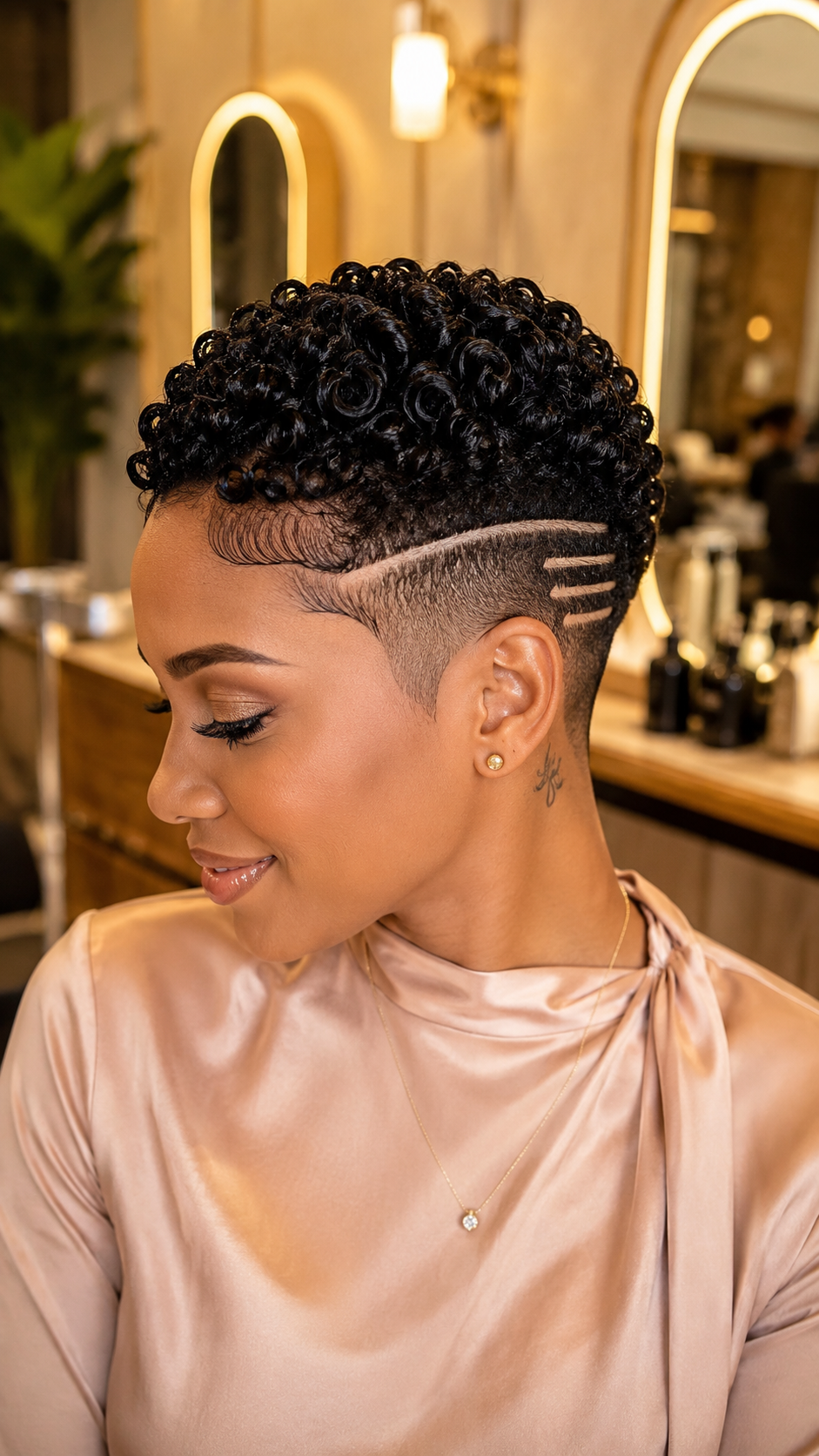
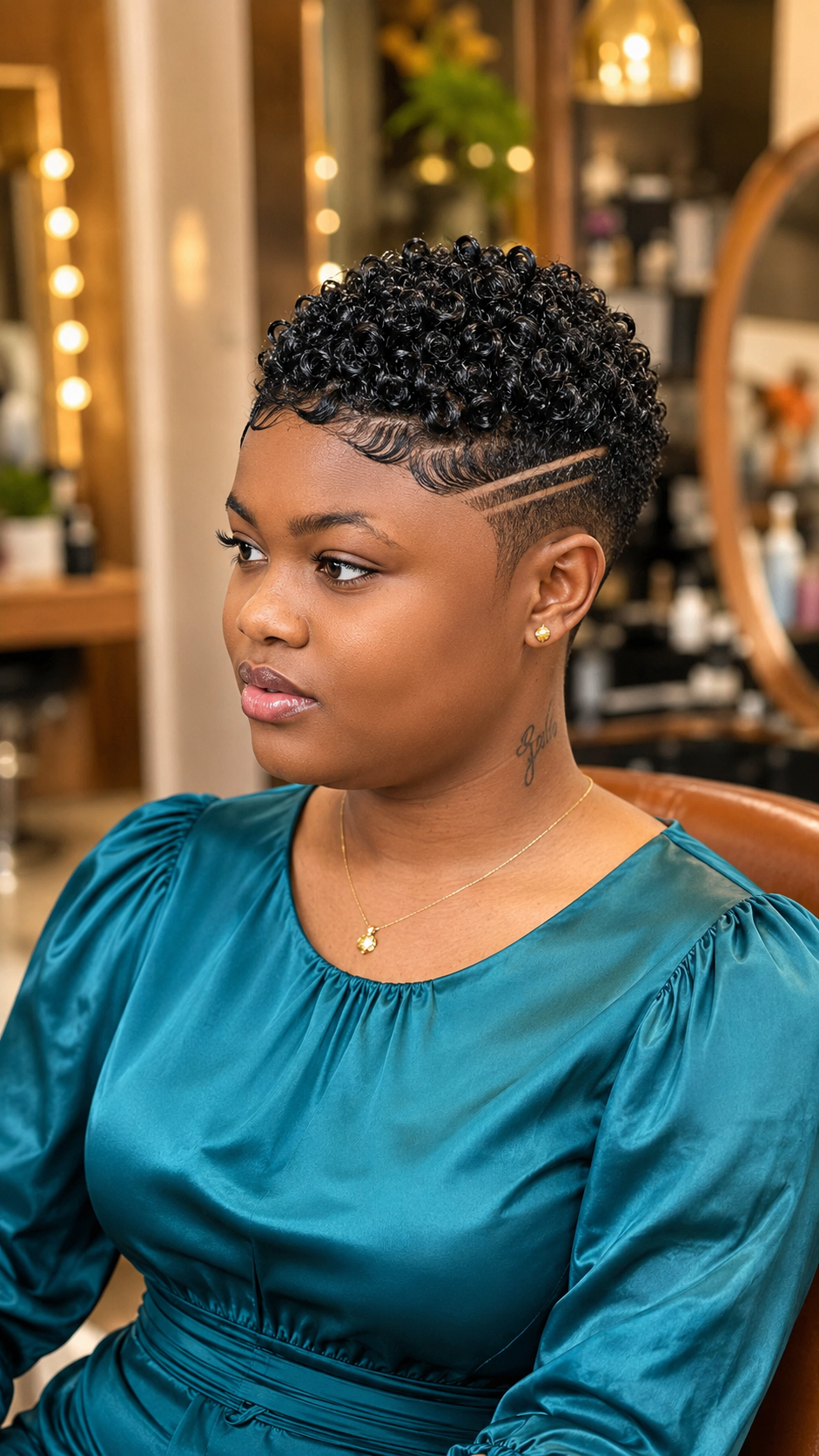
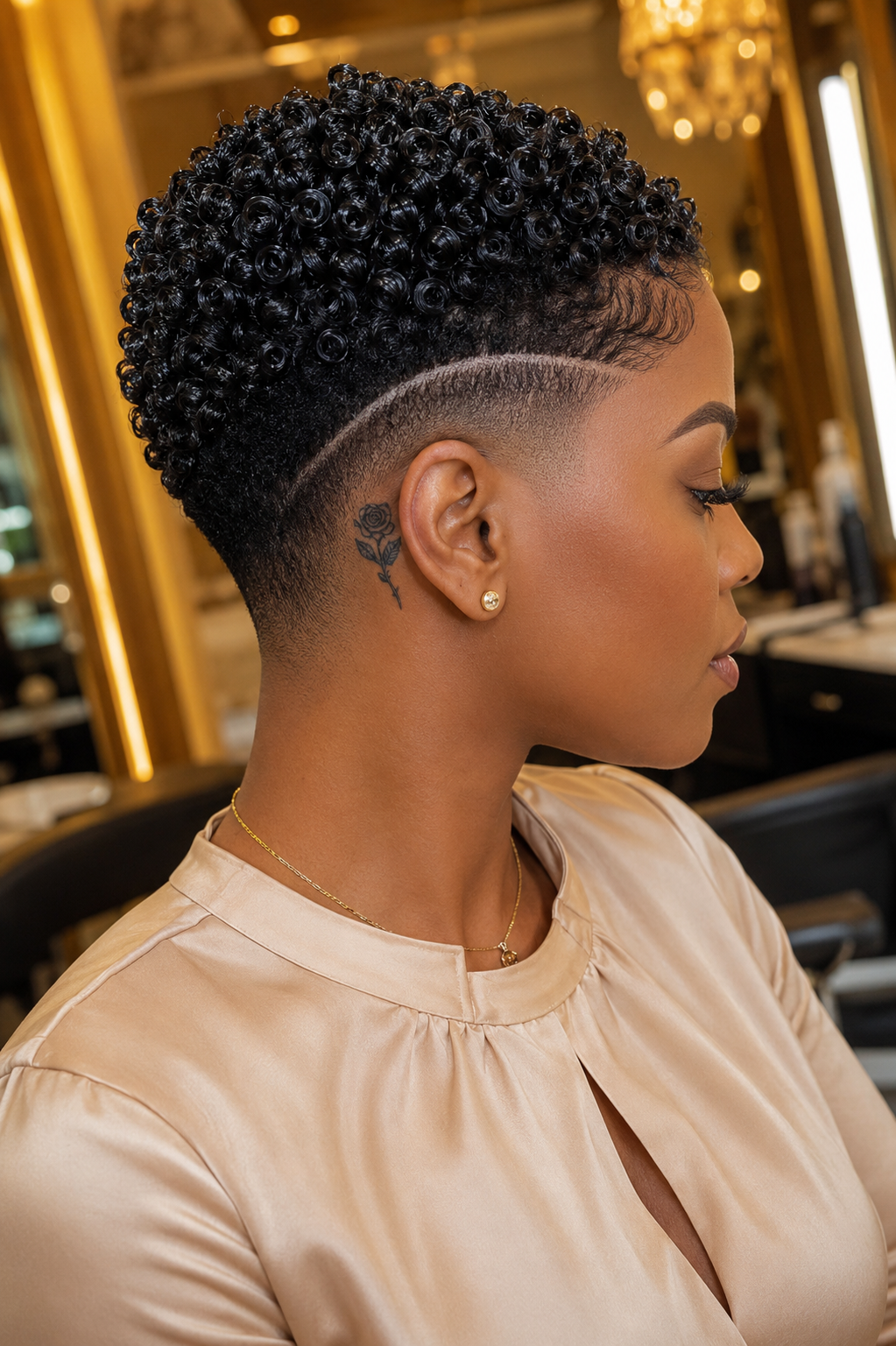
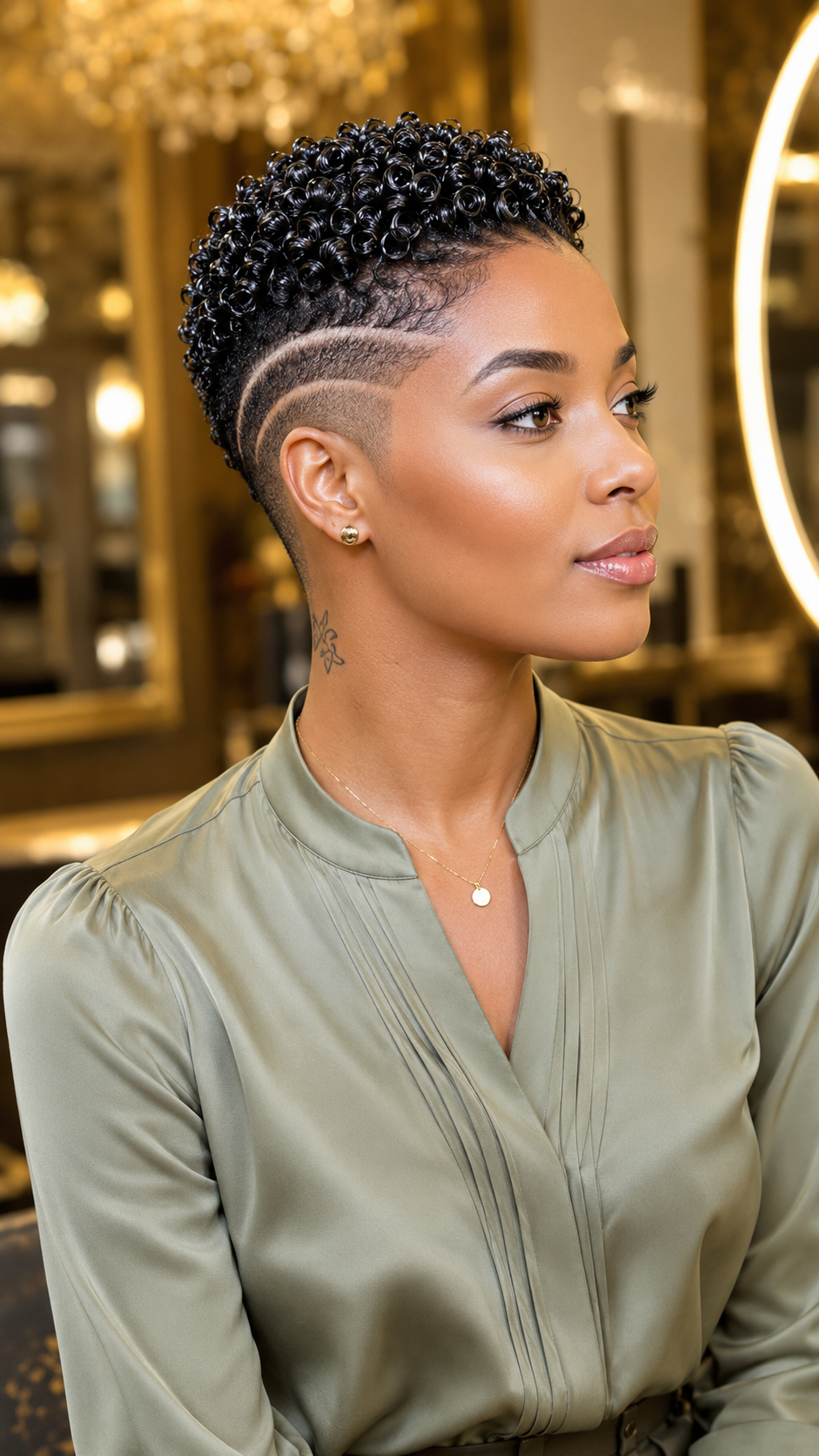
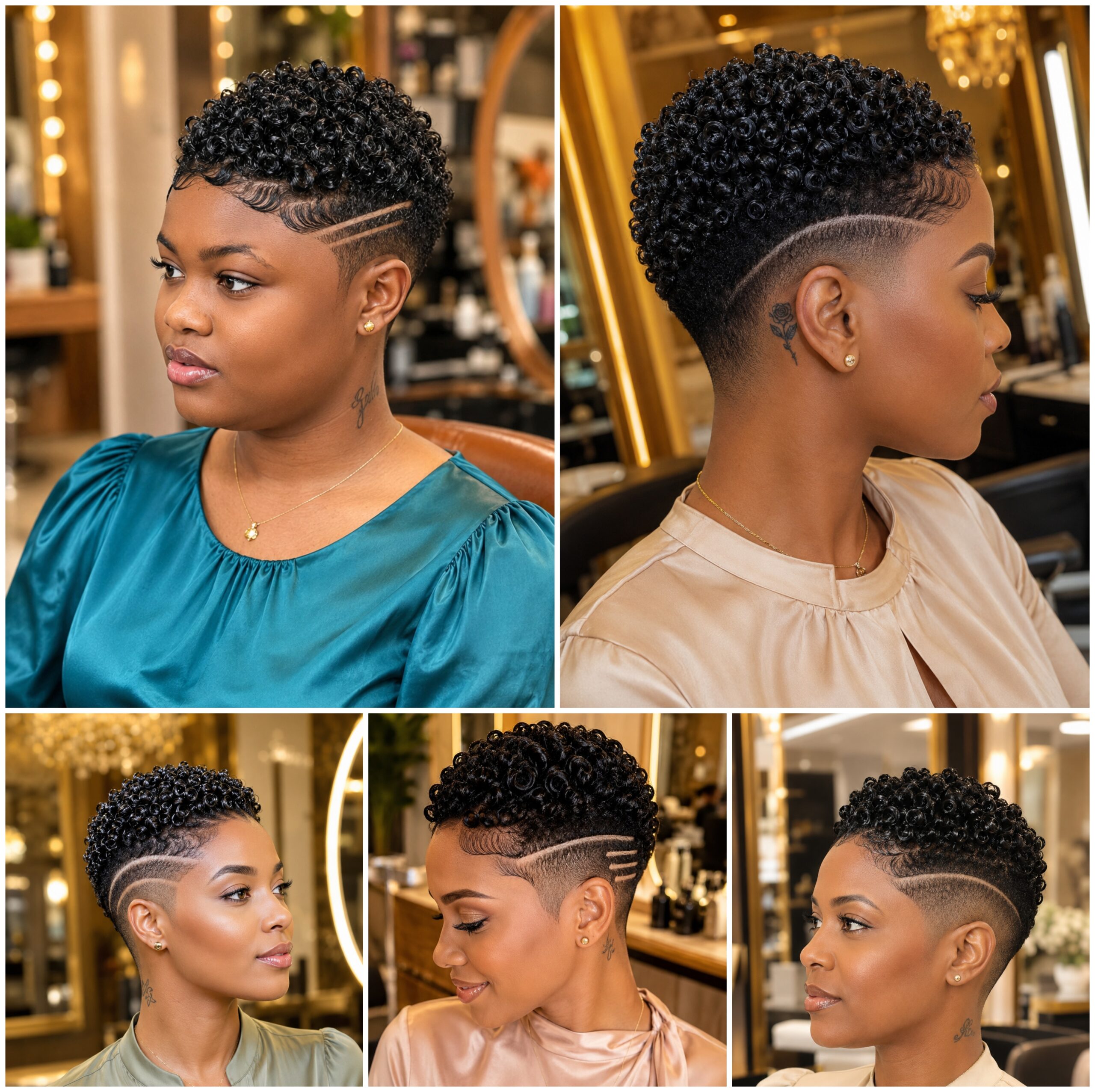
A lively crown of compact curls paired with closely blended sides creates a flattering pixie silhouette with noticeable contrast around the temples and neckline. The front edge becomes the focal point through carefully arranged ripple-like curves, bringing a softer flowing element to the precision of the fade while allowing the natural curl pattern above to retain its volume.
Achieving this balance depends on moisture, curl control, and careful hairline styling. Lightweight leave-in conditioner and curl foam can support the upper curls without making them heavy, while a small amount of styling product along the front helps the curved sections stay in position. Finishing with a light serum can add reflection without coating the hair excessively.
Building Volume Through the Curly Crown
The upper section can follow its natural curl pattern or be shaped into more individual spirals while the hair is damp. Working in small sections gives the stylist greater control over curl direction and helps create visible separation throughout the crown.
Smaller sections generally produce tighter curls, while slightly larger sections provide additional fullness. Keeping a little more length toward the center and front can help preserve the rounded pixie profile once shrinkage occurs.
The final cutting should account for the way coily and curly textures contract after drying. Leaving additional length initially gives the stylist room to refine the silhouette without accidentally making the crown shorter than intended.
Shaping Flowing Curves Along the Front
The front section can be arranged into several gentle bends that follow the natural direction of the hairline. Styling foam, edge control, and a fine edge brush can help guide the hair into these curved sections without requiring excessive product.
Scale is particularly important around a compact haircut. Smaller ripples usually complement the proportions better than oversized waves that extend too far onto the forehead. The curves can also vary slightly in size so the front does not appear overly uniform.
After shaping, tying a satin scarf around the hairline for several minutes can help the product set. Once released, the front should retain its flowing pattern while the curls immediately behind it remain springy and separated.
Creating Contrast Through the Fade
The shortest sections can be concentrated around the temples, ears, and lower neckline before gradually increasing in length toward the crown. This creates visible contrast without removing unnecessary density from the upper sides.
A lower fade provides a softer transition and allows more natural texture to remain around the head. Taking the lowest sections closer to the skin produces a stronger barber-inspired profile and can make the curved front detailing appear more prominent.
The rear blend should connect naturally with both sides. Careful graduation around the back prevents the crown from appearing disconnected when the hairstyle is viewed from different angles.
Protecting Delicate Edges
Repeated hairline styling should be done gently, particularly around the temple corners. A barber can refine the outline while respecting the existing growth pattern rather than pushing the natural edge backward to create an artificially sharper shape.
Using lightweight foam or a small amount of edge product can reduce buildup around frequently styled sections. Hard brushing every day is unnecessary once the curves have been established.
Regular moisture is also useful because the front sections may dry more quickly when they are repeatedly manipulated. A small amount of leave-in product can help maintain flexibility between wash days.
Choosing a Stylist and Barber
Look for an Afro hair salon, natural hair specialist, curl stylist, or women’s barber experienced with both precision fading and detailed front styling. Useful searches include curly pixie stylist near me, women’s fade barber near me, finger wave stylist for natural hair, and Black hair pixie specialist.
Review recent portfolio photographs before booking. Look specifically for clients with similar curl density and examine how the stylist handles the transition between the fuller crown and shorter sides. Close photographs of previous hairline work can also reveal how carefully small curves are shaped.
Appointments may be available through Instagram, WhatsApp, salon websites, or online booking platforms. Sending a reference photograph before the appointment can help communicate the preferred crown height, fade level, and direction of the front curves.
Ask whether washing, conditioning, curl styling, cutting, fading, outlining, and hairline styling are included in the service price. Some salons may separate the curl-styling appointment from barber services.
Finding a Similar Wig
A removable alternative can be explored through custom wig makers, beauty supply stores, and online wig retailers specializing in compact curly units. Helpful searches include curly pixie wig for Black women, short coily lace wig, finger wave hairline wig, and tapered curly pixie wig.
Human-hair units usually provide greater flexibility for reshaping the curls, adjusting crown density, and styling small sections along the front. Quality synthetic units can be practical when maintaining a consistent curl pattern with less daily manipulation is preferred.
Before ordering, check cap measurements, curl density, curl diameter, side length, lace shade, and hairline construction. A realistic lace front becomes particularly important when the desired appearance includes visible styling directly along the forehead.
For custom orders, send front and side reference photographs. Ask whether the unit can be constructed with lower density around the temples, since overly full sides may hide the compact proportions associated with a closely shaped pixie.
Refreshing Curls and Front Ripples
When the crown begins to lose bounce, lightly mist it with water and apply a small amount of curl foam or leave-in conditioner. Individual curls can then be reshaped with the fingers rather than restyling the entire crown.
The front curves can be refreshed separately with a small amount of foam. Guide each section back into its established direction and briefly secure the hairline with a satin scarf while it sets.
Heavy oils and thick creams should be used sparingly. Excessive buildup can reduce curl movement and make the carefully arranged front sections harder to maintain.
Maintaining the Side Profile
The faded areas generally require attention sooner than the upper curls. As new growth appears around the temples and ears, the contrast gradually becomes softer even when the crown still looks fresh.
A barber can refresh only the shorter sections and neckline without cutting the existing curls above. This allows the crown to retain its preferred length while restoring the original proportions around the sides.
Springy curls, closely graduated sides, and carefully arranged front curves create an eye-catching combination of natural movement and detailed styling. Consistent hydration, gentle edge care, and occasional barber maintenance can help preserve the shape while keeping the curl pattern lively.
Search Terms
curly pixie fade for Black women · rippled hairline curly pixie · curly fade with wave edges · short coily pixie fade · finger wave hairline natural hair · Afro pixie with sleek edges · curly crown fade haircut · women’s pixie fade with wave hairline