
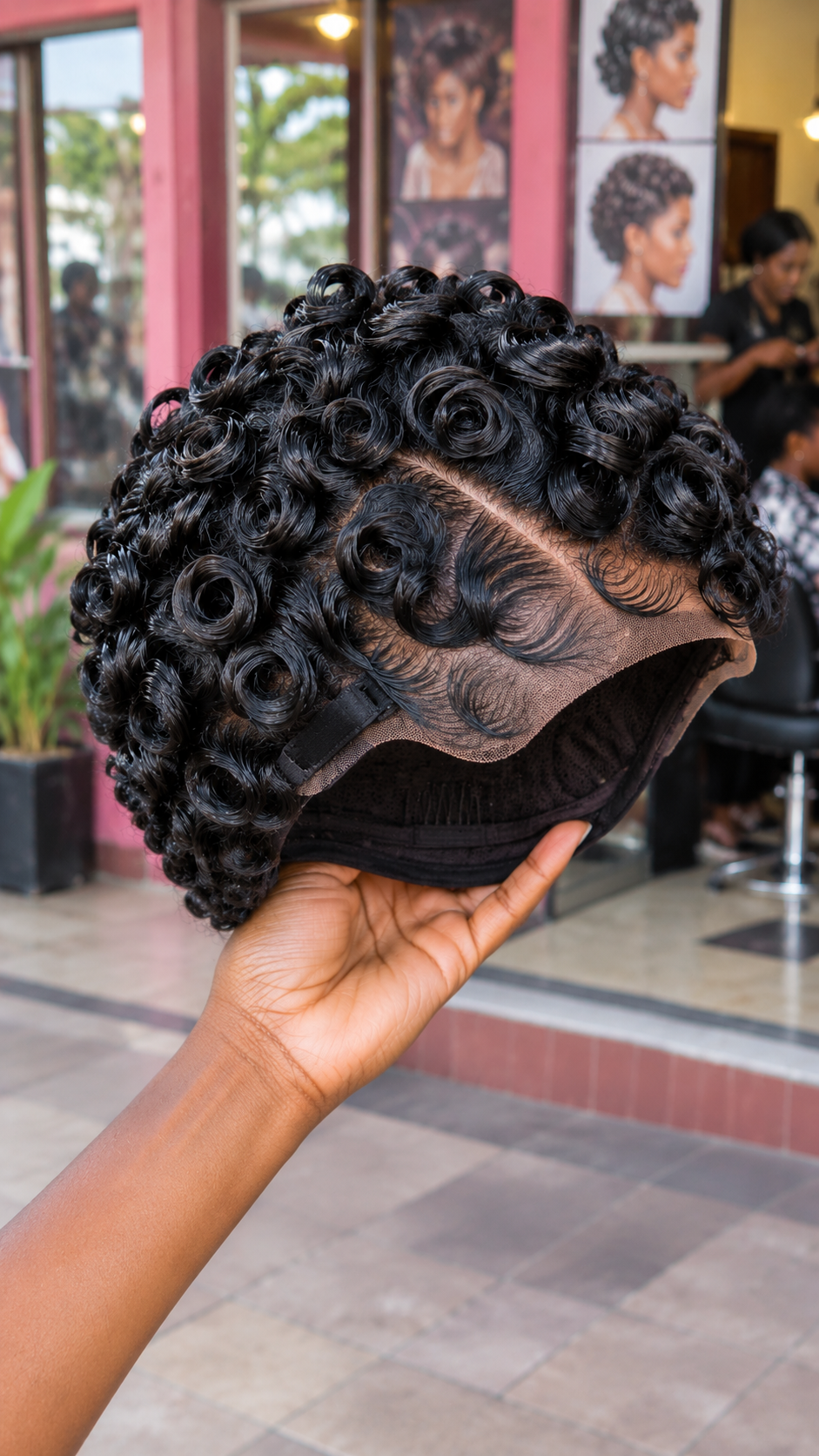
A beautifully styled pixie wig can turn a relatively compact haircut into an expressive hairstyle through the relationship between curls, parting placement, and delicate front styling. The black wig shown here offers an especially interesting interpretation. Its crown is covered with glossy circular curls, while a diagonal separation introduces a flowing arrangement of finger waves across the front. Several larger loops appear near the visible temple, creating a graceful transition between the raised curls and the finer strands near the hairline.
The photograph captures the wig held in one hand outside a neighborhood salon with a pink storefront. The unit is displayed before installation, with its front lace exposed and the dark interior cap opening visible beneath the styled hairline. Unlike a finished hairstyle photographed on a wearer, this angle allows prospective buyers to examine both the curl arrangement and several elements of the wig’s construction.
The hair appears predominantly deep black, with bright reflections along the curved strands. Large rosette-like curls are distributed across the upper head and visible side, while smaller loops occupy the outer sections. Near the front, the circular styling gives way to broad waves that sweep across the lace in a more elongated pattern.


The difference between these two styling movements gives the wig its personality. The crown feels rounded and full, while the front hairline remains carefully arranged and relatively close to the foundation. A prominent curl near the diagonal parting adds another focal point, connecting the circular crown with the lower waves.
For women seeking a stylish black pixie wig, this design offers more than a familiar curly silhouette. It demonstrates how a carefully positioned parting and intricate forehead waves can create a distinctive appearance without requiring colored highlights, elaborate shaved designs, or long hair.
Where the Curl Arrangement Meets the Front Hairline
The most important area to examine is the transition between the raised circular curls and the fine strands near the forehead. In many ordinary curly pixie wigs, the curls continue uniformly toward the front. Here, the arrangement is more deliberate.
The upper hairstyle contains numerous circular loops, several with clearly recognizable openings. Near the diagonal separation, these curls give way to longer strands that bend into flowing waves across the front.
The transition is particularly noticeable beneath the prominent circular curl positioned near the central front-side area. This loop sits close to the parting, while the strands below travel downward into the decorative wave arrangement.
Rather than filling the entire forehead with circular curls, the styling leaves sufficient space for the waves to remain visible. The two sections complement each other without appearing disconnected.
That balance is essential when recreating the hairstyle. A wig maker who extends the crown curls too far forward may conceal the delicate front waves. Conversely, enlarging the wave area excessively could reduce the visible crown volume.
For a close reproduction, the stylist should plan the boundary between these sections before arranging the individual curls.
The Circular Curls Have Different Sizes and Directions
The crown contains numerous glossy black ringlets resembling compact rosettes. Some rings have wide central openings, while others appear smaller and more tightly wound.
The individual curls are not positioned in a completely identical pattern. Several near the upper front appear larger, while smaller loops occupy spaces along the side and rearward sections.
This variation gives the hairstyle depth. The larger curls establish recognizable circular shapes, while the smaller ones create continuity across the rounded crown.
The curls also face slightly different directions. Some openings are oriented toward the camera, while others turn upward or toward the visible side. This creates a three-dimensional arrangement rather than a flat surface of identical circular shapes.
Despite the number of curls, the overall hairstyle remains relatively compact. The strands do not extend into long hanging spirals, and the crown retains a rounded silhouette.
Why Matching the Curl Diameter Matters
The size of the circular openings can substantially change the finished appearance. A crown made entirely from tiny coils may resemble a tightly curled pixie rather than the prominent rosette arrangement shown here.
Alternatively, oversized circular curls could make the hairstyle appear much fuller and taller than intended.
The photograph shows a combination of medium and larger open loops, supported by smaller curls around the outer sections.
For a custom order, ask the wig maker to preserve that variation rather than using one uniform curl size.
The intended crown height should also be discussed. Hair length before curling and the finished height are not necessarily the same, because circular styling can make longer strands appear much more compact.
Ask for photographs from above and behind before approving the finished piece. The supplied image offers detailed front-side information but does not establish every aspect of the rear curl arrangement.
A Diagonal Parting Creates the Main Styling Direction
A visible diagonal separation runs through the upper front section. The parting creates a clear division between surrounding circular curls and the finer strands forming the forehead waves.
The exposed channel appears lighter than the black hair because an underlying foundation is visible between the strands.
Several prominent circular curls sit close to the upper edge of the separation. Beneath it, dark strands follow a different direction, gradually forming elongated waves.
The parting is therefore more than a decorative element. It determines how the upper curls relate to the hairline and gives the hairstyle a recognizable directional structure.
The photograph does not establish that the separation was produced by shaving natural hair. Since this is a wig, the channel may have been created through the arrangement of hair on the foundation or another construction method.
Keeping the Parting Proportionate
The diagonal channel should remain visible without becoming unnecessarily wide.
An excessively broad separation could create an unwanted gap between the curls. A very narrow channel might become obscured if neighboring strands shift across it.
For custom work, the stylist should establish the parting before completing the surrounding curls and waves.
The exact angle should follow the reference, particularly where the separation approaches the front hairline.
Because the wig is being held rather than worn, the final position must be evaluated during fitting. Cap size and placement can influence how the diagonal parting aligns with the wearer’s forehead.
The Flowing Front Waves Deserve Their Own Attention
Beneath the circular crown, fine strands are arranged into broad, flowing waves. These strands lie much closer to the lace than the raised curls above them.
Several wave sections curve outward and downward across the visible front area. Their paths resemble elongated S-shaped movements rather than complete circular rings.
Near the temple, additional strands form smaller curves that extend toward the lower edge of the hairline.
The front waves have a carefully arranged appearance because neighboring strands follow similar directions. Their alignment creates a flowing surface without requiring substantial volume.
One particularly noticeable section appears beneath the prominent front-side curl. It bends toward the lower hairline and provides a visual connection between the crown and the side.
This front arrangement is among the most delicate parts of the hairstyle and should not be treated as ordinary loose baby hair.
Why Random Baby Hair Styling Would Change the Look
The front strands follow deliberate paths that complement the diagonal parting. Replacing them with unrelated small spirals or randomly curled baby hairs would create a different hairline.
For a faithful recreation, ask the stylist to maintain the broad flowing waves and preserve their relationship with the upper curls.
The strands should remain relatively close to the lace, allowing the raised rosettes to remain the main source of volume.
The photograph does not establish which styling products or setting techniques were used. Maintenance instructions should therefore follow the actual fiber composition and the guidance of the stylist responsible for the finished wig.
The Visible Side Retains Full Curl Coverage
The wig contains numerous circular curls extending down the visible side. Smaller loops continue beneath the larger crown rings, creating a rounded outer shape.
Unlike pixie wigs that use closely shaved-looking temples, this design maintains substantial curl coverage around the visible side.
No clearly exposed decorative razor lines or geometric shaved patterns appear beneath the curls. The visual interest comes primarily from the circular arrangement and the flowing front waves.
The curls become more compact toward the lower side, creating a gradual transition in size without introducing a separate haircut pattern.
For a custom reproduction, the stylist should maintain the rounded side silhouette rather than replacing the lower section with a close taper.
The complete back is not shown, so buyers should request a direct rear photograph before assuming that the same curl density continues around the entire nape.
Why the Deep Black Color Works So Well
The hair appears consistently deep black, with bright reflective areas visible along the circular curls and flowing waves.
These reflections follow the shape of the strands and should not automatically be interpreted as gray or silver-colored highlights.
The dark color emphasizes the spaces inside the ringlets, allowing individual curls to remain recognizable.
It also creates contrast against the lighter-looking parting and the beige-tan lace beneath the front hairline.
When purchasing, ask whether the available shade is natural black, off-black, or jet black. Commercial color names vary between suppliers.
A neutral-daylight photograph can help establish the actual shade more accurately than a heavily edited promotional image.
The glossy appearance does not establish the fiber composition. Human hair, synthetic fibers, and blended materials can all produce reflective surfaces depending on their construction and styling.
Examining the Lace Before Installation
A broad section of beige-tan mesh extends beyond the front hairline. The lace remains untrimmed, indicating that the wig is being displayed before final preparation for wearing.
The mesh is particularly visible beneath the decorative front waves, where it creates a border between the styled hair and the cap opening.
The photograph does not establish the exact lace grade, thickness, transparency, or full dimensions. It should not be described as HD lace without independent product information.
The color of the mesh may also appear different against an individual wearer’s skin than it does in the photograph.
Because the fine front strands extend close to the lace edge, fitting should occur before trimming.
Removing too much lace may interfere with the hairline and can be impossible to reverse.
The Visible Cap Provides Useful but Limited Information
The wig is held with its interior opening partly facing the camera. A dark cap foundation and stitched fabric sections are visible beneath the lace.
A dark band is also visible near the opening, but the photograph does not reveal the complete interior construction or every fastening component.
Consequently, the exact number of attachment combs, adjustable straps, or other securing elements cannot be confirmed.
The visible cap does not establish that the wig is suitable for adhesive-free installation.
Before purchasing, request a complete underside photograph showing the internal construction and any attachment hardware.
Ask for cap circumference, front-to-nape length, and ear-to-ear measurements.
The seller should also confirm whether the hair is human, synthetic, or blended and explain any styling restrictions.
What Kind of Wig Buyer Will Appreciate This Hairstyle?
This design may appeal to women who prefer compact hairstyles with considerable detail around the forehead.
The circular crown provides fullness without long hanging hair, while the flowing waves create an expressive front arrangement.
It may also interest buyers who enjoy highly arranged curls but do not want bright color or shaved side patterns.
However, the hairstyle may require more careful maintenance than a casually arranged curly pixie. The circular openings and delicate front waves can become disturbed by aggressive brushing, compression, or repeated manipulation.
Buyers who prefer minimal daily styling should ask the seller how well the arrangement can be maintained and whether professional resetting is recommended.
The suitability of the wig also depends on the cap construction, material, and fitting rather than appearance alone.
Where to Buy Similar Circular Curl Pixie Wigs
Women interested in this hairstyle can begin with online wig retailers, local beauty supply stores, and professional wig makers specializing in sculpted circular curls.
However, product descriptions such as black curly pixie wig may refer to many different hairstyles.
Some wigs contain tiny spring coils, while others have long loose spirals or conventional finger waves without the prominent circular crown.
When comparing listings, focus on the actual ring openings, crown density, diagonal parting, and front-wave arrangement.
A ready-made wig may be suitable when the desired styling is already available.
A custom wig maker may offer greater control over curl diameter, crown height, parting direction, and the placement of the decorative waves.
Before paying a deposit, confirm material composition, cap dimensions, lace specifications, production time, shipping arrangements, and return conditions.
Planning a Custom Wig Order
Begin by sharing the photograph with the seller or wig maker. Explain that the desired design combines prominent circular black curls, a diagonal front-side parting, and broad flowing waves beneath the crown.
Specify that the upper rings should remain recognizable rather than becoming extremely small or tightly compressed.
Ask the maker to preserve the visible curl coverage around the side rather than introducing a closely shaved-looking temple.
Discuss the intended crown height and the direction of the front strands.
Ask whether the product will arrive fully styled or require additional salon work after delivery.
Request photographs from the front, both sides, rear, and underside before shipping.
If precise matching matters, ask the maker to explain which details can be reproduced accurately and which may vary between handmade pieces.
Booking a Professional Installation Appointment
A wig stylist experienced in circular curl placement, finger-wave hairlines, and lace preparation is a suitable professional for recreating this hairstyle.
During consultation, show the reference photograph and explain the importance of the diagonal parting and flowing front waves.
The stylist should inspect the delivered wig before making permanent adjustments.
Check that the circular curls have retained their shape during transportation and that the delicate front strands are not displaced.
The cap should then be positioned on the wearer and assessed for comfort and proper alignment.
If lace trimming is necessary, it should occur only after the correct position has been established.
The attachment method should depend on the actual cap construction and the wearer’s comfort rather than assumptions based on the photograph.
Illustrative Prices for Sculpted Black Pixie Wigs
The cost of recreating this hairstyle may depend on the selected fiber, cap construction, circular curl placement, decorative front waves, and installation requirements.
The following USD ranges are illustrative planning estimates rather than verified live prices or quotations for the photographed wig.
| Wig Category | Illustrative USD Range | Potential Cost Considerations |
|---|---|---|
| Premium Custom | $375–$950+ | Individual cap measurements, specialist circular curl construction, precise front-wave styling, and detailed lace preparation. |
| Standard Custom | $185–$445 | Selected cap options, customized curl sizes, and adjustments to the diagonal parting and hairline. |
| Basic Human Hair | $105–$290 | Human-hair base unit that may require separate curling, hairline styling, and fitting preparation. |
| Premium Synthetic | $70–$195 | Higher-grade synthetic alternatives with prearranged circular curls and material-dependent styling flexibility. |
| Basic Synthetic | $25–$90 | Budget alternatives that may differ in curl precision, front-wave accuracy, and cap construction. |
These categories represent possible purchasing alternatives rather than confirmed classifications of the photographed product.
The actual fiber composition and selling price cannot be established from the image.
The elaborate circular curl arrangement and decorative front waves may involve substantial styling labor, particularly when the individual curls must be positioned by hand.
Ask whether the quotation includes the base wig, styling, cap fitting, lace preparation, installation, shipping, and future maintenance services.
Maintaining the Circular Curls Without Flattening Them
The primary maintenance concern is preserving the rounded shape of the crown curls.
Repeated brushing, aggressive finger separation, and compression may disturb the circular openings and change the overall silhouette.
Ask the supplier how the curls were formed and whether they can be safely repositioned after cleaning.
Some styles may require professional resetting if the circular shapes become heavily compressed.
Cleaning methods should follow the confirmed fiber composition. Synthetic hair should not be exposed to heated styling tools unless the manufacturer specifically permits it.
Human hair may allow different methods, but previous processing and the condition of the fibers should still be considered.
Protecting the Finger Waves and Front Lace
The fine front strands need a different approach from the larger crown curls. Their appearance depends on maintaining specific flowing curves close to the hairline.
Repeated combing across the waves may disturb their direction, while excessive styling products can cause unwanted buildup.
Ask the wig maker which products and methods are suitable for the actual material.
When storing the wig, use a suitable support that preserves the crown without flattening the waves or stretching the lace.
Before wearing the wig again, inspect the front strands and parting to ensure they remain in the intended position.
If significant restyling is required, professional assistance may be preferable to attempting irreversible changes at home.
The Practical Benefits and Limitations
One advantage of this hairstyle is its compact length. The circular curls create fullness without long hanging hair, making the silhouette distinctive while remaining relatively contained.
The diagonal parting and flowing front waves offer additional detail without relying on bright highlights or geometric side carvings.
The dark color also allows the curls and hairline movement to become the main styling elements.
However, the intricate arrangement may require careful handling. Circular curls can lose their openings if compressed, and the finer waves may become displaced through repeated manipulation.
A precise custom reproduction may also cost more than a basic curly pixie because of the styling labor involved.
These factors should be considered alongside personal preferences, available maintenance time, and the intended frequency of wear.
A Black Pixie That Celebrates Fine Hair Styling
The defining characteristics of this hairstyle are its glossy black circular curls, diagonal crown separation, and flowing waves arranged across the front hairline.
The raised ringlets create a rounded silhouette, while the delicate strands below provide a graceful contrast. The visible lace and partial cap opening offer useful information about its preparation stage, although complete product specifications remain unverified.
For buyers seeking a similar wig, the most reliable approach is to compare actual curl placement, hairline direction, and cap construction rather than relying on a generic black curly pixie description.
Request additional photographs, confirm the fiber and lace information, and consult a professional stylist when close matching is important.
With suitable construction, careful fitting, and appropriate maintenance, a similar design can provide an attractive compact pixie hairstyle that emphasizes circular curls and beautifully arranged front waves.
Search Terms
Captivating black pixie curls · Sweeping front finger wave wig · Circular black rosette crown hairstyle · Diagonal parting glossy black lace wig · Open spiral ringlet pixie hairpiece · Deep black crown with flowing forehead strands · Compact circular curls with side waves · Black curly pixie with visible tan lace