
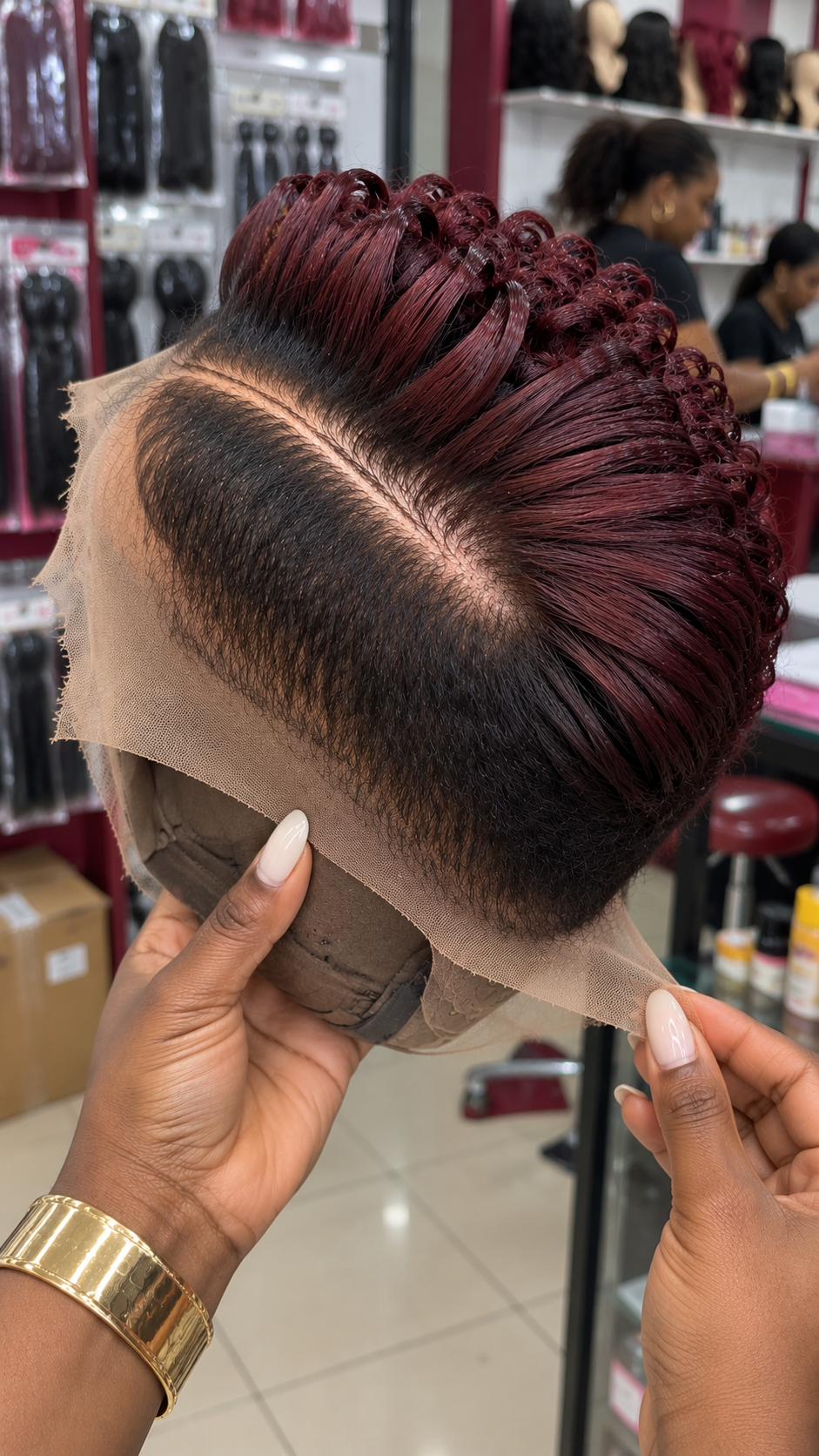
A rich burgundy color can completely change the personality of a pixie wig, especially when it is paired with carefully arranged loop curls and a dramatic side-part structure. The wig shown here combines deep wine-red tones across the upper section with a darker foundation around the side and lower areas. Instead of relying on length for impact, the design builds its shape through elevated loops, directional styling, contrast and a carefully separated side section.
The photograph also gives an unusually useful view of the wig before installation. The lace extends beyond the hairline, the interior cap can be seen underneath, and the side construction is exposed clearly enough to understand how the finished hairstyle is intended to sit. This makes the reference valuable for anyone planning to order a similar custom unit because it shows more than the final appearance. It also reveals important construction details that should be discussed with a wig maker before purchasing.
The upper portion is the visual focus. Burgundy strands rise from a deep diagonal part and are formed into broad loops that gradually become smaller toward the crown and back. The result is a compact pixie silhouette with considerable dimension. The darker foundation underneath prevents the wine-red color from becoming visually flat and gives the loops stronger separation.
The Burgundy Color Placement Gives the Crown Its Depth
The color in this wig is not simply a single bright red. The visible upper hair reads as a deep burgundy or wine shade, while the roots and lower side area remain significantly darker. This combination produces depth between individual loops and keeps the hairstyle from appearing like one solid block of color.
Under bright salon lighting, the raised sections reveal warmer red reflections while recessed areas appear closer to dark burgundy. That variation is particularly effective on sculpted curls because every bend catches light differently. A flatter hairstyle would not display the same amount of tonal movement.
When requesting a similar unit, customers should avoid ordering only by a generic label such as “red.” Burgundy, wine red, cherry red, auburn and mahogany can look very different. Sending the reference photograph to the seller and asking for a dark burgundy upper section with a deeper root and side foundation will communicate the desired direction much more accurately.
Why the Large Loop Curls Matter to the Silhouette
The curl pattern is one of the most distinctive elements in this design. These are not loose everyday curls. The hair has been arranged into deliberate loop formations that rise from the scalp and bend backward. Several loops remain open enough to reveal their circular shape, while others overlap to build density through the crown.
The front and upper-middle loops are larger and more elongated. As the hairstyle travels toward the back, the loops become more compact. This progression creates a controlled dome rather than an evenly sized mass of curls. It also keeps the front visually dramatic while allowing the rear section to follow the head more closely.
A custom wig maker recreating this look should understand that curl direction is as important as curl size. Simply curling every strand and allowing it to fall naturally would produce a very different wig. The loops need to follow the direction established by the parting and should be arranged intentionally so the crown retains its sculpted appearance.
The Deep Side Part Controls the Entire Design
A pronounced diagonal part separates the raised burgundy section from the darker side area. This line creates a strong visual boundary and establishes the direction in which the upper hair travels. The placement also gives the hairstyle an asymmetrical profile, which is one of the reasons the wig looks distinctive even before installation.
The side below the part is kept close to the base and appears much flatter than the crown. That contrast makes the upper loops look taller without requiring excessive density. It is a useful design principle for pixie wigs: volume can appear stronger when it is positioned beside an intentionally close section.
For custom orders, the position of this part should be discussed in advance. Moving it too high, too low or too far toward the center can alter the proportions of the entire hairstyle. A reference image showing the same angle as this photograph can help a stylist understand where the separation should begin and how it should travel toward the back.
Visible Lace and Cap Construction Before Installation
The photograph clearly shows lace extending beyond the perimeter of the hairline. Because the unit is being held before installation, the excess lace has not yet been trimmed. This is useful for buyers because it demonstrates that the hairline area is designed to be customized during fitting rather than arriving with the lace already cut directly against the hair.
The interior cap is also partially visible underneath. This confirms that the hairstyle is being presented as a wearable wig unit rather than simply a haircut photographed on a person. However, the photograph alone does not establish every technical specification of the lace or cap. Buyers should therefore ask the seller directly about lace type, cap measurements, adjustable components and attachment options rather than assuming them from appearance.
The excess lace should normally be fitted and trimmed according to the wearer’s hairline. Anyone who has not worked with lace wigs before may prefer to have the first fitting completed by an experienced wig stylist. Cutting too close or removing the wrong section can permanently affect the perimeter of the unit.
What to Tell a Wig Maker When Ordering This Style
A strong custom order starts with visual references and precise instructions. Send the photograph and identify the elements that matter most: deep burgundy upper color, darker foundation, large loop curls, diagonal side part, close side area and the compact pixie proportions.
Ask whether the wig will arrive fully styled or only partially set. For a sculpted design like this, receiving the unit already arranged can save considerable work. If the seller ships the loops pre-formed, ask how the wig will be protected inside the package so the crown is not compressed in transit.
Cap size should also be confirmed before production. Follow the wig maker’s measurement instructions rather than guessing between small, medium and large. Depending on the maker, measurements may include head circumference, front-to-nape distance, ear-to-ear distance and temple-to-temple width.
Finally, request confirmation of the actual burgundy shade before the order is completed. If possible, ask for a photograph of the chosen hair color under ordinary indoor lighting. Highly edited product photographs can make burgundy appear brighter or more purple than it looks in person.
Search Terms
Burgundy Loop Curl Pixie Wig · Wine Red Pixie Wig With Dark Roots · Burgundy Sculpted Curl Wig · Deep Side Part Pixie Wig · Burgundy Lace Front Pixie Wig · Loop Curl Lace Wig · Wine Red Pixie Wig With Side Part · Sculpted Burgundy Pixie Wig
Choosing Human Hair or Synthetic Fiber for Sculpted Loops
Human hair can be a practical option for buyers who want the ability to reshape individual loops, refresh the crown or adjust the style later. It generally gives a professional stylist more freedom when working with controlled heat. The tradeoff is that a carefully arranged loop pattern may require maintenance after washing or prolonged wear.
Premium synthetic fiber can be attractive for a hairstyle whose primary goal is maintaining a specific curl formation. Pre-set synthetic loops may retain their original arrangement with less frequent restyling. However, heat tolerance varies between fibers, and hot tools should never be used unless the manufacturer specifically confirms that the material is heat resistant.
The best choice depends on how the wig will be worn. Someone who wants frequent salon restyling may value human hair, while someone who wants the burgundy loops to remain close to their original arrangement may prefer a professionally constructed synthetic option. Construction quality matters more than simply choosing one material category over another.
Premium Custom / Standard Custom / Basic Human Hair / Premium Synthetic / Basic Synthetic
| Wig Category | Estimated Price Range | What the Buyer Can Expect |
|---|---|---|
| Premium Custom | $300–$500+ | Individual color work, detailed loop placement, custom measurements, professional hairline preparation and advanced styling |
| Standard Custom | $190–$300 | Personalized burgundy color, side-part placement and professionally arranged pixie curls |
| Basic Human Hair | $120–$200 | A workable human-hair base that may require additional cutting, coloring or salon styling |
| Premium Synthetic | $80–$150 | Higher-quality fiber with pre-set curls and less frequent reshaping |
| Basic Synthetic | $45–$80 | A lower-cost option with simpler cap construction and less customization |
These figures are general shopping estimates and are not the confirmed price of the wig shown in the photograph. Final cost can change according to hair material, cap construction, lace area, coloring process, customization, stylist labor, shipping and location. Always request a complete quote from the seller before placing an order.
Booking a Professional Fitting After the Wig Arrives
A salon appointment can be especially useful for a wig with a visible lace perimeter and a structured side part. Bring the wig, the original reference photograph and any care information supplied by the maker. The stylist can position the unit correctly before deciding how much lace should be removed.
Correct positioning matters because the deep part and close side section need to sit in believable locations relative to the wearer’s temple. If the unit is shifted too far forward, backward or sideways, the intended proportions can change noticeably.
During the appointment, ask the stylist to preserve the loop arrangement wherever possible. Shipping may flatten a few sections, but that does not necessarily mean the entire crown needs to be restyled. Individual loops can often be refreshed while the rest of the original structure remains intact.
How the Hairline Should Be Approached During Customization
The front perimeter should complement the sculpted crown rather than compete with it. Because the upper hair already carries substantial visual detail, an excessively heavy hairline can make the front appear crowded. The goal is to transition naturally from the lace area into the raised loops.
Hairline density should be discussed with the wig maker before ordering if customization is important to you. Some customers prefer a fuller perimeter, while others want a lighter appearance that can be personalized during installation. The photograph demonstrates the lace area clearly, but it does not provide enough information to guarantee a particular lace specification or pre-plucked density.
For this reason, questions about bleaching, knot work, lace tint and adhesive compatibility should be directed to the maker or installing stylist. Those details depend on the actual materials used in the individual unit.
Maintaining the Burgundy Color and Loop Formation
A sculpted pixie wig should be handled differently from loose curls. Avoid repeatedly brushing through the crown because doing so can dismantle the loop formation. When minor adjustments are needed, individual sections should be handled separately rather than combing through the entire hairstyle.
Store the wig on a properly sized stand so the crown is not crushed. Avoid placing heavy objects on top of it or storing it tightly inside a small bag. If the unit must be transported, allow enough space around the raised loops to preserve their shape.
Human-hair versions should be washed according to the wig maker’s recommendations. Heavy product buildup can weigh down the loops and reduce their separation. Color-treated burgundy hair may also benefit from products intended for colored hair, provided they are compatible with the wig construction.
For synthetic versions, use only products appropriate for synthetic fibers. Do not assume the unit can tolerate curling irons or other heated tools. The original seller should provide the safest temperature and care instructions when heat-resistant fiber is used.
Why Burgundy Works Especially Well With This Curl Pattern
Burgundy provides enough color to make the hairstyle noticeable while retaining substantial depth. The darker areas between the loops create natural-looking shadow, while the exposed surfaces reflect red and wine tones. This interaction is particularly effective on a three-dimensional curl pattern.
The shade also works well with the dark foundation visible beneath the crown. Instead of creating a sharp transition between two unrelated colors, the deep root blends gradually into the burgundy upper section. That makes the color placement feel intentional and helps emphasize the shape of each loop.
Customers who want a slightly brighter interpretation could discuss cherry-red or warmer auburn variations with a colorist. Those who prefer something deeper could request wine, mahogany or dark burgundy. The reference image should remain the primary guide because color names alone vary considerably between wig suppliers.
Questions Worth Asking Before Paying for a Custom Order
Ask the seller whether the displayed hairstyle is available as an existing unit or must be recreated. Confirm whether the quoted price includes coloring and final styling. Find out whether the lace arrives uncut, whether the cap includes adjustable elements and whether custom measurements are accepted.
You should also ask whether the curl arrangement shown in the seller’s reference photographs will be reproduced on your specific unit. When purchasing custom work, photographs of the actual completed wig before shipping can be extremely helpful. They give the buyer an opportunity to check color, part placement and overall proportions before the package leaves the seller.
If you are ordering internationally, confirm processing time separately from shipping time. A custom wig may require several days or weeks of production before it is handed to the courier. Understanding both timelines makes it easier to schedule a salon fitting for an event or planned date.
A Practical Order-to-Installation Plan
- Save this reference image and identify the burgundy color, dark foundation, loop curls and diagonal side part as the essential design elements.
- Choose a wig maker or salon that can show previous pixie and sculpted-curl work.
- Send accurate head measurements using the seller’s measuring method.
- Confirm hair material, cap size, lace area, burgundy shade and whether the loops will arrive fully styled.
- Request the complete price including customization, coloring, styling and delivery.
- Ask for photographs of the completed unit before shipment when the seller offers this service.
- Book a wig stylist for fitting, lace trimming and minor curl adjustments after delivery.
- Store the wig correctly between wears so the raised loop pattern keeps its intended shape.
Getting the Closest Result to the Reference
The success of this wig depends on several elements working together rather than one isolated detail. The deep burgundy color provides richness, the dark foundation adds contrast, the large loops create volume, and the diagonal side part controls the direction of the hairstyle. The visible lace construction then allows the perimeter to be fitted to the wearer during installation.
When shopping, avoid focusing only on the color. A burgundy wig with ordinary curls will not create the same appearance. Likewise, copying the loop pattern without the strong side separation can change the entire silhouette. Show the wig maker exactly which elements you want preserved and ask how they plan to reproduce them.
A professionally constructed version can be ordered through a custom wig maker, wig salon or stylist experienced with sculpted pixie units. Compare previous work, ask detailed questions and confirm the specifications in writing before payment. Once the unit arrives, a careful fitting and restrained maintenance routine will help preserve the distinctive loop formation and rich wine-red appearance that make this design immediately recognizable.