
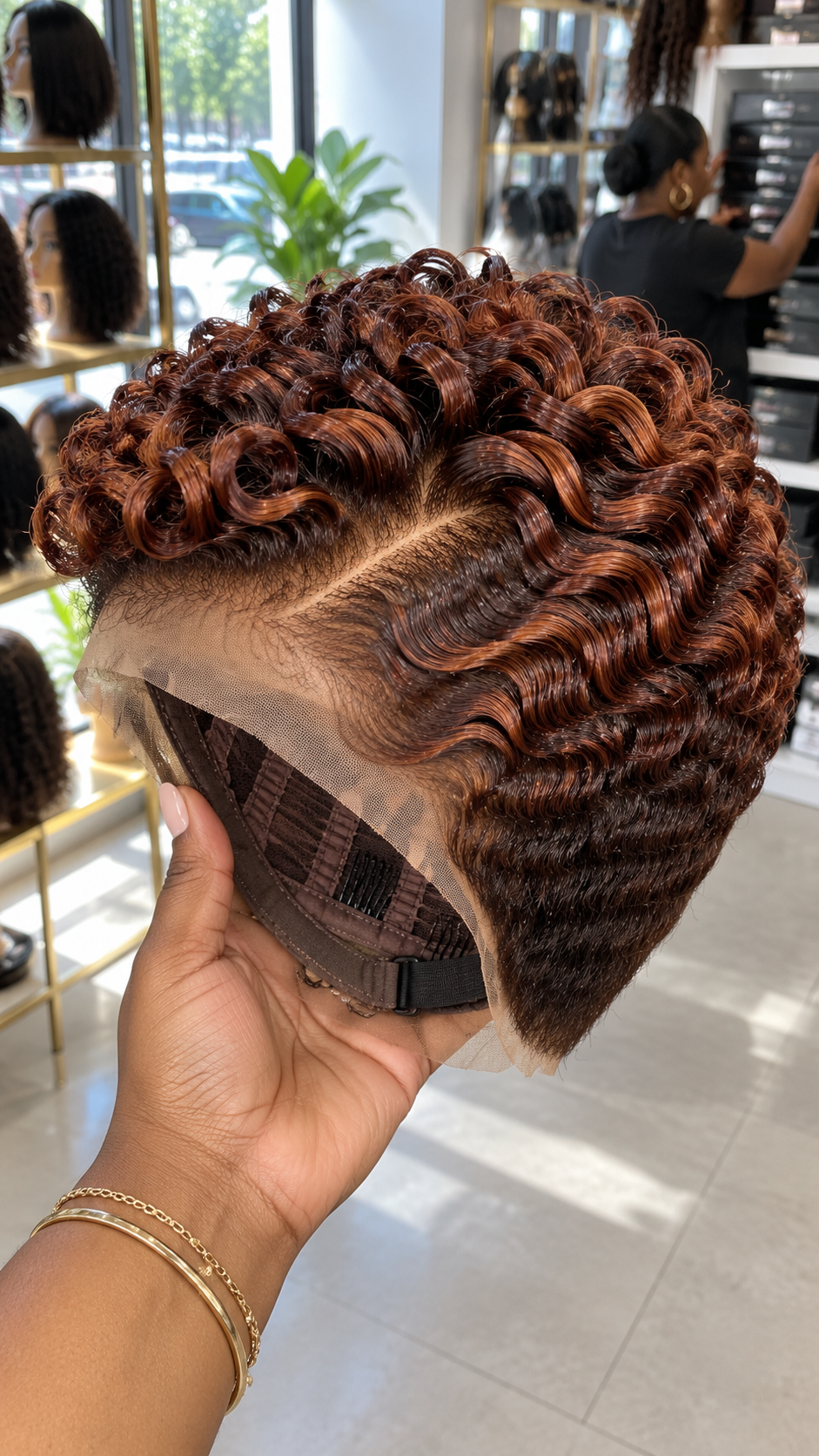
The most important detail in this auburn chestnut wig is the change in curl construction as the hair moves from the crown toward the side. Near the upper front, the strands form rounded loops with visible openings. Farther across the side, those loops gradually give way to broad S-shaped waves that travel backward and downward. The lower section then narrows into closely arranged dark brown hair. This progression creates a distinctive hairstyle without relying on decorative shaved stripes or exaggerated height.
The photograph shows the wig being held inside a brightly lit beauty salon, with daylight entering through a nearby window. The beige lace remains untrimmed, and part of the brown interior cap is visible beneath the front edge. A small interior comb and dark adjustment band can also be seen. These details make the image useful for evaluating both the appearance of the wig and several practical questions that should be resolved before purchasing.
The coloring is equally distinctive. Rich auburn chestnut dominates the visible hair, with copper reflections along the raised curls and deeper chocolate-brown tones near the roots and lower side. The photograph does not establish whether those lighter sections were separately colored or simply appear brighter because of their position under the light. What can be established is the visual relationship between the warm upper hair, darker foundation, and carefully arranged wave pattern.


The Hairstyle Changes Character Across the Head
Rather than treating the entire wig as one uniform curly hairstyle, it is more useful to examine the visible sections according to their direction and shape.
The front-left area contains compact curls that turn inward and form recognizable circular openings. Several of these curls overlap, with their outer surfaces catching copper-colored reflections.
Near the central upper section, the curls become broader and more elongated. Some form partial rings, while others bend into sweeping loops that begin to travel toward the side.
Farther right, the arrangement becomes noticeably more directional. The hair follows a sequence of broad S-shaped waves, with neighboring strands moving together rather than separating into independent ringlets.
Below these waves, the hair lies closer to the foundation and narrows toward the lower visible edge. The overall result is a graduated styling pattern, not a collection of identical curls repeated across the entire wig.
This difference is essential for anyone seeking an accurate reproduction. A seller who supplies ordinary ringlets across the entire head may match the general color but miss the hairstyle’s most recognizable characteristic.
Where the Ringlets Give Way to Sculpted Waves
The transition is especially noticeable near the upper side, where a diagonal exposed parting separates the front curl arrangement from the larger sweeping sections.
The hair immediately beside this parting rises into a broad curve, then bends backward into a series of flowing ridges. These ridges resemble finger-wave-inspired styling rather than conventional hanging curls.
The individual strands appear closely aligned within each wave. This gives the surface a polished appearance and emphasizes the direction of the hair.
A custom stylist should preserve the change from open curls to elongated waves rather than forcing every section into the same shape.
The photograph does not reveal the complete opposite side or rear, so those areas should be confirmed through additional images before approving a custom order.
Understanding the Auburn Chestnut and Copper Color Balance
The visible hair has a warm reddish-brown appearance with copper highlights created by the illuminated strands. Some upper sections look closer to chestnut, while others display brighter amber-copper reflections.
The darkest areas are concentrated beneath the upper styling and through the lower side, where the hair appears deep chocolate brown.
This contrast creates depth within the hairstyle. The raised loops catch more light, while the recessed areas between them appear darker.
The color should not be described as uniformly ginger, bright orange, or blonde. Those descriptions would suggest a substantially lighter result than the one visible in the photograph.
For a custom order, auburn chestnut with copper reflections and a darker chocolate foundation is a more useful description.
Using Daylight to Judge the Actual Shade
The photograph was taken in a salon with substantial daylight entering from nearby windows. That makes the visible color useful as a reference, but it does not eliminate the effects of camera processing or indoor lighting.
Ask a seller to photograph the proposed wig near a window and under ordinary room lighting.
Compare the darker roots, the raised copper sections, and the lower side rather than evaluating only one brightly illuminated curl.
If the unit contains human hair, ask whether the desired shade requires additional color processing. If it contains synthetic fiber, confirm that the intended color arrangement is available without relying on unverified dyeing methods.
The photograph alone cannot establish the fiber material or the process used to achieve the color.
A Diagonal Parting Creates a Natural Styling Boundary
The visible front contains a diagonal parting that separates neighboring groups of curls and waves. The exposed foundation forms a narrow, lighter-looking channel between the darker hair sections.
Unlike decorative razor stripes, this separation appears to organize the styling direction. The curls on one side form compact loops, while the hair on the other side progresses into broader waves.
The parting is not exceptionally wide, and the surrounding hair retains substantial coverage.
For a custom reproduction, the stylist should preserve the narrow separation without exaggerating it into a large shaved channel.
The parting also provides a useful reference point during fitting. If the wig is positioned incorrectly, the relationship between the front curls and side waves may change.
Why This Wig Does Not Need Additional Carved Lines
The visible side does not show multiple decorative razor channels, nested crescents, or geometric barber patterns.
Its visual interest comes from the broad wave arrangement and the darker tapered section beneath it.
Adding carved stripes could interrupt the flowing strands and create a different hairstyle.
When ordering, explain that the side should remain covered with closely arranged hair and that the existing parting is the primary exposed separation.
A stylist should not remove additional hair unless the buyer has explicitly requested a different design.
The Lower Side Is Closely Arranged Rather Than Completely Shaved
Beneath the prominent auburn waves, the lower side contains dark brown strands that follow the contour of the wig. The hair appears comparatively close to the foundation, creating a tapered silhouette.
The density gradually decreases toward the lower edge, where the strands become finer and less prominent.
This section provides an important visual counterweight to the upper curls. Without the darker, closer arrangement, the hairstyle could appear excessively full around the side.
The lower hair should not be mistaken for a completely bare shaved area. The photograph shows visible strands throughout much of the section.
A custom maker should preserve enough coverage to maintain the tapered appearance without exposing unnecessary foundation material.
The Interior Comb Changes the Questions Buyers Should Ask
Part of the wig’s underside is visible beneath the front lace. The interior appears brown, with fabric panels, stitching, and a small dark comb attachment.
A dark band and adjustment hardware are also visible near the lower edge of the cap.
These components suggest that the wig includes attachment and fitting elements, but the photograph does not establish the complete retention system.
The visible comb may be intended to help secure the wig to existing hair. However, it cannot be assumed that every wearer will find this attachment suitable.
The dark band may provide adjustment, but its exact range and intended use should be confirmed with the seller.
Checking the Cap Before Selecting an Installation Method
Ask the seller for the cap circumference, front-to-back length, and ear-to-ear measurements.
Request a complete underside photograph showing all combs, clips, bands, and other attachment components.
If the wig is advertised as glueless, ask the seller to explain how it is intended to remain secure without adhesive. The presence of a comb or band does not independently confirm adhesive-free suitability.
Buyers who cannot comfortably use a comb attachment should discuss alternative fitting options with a qualified wig stylist.
The cap should be evaluated for comfort and appropriate tension before the lace is permanently trimmed.
The Beige Lace Still Requires Individual Fitting
A broad section of beige lace extends beyond the front hairline and along the visible side. The mesh remains untrimmed, indicating that the unit is being presented before final installation.
Fine dark strands are visible near the hairline, particularly around the front curl arrangement and the beginning of the diagonal parting.
The lace appears beige under the available lighting, but its final appearance against a person’s skin cannot be established from the photograph alone.
The image also does not confirm the exact lace grade, thickness, or manufacturing specification. It should not automatically be described as HD lace.
For this hairstyle, trimming should take place only after the wig has been correctly positioned. Removing excess lace too early could affect the front hairline or the relationship between the curls and the face.
Preparing for a Professional Lace Appointment
When booking an installation, explain that the wig contains sculpted curls and waves that should remain in their original arrangement.
Ask whether the stylist can fit the cap, assess the lace color, trim the excess mesh, and preserve the front styling.
The installer should examine the diagonal parting and side waves before making adjustments.
If the hairline needs customization, the stylist should explain what will be changed and whether those modifications are reversible.
The finished installation should retain the compact silhouette without pulling the side waves into an unintended position.
Finding a Wig Maker Who Can Combine Ringlets and Broad Waves
This hairstyle requires a different skill set from a conventional curly pixie. The front contains compact circular curls, while the side relies on larger, coordinated waves.
When contacting a wig maker, describe the desired unit as an auburn chestnut pixie lace wig with copper ringlets, a diagonal parting, and sweeping side waves.
Send the original photograph and explain that the lower side should remain dark and closely arranged without additional decorative stripes.
Ask for examples of previous work involving sculpted curls and finger-wave-inspired styling.
A stylist experienced only with loose curls may not necessarily be able to reproduce the directional wave arrangement accurately.
Independent wig makers, specialist lace wig boutiques, local beauty supply stores, and online wig marketplaces are possible places to begin searching.
Exact availability should be confirmed directly. A similar photograph in a listing does not guarantee that the delivered wig will match the reference.
How to Evaluate a Custom Order Before Shipping
Ask the maker to provide photographs showing the front curl arrangement, the diagonal parting, and the side waves.
A slightly elevated view can help reveal whether the upper loops retain their intended shape.
A close side photograph should show the broad wave progression and the darker tapered section beneath it.
Request a rear view because the supplied photograph does not reveal the complete back of the hairstyle.
Finally, ask for a complete underside photograph showing the cap construction and attachment components.
These images can help identify differences before the unit is shipped or permanently customized.
Illustrative Pricing for Auburn Chestnut Sculpted Pixie Wigs
The following USD amounts are broad illustrative planning ranges, not verified live prices for the photographed wig. Actual quotations may vary according to supplier, location, material, cap construction, color processing, and styling labor.
| Wig Category | Illustrative USD Range | Potential Cost Considerations |
|---|---|---|
| Premium Custom | $355–$870+ | Individual cap construction, auburn chestnut coloring, sculpted ringlets, broad side waves, and possible personalized fitting |
| Standard Custom | $190–$455 | Customized copper-brown color arrangement, selected cap options, curl styling, and professional wave setting |
| Basic Human Hair | $100–$280 | Base human-hair unit with potential additional charges for coloring, ringlet setting, and side wave styling |
| Premium Synthetic | $70–$200 | Pre-styled curl and wave arrangement, cap specifications, and fiber-dependent maintenance limitations |
| Basic Synthetic | $30–$110 | General auburn curly pixie resemblance, simpler construction, and potentially less accurate sculpted details |
These categories represent possible purchasing alternatives. The photograph does not establish whether the wig contains human hair, synthetic fiber, or a blend.
The main cost considerations are likely to include the detailed curl arrangement, the transition into broad waves, and the warm auburn color.
A basic auburn curly wig may be relatively straightforward to purchase, but reproducing the sculpted side movement can require additional professional work.
Color processing may also affect the quotation, particularly if a human-hair unit requires additional treatment to achieve the desired copper reflections.
Cap customization, lace fitting, installation, shipping, taxes, and additional salon appointments may not be included in the advertised price.
Ask for an itemized quotation identifying the base wig cost and any separate styling or installation charges.
Maintaining Two Different Curl Structures
The front ringlets and broad side waves may require different handling because they are arranged in different ways.
The circular curls should be protected from aggressive brushing or repeated pulling, which could distort their openings.
The side waves depend on coordinated strand direction. Separating those strands into individual curls could change the intended appearance.
Before washing or restyling, ask the supplier how the hairstyle was created and which products are compatible with the actual fiber.
Synthetic hair may have restrictions involving heat and chemical processing. Human hair may permit different treatments, but previously colored strands can still require careful handling.
Do not attempt to reshape the curls or waves with high heat until the material and its temperature limitations have been confirmed.
Protecting the Copper Color and Lower Taper
The warm auburn color may require material-specific care, especially if the hair has undergone chemical processing.
Heavy product buildup can reduce the visibility of individual strands and alter the reflective appearance of the waves.
The lower tapered section should remain closely arranged rather than being brushed outward into additional volume.
When storing the wig, use an appropriately sized support that does not compress the upper curls or stretch the cap.
The lace and visible attachment components should be handled carefully during removal and storage.
What Makes This Particular Wig Worth Reproducing
The most successful version of this hairstyle will preserve the gradual transition between its different sections.
The front should contain recognizable auburn chestnut ringlets with copper reflections. The upper side should progress into broad S-shaped waves, while the lower section remains darker and closely arranged.
The diagonal parting should remain visible without becoming an exaggerated shaved channel.
The cap should fit appropriately, and the lace should be customized only after the intended wearing position has been established.
Rather than adding extra curls, decorative lines, or brighter coloring, the focus should remain on the relationship between the circular front, flowing side, and tapered lower section. That progression gives the wig its distinctive appearance and provides a clear standard for evaluating ready-made alternatives or a custom commission.
Search Terms
auburn chestnut finger wave lace wig · copper brown sculpted pixie curls · diagonal parting reddish brown hairpiece · chocolate tapered side wave wig · copper loop crown flowing S waves · visible interior comb auburn lace unit · untrimmed beige lace chestnut pixie · glossy cinnamon auburn sculpted curl wig