
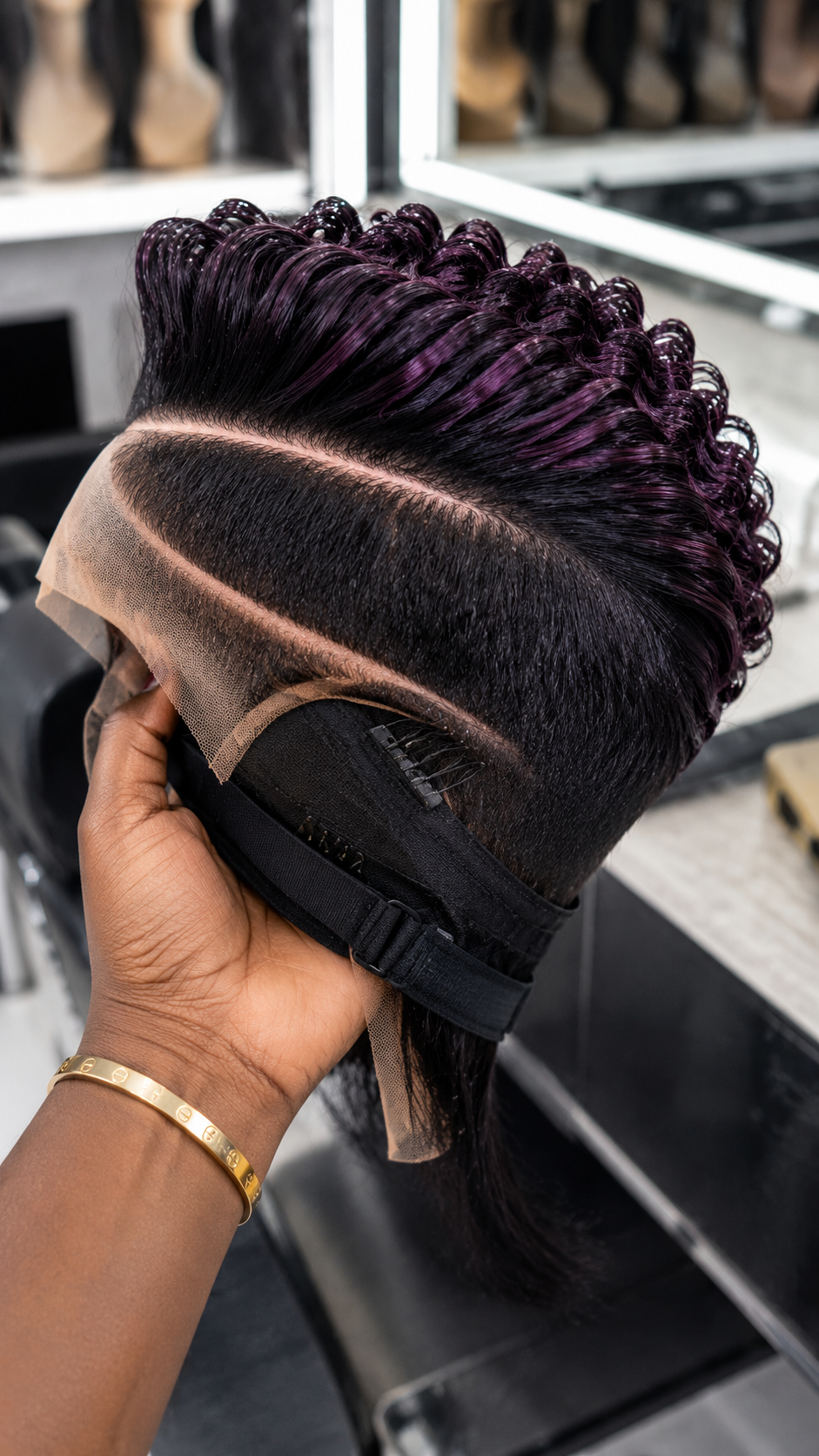
A short pixie can use exactly the same amount of hair and still create two completely different looks depending on which direction the crown travels. This black-and-plum unit makes that difference unusually clear. The upper hair does not fall forward toward the forehead. It rises from the root and travels backward before turning into sculpted loops toward the crown.
That backward direction opens the front of the wig, exposes more of the forehead and temple area, and makes the upper silhouette look longer from front to back. It is a styling decision that affects the whole face before curl size, shine, or even colour becomes the main issue.
Before buying a pixie like this, ask yourself whether you actually want a swept-back crown. If you normally prefer hair falling toward the forehead, this exact unit may feel much more exposed when worn than it appears while being held in a product photograph.
Where To Buy A Swept-Back Pixie Wig
Custom wig makers. A custom maker is the strongest option when direction matters. Send a side-profile reference and specify that the upper section should rise and travel backward from the hairline rather than falling forward into a fringe.
Instagram and TikTok sellers. Ask for a video from the front as well as the side. A side photograph shows the backward sweep beautifully, but only the front view tells you how open the hairstyle actually leaves the face.
Etsy. Independent makers may offer control over crown direction, loop size, cap dimensions, and colour placement. Make it clear that the direction is part of the order rather than simply requesting a short curly pixie.
Marketplaces like Amazon, AliExpress, and Temu. Many listings use similar product names even when one unit is forward-swept and another is brushed backward. Compare buyer photos rather than trusting the words curly pixie alone.
Local beauty supply shops and salons. Local shopping is very useful for this silhouette because you can hold the wig at head level and see immediately how much forehead and temple area the style exposes.
Vendors and wholesalers direct. Ask whether the crown direction is permanently preset in the fibre, heat-shaped into human hair, or maintained mostly by styling product. That determines how easily the orientation may change after washing.
Regionally. Wig makers in Lagos, Accra, Atlanta, London, and major South African hair markets may describe this as swept-back, brushed-back, sculpted-back, or directional pixie styling. A reference photograph is safer than relying only on terminology.
Vet the seller. Look for front, side, top, and three-quarter views. If a seller only shows the strongest side profile, you do not yet know how the exposed front will look on a real wearer.
Red flags. Be cautious if the crown stands backward only because it is heavily coated with gel, if the roots collapse when touched, or if different photos show the hair suddenly falling in completely different directions.
When you order, send. Provide your cap size, preferred crown height, preferred amount of forehead exposure, colour reference, and a side image showing exactly how far backward you want the hair to travel.
Contact / order inquiries: WhatsApp [WhatsApp: +XX XXX XXX XX XX]
How Much It Costs
Premium custom human hair. A carefully styled human-hair swept-back pixie with lace, detailed crown work, colour accents, and custom cap construction can commonly range from about $240–$450.
Standard custom human hair. Around $180–$320 can cover many good short human-hair units. At this level, ask whether the crown direction survives normal handling or requires a complete reset after every wash.
Basic human hair. Around $150–$240 may buy a simpler version with more generic crown direction, heavier lace, or less precise styling through the front.
Good synthetic. Around $60–$150 can work very well for a strong directional pixie because quality synthetic fibre can preserve a factory-set swept-back shape with relatively little maintenance.
Basic synthetic. Around $25–$70 is common for budget units. Check whether the backward sweep looks intentionally shaped or simply stiff from heavy product.
Colour work. Deep plum or violet accents over a dark base may increase the cost of custom human hair when lifting or selective colouring is required.
What the price may exclude. Custom cap sizing, lace tinting, knot work, colour refreshes, crown resets, and professional first fitting may all cost extra.
Shipping and duty. International delivery, customs charges, and local taxes can increase the final cost substantially. Compare the complete delivered price rather than only the listing price.
Ongoing costs. Human-hair swept-back styles may require mousse, setting products, and occasional root-direction refreshing. Synthetic versions may hold direction longer but offer less flexibility if you later want the hair pushed forward.
First-year total. Include curl products, setting products, lace care, possible colour maintenance, and professional restyling if you cannot rebuild the directional crown yourself.
Cost per wear. A wig that naturally sits in your preferred direction will usually deliver better value than a cheaper one that you have to fight into position every time you wear it.
What a very low price may signal. It may mean that the swept-back effect exists mainly because of a temporary salon set rather than because the hair and cap were constructed to support that direction.
Deposit structure. Custom makers often request around 30–50% upfront and the balance before shipping. Keep the requested direction in writing because “curly pixie” alone does not describe this silhouette.
Shipping, Delivery, And What To Expect After Ordering
When the wig arrives, examine it before cutting the lace. Hold it in the correct wearing orientation and look at the root direction along the entire front.
The hairs should travel backward consistently rather than pointing forward at one temple and backward at another. Small variation is natural, but the overall direction should be obvious.
Then look at the crown from the side. The backward movement should continue naturally into the loops instead of ending abruptly behind the hairline.
The First Inch Of Hair Controls The Whole Silhouette
The most important part of a directional pixie is not the end of the curl. It is the first section of hair leaving the root.
If that first inch points forward, the strand eventually falls toward the forehead even if the end is curled beautifully. If it rises and points backward, the same strand moves away from the face before forming its curl.
Repeat that direction across the entire front and the wig becomes swept-back.
This is why two pixies with similar loops can frame a face completely differently.
Swept-Back Hair Exposes More Of The Hairline
Forward-swept hair can hide part of the frontal edge. A backward-directed style does the opposite.
The hairline remains open because the strands are moving away from it. That means the lace, density gradient, temple shape, and front placement become easier to see.
This does not make swept-back styling worse. It simply makes good frontal work more important.
If the hairline is one of the weaker parts of a wig, a heavy forward fringe can hide it. A style like this cannot rely on that trick.
The Face Becomes More Open
This is the biggest visual effect for the wearer.
A swept-back pixie leaves more forehead visible and reduces the amount of hair sitting across the upper face. Eyes, brows, temples, and cheekbones receive more visual attention.
Some wearers love that openness because it feels sharp and confident. Others feel more comfortable with a softer fringe or curls positioned closer to the forehead.
Neither preference is right or wrong. The important thing is understanding what you are purchasing before the wig arrives.
Backward Direction Makes The Crown Look Longer
When hair travels backward, the eye follows the same path.
Instead of seeing only vertical crown height, you begin seeing length from the front hairline toward the back of the head. That makes the crown feel more elongated.
A forward pixie concentrates more of its visual weight near the face. A backward pixie spreads that visual weight toward the crown.
The total hair length may be nearly identical, but the silhouette tells a different story.
This Is Different From Simply Adding Volume
Volume describes how much space the hair occupies. Direction describes where that space goes.
You can have a high-volume pixie that still falls forward. You can also have a moderate-density pixie whose hair travels backward and therefore creates a long sculpted profile.
Do not pay for excessive density simply because you want this silhouette. The maker may achieve it more effectively through root direction and controlled setting.
More hair is not always the answer.
The Loops At The Back Complete The Motion
The upper section in this wig begins relatively sleek near the roots and gradually becomes more looped toward the crown and back.
That progression supports the directional effect. The hair appears to travel backward before finally folding into curls.
If large loops started directly at the front edge, the silhouette would feel rounder and less directional.
The placement of the curls therefore matters almost as much as their shape.
A Forward Curl At The Wrong Place Can Break The Flow
Strong directional styling depends on consistency.
One large strand falling forward near the center of the hairline can interrupt the entire swept-back impression. The viewer suddenly sees two competing directions.
That does not mean every strand needs to be identical. Natural variation is desirable. But the major pieces should agree about where the style is going.
When checking a seller video, watch for random forward pieces rather than focusing only on the prettiest back loops.
Washing Can Reset The Direction
On human hair, a strong swept-back orientation may be partly the result of setting, heat, mousse, or controlled drying.
After a thorough wash, the underlying hair may remain curly while the exact backward arrangement becomes softer.
That means you may need to direct the roots backward again while drying and setting the crown.
Before washing for the first time, photograph the wig from several angles so you have a clear map of the original direction.
Human Hair Gives You More Directional Freedom
The major advantage of human hair is that you can usually change the orientation.
If you later decide that the forehead feels too exposed, a skilled stylist may be able to redirect part of the crown forward or sideways.
The tradeoff is maintenance. Human hair does not automatically preserve every sculpted position forever.
The more specific the salon finish, the more likely it is that you will eventually need to reproduce it.
Synthetic Fibre Can Make The Direction More Permanent
Quality synthetic fibre may hold a factory-created backward bend for much longer with less effort.
For someone who wants this exact silhouette repeatedly, that can be a practical advantage.
The downside is that the style may be less flexible. A strongly preset synthetic crown may resist attempts to turn it into a forward pixie later.
Ask whether the fibre is heat-safe before trying to change the direction yourself.
The Plum Colour Reinforces The Movement
This unit uses dark plum or violet reflections over a black base. The brighter purple sections appear along some of the swept-back strands and loops.
That placement makes the direction easier to read because the eye follows the coloured streaks backward.
The colour is not what creates the silhouette, but it emphasizes it.
If the same wig were completely black, the directional flow would still exist, though some strands would visually merge together more easily.
The Short Side Makes The Backward Crown More Dramatic
The side of this wig is cut extremely close. That removes almost all competing volume underneath the swept crown.
As a result, the longer directional section above becomes even more noticeable.
The contrast is similar to architecture: a narrow base makes an upper form appear longer and stronger.
If the sides were fuller, the backward sweep would feel softer and less sculptural.
Check The Direction From Both Sides
A seller may show the side where the swept-back arrangement looks cleanest.
Ask for the opposite side too.
The crown should still travel backward coherently even if the exact curl placement is asymmetrical. If one side collapses forward or appears much flatter, the unit may have been styled primarily for a single camera angle.
A directional pixie should remain directional when you walk around it.
Before You Pay
- Can you show a straight-on view so I can see how much forehead this swept-back style exposes?
- Does the hair naturally leave the roots backward, or is the effect created mainly with heavy gel?
- What happens to the backward direction after the first wash?
- Can the crown be redirected forward or sideways later if I want another look?
- Can you show both side profiles to prove the directional shape works from more than one angle?
Trimming The Lace
Set the wig in its true wearing position before trimming the lace. Because the front hair is swept away from the face, the frontal edge will remain more visible than it would beneath a fringe.
Check that the crown is pointing backward naturally without requiring you to pull the entire wig backward on your head.
Once the cap position is correct, trim gradually around the hairline. Do not move the wig merely to create a stronger swept-back appearance. Root direction should create the silhouette, not incorrect cap placement.
Search Terms
swept back pixie wig · purple black sculpted pixie wig · brushed back curly pixie wig · plum highlight short pixie wig · backward curl lace pixie wig · shaved side swept back wig · violet black pixie wig · sculpted back curl pixie wig
Final Thoughts
The defining feature of this black-and-plum pixie is not simply the purple colour or the curls at the crown. It is the direction. The hair leaves the front and travels backward, opening the face and stretching the visual shape of the crown from front to back.
That is why direction deserves to be part of the buying decision. If you love an open forehead and a sculpted profile, a swept-back pixie can deliver it without requiring excessive density. If you prefer softness around the face, a forward or side-swept version may suit you better.
Buy the direction you want to live with, not only the curl pattern you like in the photograph.