
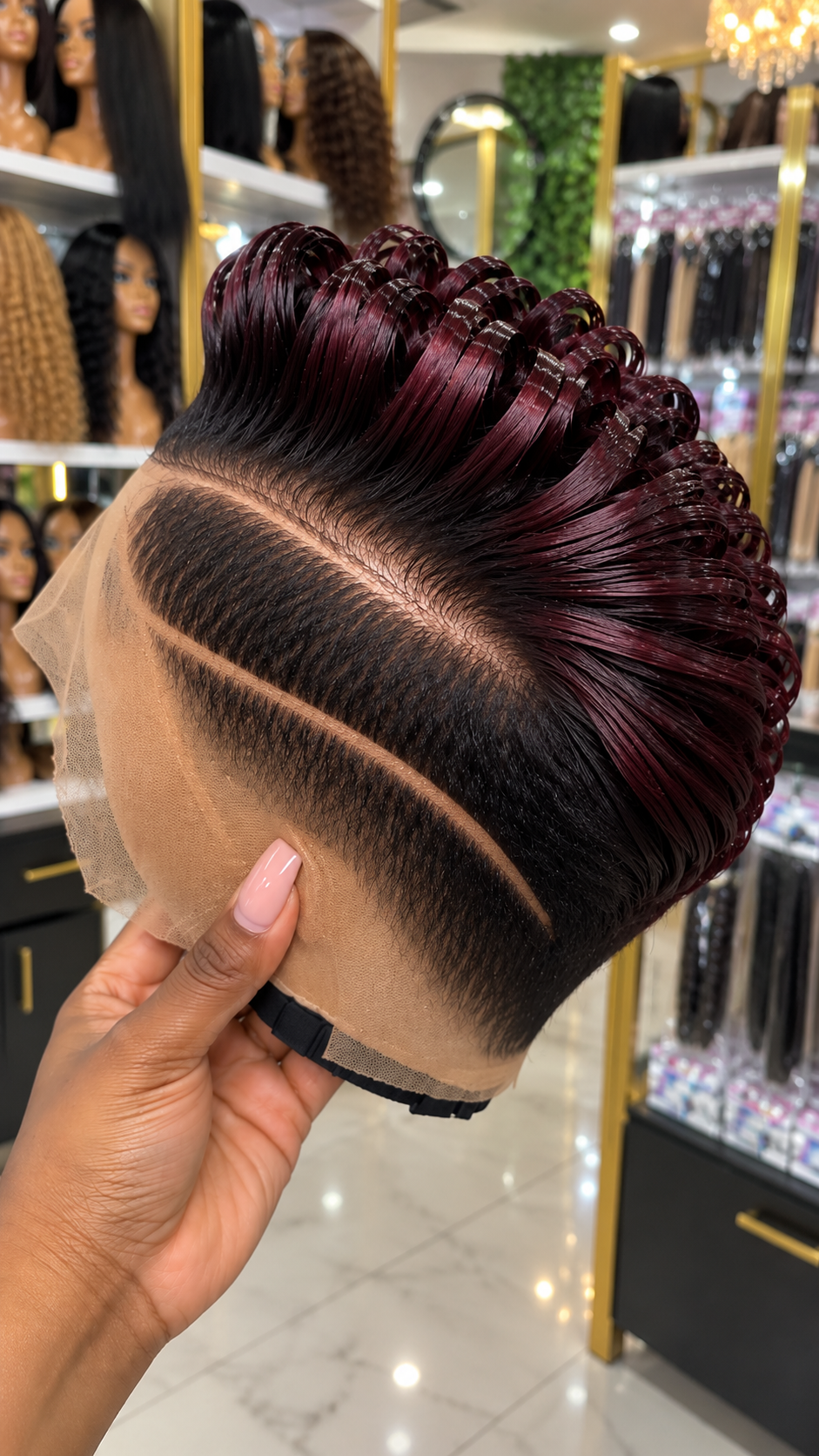
Burgundy hair becomes particularly striking when it is shaped into sweeping ribbons rather than conventional curls. This sculpted pixie wig brings together deep wine-red coloring, elevated looped strands, and a closely arranged dark side panel. A long diagonal parting separates the two areas, creating a distinctive contrast between the glossy upper hairstyle and the finer hair beneath it.
Photographed inside a beauty supply salon, the wig is held at an angle that reveals the entire visible side and much of the raised crown. The upper strands rise from near-black roots before curving backward into broad, carefully arranged loops. Burgundy and plum reflections appear across the folded sections, while the darker roots remain noticeable at their base. Toward the rear, the ribbons become more closely packed and transition into smaller rounded curls.
The side is especially restrained compared with some decorative pixie hairstyles. Instead of multiple intersecting razor patterns, it contains one prominent diagonal division beneath the crown and a second, gently sweeping channel across the lower section. The dark hair between these separations follows the shape of the cap, creating a compact silhouette that supports the more elaborate styling above.
Untrimmed beige lace extends along the front and lower side, while part of a black fastening component is visible beneath the opening. These details identify the unit as a pre-installation wig, although its exact fiber composition, complete cap construction, and recommended attachment method cannot be determined from the photograph alone.
Wine-Red Color Changes Across the Raised Ribbons
The first detail worth examining is the distribution of burgundy across the upper hair. The color does not appear uniformly bright from root to tip. Instead, the base is much darker, transitioning into rich wine-red and plum-burgundy tones along the longer sections.
Near the front, the raised strands contain deep reddish reflections that become more noticeable as they bend backward. Farther along the crown, several sections display brighter burgundy surfaces with darker spaces between individual loops.
This contrast helps distinguish the ribbons without requiring blonde or copper highlights. The warm salon lighting contributes to the reflective appearance, so an exact commercial shade number cannot be established from this image.
The lower side remains predominantly very dark brown to black. This difference is important because it prevents the entire hairstyle from becoming a single block of burgundy color.
When contacting a supplier, describe the desired palette as deep burgundy ribbons over dark roots with a near-black side section. This provides more useful direction than requesting a red pixie wig.
Ask whether the available hair is already colored or whether additional processing would be required. The answer matters because coloring methods, future maintenance, and potential restyling options vary by fiber.
Choosing a Burgundy Shade That Suits the Design
Commercial burgundy colors range from deep brownish wine to brighter cherry-red and purple-red shades. For this hairstyle, a darker wine or plum-burgundy is closer to the visible reference than a bright scarlet tone.
A very light red could reduce the contrast between the roots and the ribbon surfaces. Conversely, a nearly black burgundy might make the individual loops less noticeable under ordinary indoor lighting.
Request daylight photographs and a close view of the roots before approving the color. If ordering a custom piece, confirm that the dark root area continues naturally into the raised strands rather than forming a sharply separated band.
The Crown Rises into Sculpted Loops
The upper styling combines the movement of swept-back hair with the shape of rolled ribbon curls. At the front, the strands rise almost vertically from the dark foundation. They then curve backward, forming elongated loops with smooth-looking, closely aligned strands.
Unlike compact circular rosettes that sit flat against the crown, these loops have a noticeable upward direction. Several are narrow and tall, while others open into broader rounded shapes.
There is a gradual change in their appearance across the hairstyle. The front and central sections contain prominent raised ribbons, while the rear edge shows smaller overlapping curls. This produces a progressive shape rather than an abrupt change from straight hair to tight ringlets.
The upper volume remains controlled. The crown has height, but the curls do not spread outward into a wide, fluffy silhouette. Their direction creates the impression of movement toward the back.
For customers commissioning this style, that direction is one of the most important specifications. Simply requesting burgundy finger curls might result in a collection of small circular coils instead of the lifted, elongated loops shown here.
The Dark Roots Create a Strong Visual Foundation
The darkest hair appears near the base of the raised ribbons and across the side panel. Its presence makes the burgundy sections appear more dimensional, particularly where the strands begin their upward movement.
At the transition between the dark roots and colored lengths, the hair gradually becomes redder. Some sections show more plum than others, but the overall appearance remains coordinated.
The darker foundation also connects the crown to the lower side. Without it, the burgundy loops might appear visually detached from the closely arranged hair beneath them.
For a custom order, confirm whether the roots should be black, espresso brown, or very dark burgundy. These choices can produce different results even when the upper color is similar.
The photograph does not establish whether the darker roots are naturally pigmented hair, dyed hair, or manufactured fibers. The buyer should rely on the supplier’s product information for those details.
A Long Diagonal Division Establishes the Silhouette
One of the strongest structural elements is the pale diagonal parting that travels across the visible upper side. It begins near the front hairline and extends toward the rear, separating the elevated burgundy ribbons from a dense panel of shorter dark hair.
Along its upper edge, the roots transition into the raised hairstyle. Along the lower edge, fine dark strands follow a flatter direction.
The parting is narrow and relatively continuous. Its diagonal path becomes particularly noticeable because it lies directly between the two contrasting hair lengths.
Customers should specify the direction from the wearer’s perspective when ordering. A mirrored part may look similar in a promotional photograph but will place the decorative styling on the opposite side once installed.
It is also worth asking for a photograph showing the division from the front. The reference provides a strong side view, but it does not establish the complete frontal layout.
The Lower Curved Channel Has a Restrained Appearance
Below the primary diagonal part, a second pale channel follows a long, gently curving path through the dark side hair. This lower division is noticeable but not excessively wide.
The space between the two channels remains filled with closely arranged dark strands. Toward the rear, the lower division approaches the upper side area and finishes in a tapered-looking curve.
The effect is decorative without becoming overly complicated. There are no clearly visible crossing lines, star patterns, or additional parallel stripes that would justify describing the wig as having elaborate geometric carving.
Although the channel resembles barber-inspired artwork, the photograph cannot confirm precisely how it was created. It may involve strategic parting, hair removal, or specialized construction.
Before attempting to reproduce it, a wig maker should inspect the foundation and determine whether a similar separation can be created without exposing or damaging the cap.
Keeping the Lower Side Proportional
Much of the hairstyle’s appeal comes from the narrow profile of the lower side. The short hair remains close to the foundation and provides contrast with the elevated ribbons above.
Removing too much hair would make the side more exposed than the reference. Leaving too much volume could obscure the curved channel and weaken the distinction between the upper and lower areas.
A custom maker should preserve enough density around the separation to maintain its visible path. The exact length should be chosen according to the cap construction and the intended fit.
The Untrimmed Lace Is Part of the Buying Decision
A broad section of beige mesh extends beyond the front and lower side of the hairstyle. Its edges remain loose, showing that the lace has not yet been trimmed for installation.
The color of the mesh is lighter than the dark hair above it, making the front foundation visible in the photograph. Fine strands are arranged close to the upper edge, but the complete front hairline is not shown from a straight-on angle.
Buyers should request a close frontal photograph, a side photograph, and a complete underside view before purchasing. These images can help clarify the lace dimensions and how the hairline is constructed.
Visible lace does not confirm an HD lace product. The material, transparency, and construction should be verified directly with the seller.
The lace should not be cut until the cap has been positioned correctly. Removing too much material could affect the available attachment area or disturb strands near the hairline.
What the Visible Fastening Component Tells Us
Part of a black band or fastening component can be seen beneath the lower opening of the wig. The remainder of the interior is largely concealed by the viewing angle and the person holding it.
This means the photograph does not establish a complete list of clips, combs, adjustment straps, or other securing parts. Nor does it verify whether the unit is intended for adhesive-free wear.
A seller should provide a clear underside photograph and identify the cap size and available adjustment system.
For frequent use, fit deserves as much attention as the outer styling. A cap that shifts can change where the diagonal part and lower curved channel sit relative to the wearer’s temple.
The buyer should also confirm whether any custom sizing options are available and whether the wig can accommodate the natural hair underneath.
Ordering the Burgundy Version Without Losing Its Character
The most reliable way to request this style is to describe its essential elements separately. Begin with the dark-root burgundy color, then specify the elevated ribbon curls and the closely arranged lower side.
Explain that the crown should sweep backward and that the loops should remain recognizable rather than being brushed into loose volume.
Next, identify the long diagonal parting and the single lower curved channel. These elements should remain relatively narrow and follow the same general direction as the reference.
Send the photograph alongside the measurements requested by the wig maker. Ask for examples of previous sculpted ribbon hairstyles, particularly those with a visible separation between the crown and side.
Before paying for custom work, agree on the fiber, color, cap construction, lace specifications, and expected finishing services. A photograph of the completed product should be reviewed before shipping whenever the seller offers that option.
Where This Style Can Be Purchased or Recreated
Suitable places to look include specialist wig studios, salons that offer custom pixie units, and online shops selling sculpted lace wigs. Local beauty supply stores may also stock burgundy pixies that can serve as starting points for further styling.
A ready-made option may be less expensive and easier to obtain, but its loops may be shorter, more circular, or differently directed. The lower curved channel may be absent entirely.
Custom production is worth considering when the precise relationship between the raised ribbons and side design is important to the buyer.
Search descriptions such as burgundy ribbon curl pixie wig or wine-red swept-back pixie with a diagonal side part can help narrow the selection.
Do not assume a product listing matches the photograph based on its title alone. Request actual unit photographs and confirm the specifications before placing an order.
Choosing Between Human Hair and Synthetic Options
Both human-hair and synthetic wig categories may offer sculpted pixie designs, but their styling and care requirements differ.
Human-hair units may allow professional reshaping depending on their processing history and condition. However, a previously colored unit may be more sensitive to additional chemical treatments.
Synthetic options may arrive with established curls, but their ability to tolerate heat depends on the manufacturer’s specifications. Some fibers cannot safely be restyled with conventional heated tools.
The photograph does not identify the material of this particular wig. Its glossy appearance should not be used as proof of human hair.
Before choosing, ask whether the ribbon loops can be restored after washing, whether the burgundy color is stable, and what products are recommended for maintenance.
Estimated Cost of a Custom Burgundy Ribbon Pixie
The price of a similar hairstyle can be influenced by the type of hair, the depth of the burgundy coloring, cap construction, individual ribbon styling, and the work needed to create the lower curved channel.
The amounts below are illustrative USD planning ranges, not verified live prices for the photographed unit. They should be used to compare possible purchasing categories rather than as guaranteed quotations.
| Wig Category | Illustrative Price Range | Potential Work and Specifications |
|---|---|---|
| Premium Custom | $340–$820+ | Personalized measurements, coordinated burgundy color placement, individually arranged ribbon curls, and specialist side detailing. |
| Standard Custom | $175–$430 | Custom compact pixie with swept-back loops, dark roots, diagonal parting, and selected side customization. |
| Basic Human Hair | $105–$290 | A human-hair pixie base that may need professional color work, curl preparation, and additional finishing. |
| Premium Synthetic | $65–$205 | Higher-priced synthetic pixie alternatives with prearranged colored curls, subject to confirmed product specifications. |
| Basic Synthetic | $25–$100 | Budget burgundy curly pixies that may resemble the general silhouette without the same ribbon or side arrangement. |
Color processing and individual loop preparation can add labor costs. Cap alterations, fitting, shipping, installation, and future restyling may also be charged separately.
A higher price does not automatically guarantee that the visible curl direction or parting will match the reference. Photographs of the actual work remain essential.
Professional Fitting Before the Lace Is Trimmed
The installation process should begin with an inspection of the cap and hairline. The stylist needs to check that the wig sits comfortably and that the longer ribbons remain directed backward.
The diagonal parting should align naturally with the wearer’s head, while the lower curved channel should sit near the intended temple area rather than too far forward or backward.
If the unit has lace requiring trimming, this should happen after the fit is assessed. The stylist should avoid cutting into the fine strands near the parting or the lower side.
Any adhesive, glueless, closure, or frontal installation choice must be based on the actual construction. A visible lace edge alone does not establish which method is suitable.
After installation, the upper curls should be checked from both the front and side. Small adjustments may improve their appearance, but aggressive brushing could disrupt the ribbon formation.
Caring for Burgundy Ribbons Between Salon Visits
The elongated loops require a gentler routine than ordinary loose curls. Repeatedly brushing through the upper sections can separate the aligned strands and cause the ribbons to lose their recognizable curves.
When removing the wig, support the cap rather than pulling on individual loops. Avoid storing the unit where the crown will be pressed against other objects.
Cleaning products and washing frequency should follow the confirmed fiber and manufacturer guidance. For human hair, washing may loosen the sculpted setting, making professional restoration necessary. For synthetic hair, any use of heat must first be confirmed as safe.
The burgundy color also deserves attention. If the unit was chemically dyed, frequent washing and unsuitable products may affect its appearance. If the color comes from manufactured fibers, the maintenance requirements may differ.
Ask the supplier whether professional resetting is available and whether the upper ribbons can be restored without changing their original direction.
Protecting the Dark Side and Its Curved Division
The lower side does not require the same handling as the raised crown. Its appearance depends on short dark strands remaining close to the foundation, with the curved channel left clearly visible.
Avoid brushing directly across the separation in a way that moves surrounding strands into the channel. Likewise, do not attempt to deepen the line with a razor without understanding the underlying construction.
The area should be inspected when the wig is being fitted because tension or incorrect positioning may alter how the channel appears.
If the side loses its original arrangement, an experienced wig stylist may be able to restore it. The appropriate method depends on whether the channel was produced through parting, cutting, or another construction technique.
Who Might Prefer This Burgundy Pixie?
This hairstyle may suit women who enjoy warm, expressive hair colors but prefer a compact silhouette. The elevated ribbons add drama without requiring long curls around the shoulders.
Its darker roots can create a more restrained foundation, while the wine-red upper sections introduce a noticeable color statement.
The hairstyle is particularly interesting from the side, where the diagonal parting and lower curved channel become visible.
There are practical considerations. Carefully sculpted ribbons may need professional maintenance, and the decorative side requires appropriate handling. The actual comfort and durability of the wig will depend on fit, material, and construction.
For someone who wants a low-maintenance hairstyle that can be brushed freely, a simpler curly pixie might be more practical. For someone willing to preserve a carefully arranged design, the ribbon styling offers a distinctive alternative.
A Burgundy Pixie Where Direction Matters
The strongest quality of this hairstyle is not simply its red color or cropped length. It is the way the dark-rooted ribbons rise, curve backward, and gradually become smaller near the rear, while the lower side remains closely arranged beneath a long diagonal division.
The single sweeping lower channel adds character without competing with the upper curls. Together, these details create a sculpted pixie that looks intentional from its visible profile.
Customers seeking a close reproduction should prioritize the correct burgundy shade, the direction of the loops, the narrow parting, and the proportions of the dark side. Verified cap specifications and professional fitting are equally important before the wig is worn.
With suitable construction and careful maintenance, a similar burgundy ribbon pixie can offer a rich combination of color, sculpted movement, and elegant side detailing.
Search Terms
Wine burgundy ribbon pixie wig · Dark root plum red swept back curls · Burgundy loop crown with diagonal part · Deep wine red sculpted pixie hairstyle · Black tapered side with curved channel · Burgundy lace front ribbon curl wig · Raised maroon ribbon loops with dark roots · Single curved side line burgundy pixie