
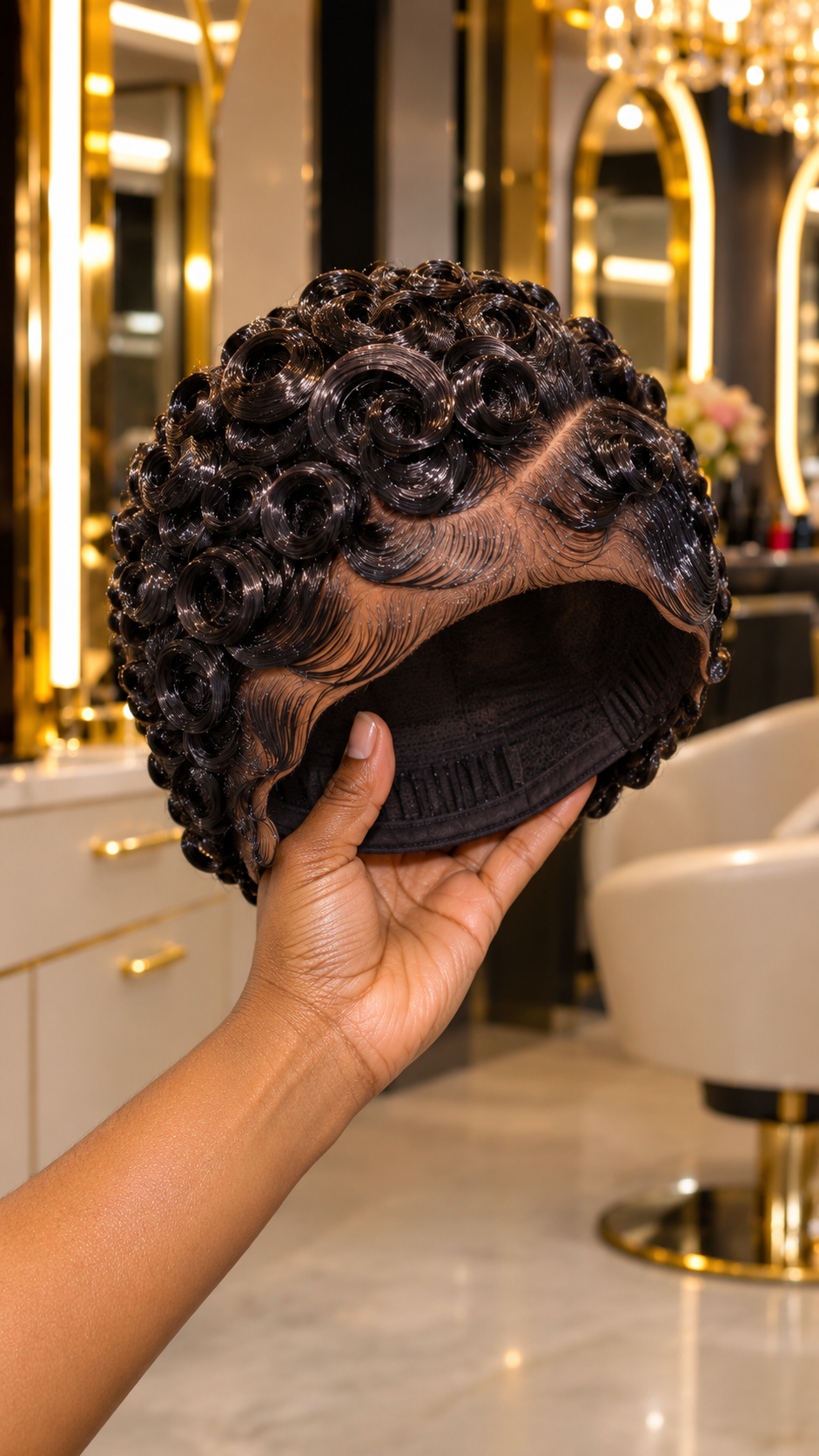
Some pixie wigs make their strongest impression through color, while others rely on carefully arranged curls. This deep black hairstyle belongs to the second category. Its glossy circular rosettes form a compact, rounded crown, while sweeping finger waves create an elegant frame around the visible hairline. A diagonal parting separates the two styling areas, giving the wig a distinct appearance without requiring contrasting colors or elaborate shaved patterns.
The photograph captures the wig being held inside a salon with illuminated gold-framed mirrors and warm interior lighting. Unlike an installed hairstyle, the unit is positioned with its interior facing the camera. This angle reveals part of the dark brown cap, including a broad inner band and stitched construction details. Above the opening, the carefully arranged curls remain visible, allowing the outer hairstyle and a section of its foundation to be examined together.
The most interesting element is the relationship between the circular curls and the sweeping strands underneath them. Larger rosettes occupy the upper front and crown, while smaller curls continue around the visible sides. Beneath the curls, the hair lies flatter and follows curved paths toward the lower perimeter. The result is a sculpted pixie with noticeable fullness above and delicate wave detailing below.
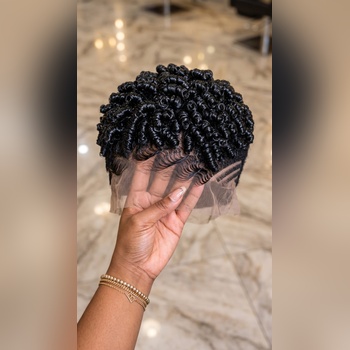
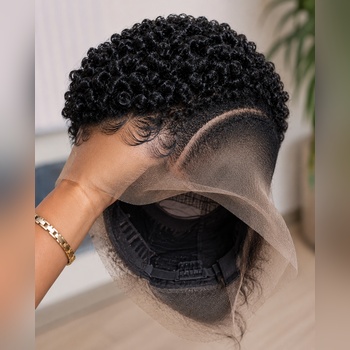
For buyers, the design offers an important lesson: choosing the right black pixie wig involves more than selecting a color and approximate length. Curl diameter, the direction of the front waves, cap measurements, and installation requirements can all affect the finished appearance.
A Crown Built Around Beautiful Circular Curls
The upper section contains numerous glossy rosette curls arranged into a rounded, closely packed silhouette. Each curl is formed from strands following a circular path, with several creating visible openings at their centers.
The largest loops appear around the upper front and central crown. Smaller formations occupy the surrounding areas, filling gaps between the more prominent curls.
This combination of different curl sizes creates depth without leaving the hairstyle looking uneven. The larger rosettes provide visual interest, while the smaller curls maintain continuity across the surface.
The hair remains compact around the head. There are no long hanging curls or extended layers that would turn the design into a bob or shoulder-length hairstyle.
Its rounded silhouette makes the rosette arrangement especially noticeable from the photographed angle. Individual loops curve toward neighboring curls, producing a connected surface rather than isolated strands.
Buyers seeking a similar result should request sculpted circular rosettes rather than ordinary loose ringlets. The two curl types can look considerably different even when the finished wigs have similar overall dimensions.
The Curl Diameter Changes the Entire Appearance
Small circular curls can produce a densely arranged crown, while larger loops create greater visual separation.
This hairstyle combines both, but the most noticeable formations are medium-sized rosettes with clearly visible circular centers.
Some curls appear slightly compressed where they overlap, while others retain more open centers.
For custom ordering, it is useful to specify whether the crown should resemble closely packed rolled spirals or broader circular loops.
A professional wig maker can explain which options are possible with the selected material and whether the curls will require resetting after washing.
The Diagonal Parting Creates the Main Styling Division
A narrow diagonal parting travels upward through the visible front section, separating the compact crown from a flatter arrangement of dark strands.
The division introduces direction to the hairstyle. Above it, the hair is shaped into circular rosettes; below it, the strands follow more elongated, sweeping paths.
The parting appears relatively narrow, with fine dark strands arranged neatly along its edges.
Its diagonal orientation makes the front less symmetrical than a conventional center-parted pixie.
Several curls sit close to the upper side of the parting, while the lower section contains sculpted waves that move toward the visible temple.
This arrangement prevents the hairstyle from appearing like a simple collection of curls placed over a flat foundation.
For custom reproduction, the position of the parting should be discussed before styling begins. Moving the division too far toward the center or changing its angle could alter the relationship between the curls and the front waves.
The Sweeping Hairline Has Its Own Artistic Character
The lower front section contains fine strands arranged into broad, flowing finger waves. These waves are noticeably flatter than the circular curls above.
Several strands travel together along curved paths, creating delicate parallel lines. Their direction changes gradually, giving the waves an elegant appearance.
Near the visible lower side, the hair follows a downward curve before blending into the surrounding shorter strands.
The wave formation is especially noticeable because the reflective black strands contrast with the warm brown-toned foundation beneath them.
Although the hairstyle includes a prominent diagonal parting, it does not show distinct shaved stripes or geometric barber cuts. Its decorative detail comes from the sculpted waves and rosette arrangement.
A wig maker reproducing the design should therefore focus on precise finger-wave placement rather than introducing additional razor lines.
The Importance of the Lower Wave Direction
Finger waves can change the apparent shape of a pixie depending on where their curves begin and end.
Waves directed toward the temple may create a graceful side frame, while broader forehead sweeps can emphasize the front hairline.
In this hairstyle, the visible waves follow elongated curves beneath the diagonal parting and gradually descend toward the lower perimeter.
Customers should provide the reference photograph when requesting the same direction. A general instruction to add baby hairs may produce smaller decorative curls rather than the broad wave arrangement shown here.
Deep Black Hair with Rich Reflective Dimension
The hairstyle appears predominantly deep black, with subtle warm reflections visible where the salon lighting strikes the curved strands.
The centers of the rosettes remain darker, while their rounded surfaces catch narrow bands of light.
This contrast makes the individual curls recognizable without the need for colored highlights.
Some reflections appear dark brown under the warm lighting, but the photograph does not establish that separate brown highlights were deliberately added.
Buyers should compare natural black and jet-black shades using photographs of the actual product.
A shade described as jet black may appear darker than a natural-black alternative, depending on the supplier and fiber material.
Because glossy fibers can reflect salon lighting strongly, a daylight photograph can help establish the intended appearance before purchase.
Examining the Visible Cap Interior
The wig is held with its opening facing the camera, revealing a dark brown interior foundation.
A broad reinforced band follows the lower portion of the opening. Above it, stitched panels and a dark mesh-like area are visible.
The interior looks structured rather than completely open, although the photograph does not provide enough information to identify every component.
The visible construction is important for potential buyers because cap size and internal support can influence how the hairstyle sits on the head.
However, the photograph does not establish the exact cap technology or complete fastening system.
Additional combs, clips, adjustable straps, and other components may exist outside the visible area, but their presence should not be assumed.
Ask the seller for a complete underside photograph showing every attachment component and the full cap perimeter.
Understanding the Front Foundation
A brown-toned foundation is visible beneath the styled front waves. The edge of the wig follows a curved path above the opening.
Unlike photographs showing a large section of loose, untrimmed lace, this angle does not reveal a broad lace extension across the entire front.
The exact front construction therefore remains uncertain.
Customers should ask whether the unit uses a lace front, closure, frontal, or another foundation.
If lace is present, the supplier should identify its actual dimensions, material, and available colors.
Visible mesh or a fine hairline is not sufficient evidence that a wig uses HD lace.
The correct installation method should be selected only after the construction has been confirmed.
Choosing the Correct Fit for a Sculpted Pixie
Cap measurements are especially important when a hairstyle contains a directional parting and carefully positioned waves.
A cap that sits too far forward may change the apparent position of the hairline. A cap that sits too far backward may shift the front waves away from their intended location.
Excessive tension can also affect comfort and alter the rounded shape of the crown.
Before ordering a custom unit, measure the head according to the maker’s instructions.
Measurements may include circumference, front-to-nape distance, and ear-to-ear dimensions.
Customers should also consider how their natural hair will be arranged beneath the wig.
The goal is to support the compact crown while allowing the front waves and diagonal parting to sit naturally.
Where To Find a Similar Black Rosette Pixie
Similar sculpted pixie wigs may be available through specialist wig makers, local beauty supply shops, professional salons, and online wig boutiques.
Useful search descriptions include black rosette pixie wig, circular curl lace wig, and sculpted pixie with sweeping finger waves.
Ready-made products may offer a comparable overall silhouette, although their individual curl formations and front-wave arrangement can differ.
Customers seeking a close reproduction may benefit from working with a wig maker experienced in circular curl styling.
Review photographs of completed wigs from different angles before deciding on a supplier.
Pay particular attention to the consistency of the rosettes and the appearance of the front waves.
The photograph does not establish a verified manufacturer, current stock availability, or live selling price.
Questions Worth Asking Before Placing an Order
A carefully prepared inquiry can prevent misunderstandings between the buyer and the wig maker.
Start by sharing the photograph and explaining that the desired design consists of compact black rosettes, a diagonal front parting, and broad sweeping finger waves.
Ask whether the seller has an existing unit with a similar curl arrangement.
If customization is necessary, confirm the proposed curl size and crown fullness before production begins.
Discuss the position of the parting from the wearer’s perspective.
Request the fiber composition, cap measurements, and complete interior photographs.
Ask whether the front foundation supports the preferred installation method.
Finally, confirm the total price, preparation requirements, shipping terms, and available aftercare services.
Ready-Made Construction or Custom Rosette Styling
A ready-made pixie can be convenient for customers who want a similar hairstyle without requiring an exact reproduction.
However, an ordinary curly pixie may contain loose ringlets rather than closely arranged circular rosettes.
Its front waves may also follow a different direction, and the cap measurements may not suit every wearer.
Custom styling offers more control over the position of the parting, curl diameter, and hairline arrangement.
A professional may also be able to reshape a suitable ready-made base, depending on the material and construction.
Before purchasing a wig for restyling, confirm whether its fibers can safely tolerate the proposed techniques.
Not every synthetic unit can be heat-styled or chemically processed.
Choosing an Appropriate Installation Method
Different cap constructions support different installation approaches.
A closure-based unit may be suitable for certain compact pixies, depending on its coverage and available parting area.
A frontal design may provide additional hairline coverage, although its suitability depends on the construction and dimensions.
Some wigs can be worn without adhesive when their cap fit and securing components provide appropriate stability.
However, the visible interior does not establish that this particular wig is glueless.
Customers should discuss installation options with the supplier and stylist before making a purchase.
During fitting, the stylist should preserve the position of the diagonal parting and avoid compressing the circular curls.
Estimated Prices for Black Rosette Pixie Wigs
The cost of a similar hairstyle may depend on the hair material, cap construction, individual curl preparation, and professional finger-wave styling.
Carefully arranged circular rosettes may involve more labor than standard loose curls, particularly when the maker must preserve individual openings and consistent crown density.
The following USD figures are illustrative planning ranges rather than verified live selling prices or quotations for the photographed wig.
| Wig Category | Illustrative USD Range | Possible Purchase Characteristics |
|---|---|---|
| Premium Custom | $325–$790+ | Individual cap sizing, detailed rosette formation, personalized parting placement, and professional front-wave styling. |
| Standard Custom | $165–$395 | Custom compact black curls with selected crown density and sculpted finger waves. |
| Basic Human Hair | $100–$270 | A human-hair pixie base that may require additional curl setting and hairline customization. |
| Premium Synthetic | $65–$190 | Higher-priced synthetic curly pixies with prearranged rosettes, depending on manufacturer specifications. |
| Basic Synthetic | $25–$95 | Budget black curly pixies that may resemble the general silhouette without matching the sculpted circular arrangement. |
Additional charges may apply for professional fitting, specialized hairline preparation, shipping, or later curl restoration.
The photograph does not verify whether the displayed wig contains human hair, synthetic fibers, or a blend.
These categories therefore describe possible purchasing options rather than confirmed product characteristics.
What to Inspect Before the First Wear
When the wig arrives, begin by examining its outer styling and cap interior.
Check whether the circular curls retain their intended shape and whether the diagonal parting appears consistent.
Inspect the front waves for loose strands or areas where the styling has shifted during transport.
Examine the interior stitching and any securing components provided by the seller.
Before trimming lace or altering the hairline, the stylist should confirm the cap fit.
Permanent changes near the front can affect the delicate wave arrangement or reduce the material available for attachment.
If adjustments are necessary, choose a professional familiar with sculpted pixie wigs.
Maintaining the Circular Rosettes
One of the main maintenance challenges is preserving the separation between neighboring curls.
Brushing aggressively through the crown may loosen the rolled formations and cause the strands to merge.
The appropriate washing routine depends on the confirmed fiber composition and how frequently the unit is worn.
For human-hair wigs, cleansing may loosen the original styling and require professional resetting.
For synthetic units, heated tools should only be used when the manufacturer confirms compatibility.
Avoid excessive product buildup between the rosettes, since it may reduce their visible separation.
When handling the wig, support the cap rather than pulling on individual circular curls.
Keeping the Front Waves in Position
The finger-wave arrangement requires attention because its appearance depends on fine strands following coordinated paths.
Repeated rubbing, brushing against the wave direction, or excessive handling can disturb the sculpted sections.
If the waves begin losing their original shape, consult a stylist who understands the material and construction.
Attempting to reshape them with inappropriate products or high heat may cause damage.
For storage, use a suitably sized wig stand that supports the crown without flattening the rosettes.
Avoid positioning the styled front against surfaces that may compress the delicate waves.
Practical Benefits and Limitations
The compact silhouette may appeal to women who prefer decorative hairstyles without long hair around the shoulders.
The circular rosettes create fullness, while the sweeping front waves introduce an elegant detail around the hairline.
The deep black color also makes the design suitable for customers who prefer a consistent shade rather than noticeable color contrasts.
However, the sculpted arrangement may require more careful maintenance than ordinary loose curls.
Frequent washing and handling can affect the circular formations, and professional resetting may be necessary depending on the material.
Comfort and durability depend on the cap fit, construction quality, fiber composition, and installation method.
For regular wear, customers should consider both the initial purchase cost and the maintenance required to preserve the hairstyle.
A Distinctive Pixie Built on Curl Placement
This black pixie demonstrates how carefully arranged curls can create an elaborate appearance without relying on contrasting colors or exaggerated length.
The circular rosettes provide the rounded crown, while the diagonal parting gives the hairstyle direction. Beneath them, sculpted finger waves create a graceful transition toward the visible hairline.
The exposed interior also reminds buyers that a beautiful outer hairstyle must be supported by suitable cap construction and accurate measurements.
For anyone considering a similar unit, the best approach is to prioritize the rosette arrangement, parting direction, hairline styling, and verified product specifications.
With professional fitting and material-appropriate care, a similar sculpted pixie can offer an attractive combination of glossy black curls and elegant sweeping waves.
Search Terms
Jet black rosette pixie wig · Glossy circular curl crown hairstyle · Black pixie with swooping finger waves · Diagonal part sculpted black curls · Compact rolled ringlet wig · Black finger wave hairline pixie · Dark brown interior cap rosette wig · Rounded black curl pixie with side sweep