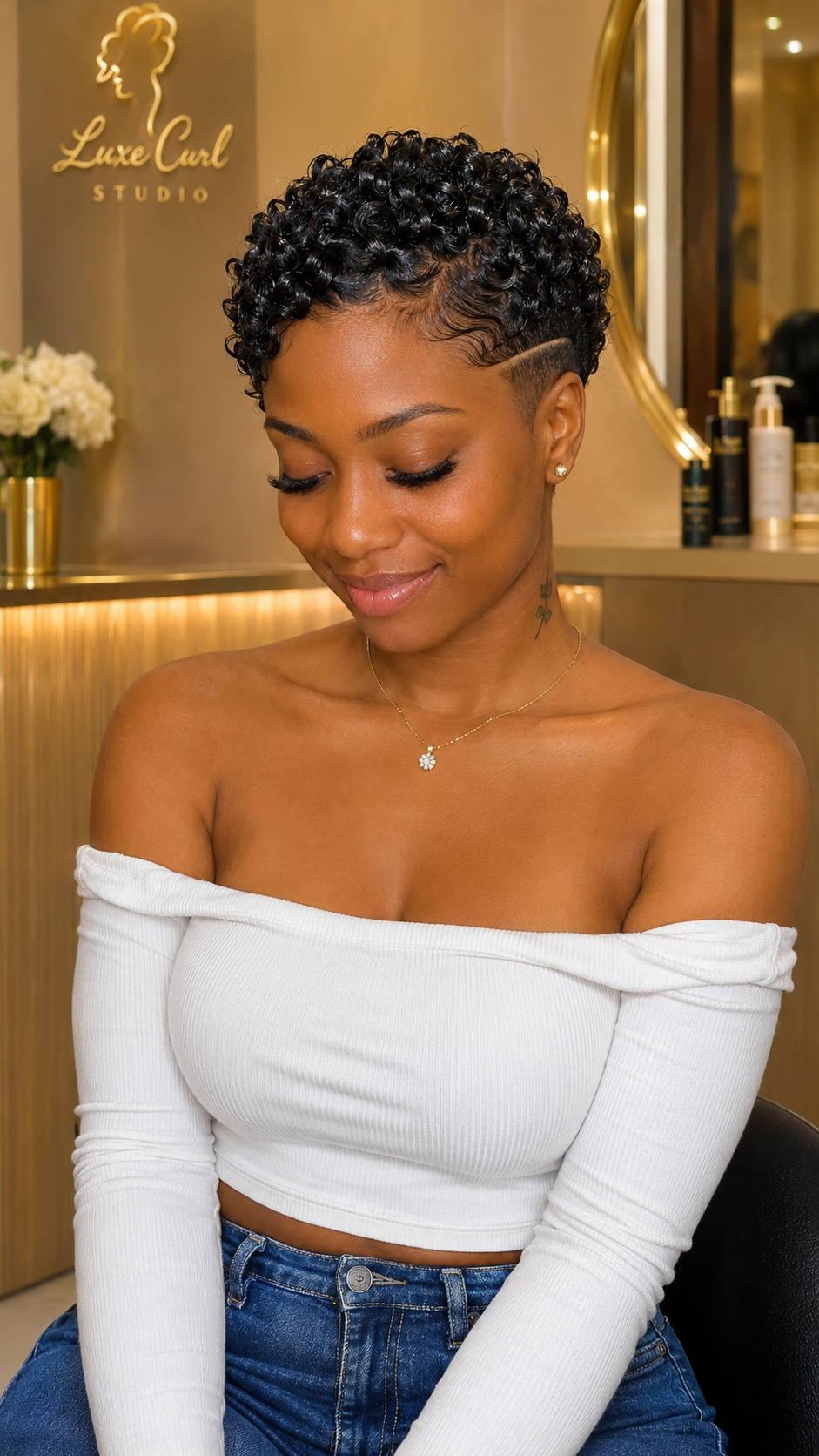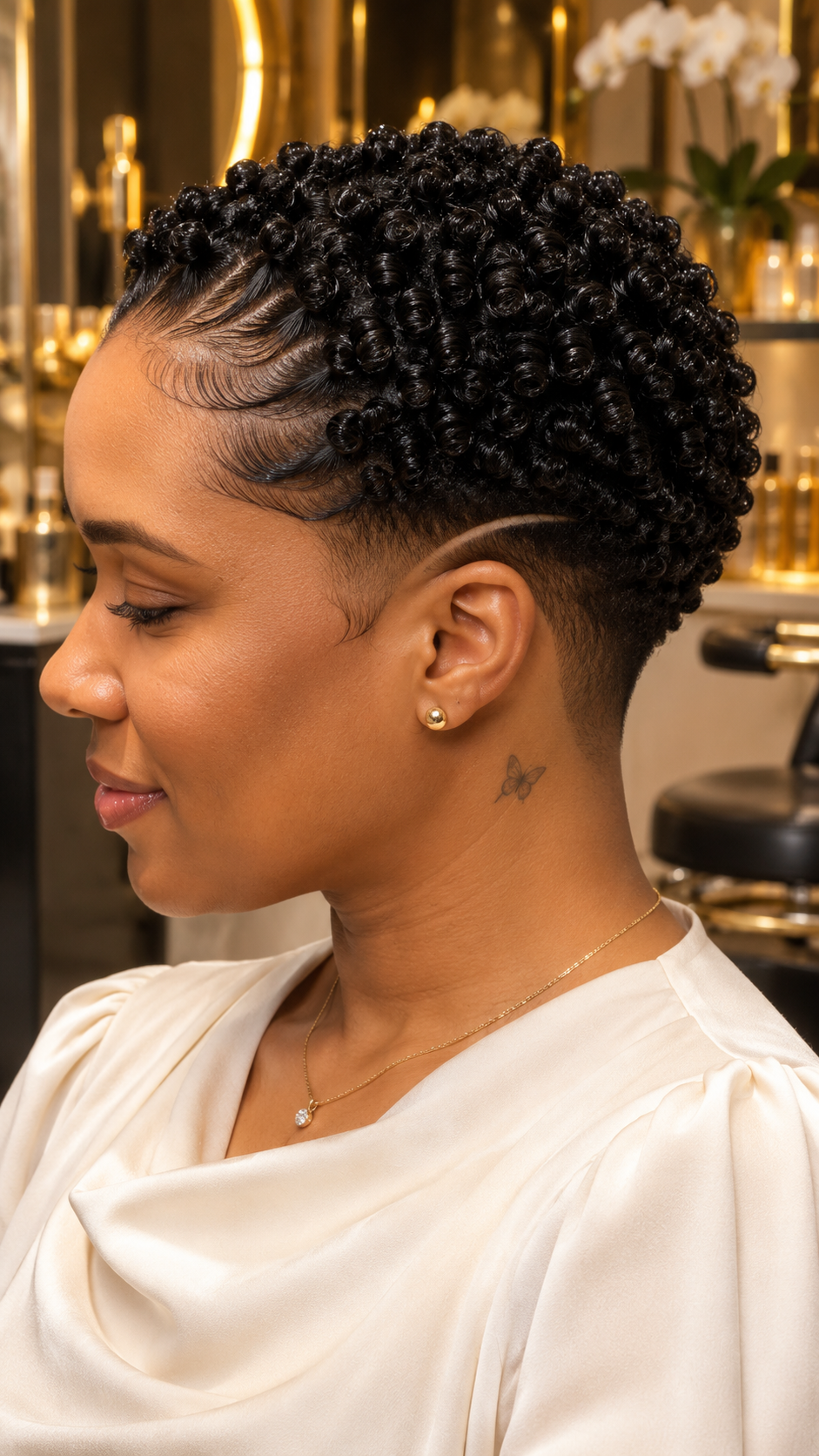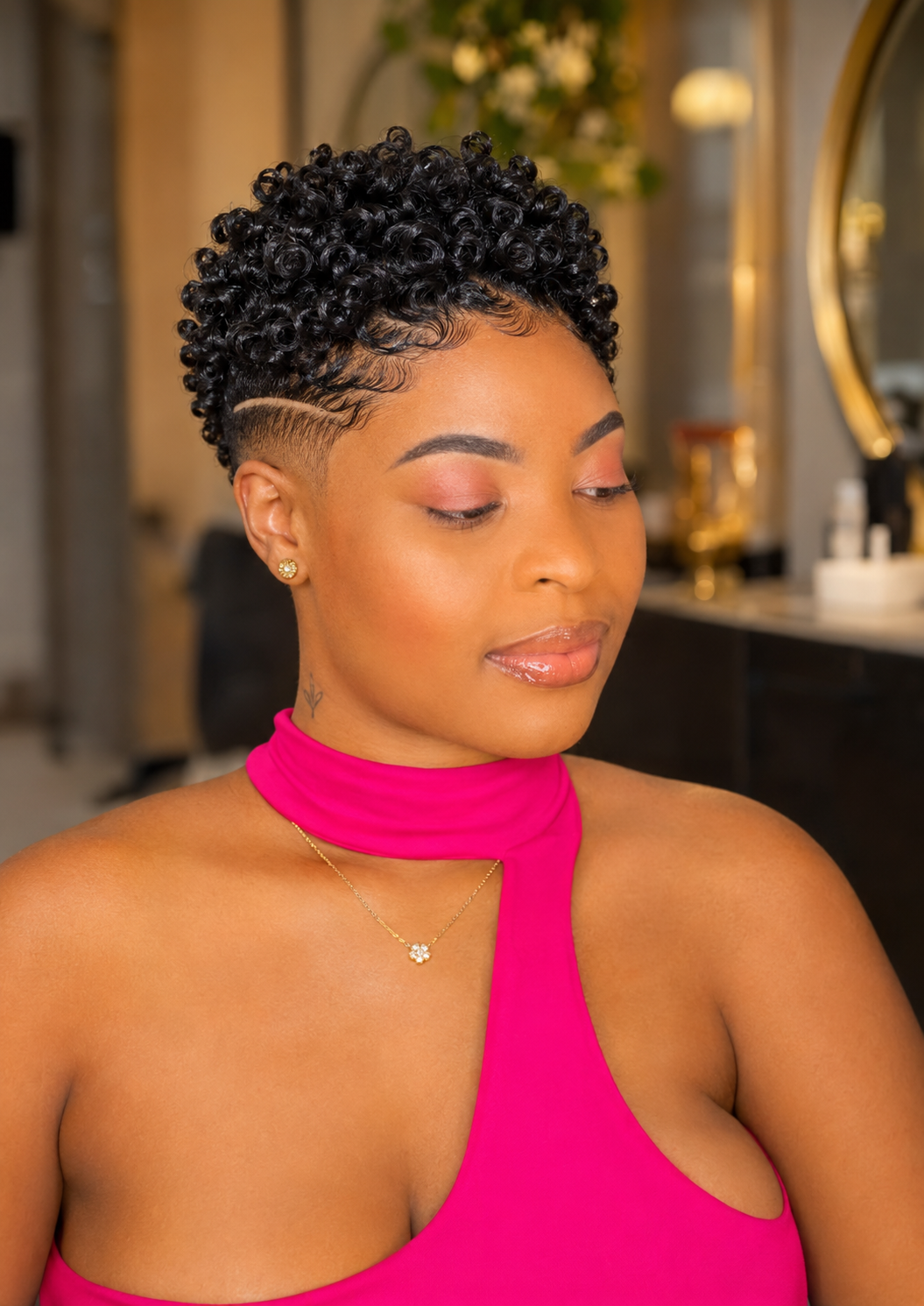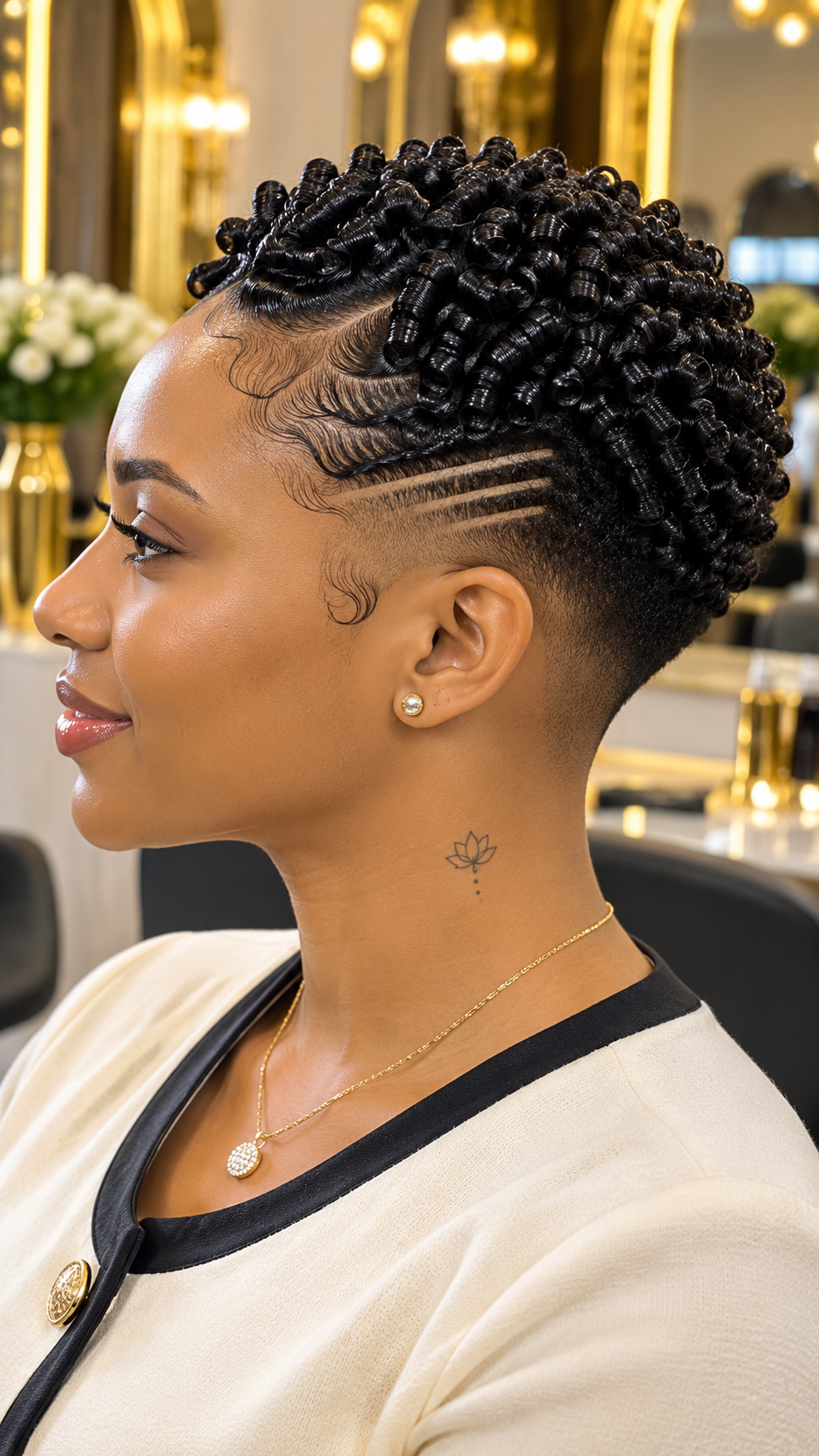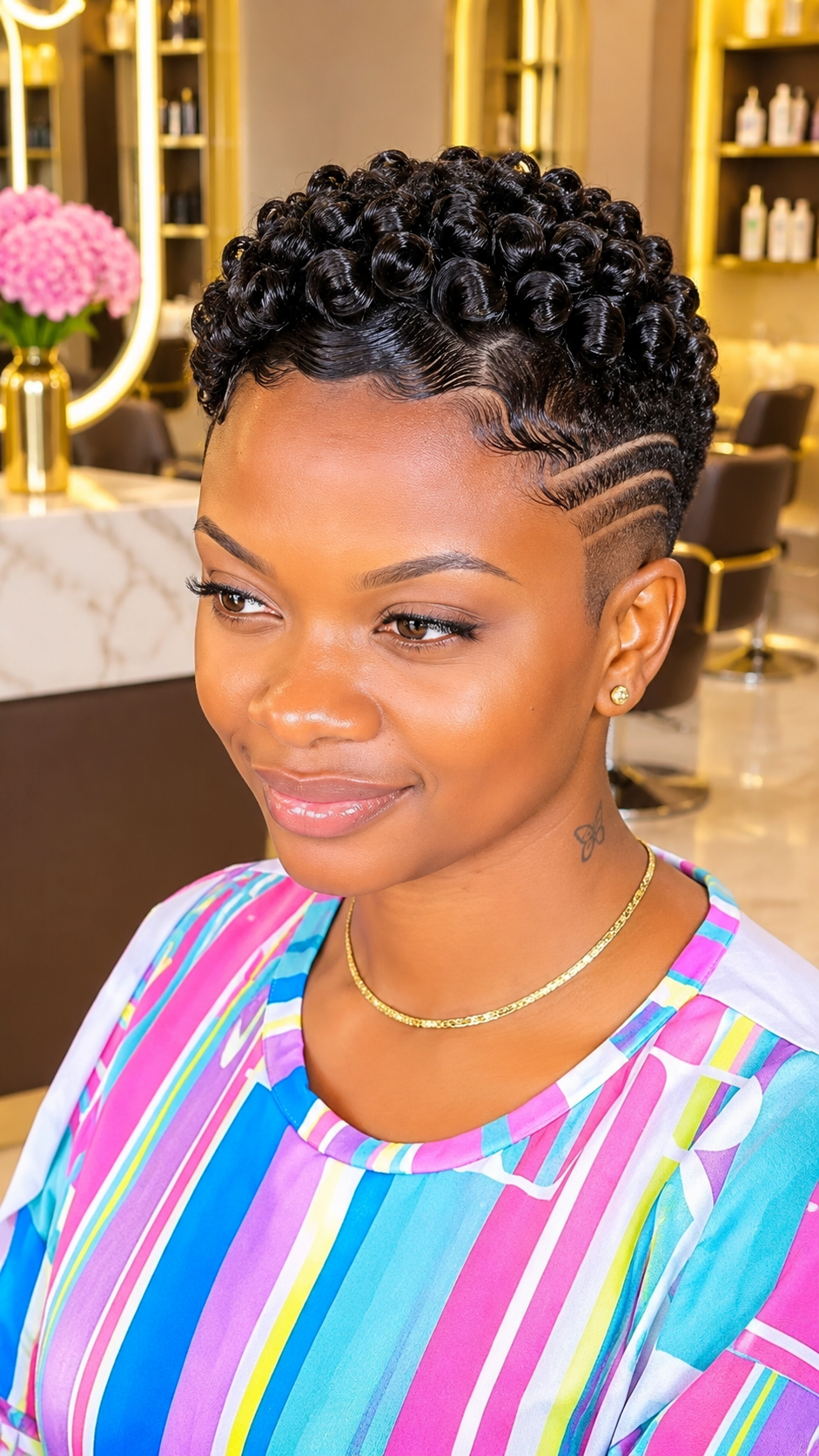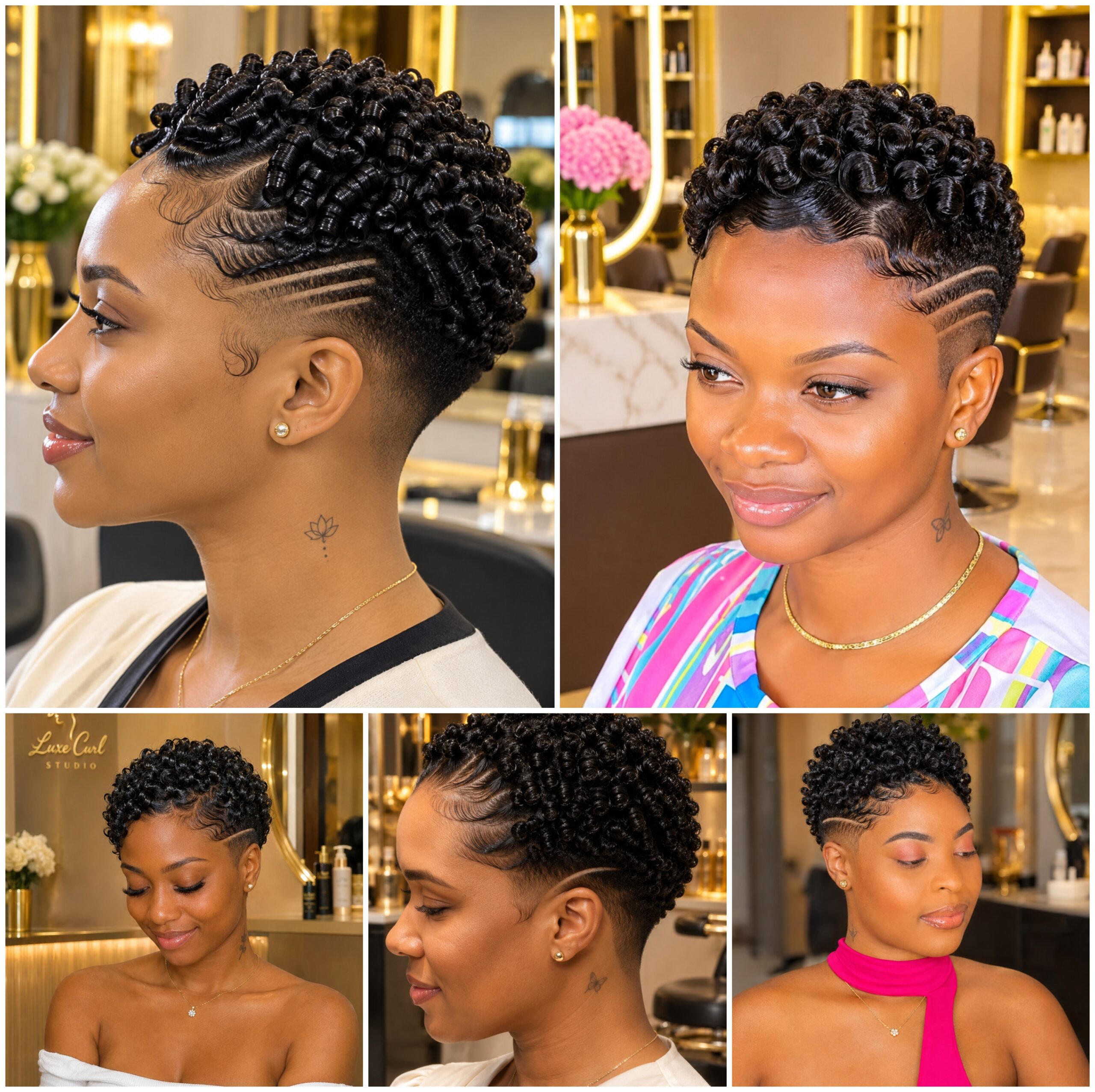
Short spiral curls and razor-inspired side patterns create a striking combination of softness and precision. The curls provide volume, movement, and dimension, while the closely tapered sides introduce artistic details that make the hairstyle stand out. For women who appreciate sculpted pixie hairstyles, this combination offers an expressive alternative to conventional cropped curls.
The appeal lies in the contrast between the upper and lower sections. Compact spirals can create a rounded crown, while curved lines, diagonal stripes, or carefully positioned geometric accents bring character to the sides. The final appearance depends on the size of the curls, the direction of the hair, the density around the temples, and the placement of the decorative lines.
This hairstyle can be created directly on suitable natural hair or reproduced through a professionally customized wig. The two options require different techniques, particularly when shaping side patterns. A barber may carve designs into natural hair, while a wig specialist must consider the cap construction before cutting or separating strands.
Because this hairstyle is being discussed by title rather than through a specific reference photograph, the following recommendations cover suitable variations rather than claiming that one particular curl pattern, color, or side design has been visually confirmed.
The Appeal of Compact Spiral Curls
Spiral curls create a recognizable shape because the strands bend into circular or corkscrew-like formations. In shorter hairstyles, these curls can remain concentrated around the crown, giving the hair a rounded silhouette without the length associated with shoulder-length ringlets.
The appearance changes according to curl diameter. Small spirals tend to create a closely packed surface, while medium-sized loops allow more space between individual curls. Larger ringlets can introduce additional height and a more open arrangement.
For a balanced pixie, the crown may be slightly fuller than the sides. This concentrates the curls where they are most visible while allowing the lower sections to support a sharper outline.
Some variations use tightly rolled finger coils, whereas others incorporate open spirals with clearly visible circular centers. Both approaches can work, provided the curl arrangement complements the selected side pattern.
The hairstyle does not require excessive length. Carefully positioned curls can create an expressive appearance even when most of the hair remains relatively close to the head.
Razor Side Artwork Creates the Contrast
The decorative side pattern is often what distinguishes one spiral pixie from another. A simple line can introduce contrast, while multiple curves or intersecting accents can produce a more elaborate appearance.
Several approaches are possible, including single sweeping lines, parallel temple stripes, gently curved arches, and angular geometric arrangements.
The choice should reflect the available hair density and the desired overall appearance rather than the number of lines alone.
Curved designs can complement rounded curls because their direction echoes the movement of the upper hair. Straight diagonal stripes produce a sharper visual contrast.
Closely spaced parallel lines may create an elegant detail, but the remaining hair between the channels must be sufficient to keep each division recognizable.
Patterns that extend too far into the crown can interfere with the spiral arrangement. For this reason, many balanced designs keep the artwork concentrated around the temple or lower side.
Single Lines, Double Curves, and Geometric Designs
A single curved line is suitable for someone who prefers a restrained accent. It introduces a noticeable division without requiring extensive cutting.
Double curves can create a more elaborate appearance while preserving a coordinated direction. Their spacing should be considered carefully because two channels positioned too closely may appear as one broad separation.
Three-line arrangements create a stronger decorative statement. They may work especially well when the upper hair has enough fullness to balance the additional detail.
Geometric patterns can introduce sharper angles, although their appearance differs considerably from flowing temple curves.
The best selection depends on personal preference, head shape, and the amount of hair available in the side section.
For wigs, these patterns should be planned during construction or assessed by a specialist before any permanent cutting begins.
Creating a Balanced Crown and Tapered Side
The relationship between crown volume and side density determines whether the hairstyle appears balanced.
A relatively full crown can make the spirals more noticeable, but excessive height may overpower delicate side artwork.
Very short sides can create a strong contrast. However, removing too much hair may leave insufficient coverage for decorative channels.
A gradual taper offers an intermediate option. The strands become shorter toward the lower perimeter while the upper curls remain relatively full.
For natural hair, an experienced barber can assess how much length should remain around the temples before creating the design.
For a wig, the maker needs to evaluate the cap foundation, ventilation, and hair density. Cutting too close to the foundation may expose material that would otherwise remain concealed.
The objective is to preserve the rounded upper shape while giving the decorative side enough visibility.
Choosing the Right Curl Diameter
Not every spiral curl produces the same effect. Small coils create a dense appearance and can make the crown look compact, while larger curls produce more visible separation.
Finger coils may be suitable for tightly arranged spiral formations. They are typically created by shaping small sections around the fingers or an appropriate styling tool.
Depending on the hair type and desired result, a stylist may also use rollers, setting methods, or other professional curl-forming techniques.
The appropriate method depends on the material. Natural hair and confirmed human-hair wigs may respond differently from synthetic fibers.
A buyer should not assume that every precurled wig can be safely reshaped using heat.
For custom orders, a clear reference photograph showing the preferred curl diameter is more useful than a general request for curly hair.
The maker should also explain how the curls will behave after washing and whether professional resetting may be required.
Hair Colors That Complement Spiral Pixies
Color can emphasize either the curls or the decorative side pattern. Darker shades often make the hairstyle appear cohesive, while warmer and lighter colors can reveal the individual spiral formations more clearly.
Jet black is a popular option for customers who want the curl shape and side artwork to remain the primary details.
Chocolate brown offers a softer alternative, especially when the curls contain subtle warm reflections.
Copper and auburn can introduce richness, while honey and caramel tones may create brighter highlights along the circular strands.
Burgundy offers a deeper red appearance, and silver or platinum tones can produce a striking contrast with closely arranged side sections.
These are possible color choices rather than characteristics of a specific photographed hairstyle.
When selecting a wig, request photographs of the available shade in neutral daylight. Commercial color names are not always consistent between suppliers.
Customers considering a chemically colored human-hair wig should ask about its processing history, while synthetic options require confirmation of any permitted coloring methods.
Where To Get This Hairstyle Done
For a hairstyle created directly on natural hair, an experienced barber or natural-hair stylist can help coordinate the spiral crown with the desired side artwork.
A stylist familiar with finger coils can prepare the upper curls, while a barber skilled in precision detailing can refine the lower taper and decorative channels.
Some salons provide both services in one appointment. Others may require separate specialists.
Customers should share reference photographs before booking and explain which aspects are most important, such as curl size, crown height, and the position of the side pattern.
Ask whether the salon has previous examples of similar work. Photographs showing the actual finished sides are particularly useful when evaluating intricate designs.
For wig-based styling, choose a professional who understands how to create decorative effects without damaging the cap.
The availability of these services and their prices will depend on the salon, location, and complexity of the requested work.
Where To Buy a Similar Wig
Short spiral pixie wigs may be available through local beauty supply shops, online wig boutiques, specialist wig makers, and salons offering customized units.
Ready-made curly pixies can provide a starting point, but decorative side patterns may require additional customization.
Buyers can search for spiral coil pixie wigs, finger curl tapered wigs, or curly pixie wigs with side artwork.
When comparing listings, examine the actual curl structure instead of relying exclusively on product titles.
Check whether the crown consists of compact finger coils, larger open spirals, or ordinary loose curls.
Ask the seller to provide front, side, rear, and underside photographs of the unit being offered.
Confirm the fiber composition, cap size, color, and any available adjustment components.
No particular supplier, stock level, or live product price is verified here.
Ordering a Custom Spiral Pixie
A custom order begins with deciding which visual details matter most. For this hairstyle, the main choices are spiral diameter, crown fullness, side taper, and decorative line arrangement.
Provide the wig maker with reference photographs from multiple angles. If the side design is asymmetrical, specify whether it should appear on the wearer’s left or right.
Discuss the desired color and whether the roots should remain darker than the curls.
For a wig, accurate head measurements are important. A maker may request circumference, front-to-nape distance, and ear-to-ear measurements.
Ask whether the selected construction can support the proposed side artwork before production begins.
Confirm the hair material, available cap options, installation requirements, and estimated preparation process.
Before approving the completed unit, request photographs showing the spiral arrangement and any decorative side channels.
Also confirm what the quoted price includes, such as customization, shipping, installation, or later alterations.
Ready-Made Wigs Versus Personalized Construction
A ready-made pixie may be suitable for customers who want a convenient hairstyle without requiring an exact decorative design.
It can also be a practical choice when the available curl size and cap measurements already meet the buyer’s needs.
Custom construction offers greater control over the upper curls and lower artwork, although it may involve additional styling labor.
One limitation of modifying a ready-made wig is that the existing density may not support extensive side cutting.
The cap construction may also restrict where the stylist can safely create separation lines.
Buyers should therefore discuss potential alterations before purchasing a basic unit for customization.
Closure, Frontal, and Glueless Considerations
Different wig constructions offer different levels of hairline coverage and styling flexibility.
A closure-based design may be appropriate for certain compact pixies, although its lace area and available parting options should be evaluated.
A frontal construction may provide greater coverage around the front and temples, depending on its dimensions.
The choice should reflect the intended hairstyle rather than relying on a particular construction label alone.
Glueless installation requires a suitable cap fit and appropriate securing components. Not every lace wig is automatically suitable for adhesive-free wear.
Ask the supplier to explain the installation options supported by the actual unit.
The presence of lace also does not independently establish that the material is HD lace. That specification must be confirmed through reliable product information.
Estimated Prices for Spiral Curl Pixie Wigs
Prices can vary according to the selected fiber, cap construction, curl preparation, and complexity of the decorative side design.
A simple spiral pixie may require less customization than one with multiple carefully shaped channels.
The following USD amounts are illustrative planning ranges, not verified live prices or seller quotations.
| Wig Category | Illustrative USD Range | Possible Purchase Scope |
|---|---|---|
| Premium Custom | $320–$850+ | Individual sizing, personalized spiral arrangement, detailed side artwork, and professional hairline customization. |
| Standard Custom | $170–$420 | Custom compact curls with selected side patterns and basic cap personalization. |
| Basic Human Hair | $100–$280 | A human-hair pixie base that may require additional curling, tapering, and decorative styling. |
| Premium Synthetic | $65–$200 | Higher-priced synthetic curly pixies with prearranged spirals, depending on product specifications. |
| Basic Synthetic | $25–$100 | Budget curly pixies that may offer a similar silhouette without specialist side artwork. |
The cost of a custom unit may increase when multiple decorative channels require careful planning or when the selected color involves additional preparation.
Installation, shipping, cap alterations, and later curl restoration may be priced separately.
The human-hair and synthetic categories describe purchasing possibilities rather than identifying the material of any particular wig.
Preparing for the First Installation
Once a wig arrives, inspect the curls, side artwork, cap interior, and hairline before making permanent changes.
The stylist should confirm that the cap fits correctly and that the decorative lines align with the intended temple.
If the wig includes lace that requires trimming, this should be performed after the fit has been checked.
Removing excess material too aggressively can interfere with the styled hairline or expose the cap foundation.
The securing method should follow the actual construction and the wearer’s preferences.
During installation, avoid excessive pressure on the spirals because flattening the crown may change the intended silhouette.
Keeping Spiral Curls Neat Between Appointments
Spiral curls need careful handling to preserve their circular formations.
Frequent brushing may separate the strands and loosen the original curl arrangement.
The correct washing schedule depends on the material, product buildup, and frequency of wear.
For human-hair wigs, a stylist may recommend appropriate cleansing and curl-restoration methods based on the processing history.
For synthetic fibers, heat and chemical compatibility must be confirmed before restyling.
Use only suitable products in moderate amounts, since excessive buildup can make neighboring curls cling together.
When removing the wig, support the cap instead of pulling on individual spirals.
Storage on a properly sized wig stand can help prevent unnecessary compression.
Preserving the Side Artwork
The lower decorative pattern requires a different maintenance approach from the upper curls.
The visible channels depend on the surrounding shorter hair remaining in position.
Repeated brushing across the lines can move strands into the separated areas and reduce the clarity of the design.
For a natural haircut, a barber can advise when the side pattern may need refreshing as the hair grows.
For wigs, the design should only be altered after a specialist has assessed the construction.
Do not attempt to deepen the channels with clippers or razors without appropriate experience. Permanent cutting may damage the cap or remove more hair than intended.
Advantages and Practical Limitations
One advantage of this hairstyle is its compact silhouette. It offers visible curl detail without requiring long hair around the shoulders.
The decorative side provides a personalized accent and can be adapted to different levels of complexity.
Color choice offers another opportunity for variation, from deep black and chocolate brown to copper, burgundy, and blonde.
However, maintaining carefully arranged spirals may require more attention than caring for an ordinary loose-curly style.
Intricate side artwork may also need professional maintenance, particularly when the design relies on closely spaced channels.
Wig comfort and durability depend on the actual cap, fiber, installation method, and care routine.
Customers should choose a version that suits their preferred maintenance commitment as well as their aesthetic goals.
A Pixie Hairstyle with Character and Precision
Compact spiral curls and carefully arranged side artwork offer a distinctive approach to pixie styling. The rounded upper curls bring softness and fullness, while the decorative side introduces contrast and individuality.
The most successful versions maintain a clear relationship between curl size, crown density, taper placement, and the direction of the side pattern.
Whether created on natural hair or through a custom wig, the hairstyle benefits from an experienced professional who understands both curl formation and precision side detailing.
For buyers, accurate measurements, realistic product information, and clear reference photographs are more valuable than broad promotional claims.
With suitable construction, careful styling, and consistent maintenance, this hairstyle can provide an attractive balance of sculpted spirals and expressive barber-inspired artistry.
Search Terms
Short spiral curls with razor side patterns · Sculpted finger coil pixie hairstyle · Curly pixie with carved temple lines · Compact spiral crown tapered sides · Black finger coils with curved side artwork · Pixie wig with precision razor stripes · Rounded spiral curls and side fade · Barber inspired curly pixie wig