
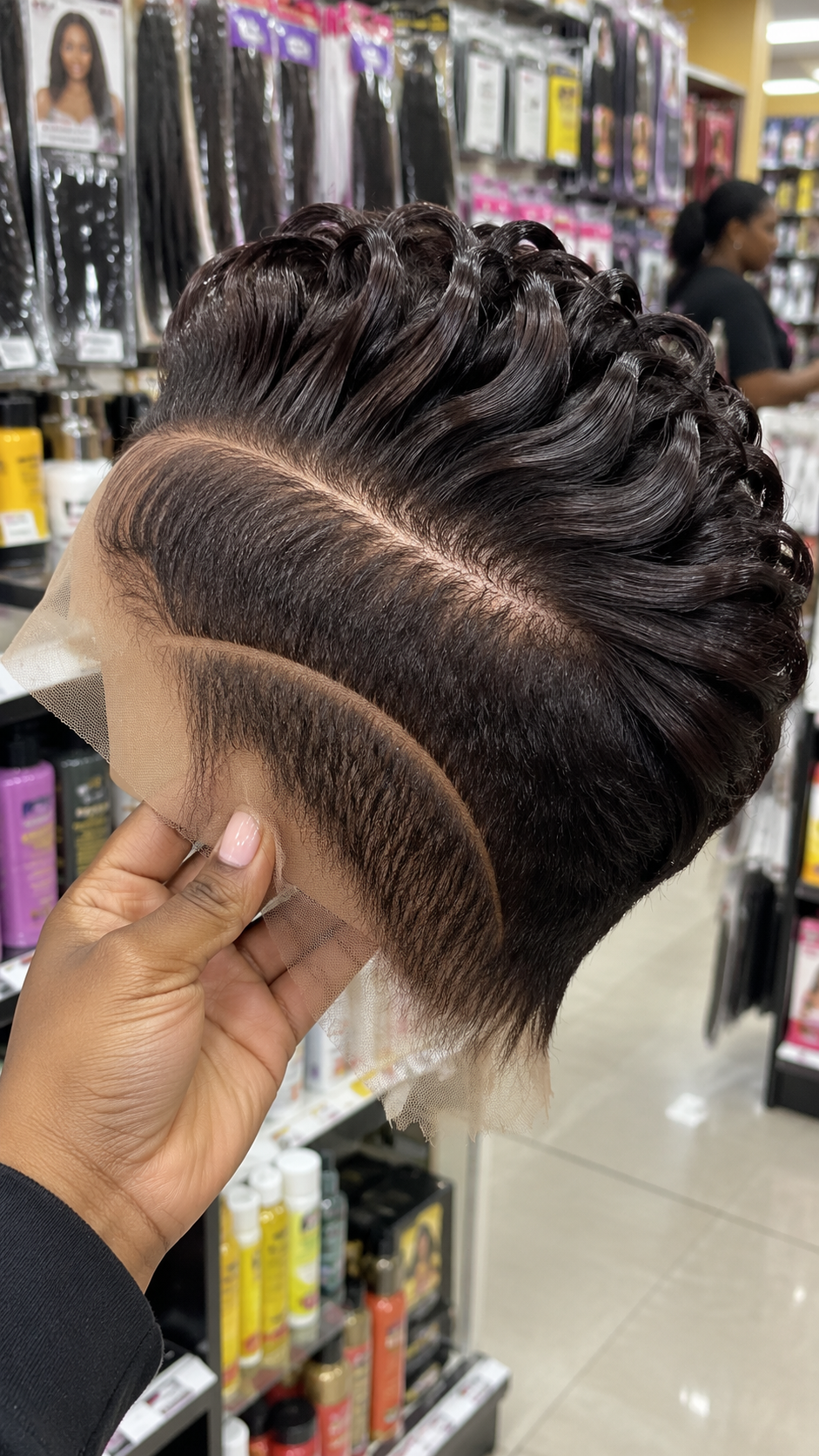
A beautifully sculpted pixie does not need bright highlights or dramatic color contrasts to attract attention. Sometimes, the most memorable hairstyles rely on the direction of the hair, the shape of each curl, and the precision of a carefully arranged side. This dark espresso pixie wig illustrates that approach with its elevated ribbon curls, sweeping crown, and a distinctive curved separation running through the closely fitted lower section.
Displayed in a beauty supply store, the wig is held in one hand before installation. Its upper section contains broad, glossy loops that rise from the front and curve backward into the crown. The hair appears nearly black at the roots, with subtle espresso-brown reflections visible along the sculpted strands. Beneath the raised curls, a lighter curved channel separates two areas of closely arranged dark hair, creating a striking side profile.
The hairstyle combines the fullness of a curled crown with the more controlled appearance of a tapered pixie. Rather than using numerous decorative stripes, its side design concentrates attention on one prominent sweeping arc. This gives the hairstyle a recognizable structure while allowing the upper curls to remain the main attraction.
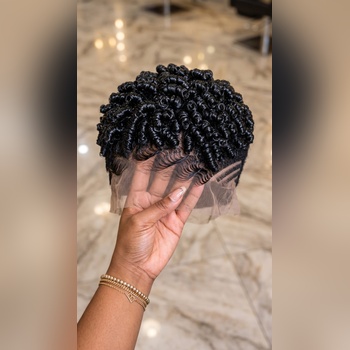
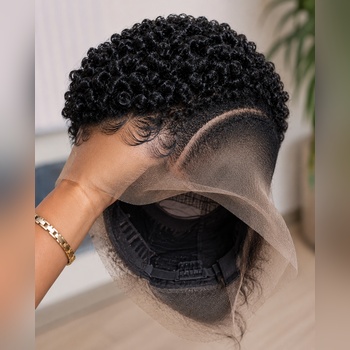
A broad section of beige lace extends beyond the front and side hairline. The wig is therefore shown before its final fitting and trimming. Although the photograph reveals important styling details, it does not confirm the fiber composition, exact lace grade, manufacturer, or complete interior cap construction.
For shoppers seeking a similar hairstyle, the most important details are the wide ribbon curls, dark espresso coloring, curved side separation, and compact lower silhouette. These characteristics distinguish the design from ordinary finger-coil pixies and closely shaved hairstyles with multiple parallel lines.
A Single Curved Separation Gives the Side Its Character
The most recognizable detail beneath the raised crown is a long, curved channel that travels diagonally across the visible side. It begins near the front temple and continues backward in a broad, graceful arc.
The channel divides an upper band of relatively short dark hair from the lower side section. Both areas retain visible hair coverage, creating contrast between the darker strands and the lighter separation.
Unlike hairstyles featuring several narrow parallel stripes, this wig uses a more restrained geometric arrangement. The main channel remains prominent without introducing a complicated series of intersecting lines.
Its curvature also complements the direction of the hair above. The ribbon curls travel backward across the crown, while the lower separation follows a related sweeping movement.
This relationship makes the hairstyle appear coordinated rather than divided into unrelated sections.
Understanding the Difference Between a Side Arc and a Razor Stripe
A typical barber stripe may be relatively narrow and straight. The separation shown here is broader in its overall sweep and follows the rounded shape of the head.
The visible channel appears lighter than the surrounding hair, but the photograph cannot establish exactly how it was constructed.
On natural hair, a barber might reproduce a similar appearance through careful parting and cutting. On a wig, the construction could require selective strand placement or other techniques designed to preserve the foundation.
Buyers should not assume that the same process works for both.
When commissioning this design, provide a close-up photograph showing the full curve from the front temple toward the lower side. Ask the maker to maintain the same general width and direction.
Adding extra stripes or sharp angles would change the original appearance considerably.
The Raised Crown Is Built Around Broad Ribbon Curls
The upper hairstyle has a very different character from compact finger coils. Instead of numerous small circular ringlets, the crown contains wider sections of hair arranged into elevated, backward-facing loops.
Near the front, several broad strands rise upward and fold into rounded formations. Some loops have visible openings, while others overlap neighboring sections and create continuous curved surfaces.
These formations gradually move backward across the crown, creating an impression of controlled movement.
The loops are particularly noticeable because the individual strands lie close together within each ribbon-like section. Under the store lighting, fine reflective lines follow their curves and emphasize their direction.
The crown appears relatively full without extending into long hanging curls. Its height is concentrated above the upper side, helping maintain the overall pixie silhouette.
What to Look For in the Curl Formation
When comparing wigs, examine whether the curls are arranged as broad loops or narrow spirals.
A conventional finger-coil wig may have numerous small, hollow-centered curls distributed evenly over the head. That creates a different surface from the ribbon formations visible here.
The photographed hairstyle contains fewer prominent, wider loops toward the front, with more closely grouped curled sections continuing toward the rear.
A similar wig should preserve that progression rather than replacing the raised crown with uniformly sized circular coils.
Ask a supplier for photographs from above and from the opposite side. These additional views can help establish the arrangement of the entire crown, which is not fully visible in the reference.
Espresso Brown Reflections Add Depth Without Bright Highlights
The hair appears predominantly very dark brown, approaching black in the shadowed sections. Under the lighting, the raised curls display subtle espresso and chocolate-brown reflections.
These warmer areas follow the natural curves of the strands rather than forming clearly separated blonde or caramel highlight sections.
The roots and close-fitting side appear darker than some of the upper reflective surfaces.
This tonal relationship gives the hairstyle depth while preserving an understated color palette.
Importantly, the photograph does not prove that the warmer areas are intentionally dyed highlights. Lighting, hair sheen, and camera exposure can all influence their appearance.
Choosing Between Natural Black and Dark Espresso
Customers looking for this color should compare very dark brown and natural black options rather than automatically selecting a bright highlighted shade.
Some suppliers describe near-black brown hair as espresso, while others use terms such as dark chocolate or natural black.
Request daylight photographs of the actual product and ask whether any lighter strands have been incorporated.
If the goal is to reproduce the photographed appearance, a dark base with subtle warm reflections may be more suitable than pronounced blonde or copper streaks.
The exact manufacturer color code should be confirmed with the supplier before purchase.
The Side Density Creates a Close-Fitting Silhouette
The lower section is arranged much closer to the foundation than the raised crown. Fine dark strands follow the shape of the side, creating an appearance similar to a closely tapered haircut.
Above the curved channel, the hair forms a compact band beneath the upper loops. Below it, another section extends toward the lower perimeter.
This arrangement provides enough dark coverage to make the separation noticeable.
The side does not appear completely shaved. Fine strands remain visible throughout much of the lower area.
That detail is important when discussing a reproduction with a wig maker. Excessive cutting could create unwanted gaps or reveal the cap.
The maker should explain how the tapered appearance will be achieved while maintaining the necessary coverage.
The Front Hairline Transitions Into the Elevated Curls
At the upper front, shorter-looking strands gradually rise into the longer ribbon formations. The visible hairline is relatively restrained compared with hairstyles that use elaborate circular baby-hair patterns.
Fine strands follow the front perimeter before joining the upward movement of the crown.
The result is a transition from the flatter hairline into the raised loops above it.
This transition contributes significantly to the hairstyle’s overall balance. A heavy fringe or oversized forehead curls would interrupt the upward movement that characterizes the design.
For accurate customization, ask the stylist to preserve the front direction rather than adding unrelated decorative patterns.
The Visible Lace Must Be Considered Before Installation
A beige mesh section extends beyond the hairline around the front and temple. The lace remains untrimmed, leaving an additional perimeter that may be adjusted during fitting.
The mesh is clearly visible where the mannequin’s forehead and temple area would be positioned.
However, a photograph alone cannot identify its precise grade or establish whether it belongs to a particular frontal or closure construction.
Buyers should ask the supplier to confirm the lace dimensions, available shades, and recommended installation method.
Do not assume that fine-looking mesh is HD lace without independent product information.
Why the Lace Should Be Fitted Before Cutting
The side arc and upper curls depend on correct positioning. If the cap sits too far forward, the curved separation may appear misplaced near the temple.
If the cap sits too far backward, the front hairline may no longer align naturally with the wearer’s forehead.
The stylist should establish the intended wearing position before trimming excess lace.
Any adjustment near the side design should be made carefully to avoid disturbing the fine strands that frame the exposed channel.
Because lace trimming is generally irreversible, removing more material than necessary should be avoided.
Cap Construction and Measurements Are Essential
The photograph shows the outer hairstyle and some lace, but it does not provide a complete view of the interior cap.
It is therefore not possible to confirm the number of combs, adjustable straps, clips, or other fastening components.
Before ordering, request a photograph showing the wig fully opened from underneath.
Ask the seller to identify the construction and provide the available cap sizes.
Correct measurements are particularly important for a hairstyle with a distinct side arc because the design should sit comfortably at the intended position.
If glueless installation is preferred, confirm that the actual cap and fastening system are suitable for adhesive-free wear.
The presence of lace alone does not establish that capability.
Where to Find a Similar Ribbon Curl Pixie
This hairstyle may be available through specialist wig boutiques, independent wig makers, or suppliers offering sculpted pixie units.
However, searching only for a dark curly pixie may produce products with entirely different curls and side arrangements.
The broad ribbon loops and sweeping side arc should be emphasized when describing the desired hairstyle.
Local beauty supply stores can be useful because buyers may be able to examine the actual hair, cap, and curl structure before purchasing.
Online retailers may offer additional choices, but actual product photographs are preferable to generic promotional images.
The reference does not identify a verified seller or establish current product availability.
Questions Worth Asking Before Paying
Ask whether the product includes pre-styled broad ribbon curls or requires additional salon work.
Confirm whether the sweeping side separation is already incorporated into the unit.
Request written information about the fiber composition, lace construction, cap measurements, and fastening components.
Ask whether the curl arrangement can be restored after washing and what maintenance methods are recommended.
For a custom order, establish the production schedule, revision policy, payment terms, and shipping costs.
Request photographs of the completed unit before dispatch whenever that service is available.
Custom Production Versus a Ready-Made Alternative
A ready-made dark pixie may be a practical choice when its crown and side are already similar to the reference.
However, some ready-made units contain small finger coils or loose curls rather than raised ribbon formations.
Others have plain tapered sides without the distinctive curved separation.
A custom wig maker may be able to coordinate the side geometry and crown direction during construction.
That approach can be especially useful when the buyer wants the curved channel to follow a particular line.
Before commissioning a unit, ask which details can be reproduced accurately and whether the proposed material is suitable for the necessary styling.
Illustrative Prices for Sculpted Espresso Pixie Wigs
The following USD amounts are illustrative planning estimates, not verified live retail prices. The actual price of the photographed unit is unknown.
| Wig Category | Illustrative USD Range | Factors Affecting the Price |
|---|---|---|
| Premium Custom | $360–$850+ | Individual cap sizing, detailed ribbon curl placement, precision side arc construction, and professional hairline finishing. |
| Standard Custom | $195–$460 | Selected cap construction with personalized crown loops and a sweeping side separation. |
| Basic Human Hair | $115–$300 | A human-hair starting unit that may require professional curl setting, cutting, and fitting. |
| Premium Synthetic | $85–$220 | A manufactured dark pixie with preformed sculpted curls and possible side customization. |
| Basic Synthetic | $35–$105 | A budget pixie that may not reproduce the broad ribbon curls or curved side design accurately. |
Unlike a simple curly wig, this hairstyle may require substantial effort to organize broad sections into coordinated loops.
The sweeping side channel may also involve specialist construction or customization.
Cap measurements, lace options, density, and finishing requirements can influence the final quotation.
Installation, shipping, taxes, and future restyling may be charged separately.
Ask whether the quoted amount includes a finished hairstyle or a base wig that requires additional salon work.
Planning the First Salon Appointment
Once the wig arrives, inspect its crown, side separation, lace, and cap before making permanent alterations.
The stylist should begin by checking the fit and establishing the correct wearing position.
Next, examine whether the sweeping side arc sits at the intended angle and whether the upper ribbon curls remain balanced.
Only after these checks should unnecessary lace be trimmed.
If the curls have shifted during shipping, restoration should follow the manufacturer’s recommendations for the confirmed fiber.
Heat should not be applied automatically when the material is unknown.
When booking through WhatsApp, direct message, or telephone, explain that the unit requires careful lace fitting and preservation of sculpted ribbon curls.
Protecting the Ribbon Formations During Wear
The wide upper loops are one of the most delicate visual elements of this hairstyle.
Repeated brushing may stretch them and reduce their recognizable curved structure.
Instead of pulling directly on the curls, support the cap when handling the wig.
If the unit contains human hair, professional resetting may be possible with suitable methods that account for any previous chemical processing.
If it contains synthetic fibers, follow the manufacturer’s instructions regarding heat, steam, and reshaping.
Heavy products can collect between the folded strands and affect their appearance.
Maintenance should prioritize preserving the direction and separation of the ribbon sections rather than creating additional volume.
What Happens When the Side Arc Becomes Less Visible?
With regular handling, fine strands may shift across the exposed side channel.
This can make the separation appear narrower or less distinct.
Before cutting additional hair, ask a wig stylist whether the strands can be repositioned.
Removing too much hair may permanently expose the foundation.
The goal should be to preserve the original curved separation rather than gradually widening it during repeated maintenance appointments.
Storage and Everyday Practicality
A correctly sized wig stand can support the compact silhouette between wears.
Avoid compressing the upper curls beneath heavy accessories or other wigs.
For travel, use protective packaging with sufficient room around the raised crown.
Keep the lace away from rough surfaces that could snag the mesh.
Before wearing the wig again, inspect the ribbon curls, front hairline, and sweeping side channel.
The compact length may appeal to women who prefer shorter hairstyles without loose strands extending toward the shoulders.
However, the sculpted crown and side geometry may require more careful attention than an ordinary curly pixie.
Choosing a Pixie That Balances Structure and Movement
The strongest quality of this hairstyle is the coordinated relationship between its elevated crown and curved lower side.
The broad espresso ribbon curls create movement and fullness, while the close-fitting lower hair provides contrast.
The sweeping side arc adds a recognizable decorative detail without introducing multiple competing patterns.
For a successful reproduction, focus on the width and direction of the upper loops, the dark color palette, the rounded silhouette, and the placement of the curved side separation.
Before purchasing, verify the material, lace specifications, cap measurements, fastening system, and expected maintenance requirements.
Additional photographs of the opposite side, complete rear, and interior construction will help establish details that cannot be confirmed from this profile view.
A carefully chosen unit should preserve the hairstyle’s distinctive balance of raised ribbon curls and restrained geometric detailing while providing comfortable wear and manageable maintenance.
Search Terms
Espresso brown ribbon curl pixie · Sweeping curved side arc wig · Dark sculpted backward loop crown · Chocolate black elevated pixie curls · Single curved temple channel hairstyle · Dark brown tapered side lace wig · Broad ribbon loop pixie hairstyle · Espresso glossy crown with side part