
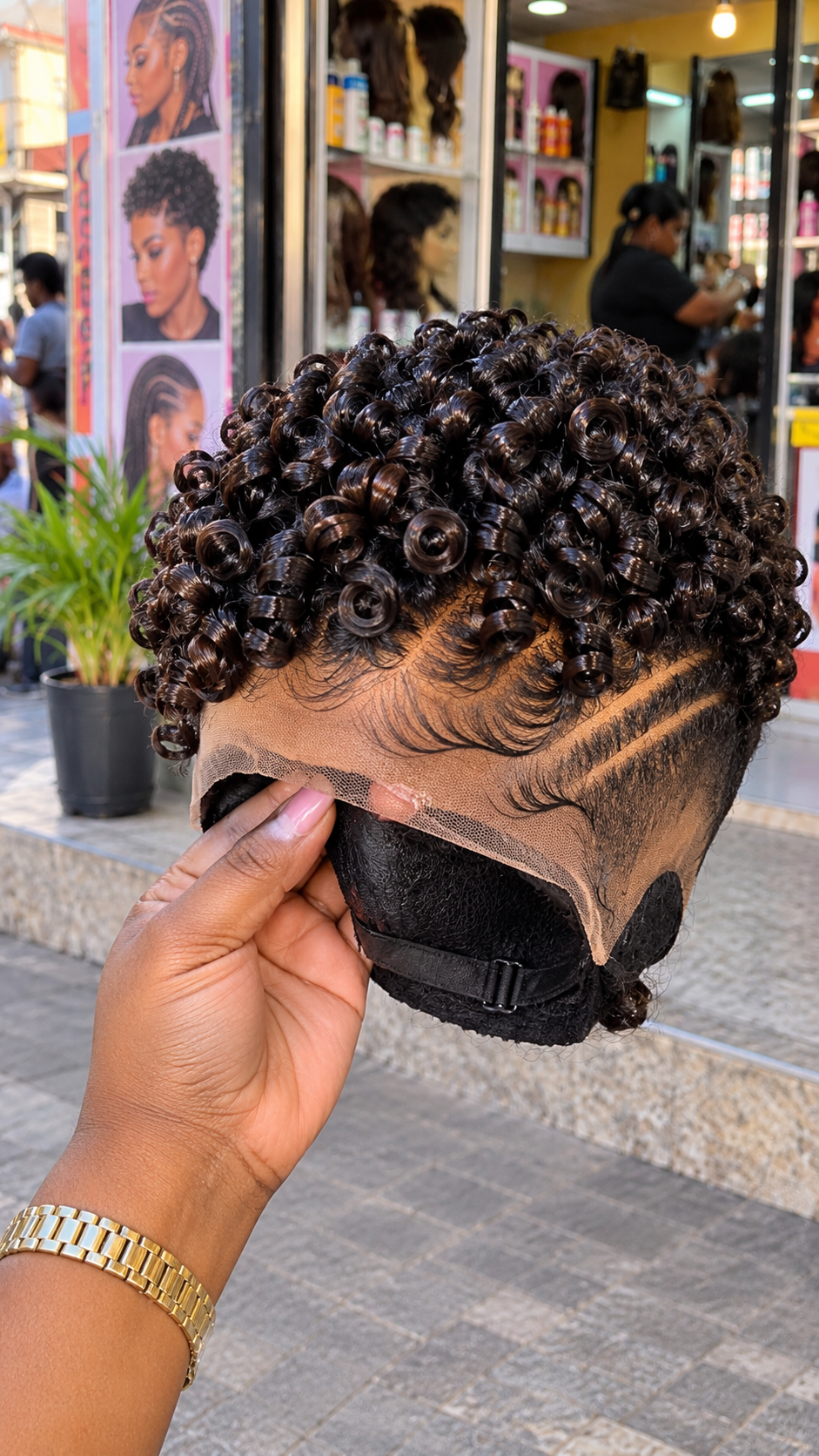
A striking pixie hairstyle does not always need dramatic highlights or considerable length to create an unforgettable impression. Sometimes, the beauty lies in the precision of its smaller details. The wig pictured here brings together a densely curled espresso-black crown, closely arranged forehead strands, and a striking curved temple design. Each section contributes something different, creating a compact hairstyle with a distinctive balance of softness and structure.
The most noticeable characteristic is the contrast between the rounded spiral curls and the sharply organized side. Hundreds of glossy strands form small, tightly wound rings across the upper head, while the temple area contains two closely spaced diagonal channels that curve backward. Beneath these channels, shorter-looking hair creates a dark tapered panel with an angular lower outline.
Held in one hand outside a working neighborhood salon, the wig is photographed before installation. The beige-brown lace remains visible around the front and side, and part of the black interior cap can be examined beneath the hairline. A dark adjustment strap with a small buckle is also visible. These construction details are useful for understanding the unit before it is fitted, although the image does not confirm the fiber composition, precise lace grade, manufacturer, or full cap specifications.


Unlike a typical finger-coil pixie with a uniform crown, this hairstyle has a particularly dense collection of small circular spirals. Some coils appear almost like miniature springs, while others form compact rosettes with clearly visible central openings. Subtle warm brown reflections appear across portions of the dark hair, creating an espresso-like appearance rather than a prominently highlighted color combination.
The photograph provides a useful reference for anyone interested in purchasing a similar wig or commissioning a custom design. The key is to evaluate its coil arrangement and side geometry together rather than judging the hairstyle by color or length alone.
The Temple Design Creates a Distinctive Side Profile
The most unusual element of this wig is the pattern along the visible temple. Two narrow, exposed diagonal channels travel backward from the front-side hairline, creating the appearance of a carefully planned barber-inspired design.
The channels are separated by a band of closely arranged dark hair. Their paths run in approximately the same direction, although their lengths and curvature are not perfectly identical.
Above the upper channel, tightly arranged curls continue from the crown. Below the second channel, the hair forms a relatively compact panel that narrows toward the lower perimeter.
The resulting shape creates a striking contrast between circular curls and linear styling.
The lower side also contains a noticeable angular transition, where the hair becomes finer near the edge of the lace. This gives the temple area a shaped appearance without introducing additional decorative stripes.
Why the Curved Channels Matter
Small changes to the side pattern can produce a substantially different result.
If the channels are made too wide, they may expose too much of the underlying cap. If they are positioned too closely together, the dark hair between them may become difficult to distinguish.
The photograph shows relatively narrow separations with visible hair coverage around them.
Anyone ordering a similar wig should provide an enlarged image of this area and explain that the two channels should remain distinct.
The photograph cannot establish whether the pattern was produced through cutting, hair placement, or a combination of methods. That construction detail should be discussed with the wig maker before any modification.
The Crown Resembles a Collection of Miniature Spirals
Across the upper hairstyle, compact circular curls create a densely arranged surface. Many have visible openings at their centers, while others overlap neighboring coils.
The ringlets are relatively small compared with broad ribbon curls or oversized sculpted loops. Their tight arrangement produces fullness without extending far beyond the head.
Several coils near the upper front are more prominently displayed, while smaller formations fill the spaces toward the sides and visible rear.
The curl directions vary slightly. Some rings face outward, making their central openings easy to see. Others are tilted or partially covered by adjacent strands.
This variation adds depth to the hairstyle and keeps the crown from appearing entirely uniform.
The Importance of Coil Diameter
When comparing curly pixie wigs, coil diameter is one of the most important visual differences.
Large circular loops create a more open and sculptural appearance. Small ringlets produce a tighter, more concentrated surface.
The pictured wig uses predominantly compact spiral curls, making the crown appear particularly intricate.
A supplier offering a similar black pixie with broad finger waves or loose spring curls may not reproduce the same result.
For custom orders, request a close-up photograph showing the actual ringlet size and the way neighboring curls overlap.
A top-down image is also helpful for assessing the curl distribution across the center of the crown.
The Hairline Uses Fine Sweeping Strands
Beneath the densely curled crown, the front contains fine strands arranged close to the lace.
These strands follow gentle curved paths toward the forehead, forming delicate, feather-like sweeps.
The front styling is noticeably flatter than the raised spiral curls above it.
Several longer strands curve toward the visible temple, visually connecting the forehead arrangement with the decorative side channels.
The combination of soft waves and geometric separations makes the transition especially interesting.
Unlike hairstyles with large circular baby-hair loops, this front section emphasizes many fine strands positioned closely together.
Keeping the Hairline Proportional
The delicate front arrangement should be considered before making any installation adjustments.
Excessive plucking could reduce the amount of hair available for the sweeping pattern.
Cutting the strands too closely may also make the original curves difficult to recreate.
A professional should evaluate the hairline after the wig has been positioned correctly on the wearer.
If the buyer wants a simpler front, that preference should be discussed before custom production rather than addressed through unnecessary cutting afterward.
Espresso Black With Subtle Warm Reflections
The visible hair appears predominantly very dark brown-black, with subtle warm reflections along some of the circular curls.
Several strands catch the light with an espresso-brown appearance, while the deeper sections remain nearly black.
These reflections are not arranged as obvious blonde, copper, or burgundy highlights.
The effect is relatively restrained, allowing the curl pattern and side geometry to remain the main visual attractions.
Some of the apparent color variation may be caused by sunlight and reflections on the glossy strands.
For that reason, the photograph cannot establish whether the wig was manufactured in a dark brown shade, colored after production, or simply photographed under warm lighting.
Choosing Between Natural Black and Espresso Brown
Buyers should ask for actual color photographs before selecting a shade.
Natural black can contain subtle brown undertones, while jet black often appears deeper and more uniform.
Espresso brown generally provides a dark appearance with warmer reflections, although color descriptions vary between manufacturers.
The photographed hairstyle appears close to the boundary between very dark espresso brown and natural black.
When commissioning a custom unit, use the reference photograph rather than relying solely on a numbered color description.
Ask the supplier to confirm the available shade under neutral lighting.
A Compact Crown With Closely Fitted Lower Hair
Despite the many spiral curls, the hairstyle maintains a relatively compact silhouette.
The upper section is full and rounded, while the lower side becomes more closely fitted toward the perimeter.
This contrast allows the crown to appear prominent without creating excessive width along the temple.
The side pattern is especially visible because the surrounding hair remains close to the cap.
If the lower section were much fuller, the curved channels could become less noticeable.
The photograph shows only one side and part of the upper hairstyle. A complete rear view would be necessary to establish the precise back shape.
Choosing the Right Density
Hair density should be considered separately for the crown and the lower side.
The circular upper curls require enough hair to maintain a full appearance, but excessive density may conceal their individual spiral shapes.
The temple area requires sufficient coverage around the exposed channels.
Removing too many strands from this section may reveal the underlying foundation.
Ask the wig maker how the desired side pattern affects the available density options.
If the product is custom-made, request photographs showing both the crown and temple before approving the finished unit.
The Lace Remains Untrimmed
A broad section of beige-brown lace extends beyond the front and visible side hairline.
The mesh remains untrimmed, indicating that the wig is being displayed before fitting.
This is particularly important because the decorative side channels and fine front strands sit close to the lace perimeter.
The mesh appears relatively fine in the photograph, but its exact grade and manufacturing specifications cannot be established visually.
Buyers should request written information about the lace type, dimensions, and available shades.
The appearance of fine lace should not automatically be treated as confirmation of a particular premium lace category.
Why Trimming Requires Extra Care
The extended lace provides material that may be adjusted during installation.
However, trimming must be performed only after the wig has been positioned correctly.
The installer should first examine where the curved side channels and front hairline will sit relative to the wearer’s temple.
Cutting too close to the decorative strands could damage the design or reduce the available fitting margin.
The temple pattern may also require careful alignment so that its two exposed channels remain visible at the intended angle.
The Interior Cap Shows an Adjustable Strap
The lower opening reveals part of the black cap construction, including a visible adjustment strap and buckle.
The strap appears positioned across the lower interior section.
These details indicate that the cap includes at least one adjustable component.
However, the photograph does not show the entire underside. Additional combs, clips, straps, or other fastening components may be present outside the visible area.
The visible strap does not establish that the wig is intended for adhesive-free installation.
Before purchasing, request a complete interior photograph showing the full fastening system.
Checking Cap Size Before Ordering
Correct cap sizing is important because the temple pattern depends on its position relative to the wearer’s head.
If the wig sits too far forward, the curved channels may appear lower than intended.
If it shifts backward, the front hairline and upper curls may sit at an unexpected angle.
Provide the measurements requested by the supplier, including head circumference and any additional dimensions required for the chosen cap.
Ask whether the adjustable strap can accommodate the intended fit.
If glueless wear is preferred, obtain explicit confirmation that the entire cap construction supports that method.
Finding a Wig Maker Who Understands Precision Side Designs
The photograph does not identify a verified manufacturer, seller, or product listing. However, it provides an excellent reference for contacting wig makers experienced in compact sculpted hairstyles.
Look for specialists who regularly create circular pixie curls and decorative side geometry.
A conventional wig retailer may offer similar dark curly units without the precise temple design.
Independent wig makers may provide more control over curl placement and the position of the exposed channels.
Local wig boutiques can allow buyers to inspect the cap, lace, and fiber before ordering.
Online sellers may offer additional choices, but actual product photographs should take priority over generic promotional images.
Questions to Ask Before Paying
Ask whether the seller can reproduce the two curved side channels with the same general spacing and direction.
Request close photographs of previous work involving compact spiral curls.
Confirm the fiber type, cap measurements, lace specifications, and available fastening components.
Ask whether the hairline arrives fully styled or requires professional finishing.
For a custom unit, establish the production timeline, approval process, and revision policy.
Shipping costs and any additional installation services should also be clarified before payment.
Ready-Made Versus Custom Production
A ready-made dark curly pixie may provide a similar color and rounded silhouette at a lower initial cost.
However, the decorative temple channels may be absent or positioned differently.
The crown may also contain larger curls than those visible in the reference.
Custom production can potentially coordinate the compact coil arrangement and side pattern during construction.
This may be preferable to attempting extensive cutting on a ready-made wig with insufficient side coverage.
Ask the maker to explain which details can be reproduced accurately and which may vary.
Illustrative Prices for Espresso Spiral Pixie Wigs
The following USD amounts are illustrative planning estimates, not verified current retail prices. The photographed wig’s actual material, manufacturer, and selling price are unknown.
| Wig Category | Illustrative USD Range | Potential Cost Considerations |
|---|---|---|
| Premium Custom | $335–$820+ | Individual cap measurements, dense miniature spiral placement, precision temple channels, and detailed hairline finishing. |
| Standard Custom | $185–$435 | Selected cap options with compact circular curls and personalized side detailing. |
| Basic Human Hair | $105–$280 | A human-hair starting unit that may require curl setting, side customization, and professional fitting. |
| Premium Synthetic | $80–$205 | A manufactured dark curly pixie with preformed spirals and possible decorative temple styling. |
| Basic Synthetic | $30–$95 | A lower-cost curly pixie that may not reproduce the compact coils or precision side channels accurately. |
For this hairstyle, the potential additional cost comes mainly from the dense spiral arrangement and the carefully positioned temple design.
Creating two narrow exposed channels while maintaining hair coverage around them can require specialist work.
The selected fiber, cap construction, lace dimensions, and styling labor may influence the final quotation.
Installation, shipping, taxes, and later maintenance services may be charged separately.
Ask whether the supplier’s quoted amount includes the completed hairstyle or only the base wig.
Preparing for the First Installation
Before installation, inspect the delivered wig for damage, misplaced curls, or irregularities in the lace.
Confirm that the adjustable strap functions as described by the supplier.
The stylist should position the cap carefully so that the decorative temple channels sit correctly.
Only after confirming the fit should any excess lace be trimmed.
If the circular curls have been compressed during shipping, restoration should follow the manufacturer’s recommendations for the confirmed fiber.
Heat styling should not be applied automatically when the hair material is unknown.
Maintaining Dense Miniature Spirals
The tightly arranged curls require careful handling because their appearance depends on maintaining individual circular formations.
Repeated brushing may stretch the coils and reduce the visibility of their spiral centers.
Avoid unnecessary pulling, particularly near the perimeter where smaller curls are more closely grouped.
If the wig contains human hair, professional resetting may be possible using suitable techniques.
If it contains synthetic fibers, conventional heated tools may be unsuitable. Follow the manufacturer’s instructions before attempting reshaping.
Heavy styling products may collect between the compact curls, making them appear less distinct.
Protecting the Temple Channels
The decorative side requires particular attention during maintenance.
Brushing hair across the exposed channels may obscure their intended appearance.
If the pattern becomes less visible, determine whether the issue is caused by temporary strand movement or a change in the construction.
Do not attempt to deepen the lines using clippers or scissors without professional guidance.
Removing additional hair could permanently damage the pattern or expose the cap.
Storage for a Compact Spiral Hairstyle
Use an appropriately sized stand to support the wig between wears.
Avoid compressing the circular curls beneath heavy head coverings or other wigs.
For travel, choose protective packaging that provides enough space around the crown.
Keep the lace away from rough surfaces and sharp objects that could snag the mesh.
Before wearing the wig again, inspect the temple design and the fine front strands rather than brushing the entire hairstyle automatically.
Who Is This Hairstyle Best Suited For?
This design may appeal to customers who enjoy intricate curly pixies with a compact silhouette and noticeable side detailing.
The dense spiral crown creates fullness, while the carefully arranged temple channels introduce a barber-inspired element.
The dark espresso-black color makes the hairstyle versatile without relying on bright highlights.
For special occasions and close-up photography, the precise curl arrangement and side pattern offer considerable visual interest.
For regular wear, buyers should consider cap comfort, fastening security, and the maintenance required to preserve the small spirals.
Choosing the Most Accurate Reproduction
A convincing reproduction of this pixie should preserve three closely related characteristics: the dense miniature spirals, the fine sweeping front strands, and the curved double-channel temple arrangement.
The dark espresso-black coloring supports these elements without becoming the dominant attraction.
Before purchasing, verify the fiber composition, lace specifications, cap measurements, adjustment hardware, and whether the wig arrives fully styled.
Request additional photographs of the opposite side, complete back, crown, and interior cap to resolve details not visible in the reference.
These steps will help buyers compare ready-made units, evaluate custom wig makers, and plan an installation that respects the original hairstyle.
Search Terms
Espresso black miniature spiral pixie wig · Curved double temple line lace wig · Dark brown black compact coil crown · Precision side channel curly pixie · Small glossy ringlet wig hairstyle · Feathered front espresso pixie lace · Angular temple taper spiral wig · Black adjustable strap sculpted pixie