
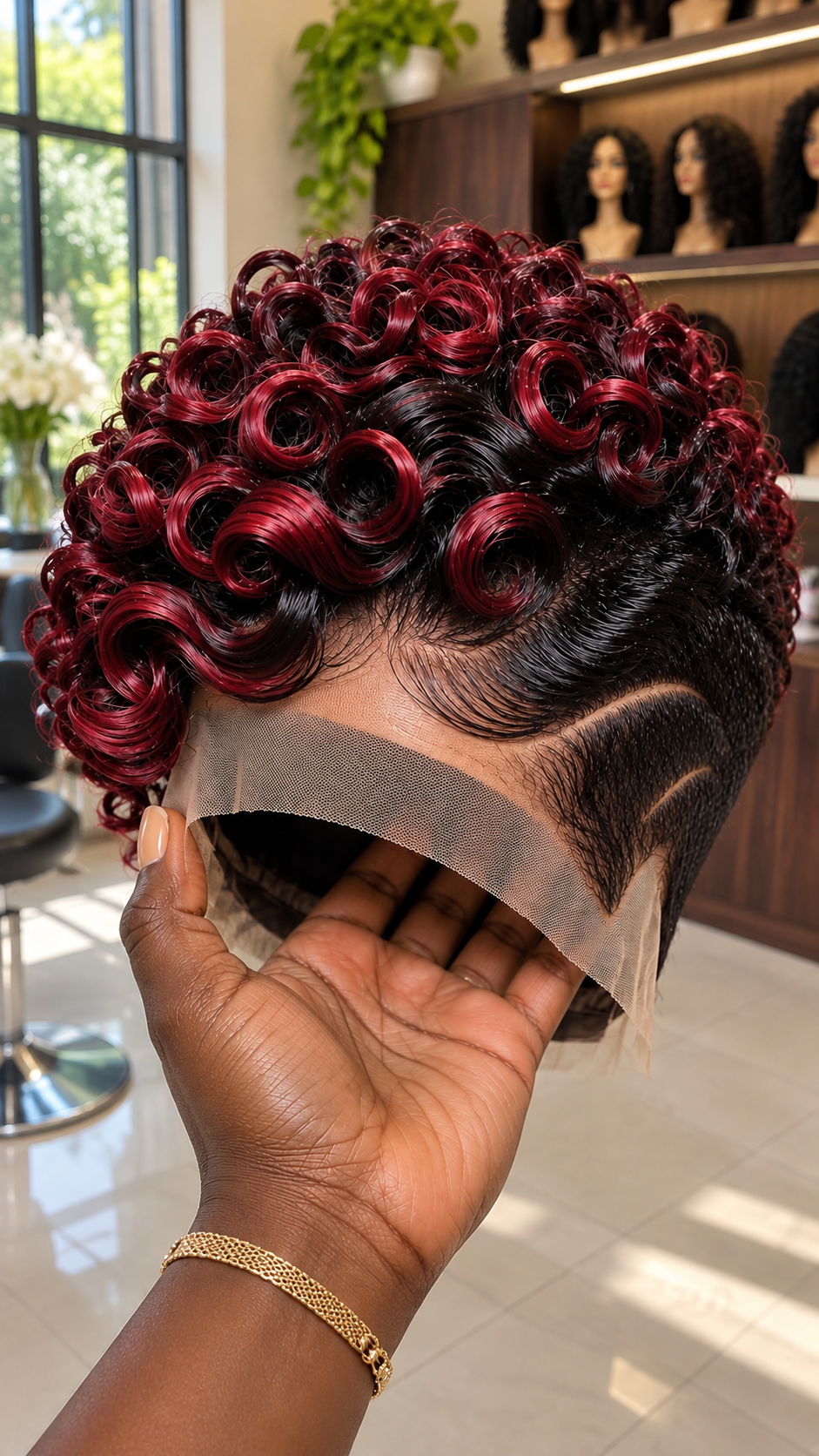
Rich burgundy hair has an unmistakable ability to transform a short hairstyle into something beautifully expressive. When deep wine-red coloring meets glossy spiral ringlets and carefully arranged temple detailing, the result is a pixie hairstyle that feels glamorous, artistic, and wonderfully distinctive. This striking short wig brings those elements together with a rounded crown of sculpted burgundy curls, a deep black foundation, and elegant curved separations that sweep across the visible side.
The hairstyle is photographed inside a bright beauty salon, where the wig is presented in one hand to showcase its intricate construction. The crown contains numerous circular ringlets in rich burgundy, crimson-red, and dark wine tones. These curls overlap in carefully arranged clusters, creating a full but compact silhouette. Beneath them, glossy black strands follow smooth backward movements before transitioning into a closely arranged temple section with prominent curved detailing.
What makes this particular hairstyle memorable is the relationship between its warm and dark sections. The upper curls contain vivid burgundy reflections, while the lower side remains predominantly black. This contrast gives the crown greater prominence and makes the decorative temple lines easier to distinguish. The burgundy color is not distributed uniformly across the entire hairstyle. Instead, darker roots and black sections remain visible between the curls, creating depth and emphasizing their circular shapes.


The wig also displays an extended beige-toned lace front and a partially visible dark interior cap. These details offer a useful view of the hairpiece before installation, although the exact fiber material, lace grade, and complete securing system cannot be established from the photograph alone.
For women considering a burgundy spiral pixie wig with sculpted black sides, this hairstyle provides an appealing combination of dimensional color, beautifully arranged curls, and carefully controlled proportions. Recreating the look successfully requires attention to the size of the ringlets, placement of the burgundy coloring, and the direction of the sweeping temple curves.
The Burgundy Crown Creates an Eye-Catching First Impression
The upper section is dominated by numerous glossy burgundy ringlets arranged into a rounded, elevated crown. The curls have noticeably circular formations, with many displaying open centers surrounded by closely grouped strands.
Some ringlets appear deep wine red, while others reflect brighter crimson and cherry-burgundy tones. Darker hair remains visible beneath and between the curls, preventing the color from appearing flat or uniform.
This combination creates an attractive sense of depth. The outer surfaces of the curls catch the light, while their darker interiors produce contrasting shadows.
The crown is relatively full, but its volume remains concentrated close to the head. Rather than extending into long hanging curls, the ringlets form a compact arrangement suitable for a short pixie silhouette.
Several larger curls appear toward the front, where their circular openings are especially noticeable. Smaller formations fill the spaces across the central and rearward crown.
The result is a carefully arranged hairstyle in which individual curls remain visible without leaving large uncovered areas.
For custom wig production, maintaining this balance is essential. A loosely curled wig would not reproduce the compact arrangement, while excessively small coils could eliminate the prominent circular shapes shown in the photograph.
Deep Wine-Red Coloring Adds Dimension to Every Curl
The hairstyle’s burgundy coloring is more complex than a single uniform red shade. Across the upper crown, several related tones appear together, ranging from deep wine and dark cherry to brighter ruby-red reflections.
The variations are particularly noticeable along the curved surfaces of the larger ringlets. As the strands turn inward, their appearance becomes darker, creating a dimensional effect.
Near the roots, the color transitions toward black and very dark burgundy. This gives the upper styling a strong foundation and helps the brighter curls stand out.
The overall appearance remains predominantly burgundy rather than bright copper, orange, or pink.
For buyers requesting a comparable color, a deep wine-burgundy shade with black roots would be a useful description.
However, color names differ between manufacturers. One supplier’s burgundy may appear purple-red, while another may produce a brighter cherry tone.
Request photographs of the actual hair under neutral lighting before approving the order. This is especially important when purchasing online because studio lighting and image processing can influence the apparent intensity of red hair.
The Black Foundation Makes the Burgundy More Striking
One of the most beautiful aspects of this design is the strong contrast between the colorful upper curls and the sleek black lower section.
The front and visible temple contain predominantly black hair, arranged close to the supporting surface. Above this area, burgundy ringlets rise into rounded formations.
This creates a clear relationship between fullness and restraint. The upper crown supplies the color and volume, while the black side provides a quieter background.
The color transition is not completely abrupt. Dark burgundy and black strands remain interwoven near the roots, allowing the upper and lower sections to appear connected.
This is an important consideration for custom production. Coloring the entire wig burgundy could remove the distinctive contrast.
Similarly, making the roots entirely black without blending them into the upper curls could produce an overly sharp division.
The reference favors a dark underlying foundation with burgundy concentrated through the visible circular curls.
For women who enjoy colorful hair without covering every section in a bright shade, this arrangement offers an attractive compromise.
Large Circular Ringlets Give the Hairstyle Its Personality
The curls are not ordinary loose ringlets hanging from the crown. They have a sculpted appearance, with strands arranged into relatively compact circular formations.
Several of the larger ringlets display a prominent opening at the center, making their spiral structure easy to recognize.
Others curl inward more tightly, forming smaller decorative loops.
The variation creates a visually rich arrangement. Each ringlet contributes its own shape while remaining part of the rounded crown.
The hairstyle also includes occasional loose-looking fine strands around the curls, adding subtle irregularity to the otherwise controlled styling.
These details help prevent the upper section from appearing completely rigid.
For custom styling, the curl diameter should be selected carefully. Oversized curls could make the crown appear unnecessarily wide, while tiny coils might create a dense surface without the larger circular openings.
A professional wig maker should evaluate the relationship between the different curl sizes before final setting.
The objective is a compact crown with visible, glossy ringlets rather than a loose curly bob or a fluffy afro silhouette.
The Front Ringlets Add Beautiful Movement
Several prominent curls extend toward the upper front of the wig, creating a graceful transition between the burgundy crown and the darker hairline.
These curls are larger and more noticeable than some of the formations farther backward.
Their outer surfaces display rich reddish reflections, while their centers remain darker.
The front ringlets also overlap slightly, creating a layered appearance without forming a heavy straight fringe.
Instead of falling across the entire forehead, the curls remain raised above the hairline, allowing the sleek black section beneath to remain visible.
This arrangement helps preserve the compact pixie proportions.
It also establishes a visual connection between the rounded curls above and the flowing black strands below.
For accurate reproduction, the front curls should retain their circular structure and not be stretched into broad ribbon waves.
The distinction between the burgundy ringlets and the black swooping sections is an essential part of the hairstyle’s character.
Sleek Black Waves Form a Beautiful Transition
Beneath the burgundy crown, the black hair is carefully arranged into sweeping sections that travel backward across the visible side.
These strands have a smooth, glossy appearance, with individual hairs following closely aligned paths.
The movement contrasts with the circular curls above. While the ringlets turn inward into rounded openings, the black hair follows elongated curves across the temple.
This change in direction creates an attractive transition between two styling patterns.
The black sections also help establish a sense of structure. Their closely arranged strands make the colored curls appear fuller and more elevated.
Near the upper temple, the hair rises gently before bending backward toward the crown.
Lower down, it becomes flatter and more compact, preparing the surface for the decorative curved separations.
For custom production, the maker should preserve the natural-looking direction of these strands. Replacing the sleek waves with loose curls could conceal the lower design and change the overall silhouette.
The Sweeping Temple Curves Add a Distinctive Accent
The visible side contains curved separations that create an elegant decorative pattern through the closely arranged black hair.
The most prominent upper channel forms a broad arc extending backward across the temple. A narrower lower separation follows a related direction beneath it.
The lines do not appear as multiple straight horizontal stripes. Instead, their curvature follows the contour of the wig, complementing the rounded movement of the upper curls.
The dark hair between the channels forms carefully arranged panels, giving the side a polished appearance.
This pattern contributes a second point of visual interest without competing with the burgundy crown.
The contrast between the red curls and black curved sections is especially attractive because each uses a different kind of movement.
For buyers requesting an accurate reproduction, describe the design as sweeping curved temple separations rather than numerous shaved straight lines.
The photograph does not establish the precise technique used to create them. On a wig, the maker must consider the underlying construction before attempting cutting or directional styling.
The Pointed Lower Temple Gives the Design a Sharp Finish
Below the prominent curved channel, the dark hair narrows into a pointed-looking section near the lower visible temple.
This creates a defined finish that contrasts with the rounded upper ringlets.
The point is not a separate accessory or an added decorative shape. It is part of the closely arranged hair pattern visible along the side.
Its shape helps emphasize the direction of the sweeping lines above.
When reproducing the hairstyle, this detail should remain proportionate to the lower side.
An excessively wide pointed section could appear heavy, while removing too much hair might expose the cap beneath it.
The reference demonstrates how a relatively small decorative section can contribute significantly to the overall appearance.
A custom wig stylist should examine the side from several angles before deciding how best to recreate this transition.
The Rounded Crown Balances the Closely Arranged Side
The silhouette depends on the difference between the full upper curls and the compact lower temple.
The ringlets create a rounded crown with noticeable volume across the upper head. Beneath them, the black hair lies closer to the wig’s supporting surface.
This contrast makes the hairstyle appear carefully proportioned.
The crown is sufficiently full to display numerous circular curls, yet it does not extend into an oversized shape.
The visible rearward sections remain rounded and closely grouped.
For women who prefer short hairstyles with volume concentrated at the top, this arrangement may be particularly appealing.
During customization, avoid increasing the crown height simply to create a more dramatic appearance.
Too much height could change the compact pixie silhouette, while excessive thinning could reduce the prominence of the burgundy curls.
A professional maker should preserve the relationship between the full upper section and the close-fitting temple.
The Delicate Front Hairline Supports the Overall Design
The front hairline contains fine dark strands positioned beneath the burgundy curls.
These strands follow a smooth direction and blend into the sleek black section at the front.
The photograph does not show an excessive number of decorative baby-hair spirals across the forehead.
Instead, the hairline remains comparatively restrained, allowing the upper ringlets and curved temple pattern to attract attention.
This creates a balanced appearance in which the different styling elements have clearly defined roles.
The dark front strands also help establish a transition between the hair and the beige-toned lace beneath.
Because the wig has not been installed, the exact final hairline position cannot be established from the photograph.
A professional fitting will determine how the front sits against the wearer’s forehead.
For custom orders, ask the maker to preserve the fine front strands rather than adding oversized decorative edges unrelated to the reference.
The Beige Lace Is Visible Before Installation
A broad section of beige-toned lace extends beyond the front hairline and visible temple.
The mesh remains untrimmed and hangs below the styled section, providing a clear view of the wig before installation.
Its fine net-like structure is visible against the dark interior opening.
The extended lace may allow the installer to position and prepare the hairline, depending on the actual construction.
However, the photograph does not establish whether the material is HD lace, Swiss lace, transparent lace, or another commercial category.
Buyers should request verified specifications from the supplier rather than relying on appearance alone.
The lace shade should also be considered when selecting a wig. Different tones may appear more or less noticeable against various skin colors.
During installation, the cap should be fitted correctly before any excess lace is trimmed.
Cutting too close to the styled front or temple could damage the supporting material and reduce the ability to make adjustments.
What the Interior Cap Reveals
Part of the dark interior cap can be seen beneath the lace and through the lower opening.
The visible material appears structured, with dark fabric supporting the styled hair above.
However, the photograph does not show the entire underside.
The exact number of comb attachments, adjustable straps, or other securing components therefore cannot be confirmed.
Likewise, the image does not establish whether the wig is specifically designed for glueless installation.
Before purchasing, ask the supplier for clear photographs showing the complete interior construction.
Confirm the cap circumference, front-to-back length, and ear-to-ear measurements.
Accurate sizing is particularly important because the decorative temple pattern needs to align correctly with the wearer’s head.
A cap that shifts or sits too high could affect the appearance of both the curved side channels and the front hairline.
Choosing Between Glueless, Closure, and Frontal Options
Comparable short wigs may be constructed using closure, lace-front, frontal, or specialized glueless designs.
These options provide different amounts of lace coverage and different installation possibilities.
A closure generally contains a smaller lace area, while a frontal can extend across a broader portion of the front hairline.
For this hairstyle, the selected construction should support the dark front strands and decorative temple styling.
A smaller lace area may limit certain side-customization options, depending on the location of the curved separations.
However, the widest possible frontal is not automatically necessary for every buyer.
The appropriate construction depends on the desired result, budget, cap measurements, and installation method.
Women who prefer adhesive-free wear should ask whether the exact unit is designed to remain secure without glue.
Glueless suitability cannot be confirmed simply because a wig has lace or an interior adjustment component.
A professional wig maker can help determine which construction best supports the intended hairstyle.
Choosing the Right Curl Density and Finished Length
The burgundy crown appears full because the ringlets are arranged closely together.
However, the individual curls remain visible, with enough separation to distinguish their circular formations.
This balance depends on suitable hair density.
Insufficient density could leave gaps between the ringlets, while excessive density might make the upper section appear bulky.
For custom production, ask the stylist to recommend a density that supports prominent circular curls while maintaining a compact crown.
Hair length should also be evaluated in its finished curled state.
Strands that measure several inches before setting may appear substantially shorter after being curled into tight spirals.
A generic length label does not fully describe the final hairstyle.
Request measurements or photographs of the finished curl height, crown width, and overall silhouette.
The most important goal is to preserve the short rounded shape shown in the reference.
Human Hair and Synthetic Fiber Considerations
The photograph does not identify whether the hair is human, synthetic, or a blend.
Each material has different characteristics that may influence styling flexibility, maintenance, and price.
Human-hair wigs may allow professional recoloring and curl resetting, although chemical processing can affect hair condition.
Some synthetic wigs are manufactured with permanent-looking curl patterns that retain their shape after appropriate cleaning.
However, synthetic fibers vary considerably in heat tolerance and compatibility with styling products.
For a hairstyle containing detailed burgundy ringlets and sleek black sections, the material should be selected with both appearance and maintenance in mind.
Ask whether the curls are manufactured into the fiber or professionally set after construction.
Also confirm whether the burgundy coloring is part of the original material or has been applied afterward.
These details can help determine the most suitable washing and restyling routine.
Where To Find Similar Burgundy Pixie Wigs
Specialized wig boutiques, custom wig makers, beauty supply stores, and salons experienced in sculpted short hairstyles are suitable places to begin searching.
Useful descriptions include burgundy spiral pixie wig, wine-red rosette curl hairpiece, black-rooted burgundy short wig, and sculpted burgundy pixie with curved temple detailing.
When comparing online listings, examine the actual hairstyle rather than relying exclusively on the product title.
Some burgundy pixie wigs contain loose ringlets rather than compact circular curls.
Others may have a similar wine-red color but lack the contrasting black temple section.
For ready-made units, request photographs of the exact product available for shipment.
For custom orders, review the maker’s previous work involving tightly sculpted curls, contrasting roots, and decorative side designs.
The photograph does not establish the original manufacturer, seller, or current retail availability.
Where To Buy This Wig
To commission a comparable hairpiece, begin by sharing the reference photograph with an experienced custom wig maker.
Explain that the crown should contain glossy circular ringlets in rich wine-burgundy shades, with darker roots remaining visible between the curls.
Specify that the lower side should be predominantly black.
Ask for the sleek front strands to flow backward into the upper styling.
Identify the curved temple separations and pointed lower-side appearance as important details.
Request a compact rounded crown rather than an oversized curly silhouette.
Discuss the fiber material, cap construction, lace shade, and installation method before production begins.
If the maker offers custom color blending, ask for a sample or neutral-lighting photograph of the proposed burgundy shade.
Before shipping, request front, side, rear, and underside photographs of the completed unit.
Confirm payment terms, delivery arrangements, and any available adjustment or correction policy.
Booking a Salon Appointment for This Hairstyle
A salon experienced in short curly wigs and detailed lace installations is a suitable choice for fitting and finishing a comparable unit.
When contacting the stylist, send the reference image and explain that the hairstyle combines a burgundy spiral crown with a dark sculpted side.
Ask whether the stylist has experience preserving intricate curls during lace preparation.
The appointment should begin with checking the cap size and positioning the wig comfortably.
The curved temple detailing should align appropriately with the intended side of the head.
If the wig requires lace trimming, the stylist should establish the correct position first.
Unnecessary brushing through the burgundy ringlets should be avoided because their circular arrangement is an essential part of the hairstyle.
Ask whether the service includes hairline preparation, cap adjustment, and final curl inspection.
For those who prefer glueless wear, confirm that the chosen cap construction supports that installation method.
Illustrative Price Ranges for Burgundy Spiral Pixie Wigs
Prices for comparable wigs may depend on material quality, color processing, cap construction, curl arrangement, and the complexity of the temple styling.
The photograph does not establish the original retail price or fiber composition.
The following US dollar figures are illustrative budgeting estimates, not verified retail quotations for the pictured wig.
| Wig Tier | Illustrative Price Range | Typical Characteristics |
|---|---|---|
| Budget | $35–$110 | Basic synthetic burgundy pixie wigs with simplified curls and limited custom side styling. |
| Value | $80–$195 | Higher-grade synthetic options with darker roots, defined circular curls, and selected styling adjustments. |
| Mid | $155–$345 | Selected human-hair or premium alternative units with professional spiral setting and partial hairline customization. |
| Premium | $300–$650 | Custom wine-burgundy coloring, sculpted ringlet placement, refined dark temple styling, and selected cap adjustments. |
| Salon-Grade | $535–$1,050+ | Specialist custom production with individual measurements, detailed color blending, circular curl sculpting, and professional installation preparation. |
Actual costs vary by seller, region, hair material, and services included.
Shipping, installation, lace trimming, coloring, and later maintenance may require additional payment.
Always request an itemized quotation before ordering a custom wig.
Ready-Made Convenience Compared With Custom Production
A ready-made burgundy pixie wig may offer faster delivery and a lower initial cost.
However, ordinary ready-made styles may not reproduce the exact combination of circular ringlets, black roots, and sweeping temple curves.
Some products may contain the correct burgundy shade but use loose curls rather than sculpted spirals.
Others might have attractive ringlets but lack the contrasting black lower side.
Custom production provides greater control over the size of the curls, color distribution, cap measurements, and decorative temple styling.
It may also allow the buyer to select the preferred installation method and finished crown proportions.
The trade-off can include additional labor, higher cost, and more detailed communication with the stylist.
Before purchasing, decide whether an approximate burgundy pixie is acceptable or whether the individual design details should closely match the reference.
Maintaining the Burgundy Ringlets
The upper hairstyle depends on its circular curls retaining their shape.
Aggressive brushing may separate the ringlets and reduce the visibility of their rounded openings.
Before washing, confirm whether the curls are manufactured into the material or professionally set afterward.
Some synthetic fibers may retain their original curl pattern after appropriate cleaning, while human-hair curls may require professional resetting.
The correct method depends on the material and original styling technique.
Avoid pulling apart the ringlets unnecessarily.
Use products appropriate for the confirmed fiber type, and avoid excessive buildup that could reduce their glossy appearance.
If several curls lose their shape, professional resetting may be preferable to aggressive home styling.
For frequent wear, inspect the crown regularly to ensure that the larger circular formations remain distinct.
Keeping Burgundy Hair Rich and Glossy
Burgundy coloring may require special attention, particularly when applied to human hair through chemical processing.
Repeated washing, unsuitable products, and excessive heat can contribute to color fading in some dyed hair.
For human-hair wigs, ask the colorist which cleaning products are suitable for preserving deep wine-red tones.
Cooler burgundy shades can change in appearance if their red or violet components fade at different rates.
However, color maintenance should depend on the actual coloring method.
Do not apply additional dye or toning products without confirming compatibility.
For synthetic wigs, follow the manufacturer’s fiber-specific cleaning instructions.
Most synthetic materials are not suitable for conventional permanent hair dye.
Protecting the original burgundy tone is important, but maintaining the sculpted ringlet structure is equally essential.
Preserving the Sleek Black Temple
The dark side requires careful handling because its appearance depends on closely arranged strands and visible curved separations.
Repeated brushing across the temple may disturb the hair panels and reduce the clarity of the decorative lines.
For human-hair units, a professional stylist may be able to refresh the arrangement using appropriate setting products.
For synthetic wigs, the suitable method depends on the material and manufacturer’s instructions.
Do not attempt to sharpen the curved channels by cutting additional hair without understanding the construction underneath.
Removing too much hair could expose the cap or permanently damage the styling.
The goal should be to preserve the original curved pattern rather than introduce additional stripes.
If the temple design becomes noticeably distorted, consult the original maker or an experienced wig stylist.
Protecting the Front Lace During Wear
The front lace supports the fine dark strands and provides the boundary between the wig and forehead during installation.
Repeated pulling, aggressive adhesive removal, or rough brushing may damage delicate mesh materials.
Use only installation and removal methods appropriate for the confirmed construction.
If adhesive is required, follow the product instructions and avoid unnecessary contact with the styled hair.
For glueless units, check that the cap remains comfortably secure without excessive tension.
Inspect the front and temple lace periodically for signs of stretching or damage.
Because the hairstyle contains detailed side styling, careful handling is especially important around the lower temple.
A professional can advise whether a damaged area can be repaired without altering the appearance.
Storing the Wig Without Flattening the Crown
Compact circular ringlets can lose their shape if the wig is stored under pressure.
Placing heavy objects on the crown may flatten the upper curls and change the rounded silhouette.
A suitable wig stand may help preserve the overall shape without stretching the cap.
When traveling, use protective packaging that minimizes compression around the burgundy ringlets.
Keep the hairpiece away from rough fabrics that could catch loose strands.
After washing, allow the wig to dry completely according to the supplier’s recommendations before storing it.
Avoid prolonged exposure to excessive heat or direct sunlight where the manufacturer advises against it.
Before wearing the wig again, inspect the curls, dark side, and lace for any sections requiring gentle attention.
How Often Should the Hairstyle Be Refreshed?
The appropriate maintenance schedule depends on the frequency of wear, hair material, and amount of styling product used.
For occasional wear, careful storage and visual inspection may help preserve the original arrangement.
For frequent wear, monitor the curls for flattening, separation, or excessive product buildup.
Human-hair wigs may require washing and professional resetting according to their actual condition.
Synthetic wigs may have different cleaning and styling limitations.
There is no single maintenance interval that suits every wig.
Ask the supplier for instructions tailored to the material and curl-setting technique.
Professional attention may be particularly useful when both the burgundy ringlets and the decorative black temple require refreshing.
Styling the Burgundy Pixie for Special Occasions
The rich burgundy color makes this hairstyle especially attractive for women who enjoy expressive fashion choices.
Its short rounded silhouette can complement elegant dresses, tailored outfits, and casual clothing.
Gold jewelry may enhance the warmth of the red coloring, while silver accessories can create an attractive contrast.
Black clothing can emphasize the richness of the burgundy crown.
Cream, beige, and other neutral colors may also provide a complementary background for the hairstyle.
Because the ringlets and temple curves already create considerable visual interest, elaborate accessories are not necessary.
Simple earrings may be enough to complete the appearance.
The best combination depends on individual preference and occasion.
For everyday wear, the compact silhouette offers a colorful alternative to longer hairstyles without requiring a large hair volume.
Advantages and Limitations of This Pixie Design
One of the strongest advantages is its combination of rich color and detailed short-hair styling.
The burgundy ringlets provide fullness and shine, while the black lower side creates an elegant contrast.
The sweeping temple curves contribute individuality without requiring numerous additional patterns.
The compact silhouette may appeal to women who prefer shorter hair with expressive styling.
However, the carefully arranged ringlets can require more delicate handling than ordinary loose curls.
Human-hair burgundy coloring may also need additional attention to preserve its original shade.
Custom side detailing may increase production costs because it requires specialist labor.
Buyers should consider cap comfort, installation preferences, and access to professional maintenance services before purchasing.
These practical factors can help determine whether a ready-made wig or custom unit is more suitable.
Additional Photographs Worth Requesting
The reference provides a clear three-quarter view of the burgundy crown and one decorative side, but other areas remain unseen.
A direct front photograph would show how the ringlets sit above the forehead.
An opposite-side photograph would reveal whether the curved temple detailing is repeated.
A rear photograph would help establish the distribution of burgundy curls toward the nape.
A complete underside image would clarify the cap construction and available securing components.
A short video under neutral daylight could also help buyers evaluate the exact burgundy color and reflective finish.
These additional views are particularly valuable for remote purchases and custom orders.
They can reduce misunderstandings about curl size, color distribution, and the placement of the temple pattern.
A Beautiful Expression of Burgundy Pixie Styling
This striking short wig demonstrates how rich wine-red coloring and precise curl placement can transform a compact pixie into an expressive hairstyle.
The rounded crown contains numerous glossy burgundy ringlets, including prominent open spirals and smaller overlapping formations.
Dark roots create depth beneath the colorful curls, while the predominantly black lower side provides contrast.
Sweeping temple separations and a pointed-looking lower section add carefully controlled decorative detail.
The extended beige-toned lace and partially visible interior cap offer useful pre-installation information, although the exact fiber composition and securing method require supplier confirmation.
For women seeking a comparable hairstyle, the most important considerations are the rich burgundy shade, compact circular curls, dark lower side, and graceful temple curves.
A successful reproduction should preserve these characteristics without adding unrelated highlights, excessive curl volume, or additional decorative patterns.
With suitable materials, accurate cap measurements, professional fitting, and careful maintenance, this burgundy pixie offers a striking combination of rich color, sculpted curls, and elegant short-hair beauty.
Search Terms
Burgundy spiral curl pixie wig · Wine red rosette crown hairpiece · Black rooted burgundy ringlet wig · Deep cherry short curly lace wig · Burgundy pixie with curved temple lines · Glossy wine red circular curls · Black temple burgundy coil hairstyle · Short burgundy sculpted ringlet crown