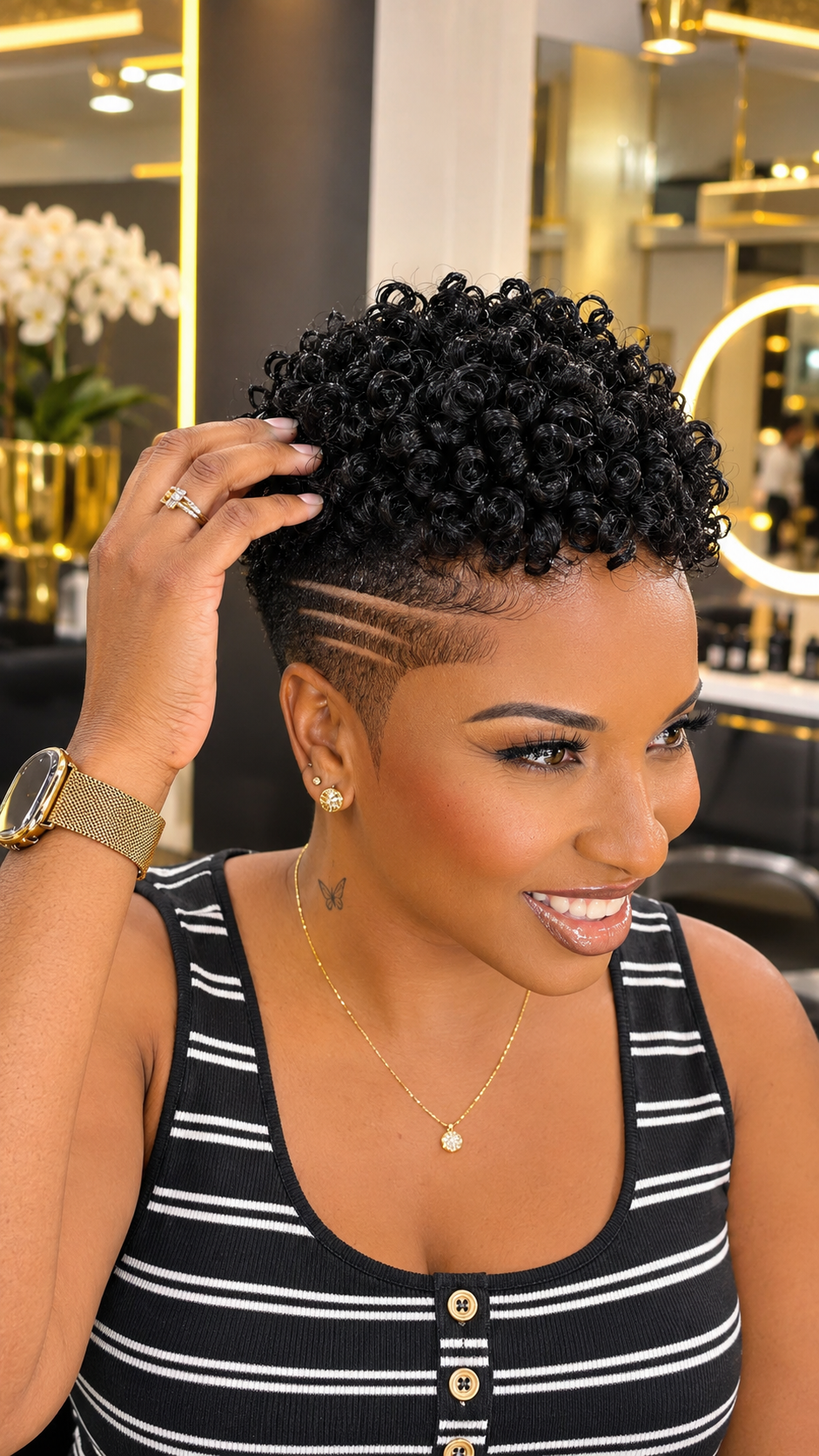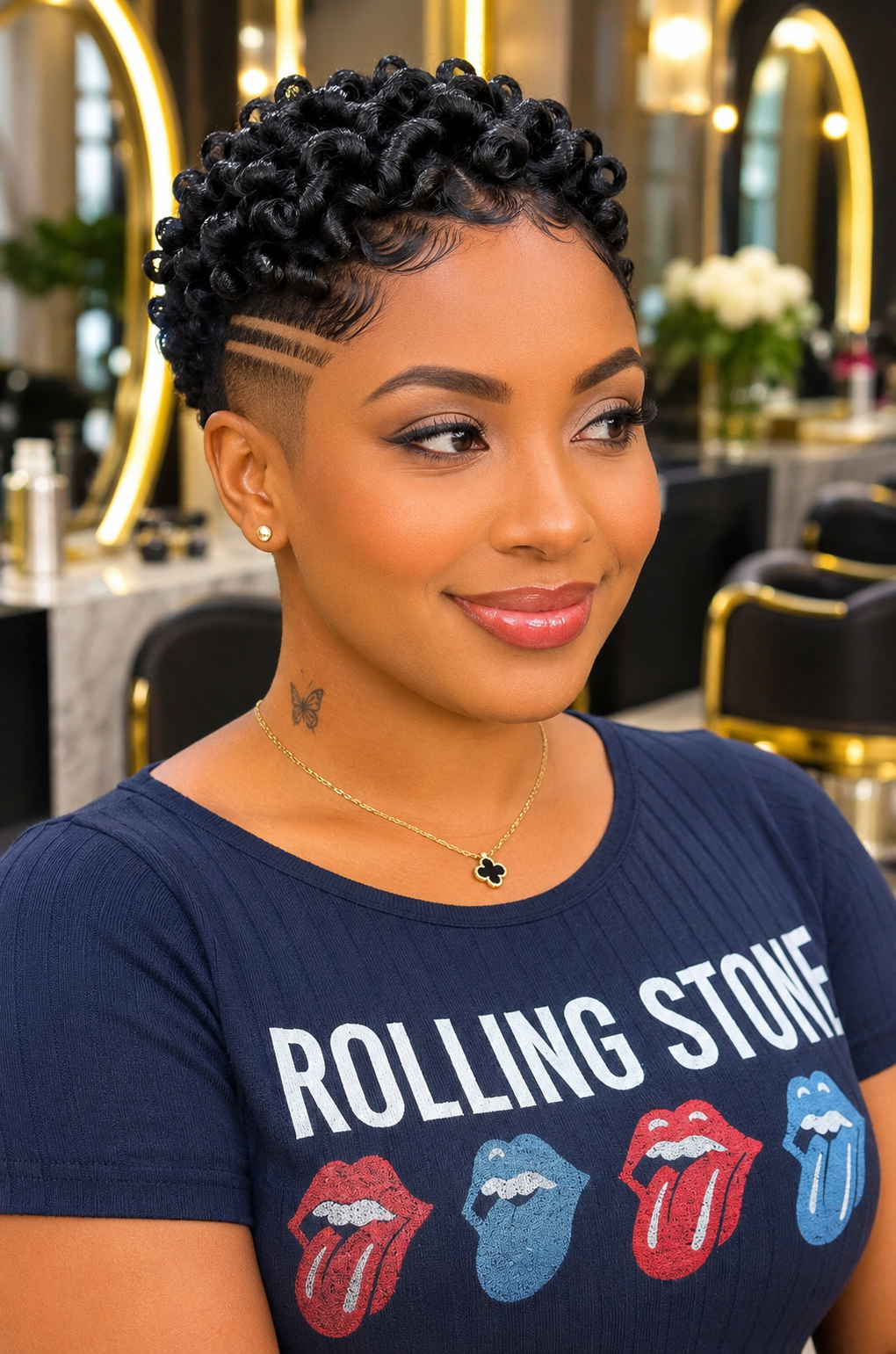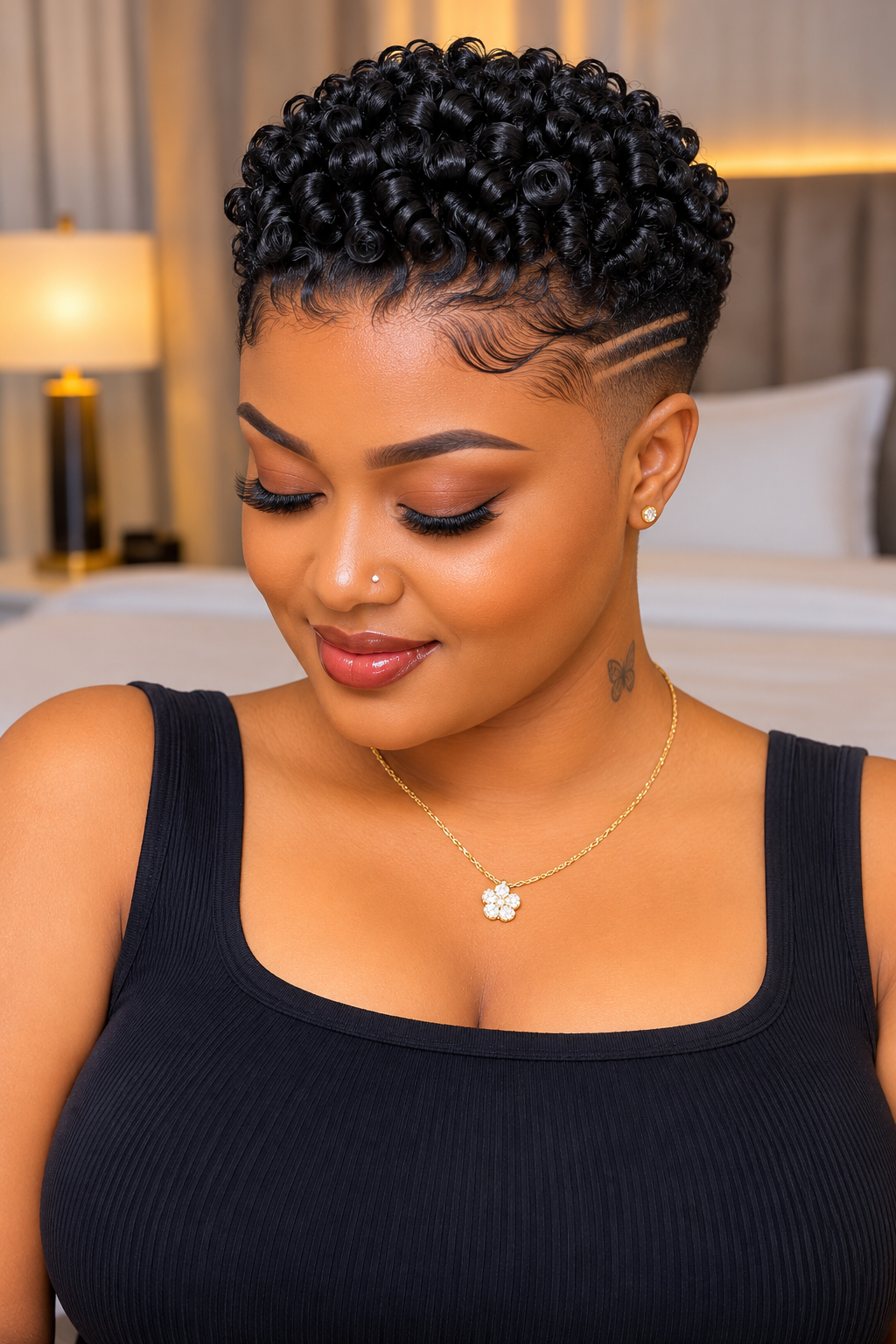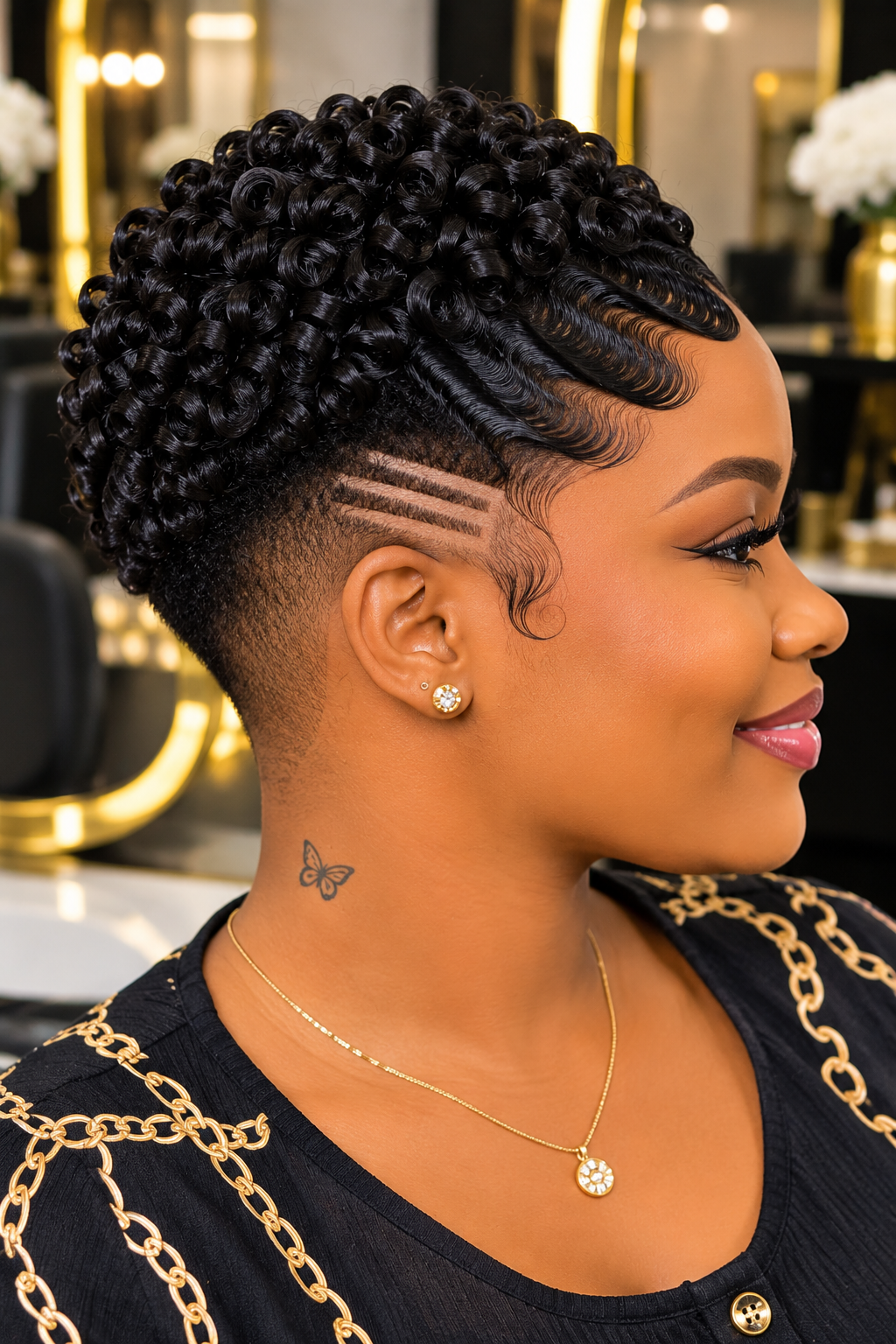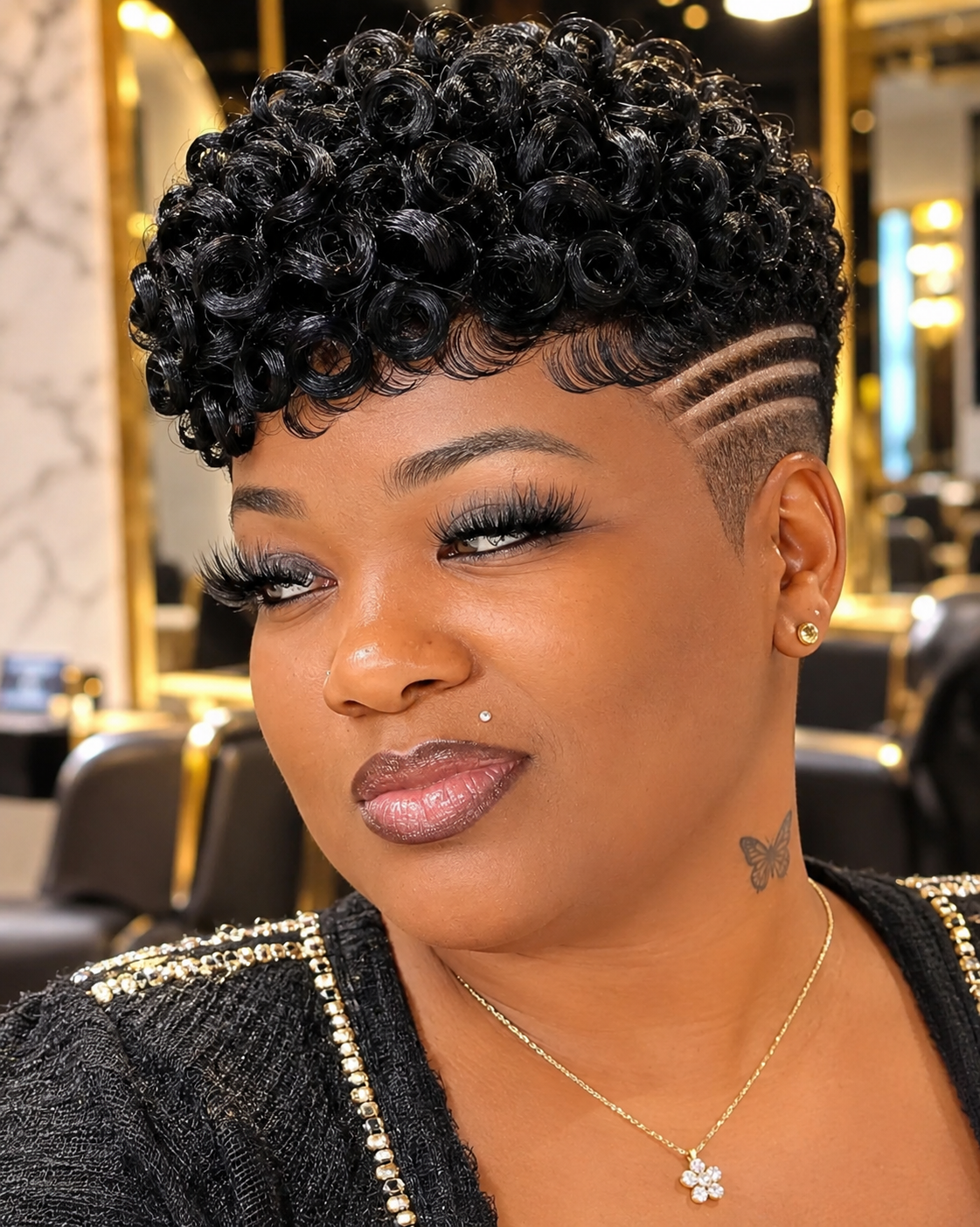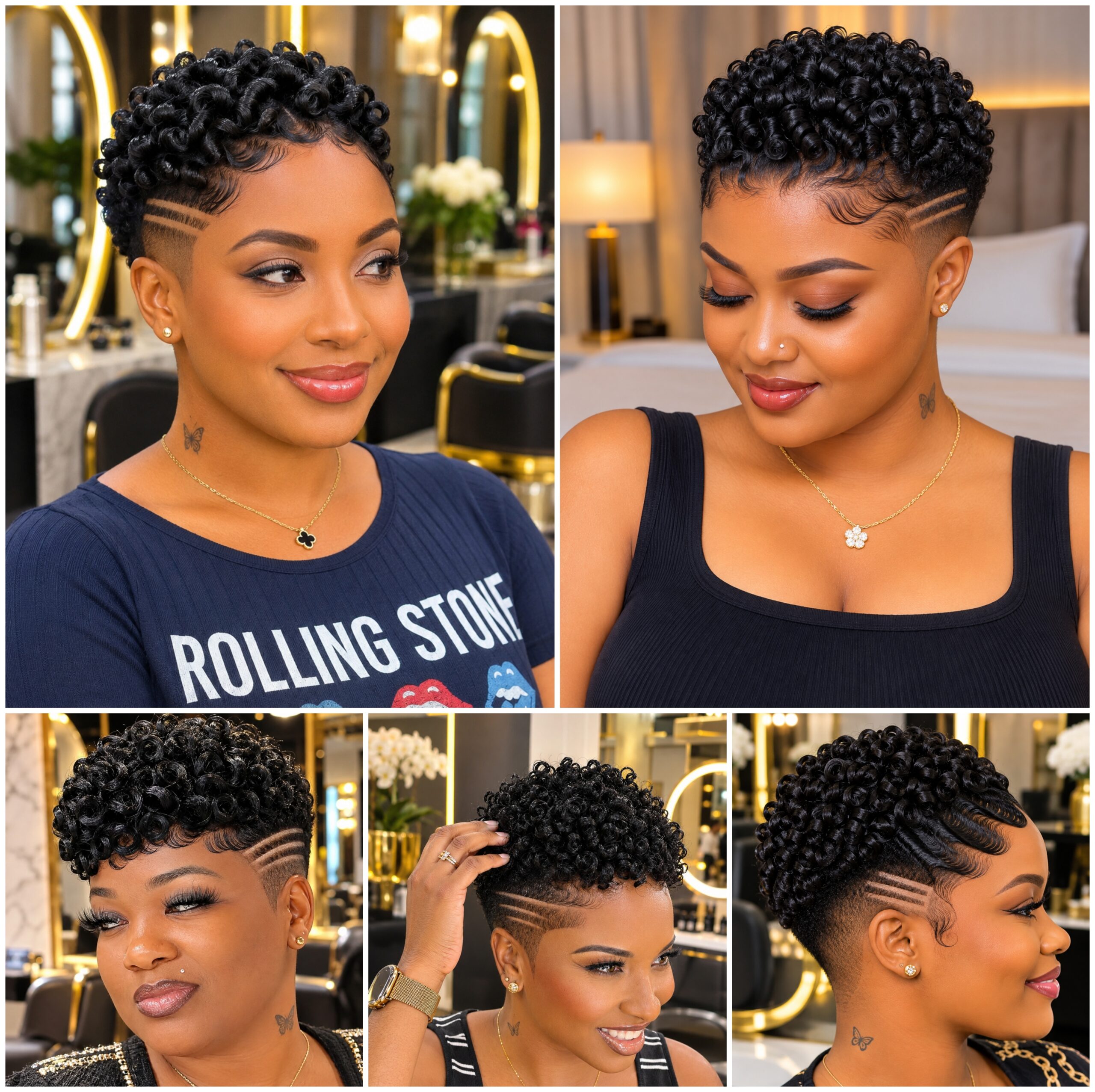
A compact crown of natural coils paired with gradually shortened sides creates a striking haircut that celebrates Afro hair while incorporating carefully placed barber artwork. Small shaved accents along the temple introduce contrast without overwhelming the rounded upper section. The result is an appealing choice for women who enjoy short coily hairstyles, tapered Afro haircuts, and precision razor side designs.
The beauty of this hairstyle comes from its proportions. The upper curls retain enough length to display their natural spring, while the sides become progressively shorter toward the ears and neckline. Decorative razor accents add a distinctive finishing element, giving the side profile character while preserving a practical, lightweight haircut suitable for everyday activities.
Understanding the Structure of a Short Coily Taper
A tapered haircut gradually reduces hair length around selected areas of the head while retaining more fullness through the crown. For short natural hairstyles, this usually means maintaining a rounded upper section and closely shaping the temples, sideburns, and neckline.


Unlike a uniformly cropped haircut, a taper introduces a gradual transition between different lengths. This allows the upper coils to remain visible without creating excessive bulk around the sides.
The crown can be shaped into a compact dome or given slightly more height through the center. Both approaches can complement a carefully graduated taper when the proportions are adjusted to the wearer’s natural hair density.
The most important consideration is preserving enough upper length for the curls to form naturally. Cutting too much hair from the crown can reduce visible coil separation, particularly for textures that experience significant shrinkage.
Creating a Rounded Crown Without Excessive Volume
A balanced crown should appear full but not disproportionately large compared with the shorter sides. The stylist can achieve this by evaluating natural curl direction, strand density, and the way the hair settles after washing.
Women with dense natural hair may benefit from careful shaping around the outer crown to prevent the hairstyle from becoming too wide. Those with finer strands may prefer to retain additional length through the upper section to preserve fullness.
The front can remain slightly longer when a softer forehead silhouette is desired. Alternatively, a more uniform crown length can create a compact appearance with consistent curl height.
Natural shrinkage should be considered before the final trim. Tightly curled strands can appear considerably shorter after drying, so a conservative cutting approach provides more control over the finished result.
Choosing the Placement of Razor Side Accents
Decorative shaved accents are generally positioned within the shorter temple area, where the surrounding hair provides enough contrast for the design to remain visible.
A narrow diagonal line can create a simple graphic detail. Two shorter accents may introduce additional personality, while a gently curved mark can follow the natural contour of the head.
The exact arrangement should be selected according to the available side space rather than forcing a large design into a compact taper.
Accurate placement is more important than the number of shaved marks. A carefully carved accent can enhance the hairstyle without distracting from the natural coils above.
Before cutting, the barber should discuss the preferred direction, thickness, and length of the artwork. Reference photographs are useful because different side designs can produce noticeably different profiles.
How Razor Line Thickness Changes the Appearance
Thin shaved accents create a delicate contrast that works particularly well with closely tapered sides. Their narrow shape allows the surrounding hair to remain visible and helps the design appear integrated into the haircut.
Wider marks create stronger contrast but remove more hair. On a very short temple section, excessive width can make the artwork appear larger than intended.
When multiple accents are used, spacing becomes especially important. Leaving enough hair between the marks allows each line to remain recognizable as new growth appears.
The barber should also consider whether the design will be maintained frequently. Simpler accents may grow out more gradually, while intricate patterns can lose their separation sooner.
Selecting a Low or Mid Taper
A low taper concentrates the shortest hair around the lower temples, ears, and neckline. This approach preserves more natural density around the upper sides and produces a softer transition beneath the crown.
A mid taper extends the shorter area slightly higher, creating stronger contrast between the coiled upper section and the closely cut sides.
Both options can accommodate decorative razor accents, although the available space for artwork varies according to the chosen taper height.
Women who prefer a subtle haircut may choose a low taper with one narrow accent. Those wanting a more noticeable side profile can discuss a closer transition and additional detailing.
The taper should follow the natural shape of the head rather than create an abrupt separation beneath the curls.
Working with Natural Curl Patterns and Shrinkage
Natural Afro hair varies in curl diameter, density, strand thickness, and moisture retention. These characteristics influence how the finished haircut appears and how frequently the crown requires styling.
Some curl patterns naturally form recognizable spirals, while others create smaller, tightly packed coils. Both can work beautifully with a tapered silhouette.
For women who prefer greater curl separation, finger-coiling techniques may help organize individual sections. Those who enjoy a softer natural appearance can retain more of the original curl arrangement.
Because shrinkage differs between individuals, the stylist should evaluate the hair in its natural condition before removing significant length.
Preserving the appropriate crown height is particularly important when the sides are closely tapered, since the contrast between both sections becomes more noticeable.
Preparing the Hair Before a Professional Cut
A successful haircut begins with clean, manageable hair. Gentle shampooing removes accumulated styling products and allows the professional to evaluate the natural curl pattern.
Follow cleansing with a moisturizing conditioner. Detangle carefully in manageable sections, working from the ends toward the roots to reduce unnecessary pulling.
After rinsing, apply a lightweight leave-in conditioner if appropriate for the styling method.
Heavy oils and thick creams should be used sparingly before the appointment because excessive product can make it difficult to assess the hair’s natural movement.
If the stylist plans to create individual finger coils, the hair may need to remain damp during the styling process.
Proper preparation supports more accurate cutting and helps preserve the natural condition of the curls.
Adding Finger-Coil Definition to the Crown
Finger coiling is an optional styling technique that can create more visible spiral separation across the upper section.
Begin with damp hair and apply a small amount of curl foam or flexible-hold gel. Divide the crown into manageable sections and rotate each section around a finger until a recognizable coil forms.
Smaller sections generally produce tighter spirals, while larger sections create additional fullness.
The stylist can adjust section size according to hair density and the desired appearance. It is not necessary for every coil to be identical, since natural variation contributes to a realistic finish.
Allow the curls to dry before excessive manipulation. This helps preserve their formation and reduces frizz.
Women who prefer minimal daily styling may choose to wear the crown in its natural coily state rather than recreating individual finger coils after every wash.
Maintaining Moisture in Closely Cropped Natural Hair
Short natural hair still requires consistent conditioning. The reduced length does not eliminate the need for moisture care, particularly when the crown contains tightly curled strands.
A lightweight leave-in conditioner can help maintain flexibility between wash days. Curl foam or a small amount of styling cream may be used when additional separation is desired.
Excessively heavy products can accumulate between compact coils and make the hair appear flat.
For a reflective finish, a small amount of lightweight serum can be applied after styling. The goal is to enhance the natural appearance of the curls without saturating them.
Regular cleansing helps remove buildup and maintain a comfortable scalp.
Protecting the Hairline During Razor Detailing
The temple area can be delicate, particularly when the natural hairline is already fine or uneven. Decorative cutting should respect the existing growth pattern.
The barber should avoid repeatedly pushing the temple corners backward simply to create a sharper outline.
Razor accents should remain within an appropriate shortened section rather than extending unnecessarily into fragile hairline areas.
Women with sensitive skin can discuss clipper-based detailing or other suitable techniques before the appointment.
Clean equipment and careful handling are essential whenever closely shaved artwork is created.
Finding an Experienced Afro Hair Barber
An Afro hair salon, natural hair studio, curl specialist, or women’s barber experienced with tapered hairstyles and razor artwork is a suitable place to request this haircut.
Useful searches include short coily taper barber near me, Black women’s natural haircut specialist, Afro taper with shaved side design, and women’s short coily hair salon.
Review photographs of completed work before booking. Look for examples showing balanced crown proportions, carefully graduated sides, and accurately positioned decorative accents.
Side and rear photographs are particularly helpful because they reveal the quality of the taper and neckline shaping.
Some professionals specialize in natural curl styling but do not provide decorative barber work. Confirm that the salon offers both services if they are required during the same appointment.
Booking the Haircut and Confirming the Details
Appointments can commonly be arranged through Instagram, WhatsApp, salon websites, online scheduling platforms, or direct telephone contact.
Before confirming, send reference photographs showing the preferred crown height, taper depth, and decorative side accents.
Explain whether the artwork should consist of a single narrow line, two coordinated marks, or a curved design.
Ask whether shampooing, conditioning, cutting, tapering, outlining, razor detailing, and optional finger-coil styling are included in the quoted service.
Some salons charge separately for decorative artwork or natural hair styling, so confirming the complete price beforehand can help avoid unexpected costs.
A consultation also allows the barber to assess whether the existing hair length and temple density are suitable for the requested design.
Where To Buy This Wig
Women who prefer a removable alternative can explore specialist Afro wig retailers, independent wig makers, beauty supply stores, and online hair shops.
Useful searches include short coily taper wig for Black women, natural Afro pixie human hair wig, cropped coil lace front wig, and short tapered curly wig with reduced sides.
Ready-made wigs may reproduce the compact crown and shortened side proportions, although authentic shaved artwork is difficult to imitate convincingly on conventional wig caps.
Human-hair units provide greater flexibility for adjusting coil formation, crown density, and side volume. Synthetic units may offer convenient pre-formed curls but are generally less adaptable to extensive restyling.
A custom wig maker may be able to reduce density around the temples and create a more closely cropped silhouette.
However, genuine scalp-level razor accents generally appear more realistic when performed directly on natural hair.
Choosing the Right Wig Length and Density
For a compact coily wig, the finished curl height is more important than the stretched length advertised by the seller.
Tightly curled hair can appear considerably shorter after styling, so buyers should request photographs showing the unit in its normal wearable condition.
A moderately full crown can recreate the rounded appearance of short natural hair. Excessive density may produce a larger Afro silhouette rather than the intended tapered shape.
The temple sections should also be evaluated carefully. Too much side volume can hide the compact proportions.
Custom density adjustments can help create a more realistic transition between the crown and the shorter sides.
Comparing Wig Cap Construction and Installation
A glueless wig with an adjustable band may be suitable for women who prefer convenient installation and removal.
Closure wigs generally feature a smaller lace section and may require less maintenance. Frontal wigs offer a wider lace area that allows greater flexibility around the visible hairline.
Basic machine-made caps can also be practical for compact curly units when the hairline is not prominently exposed.
Proper cap sizing is important for comfort and security. An excessively tight unit may cause discomfort, while a loose cap can shift during wear.
Before purchasing, compare cap measurements, lace shade, coil size, crown density, temple coverage, and available adjustment features.
For frequent wear, consider how easily the wig can be removed, cleaned, and restyled.
Comparing Wig Prices and Quality
Wig prices vary according to fiber type, cap construction, curl density, and customization. The following amounts are illustrative shopping estimates in US dollars, not verified current retailer quotations.
| Wig Tier | Estimated Price | Typical Features |
|---|---|---|
| Budget | $20–$45 | Basic synthetic coils with a standard machine-made cap |
| Value | $45–$90 | Improved synthetic curl formation and adjustable cap features |
| Mid | $90–$180 | Entry-level human hair with restylable natural coils |
| Premium | $180–$350 | Human-hair lace-front construction with flexible hairline styling |
| Salon-Grade | $350–$700+ | Custom handmade unit with personalized density and cropped proportions |
When comparing sellers, examine construction quality rather than relying exclusively on price. A well-fitting unit with appropriate crown density may resemble a natural tapered haircut more convincingly than a more expensive wig with excessive volume.
Ask about processing times, return conditions, cap measurements, and whether professional trimming is available after delivery.
For custom orders, provide clear front, side, and rear reference photographs.
Refreshing Natural Coils Between Wash Days
Short coils may become flattened after sleeping or lose their original separation during daily activities. A complete wash is not always necessary to restore their appearance.
Lightly mist the affected sections with water and apply a small amount of leave-in conditioner or curl foam.
Individual spirals can be reshaped with the fingers when additional definition is desired.
A satin bonnet, scarf, or pillowcase can help reduce friction during sleep and preserve moisture.
Avoid aggressive dry brushing because it can disturb the curl pattern and create unnecessary frizz.
Regular cleansing remains important, particularly when styling products are applied frequently.
Maintaining the Taper and Razor Accents
The closely cut sides generally show new growth sooner than the crown. As the hair grows, the taper gradually becomes softer and the decorative marks lose contrast.
Women who prefer clearly visible artwork may choose barber touch-ups approximately every one to three weeks, depending on hair growth and the desired appearance.
The barber should follow the original design rather than repeatedly widening the shaved sections.
Maintaining consistent line placement helps preserve the proportions of the haircut.
For women who prefer fewer appointments, a softer taper and simpler side accent may be easier to maintain.
Practical Benefits and Styling Limitations
The main advantages include manageable length, visible natural coil formation, reduced side bulk, and personalized barber detailing.
The compact silhouette can feel comfortable during warm weather, while the upper curls provide enough natural volume to keep the hairstyle expressive.
However, decorative accents require periodic maintenance, and the crown may need refreshing after washing or sleeping.
Women with delicate temple hair should discuss suitable design placement with their barber before cutting.
Wig alternatives offer convenient installation and removal but may not reproduce authentic shaved artwork.
Keeping the Finished Haircut Balanced
The long-term appearance of this hairstyle depends on preserving the relationship between the compact coiled crown and the gradually shortened sides.
Regular conditioning helps maintain curl flexibility, while careful barber maintenance preserves the taper and decorative accents.
Women who prefer a subtle appearance can choose a low taper with minimal artwork. Those who enjoy stronger contrast may select a closer blend and more noticeable side detailing.
With thoughtful cutting, gentle daily care, and occasional professional touch-ups, short natural coils and carefully carved razor accents can create a distinctive hairstyle that remains comfortable, practical, and flattering.
Search Terms
short coily taper for Black women · natural Afro haircut with razor side accents · women’s short coil taper haircut · coily pixie with shaved temple detail · short natural hair with side razor lines · tapered Afro coils with etched design · cropped coily human hair wig · Black women’s low taper with side artwork