
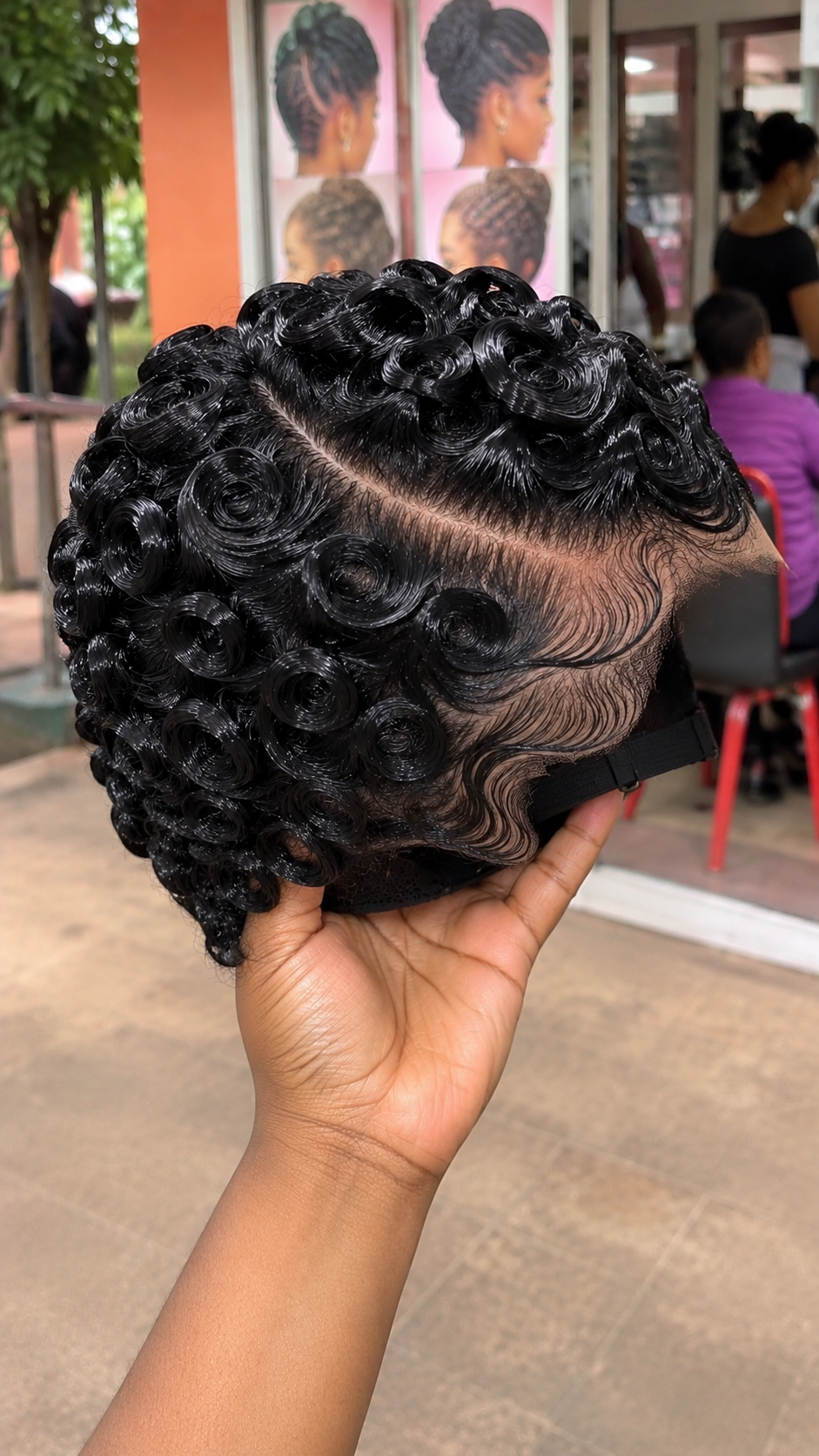
There is something particularly striking about a pixie wig that looks different from every angle. From one side, the hairstyle appears to be a tightly arranged collection of glossy black rosettes. From another, an exposed diagonal part and beautifully sculpted finger waves become the main attraction. The wig pictured here brings these elements together in a compact design that combines circular crown curls, elegant temple detailing, and a carefully structured lace hairline.
Held in one hand outside a neighborhood beauty salon, this jet black pixie wig is photographed before installation. Its raised curls resemble miniature hair roses, with overlapping strands winding around visible central openings. Beneath the prominent diagonal part, fine black hair forms long, curved waves that follow the forehead and descend toward the temple. A dark fastening strap is visible near the lower opening, while the light brown lace extends beyond the styled hairline.
What makes this particular wig especially interesting is the distribution of its circular curls. The largest rosettes are not arranged uniformly across the entire head. Several prominent formations sit near the upper front, while smaller and more tightly grouped coils continue along the visible side and lower rear. This creates a rounded hairstyle with a noticeable difference between its upper and lower sections.


The photograph offers a useful starting point for anyone considering a similar sculpted pixie lace wig. However, the hair fiber, exact lace specification, manufacturer, and complete cap construction cannot be verified from the image alone. Buyers should confirm those details before choosing a ready-made unit or commissioning a custom hairstyle.
A Diagonal Part That Changes the Entire Composition
The most important structural detail is the prominent diagonal part running across the upper front of the wig. Its exposed, scalp-like channel separates two different curl arrangements and establishes the direction of the hairstyle.
On the upper side of the separation, the hair forms relatively large circular rosettes. Below it, several smaller curls transition into elongated finger waves that follow the front hairline.
The part is neither a central division nor an ornamental shaved stripe. It serves as a boundary between the raised crown and the flatter decorative section beneath it.
Its visible width also matters. The separation is noticeable without creating an excessively broad exposed area. Fine strands remain arranged along both edges, helping the transition appear deliberate.
When the wig is positioned on a wearer, this diagonal channel will influence how the curls frame the forehead. Moving the cap forward, backward, or sideways can change the apparent angle of the part.
Making the Parting Position Part of the Order
Customers requesting a close reproduction should explain the direction of the diagonal separation rather than simply ordering a side-part pixie.
Provide the photograph to the wig maker and indicate which section should contain the larger rosettes and where the front waves should begin.
Ask whether the part is incorporated through hair placement during manufacture or created primarily through styling. That distinction can affect how the arrangement behaves after washing.
Avoid attempting to widen the part by removing additional strands. Excessive plucking may expose the underlying cap or permanently change the hair distribution.
If the buyer wants the hairstyle mirrored to the opposite side, that change should be discussed before production because it affects the direction of the decorative waves as well.
Rose-Shaped Curls Create Depth Across the Crown
The upper hairstyle contains numerous circular coils with glossy, overlapping strands. Some resemble tightly wound miniature roses, while others form broader open rings.
Several large rosettes appear near the front and upper center. Their circular openings are particularly noticeable because the individual strands follow repeated curved paths around the middle.
Farther toward the visible rear, smaller curls are arranged more closely together. This progression keeps the hairstyle full without creating excessive height.
The curls do not hang downward in long spirals. Instead, they sit relatively close to the head, producing a rounded pixie silhouette.
There is also some variation in the direction of the rosettes. Certain curls face outward, making their centers clearly visible, while others tilt slightly and overlap neighboring formations.
This variation gives the hairstyle a layered appearance rather than the perfectly repetitive surface of identical manufactured rings.
Large Rosettes Versus Small Finger Coils
Not every wig advertised as a curly pixie will reproduce this crown.
Small finger coils typically create numerous narrow spirals, while larger rosette curls emphasize circular openings and overlapping layers.
The photographed unit contains a mixture of noticeable circular formations, with larger curls occupying the upper section and smaller coils contributing to the lower silhouette.
When comparing suppliers, ask for close photographs showing the actual coil diameter, crown distribution, and curl direction.
A view from above would be particularly helpful. The reference provides a strong side perspective, but it does not reveal every curl on the opposite side or at the back.
The Front Waves Flow Below the Circular Crown
The decorative hairline has a different visual rhythm from the upper curls. Instead of forming additional rose-shaped rings, fine strands extend into elongated finger waves.
These waves follow graceful curved paths across the lace, beginning beneath the diagonal part and continuing toward the visible temple.
Several narrow ridges sit beside one another, creating a layered appearance. Their spacing allows individual strands to remain recognizable rather than merging into one dark surface.
Near the lower temple, a longer curved formation bends downward before turning back toward the surrounding hairstyle.
This detail is particularly important because it gives the compact pixie an elegant finishing element without adding a long fringe.
The front does not display shaved decorative channels or straight razor patterns. Its ornamentation comes entirely from the direction and placement of the hair.
The Lower Temple Curl Is Easy to Overlook
One small but memorable detail is the curling strand extending near the lower visible side. It appears longer and more freely curved than the closely grouped crown coils.
For customers ordering a similar wig, this lower temple curl should be identified separately in the reference photograph.
A stylist who trims the entire front perimeter uniformly could accidentally remove the strand length required to reproduce it.
Before making any adjustments, the installer should determine where this curl will sit relative to the wearer’s temple and ear.
If the wearer prefers a less elaborate hairline, the design can potentially be simplified during a custom order. However, that decision should be made before irreversible cutting.
Why the Jet Black Color Works So Well Here
The hairstyle appears consistently deep jet black, with glossy reflections across the circular coils and front waves.
There are no clearly visible blonde highlights, burgundy sections, copper strands, or contrasting roots.
Instead of using multiple colors, the wig creates depth through curl geometry. Bright reflections outline the outer edges of the rosettes, while their central openings and overlapping sections appear darker.
The finger waves produce longer reflective lines, emphasizing the direction of their curves.
Black also makes the exposed diagonal part particularly noticeable because the lighter underlying surface contrasts with the surrounding strands.
The photograph was taken under daylight near a salon entrance, so some highlights appear especially bright. That does not establish the actual fiber composition or prove that the hair has been treated with a particular product.
Human Hair and Synthetic Options
A similar hairstyle may be available in human hair, synthetic fibers, or blended materials, depending on the supplier.
Human-hair options may permit certain forms of restyling when their processing history and condition allow it. However, maintaining sculpted circular rosettes can still require specialist work.
Preformed synthetic curls may offer convenient shape retention, but their response to washing, heat, and styling products varies by fiber.
Neither option should be assumed to match the photographed wig simply because it looks glossy.
Request written material specifications and care instructions before deciding which construction best suits the intended use.
Inspecting the Hairline Before Any Installation
The wig is shown before fitting, with light brown lace visible beyond the front and temple hairline. The fine mesh extends around the decorative wave section and remains untrimmed.
This is useful because the buyer can see that the hairstyle reaches close to the perimeter while leaving additional material available for fitting.
The lace appears relatively fine in the photograph, but its exact grade cannot be identified visually. The image alone does not confirm a particular premium lace category.
There is also no reliable way to judge how the visible lace shade will appear against an individual wearer’s complexion.
The correct shade, dimensions, and construction should be discussed with the supplier before purchase.
Why Trimming Must Wait Until the Wig Is Positioned
The lace should not be cut merely by following the outline visible while the wig is being held.
Once the cap is positioned on the wearer’s head, the stylist can assess where the front waves and lower temple curl should sit.
Only then should the excess lace be trimmed, preserving a suitable margin around the hairline.
Cutting too close to the decorative strands may damage their arrangement or make later fitting adjustments more difficult.
A professional installer familiar with sculpted lace pixies is particularly valuable when the hairline contains delicate curved details.
The Visible Strap and Interior Construction
A black fastening strap is visible near the lower right-hand opening of the wig. Dark fabric and mesh-like interior construction can also be seen beneath the hairline.
These details provide limited evidence about the cap, but they do not reveal the entire fastening system.
The photograph does not confirm the total number of internal combs, clips, additional straps, or other security components.
It also does not establish whether the finished unit is suitable for fully adhesive-free wear.
Although the exposed strap suggests some form of adjustment, its exact function and range should be confirmed with the manufacturer.
Choosing the Right Cap Measurements
A properly fitted cap helps maintain the intended position of the diagonal part and decorative waves.
Before placing an order, measure the head according to the supplier’s instructions. Measurements may include circumference, front-to-nape distance, and ear-to-ear dimensions.
Ask whether the wig is available in multiple cap sizes or can be customized.
If glueless installation is preferred, request explicit confirmation that the complete cap and fastening system support that method.
For wearers who need greater parting flexibility, discuss frontal or other suitable lace construction options. A closure may offer a more limited lace area, depending on the design.
The photograph does not establish which specific construction is used here.
Where This Wig Comes From and How to Find a Comparable Style
The photograph shows a hairstyle being presented outside a salon, but it does not identify a verified manufacturer, seller, or product listing.
Customers searching for a comparable unit can contact specialist pixie wig makers, local beauty salons, wig boutiques, and online retailers offering sculpted curls.
The most effective description should emphasize the diagonal part, circular rose coils, and elongated front waves rather than relying on the generic term black curly wig.
A seller may offer a similar compact silhouette while using small spring coils or ordinary finger curls instead of the prominent rosettes shown in the reference.
Before purchasing, request actual photographs of the proposed unit rather than relying solely on sample catalog images.
A Practical Supplier Checklist
Ask for a close front photograph showing the complete decorative hairline and exposed diagonal part.
Request a top-down image to examine the size and distribution of the rosette curls.
Obtain a rear and opposite-side photograph because those areas are not fully visible in the reference.
Request a complete underside image showing the cap, fastening components, and lace construction.
Confirm the fiber type, available cap sizes, lace specifications, whether the hairstyle arrives fully arranged, and any additional customization fees.
For made-to-order units, establish the production timeline and approval process before payment.
Ready-Made Pixie or Individual Custom Work?
A ready-made unit may be suitable when the buyer prioritizes the compact black silhouette and general curly appearance.
However, reproducing the precise diagonal part and elongated finger waves may require more individual styling than a standard product provides.
Custom production may offer greater control over the relationship between the larger crown rosettes and the smaller side curls.
The wig maker can potentially arrange the hairline and crown together so that their directions remain coordinated.
Before commissioning a custom design, request examples of previous work involving circular rose curls and sculpted finger-wave hairlines.
Discuss how closely the maker can reproduce the reference, which elements may differ, and whether adjustments are included in the price.
Illustrative Price Ranges for Sculpted Black Pixie Wigs
The following amounts are illustrative USD planning estimates, not verified live prices or quotations for the photographed wig. Actual costs depend on the supplier, material, cap construction, and styling labor.
| Wig Category | Illustrative Price Range | Likely Purchase Considerations |
|---|---|---|
| Premium Custom | $350–$850+ | Individual cap measurements, intricate rosette placement, detailed diagonal part construction, and specialist hairline styling. |
| Standard Custom | $190–$450 | Selected cap options with personalized circular curls and coordinated front waves. |
| Basic Human Hair | $110–$290 | A human-hair starting unit that may require additional curl setting, hairline styling, and professional installation. |
| Premium Synthetic | $85–$210 | A manufactured pixie with preformed rosette-like curls, depending on the available design. |
| Basic Synthetic | $35–$100 | A budget curly pixie that may differ considerably in crown construction and front detailing. |
For this hairstyle, the main potential cost driver is the amount of work required to arrange the circular curls and fine hairline waves.
Unlike a multi-colored wig, the design does not visibly require elaborate color placement. However, that does not mean it will necessarily be inexpensive.
Individually arranged rosettes and carefully positioned front waves can involve substantial styling labor.
Lace customization, cap sizing, shipping, taxes, and professional installation may also be charged separately.
Ask for an itemized quotation showing what is included before comparing different suppliers.
A Salon Appointment Should Begin With the Hairline
Because the front styling is so detailed, the first installation should focus on positioning rather than immediate cutting.
The stylist should examine the cap fit, locate the intended diagonal part, and determine where the decorative waves will fall on the forehead.
Next, the lower temple curl should be checked to ensure that it does not interfere with the ear or sit at an unintended angle.
If lace trimming is required, it should follow these fitting checks.
Any additional curl arrangement should be performed only after the fiber and appropriate styling methods have been confirmed.
A barber or wig stylist may be able to refine the compact perimeter if necessary, but the existing design does not call for adding shaved decorative lines.
What Daily Wear May Actually Feel Like
A compact hairstyle can be appealing to people who prefer not to manage long loose strands throughout the day.
However, this particular wig contains many small styled elements, and those details may require careful handling.
The crown can be vulnerable to compression from tight head coverings, while the front waves may become disturbed through repeated touching.
Comfort will depend on the cap size, fastening method, ventilation, and installation rather than the hairstyle’s compact appearance alone.
For occasional wear, the sculpted arrangement may be easier to preserve between uses. For frequent wear, buyers should understand how the curls are restored after washing and whether periodic salon maintenance is expected.
Advantages and Practical Limitations
The main visual advantage is the concentration of intricate curls within a relatively compact silhouette. The consistent black color also allows the design to work with different outfits without relying on contrasting highlights.
The exposed diagonal part adds structure, and the long finger waves give the front a distinctive appearance.
The main limitation is that preserving those details may require more attention than maintaining a loosely curled pixie.
Customers should also recognize that not every budget wig can reproduce the sculpted rosette construction convincingly.
Preventing the Rose Curls From Losing Their Shape
The crown should be handled with care because the circular formations depend on strands remaining in their intended positions.
Avoid pulling a brush through the curls as though they were ordinary loose hair. Doing so may separate the overlapping strands and change their circular appearance.
Instead, follow the manufacturer’s recommended maintenance method for the confirmed fiber.
If the wig contains human hair, professional resetting may be possible using suitable setting products and techniques. The hair’s previous processing should be considered before any heat application.
If the unit contains synthetic fibers, do not assume that curling irons, steam, or hot water can be used safely.
Heavy product buildup may collect within the rosettes and make their individual centers less visible.
Maintaining the Fine Hairline Strands
The front waves should be treated differently from the raised crown curls.
Aggressive brushing can disturb the narrow ridges, while excessive product application may cause neighboring strands to clump together.
If the decorative pattern begins to lose its direction, consult a stylist who regularly works with sculpted finger-wave hairstyles.
Avoid cutting the lower temple curl merely because it extends farther than nearby strands. Its length contributes to the visible design.
Storage Considerations for a Rounded Sculpted Pixie
The most important storage goal is to avoid crushing the circular curls.
An appropriately sized stand can support the cap while leaving the crown free from unnecessary pressure.
For travel, choose packaging with enough space around the hairstyle instead of compressing the curls into a narrow bag.
Protect the lace perimeter from snagging against jewelry, fasteners, or packaging edges.
Before wearing the wig again, inspect the front waves and ensure that the cap has retained its intended shape.
Choosing This Hairstyle for Different Occasions
The compact silhouette may appeal to buyers who want an elaborate hairstyle without the movement of long hair.
For special occasions, the circular rosettes and decorative hairline provide numerous details that can be appreciated in close-up photography.
For everyday use, the main consideration is whether the wearer is comfortable maintaining such carefully arranged curls.
The hairstyle may also be attractive to wig enthusiasts who prefer handcrafted-looking styling rather than a uniform mass of small spirals.
Ultimately, the best choice depends on cap comfort, desired maintenance, available budget, and how closely the finished wig matches the reference.
A Final Look at the Details Worth Preserving
The most successful reproduction of this hairstyle will not be determined by black color alone. Its personality comes from the large circular curls across the crown, the smaller rosettes around the visible side, the prominent diagonal part, and the flowing finger waves near the forehead.
Those elements should be evaluated together before approving a purchase.
Buyers should verify the fiber, lace construction, cap measurements, fastening components, and expected maintenance requirements. Additional photographs of the rear, opposite side, and complete interior will help resolve questions that the reference cannot answer.
With the right construction and appropriate professional styling, this design offers an elegant interpretation of the black pixie wig: compact in length, rich in circular detail, and distinguished by a carefully arranged hairline.
Search Terms
Jet black rose coil pixie lace wig · Diagonal scalp part circular curls · Large black rosette crown hairstyle · Sculpted sweeping forehead finger waves · Black temple curl lace hairline · Compact glossy rose ringlet wig · Untrimmed brown lace black pixie · Black adjustable strap curly wig