
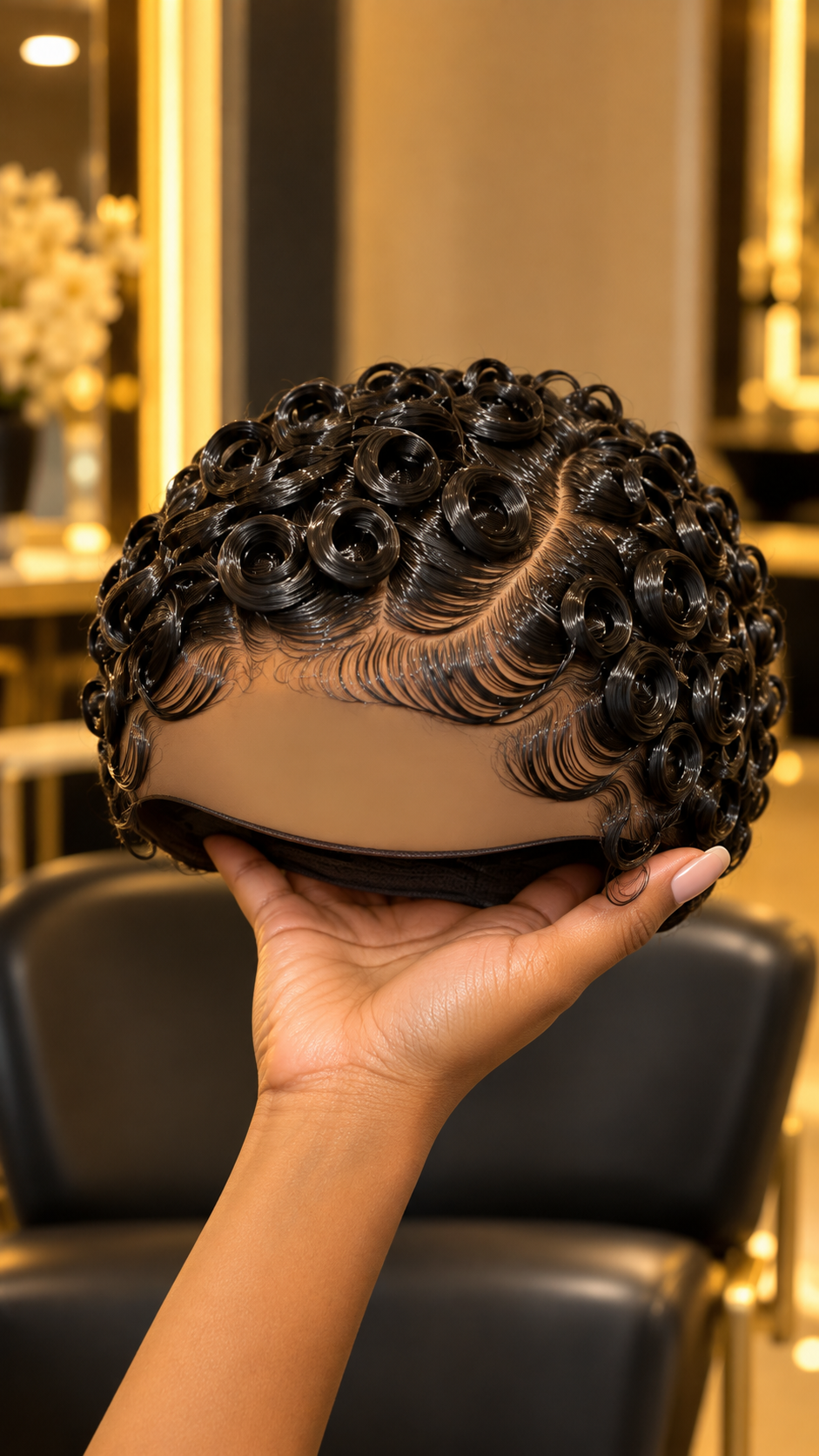
There is something captivating about a short hairstyle that combines delicate wave patterns with carefully sculpted curls. This midnight-black pixie wig brings together an elegant arrangement of finger waves, a crown filled with glossy spiral roses, and a beautifully curved parting that introduces movement across the front. Every section contributes to a compact yet expressive hairstyle that feels polished, feminine, and full of character. Rather than depending on bright highlights or exaggerated length, the design creates its appeal through precise strand placement and beautifully controlled curls.
The photograph shows a short, predominantly black wig displayed in one hand inside an elegantly illuminated salon. The upper crown is covered with numerous circular curls, each formed from closely aligned strands that wrap into a rounded spiral. Beneath these formations, the hair follows long sweeping curves across the front, creating an elaborate finger-wave arrangement. A narrow, curved scalp-toned division separates sections of the upper styling, while smaller circular curls extend toward the visible sides.
Warm salon lighting gives the black strands subtle espresso and bronze reflections, but the hair itself appears consistently dark. The curls have distinctive circular openings, allowing light and shadow to create dimension across the crown. The front hairline contains finely arranged strands that curve toward both temples, and the foundation is partially visible beneath the hairstyle.


This is an appealing choice for women who love short curly wigs but want something more structured than ordinary loose ringlets. It also offers an interesting example of how traditional finger-wave styling can be combined with contemporary sculpted curls. Whether the hairstyle is commissioned from a custom wig maker or recreated by a professional salon, preserving its proportions and intricate hairline details is essential.
A Crown of Beautifully Sculpted Spiral Roses
The upper crown is the main attraction. Numerous rolled curls sit closely together, creating a rounded surface filled with circular formations. Several curls have wide openings, while others form tighter spirals that occupy the smaller spaces between them.
These shapes resemble miniature roses, with the individual strands spiraling inward toward their centers. The circular construction gives the hairstyle an ornamental quality without introducing additional accessories.
Unlike a conventional curly pixie, where natural-looking curls may overlap randomly, the formations here follow a deliberate arrangement. Their placement creates fullness while allowing individual curls to remain recognizable.
For a faithful recreation, the stylist should preserve the mixture of medium and smaller circles. Making every curl identical could reduce the subtle variation that makes the crown interesting.
Why the Midnight-Black Color Works So Beautifully
The hairstyle uses an almost entirely black color palette. Under the salon lights, its reflective strands develop subtle warm undertones, but there are no clearly separated blonde, red, or copper highlights.
This rich coloring emphasizes the rolled construction of each spiral. The outer edges of the curls catch the light, while their deeper centers remain dark, revealing their circular shapes.
The dark color also brings cohesion to the contrasting styling techniques. Both the raised crown curls and the flatter finger waves appear to belong to the same carefully coordinated design.
Customers seeking a similar appearance should compare jet-black and natural-black color samples before ordering. Lighting conditions can influence how dark hair appears in photographs, so neutral-light product images are valuable.
The Distinctive Curved Parting Shapes the Crown
A narrow scalp-toned parting curves through the upper front section, separating neighboring groups of curls and directional waves. Rather than following an entirely straight line, the division bends naturally through the hairstyle.
This gently curved separation creates an interesting sense of movement. It also gives the upper curls a clear starting point and helps organize the flatter strands underneath.
Its proportions are important. A division that is excessively wide would change the hairstyle’s appearance, while one concealed beneath dense curls might lose its decorative effect.
A custom wig stylist should establish the intended parting location before completing the curled crown. This allows the surrounding strands to follow the correct directions.
The Finger Waves Create an Elegant Forehead Design
Below the circular crown, finely arranged strands sweep across the forehead in a series of curved formations. These sections lie closer to the foundation than the raised curls above them.
Several waves create elongated S-shaped paths, with individual strands remaining parallel as they follow the curves. The result is a graceful, flowing appearance that contrasts with the compact spiral roses.
The front design is especially distinctive because it occupies a substantial portion of the visible forehead area. It is not simply a few loose baby hairs placed around the edge.
Instead, the waves form an organized styling section that contributes significantly to the overall hairstyle.
Classic Finger-Wave Inspiration with Contemporary Curls
Finger waves have long been associated with elegant, carefully arranged short hairstyles. Their beauty comes from the controlled direction of strands rather than from excessive length.
This wig incorporates that visual tradition while introducing larger rolled curls across the crown. The two styling methods create contrasting surfaces: smooth elongated curves at the front and raised circular spirals above.
For women who appreciate vintage-inspired hair but prefer an updated appearance, this combination provides an attractive option.
The hairstyle does not reproduce a historical look in every detail. Instead, it uses recognizable finger-wave characteristics as part of a contemporary short curly design.
Individual Spiral Openings Add Remarkable Dimension
Many of the upper curls have clearly visible hollow centers. These circular openings contribute to the hairstyle’s depth and allow the individual formations to stand apart visually.
The raised outer strands reflect light while the inner portions remain darker. This creates contrast even though the hair contains no obvious contrasting colors.
Maintaining these openings requires careful control of density and curl placement. Excessive hair can fill the centers and obscure their circular structure.
Conversely, too little hair between the curls may expose unintended spaces. A professional should aim for complete coverage without sacrificing curl definition.
The Front Curls Have a Softer Direction
Some curls near the upper forehead are positioned differently from those at the back of the crown. Their shape follows the direction established by the front waves, creating a gradual visual transition.
This makes the upper hair look coordinated rather than divided into completely disconnected sections.
The front curls retain their rounded character, but their orientation contributes to the flow of the overall hairstyle.
A custom stylist should consider both curl diameter and direction. Correctly shaped curls placed in the wrong direction could change the finished appearance considerably.
A Compact Silhouette with Beautiful Fullness
The hairstyle has a rounded profile that remains close to the head. Its curls create noticeable fullness without forming an exaggerated high crown or extending into long hanging strands.
This compact proportion is essential to its pixie-inspired character.
The curls gradually follow the shape of the foundation, giving the upper hair a soft dome-like appearance. The side sections remain controlled, allowing the decorative forehead waves to stay visible.
Customers looking for a similar wig should emphasize the completed silhouette rather than requesting maximum volume. Additional height would not necessarily improve the hairstyle.
The Side Curls Complement the Front Styling
The visible sides contain smaller circular curls that continue around the upper perimeter. Their shapes echo the larger spiral roses across the crown.
Near the temples, the curls connect visually with the decorative finger waves, creating a smooth transition between the two styling techniques.
This continuity contributes to the polished appearance. The design does not abruptly switch from a full crown to a completely exposed lower side.
For a custom recreation, sufficient curled coverage should remain around the side. Adding unrelated shaved artwork or large decorative channels would change the original styling.
Delicate Temple Curls Complete the Hairline
At the visible temple, several strands curve inward into small decorative loops. These details follow the broader movement of the forehead waves.
The smaller curled accents soften the transition from the elaborate front styling to the side of the wig.
Although they occupy relatively little space, their location makes them noticeable. They contribute to the finished appearance without requiring additional beads, clips, or other ornaments.
During installation, a professional should preserve these strands where possible. Excessive trimming or repositioning could affect the intended hairline design.
The Lower Perimeter Keeps the Style Balanced
The crown curls dominate the visible exterior, while the lower hair remains comparatively compact. This prevents excessive bulk around the lower sides.
Some curled formations continue downward, creating a rounded appearance that connects the upper styling to the foundation.
The photograph does not reveal every section of the back from a direct rear angle. Buyers commissioning a similar unit should therefore request additional photographs showing the nape and lower rear.
The final shape should remain consistent with the rounded crown rather than extending into an unexpectedly long back section.
Who Might Enjoy This Sculpted Pixie Wig?
This hairstyle may appeal to women who prefer short hair with noticeable decorative detail. Its intricate curls make it more elaborate than a standard cropped pixie, while its compact length avoids the movement of long loose hair.
It may suit customers looking for a distinctive hairstyle for celebrations, professional portraits, social occasions, or everyday wear when they are comfortable maintaining a set curl pattern.
The black color is particularly useful for women who prefer classic shades but still want an expressive hairstyle.
However, personal comfort, cap fit, and maintenance preferences should guide the decision as much as appearance.
The Importance of the Wig Foundation
A sculpted hairstyle needs a foundation capable of supporting the individual curls and precisely arranged front waves.
The photograph reveals part of the dark interior cap beneath the hair. However, it does not show enough detail to establish the exact construction or fastening arrangement.
Before purchasing, customers should request photographs of the underside of the actual wig, including any adjustable components, straps, combs, or elastic sections.
The foundation should fit securely while keeping the decorative front waves in the intended position relative to the forehead.
Understanding the Visible Hairline Construction
The front styling appears arranged along a scalp-toned foundation, with fine dark strands creating sweeping patterns. However, the image alone does not verify a particular commercial lace category.
It would therefore be inappropriate to assume that the wig is constructed with HD lace or any specific grade.
Customers should ask the supplier to confirm whether the unit uses lace-front, frontal, closure, or another construction.
The available foundation determines the placement options for the parting and hairline, as well as the installation methods the wig can support.
Choosing Lace Front, Closure, or Frontal Options
Several foundation types may be suitable for a customized short hairstyle, depending on the desired styling and construction.
A lace-front wig typically provides lace around the front hairline. Closure wigs usually include a smaller lace area, while frontal constructions generally provide broader front coverage.
For a hairstyle with substantial forehead waves and an upper parting, the lace area must support the required strand arrangement.
A professional wig maker can recommend an appropriate option after reviewing the hairstyle and the customer’s preferred installation method.
The choice should consider fit, comfort, styling flexibility, and price rather than construction terminology alone.
Can This Hairstyle Be Made Glueless?
Some short wigs can be constructed for adhesive-free wear using suitable cap sizing, elastic components, and appropriately designed securing systems.
Other units may require adhesive or additional installation methods.
The photographed foundation does not provide enough information to confirm whether this particular wig is glueless.
Women who prefer removable wear-and-go hairstyles should discuss this requirement before production. The fastening system should be designed around the chosen foundation rather than added as an afterthought.
A secure fit is particularly important because movement could alter the intended position of the decorative forehead waves.
Getting the Cap Measurements Right
The rounded crown and flowing hairline must sit correctly on the wearer’s head to achieve the desired appearance.
An oversized cap may shift during wear, while an undersized one can cause discomfort or distort the foundation.
For custom production, the manufacturer may request head circumference, ear-to-ear distance, and front-to-nape measurements.
Customers should follow the supplier’s specific measuring instructions rather than estimating size from a photograph.
Accurate measurements make it easier to position the parting and decorative waves consistently.
Hair Density Should Preserve the Circular Formations
The crown requires enough hair to create numerous rounded spirals. However, increasing density excessively may conceal the circular openings that make the hairstyle distinctive.
Density also affects how closely the curls can be arranged without appearing overcrowded.
Different materials and curl-setting methods can produce different appearances even when suppliers describe them using similar density percentages.
For this reason, customers should examine photographs of completed wigs rather than relying exclusively on numerical density descriptions.
The ideal result has abundant curls, recognizable individual circles, and a compact, balanced silhouette.
Choosing a Suitable Hair Length
Although this is a short hairstyle, forming the circular crown curls may require more starting length than the finished appearance suggests.
The necessary length depends on curl diameter, material, and setting technique.
Longer starting hair does not automatically produce a better result. Excessive length may increase bulk and make it difficult to maintain the rounded pixie proportions.
A custom wig maker should recommend the appropriate starting lengths for the upper curls and flatter finger-wave sections.
Customers should focus on the final shape rather than selecting hair lengths without considering how the strands will be styled.
Human Hair Versus Synthetic Hair
The photograph does not confirm whether the hairpiece contains human hair, synthetic fibers, or a blend.
Human hair may provide greater flexibility for professional restoration of the sculpted curls, depending on its quality and previous processing.
Some synthetic fibers can retain pre-set circular curls with relatively little daily styling, making them convenient for customers who prefer maintaining one consistent appearance.
However, synthetic materials differ in heat tolerance, washing requirements, and restyling flexibility.
Before purchasing, buyers should confirm the exact material and obtain appropriate care instructions.
Where To Buy This Wig
Customers looking for a similar hairstyle can explore custom wig studios, specialist lace-wig sellers, beauty supply stores, and professional hair salons offering sculpted short hairpieces.
Online beauty retailers and social media wig businesses may also provide comparable designs, but buyers should confirm that photographs represent the actual products being offered.
A standard black curly pixie wig may serve as a starting foundation, though it may not include the elaborate circular roses and forehead waves.
Custom production provides greater control over the curl arrangement, front styling, parting position, and overall silhouette.
Before paying, request construction details, completed product photographs, current pricing, expected delivery arrangements, and return or customization terms.
Finding the Right Professional Wig Stylist
Creating this hairstyle requires knowledge of both sculpted circular curls and traditional finger-wave techniques.
These styling methods use different approaches to controlling individual strands. The upper hair must retain rounded spiral forms, while the forehead sections need to remain flatter and directional.
A professional experienced only with ordinary loose curls may not automatically reproduce the elaborate front design.
When reviewing salon portfolios, look for clear photographs of short sculpted hairstyles showing circular curls, precise partings, and carefully arranged forehead waves.
Providing the reference photograph during a consultation helps communicate the intended result.
Booking a Custom Styling Appointment
A completed wig may require only fitting, minor curl restoration, and final installation. An unfinished foundation may need extensive work to establish the circular crown and decorative front.
When contacting a salon, explain that the desired style combines a rounded spiral-rose crown with layered finger waves.
Ask whether the salon provides wig construction, customization, installation, and future maintenance services.
These may be offered as separate appointments or as a combined service, depending on the business.
Customers should confirm the total cost and whether additional styling products or finishing work are included.
How To Order This Style Successfully
A clear custom order should describe a deep midnight-black pixie wig with numerous medium-sized circular curls across the crown.
The curls should have recognizable spiral openings and remain positioned close to the foundation, creating a softly rounded silhouette.
The upper front should contain a gently curved scalp-toned division, while fine strands should form broad sweeping finger waves across the forehead.
Small curled accents should appear near the temples, connecting the decorative front to the surrounding circular curls.
The hairstyle should not include contrasting highlights, exaggerated crown height, or additional geometric shaved channels.
Customers should also specify their preferred fiber, cap size, foundation type, installation method, and budget before production begins.
Photographs Worth Requesting Before Purchase
A frontal view is especially important because the hairstyle contains elaborate decorative waves across the forehead.
An elevated crown photograph should reveal the circular curl openings and the position of the curved parting.
Side views can show how the finger waves connect to the smaller temple curls, while a rear photograph helps confirm the complete silhouette.
An underside image should display the actual cap construction and fastening components.
These views allow buyers to evaluate both workmanship and wearability instead of relying on a single attractive promotional photograph.
Estimated Pricing for Sculpted Spiral-Rose Pixie Wigs
Short sculpted wigs can vary substantially in price. Materials, cap construction, individual curl-setting labor, and decorative front styling all influence the final quotation.
The following five categories provide illustrative US-dollar budgeting ranges. They are not verified selling prices for the photographed wig, and the tiers describe possible production levels rather than guaranteed specifications.
| Price Tier | Illustrative Price Range | Typical Considerations |
|---|---|---|
| Budget | $40–$90 | Basic synthetic construction with a simplified short curl arrangement and limited personalized styling. |
| Value | $90–$165 | Improved synthetic or blended options with more carefully arranged curls and additional finishing. |
| Mid | $165–$290 | Selected human-hair or higher-grade alternative foundations with professional curl setting and front styling. |
| Premium | $290–$475 | More extensive customization, carefully sculpted spiral roses, detailed forehead waves, and selected cap options. |
| Salon-Grade | $475–$750+ | Individual measurements, specialist construction, extensive hand styling, refined hairline preparation, and professional fitting services. |
Actual quotations can fall outside these estimates. Supplier location, hair origin, craftsmanship, shipping, taxes, and installation charges all affect pricing.
Buyers should confirm whether a quoted price includes a fully finished wig or an unfinished unit that requires further salon work.
Daily Care for the Circular Crown
Because the crown contains carefully rolled curls, aggressive brushing is generally unsuitable for preserving its set arrangement.
After wearing, inspect the hair for flattened spirals or displaced strands. Handle the curls gently and avoid repeatedly separating them unless restoration is necessary.
If only one or two curls have shifted, targeted adjustment may be more appropriate than disturbing the entire crown.
For frequent wearers, this brief inspection can become part of the regular removal routine.
The objective is to preserve the distinct circular shapes and prevent unnecessary friction between neighboring curls.
Cleaning Without Disturbing the Styling
Before washing, photograph the curls and front waves to document their original arrangement.
Use cleansing products and techniques compatible with the actual fiber. Avoid forcefully rubbing the curls together, as this may cause neighboring strands to intertwine.
Allow the wig to dry without pressing the crown against a flat surface.
The appropriate washing frequency depends on use, product buildup, environmental conditions, and manufacturer instructions.
Frequent washing without a clear need can increase the amount of styling work required afterward.
Maintaining the Elaborate Finger Waves
The finger-wave section requires different attention from the raised crown curls.
The strands should retain their sweeping curves rather than being brushed into a loose fringe or rolled into additional spiral circles.
Heavy styling products may cause fine strands to adhere together, obscuring the elegant parallel patterns.
If several sections lose their shape, a professional familiar with finger-wave styling can assess suitable restoration techniques.
The reference photograph can help guide the original direction, spacing, and curvature of the waves.
Restoring Circular Curls After Extended Wear
Over time, some circular curls may become flattened or lose their original openings through handling, storage, or regular use.
For appropriate human-hair materials, a professional may be able to reset selected curls using suitable tools and setting techniques.
Synthetic fibers require additional caution because not all varieties tolerate heat or repeated reshaping.
Customers should avoid attempting high-temperature restoration without verified fiber instructions.
Professional attention can be particularly useful when multiple curls have shifted and the overall crown shape needs rebuilding.
Preserving the Deep Black Appearance
The hairstyle’s rich dark shade helps distinguish the decorative curls through reflected light.
Product buildup may reduce this definition by coating the strands and obscuring their individual movement.
Use appropriate cleansing methods rather than repeatedly applying oils to increase shine.
If a human-hair version requires color treatment, a professional should evaluate its condition before further processing.
Synthetic hair should not be treated with ordinary permanent dye unless the manufacturer confirms compatibility.
Protecting the Hairline and Foundation
The fine strands forming the forehead waves are part of the hairstyle’s most intricate area. Excessive tension or rough manipulation can affect their arrangement.
During installation, the foundation should be positioned correctly before permanent adjustments are made.
If lace trimming is required, the installer should preserve the delicate front design and avoid removing unnecessary hair-bearing material.
Any adhesive should be removed using suitable methods for the product and cap construction.
Careful installation and removal can help extend the useful life of the foundation while preserving the decorative styling.
A Realistic Maintenance Routine
After each wear, examine the curls, front waves, and foundation for visible changes.
Address minor styling displacement when needed, using techniques appropriate for the verified material.
Clean the wig when buildup, odor, or wear conditions make washing necessary, following the manufacturer’s guidance.
Arrange professional maintenance when the crown loses multiple circular formations, the forehead waves become difficult to restore, or the foundation shows signs of damage.
The ideal schedule varies with wear frequency, material quality, styling products, and environmental conditions.
How to Store the Wig Between Wears
A suitable wig stand or mannequin head can help maintain the rounded crown and carefully arranged front styling.
Avoid placing heavy objects against the curls or storing the hairpiece in a way that compresses the upper sections.
The wig should be clean and completely dry before extended storage.
For travel, protective packaging should provide sufficient room around the circular curls rather than pressing them flat.
This is particularly important for sculpted styles because restoring multiple crushed curls may require professional attention.
The Advantages of a Structured Short Wig
One major advantage is the ability to enjoy intricate curls while maintaining a compact hairstyle. The design avoids long strands around the shoulders, yet the rounded crown provides substantial visual fullness.
The monochromatic black coloring also keeps attention on the styling rather than competing highlights.
Another benefit is the removable nature of a wig, allowing women to experiment with an elaborate short hairstyle without permanently cutting their natural hair.
When properly fitted, the design can offer a distinctive alternative for women who enjoy polished, expressive short styles.
Potential Limitations to Consider
The carefully arranged spiral roses require gentle handling and may be less suitable for women who prefer frequently brushing or completely restyling their wigs.
The elaborate forehead waves can also need periodic restoration, especially when worn regularly.
Custom production may involve additional labor compared with a conventional short curly wig, increasing the overall price.
Some synthetic materials have limited reshaping flexibility, while human-hair options may require more styling attention.
Customers should consider comfort, maintenance expectations, and material suitability before choosing a highly structured hairstyle.
Why This Sculpted Black Pixie Stands Out
The most memorable quality of this hairstyle is the relationship between its two principal styling elements. The upper crown contains carefully rolled spiral roses, while the front features flowing finger waves arranged into graceful curves.
A gently curved parting organizes the sections, and the smaller temple curls provide a delicate finishing detail.
The deep black color keeps the composition unified, while subtle reflections reveal the individual strands and circular curl openings.
For buyers, the most important considerations include curl shape, crown proportions, front-wave direction, foundation construction, cap measurements, and verified material specifications.
For wig businesses, clear photographs showing the front, crown, sides, back, and underside can communicate the quality of the craftsmanship more effectively than a generic curly-wig description.
A faithful recreation should preserve the rounded silhouette, expressive spiral roses, flowing forehead waves, and dark monochromatic appearance. Their combination creates an elegant, distinctive short hairstyle built around precision, proportion, and beautiful curl artistry.
Search Terms
midnight black spiral rose pixie · sculpted black finger wave wig · circular rosette crown hairstyle · curved part black lace wig · glossy spiral curl pixie hairpiece · black forehead wave styling · short sculpted rose curl wig · rounded black pixie with temple curls