
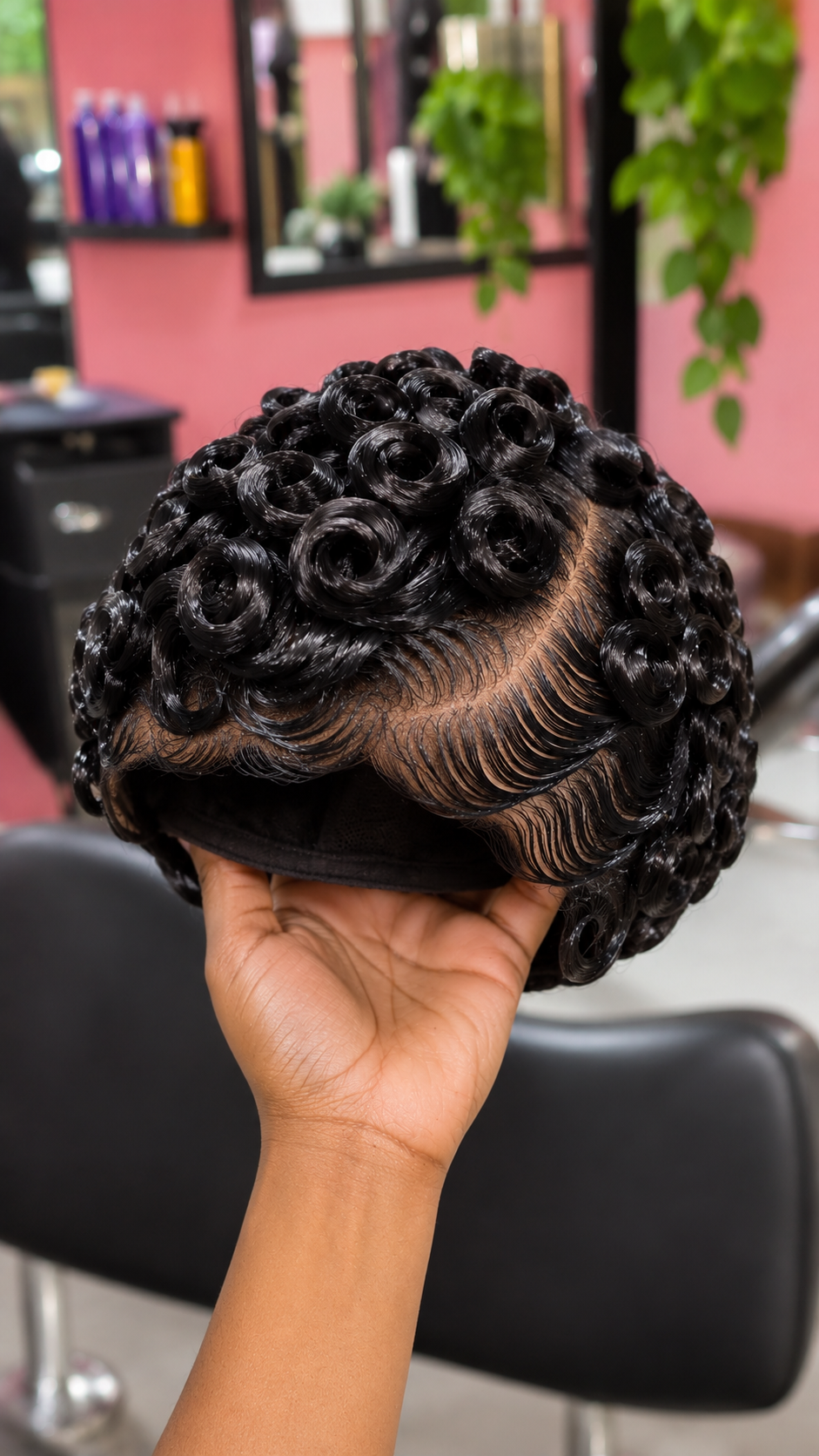
A beautiful pixie wig can make an impression through the placement of its curls rather than the addition of bright colors or elaborate accessories. The midnight black hairstyle pictured here demonstrates that approach with a crown of glossy, rose-shaped coils, a prominent diagonal part, and long, decorative finger waves descending toward the temple. Its most attractive quality is the contrast between the rounded curls above and the delicate, flowing strands below.
Photographed inside a salon with pink walls, mirrors, and black styling chairs, the wig rests in one hand before installation. The upper section displays large circular curls with tightly overlapping strands, while the front contains carefully arranged waves that sit close to a lighter, lace-like foundation. Part of the black interior cap is visible beneath the hairstyle, providing a limited view of its construction.
The wig has a relatively compact silhouette despite the fullness of its crown. The curls remain close to the head rather than hanging in long spirals. Several large rosettes occupy the upper front, while smaller formations continue toward the visible side and rear.


This hairstyle differs from an ordinary black curly pixie because the front section is not simply brushed backward or covered with loose baby hairs. Instead, individual strands are arranged into extended curved ridges, creating a strong directional pattern beneath the diagonal separation.
For customers researching sculpted pixie wigs, the image offers a valuable reference for curl placement, hairline design, and overall proportions. However, it cannot confirm whether the fibers are human hair or synthetic, the exact lace grade, the manufacturer, or the complete fastening system. Those details should be established before purchasing.
Where the Circular Curls Meet the Flowing Waves
The most interesting part of the hairstyle is the transition between its raised crown and flatter front hairline. These sections use different curl arrangements but remain connected through the same glossy black strands.
Across the upper head, the hair forms prominent circular rosettes. Several appear as tightly wound rings with visible openings in their centers. Their layered strands catch the light, emphasizing the direction of each curl.
Beneath these formations, the hair changes direction. Instead of continuing into more circular coils, fine strands sweep toward the forehead and temple in elongated curves.
A clearly exposed diagonal part separates these styling areas. Its lighter surface contrasts with the black hair and helps establish the direction of the design.
This relationship makes the hairstyle distinctive. The curls provide volume and structure, while the waves create movement close to the hairline.
The Difference Between a Rose Curl and a Finger Wave
Rose-shaped curls and finger waves can appear together in sculpted hairstyles, but they are not the same technique.
A rosette curl is arranged into a compact circular formation, often with overlapping strands that resemble the layers of a miniature rose.
A finger wave follows a longer curved path, creating an S-shaped or sweeping ridge along the surface of the hair.
The photographed wig combines these two visual forms. The upper curls remain raised, while the front waves lie closer to the underlying foundation.
When ordering a similar unit, buyers should describe both elements rather than requesting an ordinary curly pixie.
The Crown Has Large, Recognizable Rose Curls
The crown contains numerous circular formations arranged into a rounded silhouette. Several of the largest curls appear near the upper center and front, while slightly smaller rings fill the surrounding areas.
The circular shapes remain individually recognizable despite their close placement. Some have broad central openings, while others are wound more tightly.
This variation creates depth without requiring additional colors.
The curls are glossy, with bright reflections following their circular paths. Darker shadows remain between overlapping strands, making the individual rosettes stand out.
The visible side contains additional compact curls that continue toward the lower rear. Their placement helps maintain the hairstyle’s rounded outline.
The photograph does not provide a complete view of the back, so its precise curl distribution should be confirmed through additional photographs.
Choosing the Right Curl Diameter
Not every curly pixie uses the same curl size. Small spring coils create a different appearance from broad circular rosettes.
The photographed wig uses relatively prominent upper curls, several with noticeable circular openings.
A supplier offering smaller finger coils may provide a similar overall length but a substantially different hairstyle.
For custom production, request photographs showing the crown from above and the side at eye level.
Ask whether the proposed wig uses the same combination of larger upper curls and smaller surrounding formations.
The supplier should also explain how the curls are intended to be maintained after washing.
The Diagonal Part Creates a Strong Visual Direction
A pronounced diagonal part runs through the forward portion of the hairstyle. The part separates the raised circular crown from the flatter front section and helps organize the direction of the strands.
The channel appears lighter than the surrounding black hair, creating visible contrast.
Its angled path is important because the waves below follow the direction established by the separation.
The part is not a decorative shaved stripe. It functions as a styling division between different sections of hair.
Its precise construction cannot be established from the photograph. The separation may result from hair placement, styling, or a combination of methods.
Why the Parting Should Not Be Widened
Some buyers may be tempted to increase the width of a part by removing additional strands.
However, excessive plucking or cutting can expose the underlying cap or create permanent gaps.
The visible diagonal separation already provides a strong contrast against the black hair.
If a different parting position is desired, it is better to discuss the change with a wig maker before production.
Moving the separation may alter the balance between the rosette crown and front waves, so the decision should not be made casually.
Elegant Temple Waves Give the Wig Its Signature Appearance
The lower front section contains several long curved ridges arranged in a coordinated direction. These waves follow the forehead before descending toward the visible temple.
Individual strands are placed close together, creating narrow reflective lines across the darker hair.
Some waves form broad sweeping curves, while others follow smaller paths beneath them.
The result is a layered appearance that differs from ordinary baby-hair styling.
Near the lower side, several strands create pronounced curves that continue toward the edge of the wig.
The waves remain relatively flat against the lace-like surface, allowing the raised rosettes above to retain their prominence.
Protecting the Long Wave Sections
The elongated waves require careful handling because their appearance depends on strand direction and length.
Brushing the hair straight backward may disturb the curved ridges.
Cutting the fine strands too closely can make it difficult to recreate the original wave arrangement.
During installation, the stylist should inspect the existing waves before making adjustments.
If the cap requires repositioning, that should be completed before altering the front hairline.
Any restoration should depend on the confirmed fiber and manufacturer’s styling instructions.
Midnight Black Coloring Keeps the Design Cohesive
The hair appears predominantly deep black, with glossy reflections across the upper curls and front waves.
There are no clearly visible blonde, copper, burgundy, or other contrasting highlights.
The color remains consistent enough that the hairstyle’s visual variety comes mainly from curl placement and reflected light.
Where the rosettes overlap, the black appears darker. Along the outer strands, reflected light emphasizes the circular formations.
The fine temple waves produce longer reflective lines, highlighting their sweeping direction.
This gives the wig a polished appearance without relying on multiple colors.
However, glossiness does not establish whether the fibers are human hair or synthetic. Material composition should be confirmed with the seller.
The Compact Silhouette Makes the Styling Practical to Consider
Although the crown contains numerous raised curls, the hairstyle remains relatively close to the head.
The upper rosettes create fullness, while the lower side follows a more compact outline.
The flatter front waves provide a visual transition between these areas.
This arrangement may appeal to buyers who want intricate curls without the length of a bob or shoulder-length wig.
However, a compact hairstyle does not automatically require less maintenance.
The circular rosettes and delicate front waves may need careful handling to preserve their original appearance.
Buyers should consider both the visual appeal and the expected styling commitment.
Examining the Visible Hairline Material
The photograph shows a lighter, lace-like surface beneath the front waves. The edge of the material is visible near the lower front.
The wig is displayed before installation, with part of the front perimeter still exposed.
However, the photograph does not establish the exact lace grade or construction.
Buyers should request the manufacturer’s specifications and ask about available lace dimensions and shades.
The visible appearance should not automatically be interpreted as proof of a particular premium lace category.
Hairline Fitting Before Lace Trimming
The decorative waves sit close to the front perimeter, so accurate positioning is important.
If the wig is fitted too far forward, the waves may extend lower than intended.
If it sits too far backward, the diagonal part and temple waves may appear at a different angle.
A professional stylist should establish the correct cap position before removing any excess lace.
Trimming too close to the fine strands can damage the decorative styling or reduce the available fitting margin.
What the Visible Interior Can Confirm
Part of the dark interior cap is visible through the lower opening. Black fabric construction appears beneath the hairline.
The photograph does not provide a complete underside view, so the total number of combs, clips, adjustable straps, or other fastening components cannot be established.
The visible construction also does not prove that the wig is designed for adhesive-free installation.
Before purchasing, ask the supplier for a complete interior photograph showing the cap opened fully.
The seller should explain the fastening system and available adjustment options.
Choosing the Appropriate Cap Size
Cap fit affects how the hairstyle sits on the head.
A cap that is too large may shift, changing the position of the diagonal part and front waves.
A cap that is too tight may create discomfort or unwanted tension.
Provide the measurements requested by the wig maker and confirm the available sizes.
If glueless installation is preferred, obtain explicit confirmation that the cap supports that method.
Find Out Where To Buy This Style
The photograph does not identify a verified manufacturer, supplier, or product listing. However, it provides a useful reference for contacting wig boutiques and specialist wig makers.
Look for sellers experienced in compact sculpted pixie wigs, circular rosette curls, and decorative finger-wave hairlines.
General listings for black curly wigs may not reproduce the large upper rosettes or elongated temple waves shown here.
Independent wig makers may offer greater control over curl placement and parting direction.
Local wig boutiques can provide opportunities to inspect the cap and hairline materials in person.
Online retailers can also be considered, but actual product photographs should take priority over generic promotional images.
How To Order This Hairstyle
Describe the desired unit as a midnight black compact pixie wig with large circular rose curls, a diagonal part, and elongated finger waves descending toward the temple.
Specify that the upper curls should remain individually recognizable rather than forming loose hanging spirals.
Ask whether the maker can reproduce the difference between the larger crown rosettes and the smaller surrounding curls.
Confirm the hair fiber, cap measurements, lace specifications if applicable, and intended installation method.
Before payment, establish the production timeline, revision policy, and whether photographs of the finished wig will be available for approval.
Ready-Made Wigs Versus Custom Styling
A ready-made black curly pixie may provide a similar color and compact silhouette at a lower initial cost.
However, standard units may contain small spring coils or loose spirals rather than the prominent rosette formations visible here.
The elongated temple waves may also be absent.
A custom wig maker can potentially coordinate the crown curls, parting direction, and hairline styling during production.
This additional control may be valuable for buyers seeking a close reproduction.
Before commissioning a unit, request examples of previous work involving sculpted circular curls and detailed front waves.
Illustrative Pricing for Midnight Black Sculpted Pixie Wigs
The following USD amounts are illustrative budgeting estimates rather than verified current selling prices. The photographed wig’s actual material, manufacturer, and price are unknown.
| Wig Category | Illustrative USD Range | Potential Cost Considerations |
|---|---|---|
| Premium Custom | $325–$815+ | Individual cap sizing, carefully arranged rose curls, diagonal part placement, and detailed temple-wave styling. |
| Standard Custom | $175–$425 | Selected cap options with customized circular curls and coordinated front waves. |
| Basic Human Hair | $100–$275 | A human-hair starting unit that may require professional curl setting, parting work, and hairline customization. |
| Premium Synthetic | $75–$195 | A manufactured black curly pixie with preformed circular curls, depending on available designs. |
| Basic Synthetic | $30–$90 | A lower-cost curly pixie alternative that may not reproduce the large rosettes or detailed temple waves accurately. |
The circular curl arrangement may influence labor costs because the individual rosettes must remain recognizable across the crown.
The diagonal part and elaborate front waves introduce additional styling considerations.
Cap construction, lace dimensions, hair density, and professional finishing can also affect the final quotation.
Shipping, taxes, installation, and future restyling may be charged separately.
Ask whether the quoted amount includes a fully finished hairstyle or only the base wig.
Booking a Professional Installation
The first fitting should begin with checking cap size and positioning the diagonal part correctly.
A professional wig stylist can evaluate whether the front finger waves sit at the intended angle against the forehead.
Any excess lace should remain intact until the correct wearing position has been established.
Trimming too close to the fine strands may damage the decorative waves.
The stylist should also examine the circular curls for compression caused by packaging or shipping.
If restoration is required, the appropriate method should depend on the confirmed fiber and manufacturer’s care instructions.
Heat styling should not be applied automatically when the material is unknown.
Maintaining the Rose-Shaped Crown Curls
The upper hairstyle depends on preserving the circular formations.
Repeated brushing may separate the overlapping strands and alter their shapes.
Handle the curls gently and avoid unnecessary pulling.
If the wig contains human hair, professional resetting may be possible using appropriate techniques.
If it contains synthetic fibers, conventional heated tools may be unsuitable. Follow the manufacturer’s instructions before attempting restyling.
Heavy styling products can collect between neighboring curls and reduce the visibility of their circular openings.
Preserving the Long Temple Waves
The front waves require different handling from the raised crown.
Their appearance depends on maintaining the direction and spacing of the fine strands.
Aggressive brushing may disturb the arrangement.
If the waves lose their shape, consult a stylist experienced in sculpted finger-wave styling.
Unnecessary cutting should be avoided because the existing strand lengths contribute to the decorative curves.
Storage That Protects the Hairstyle
Use an appropriately sized wig stand to support the cap between wears.
Avoid placing pressure on the circular crown curls.
For travel, select protective packaging that provides enough room around the hairstyle.
Protect any visible lace from snagging or unnecessary folding.
If the wig requires professional resetting after washing, consider that maintenance requirement when deciding how frequently to wear it.
Who Will Appreciate This Black Pixie?
This hairstyle may appeal to customers who enjoy compact haircuts with elaborate circular curls and decorative front styling.
The glossy rose-shaped coils create a rounded crown, while the diagonal part and temple waves introduce movement.
The midnight black color keeps the focus on the hairstyle’s construction rather than contrasting highlights.
For photography and special occasions, the carefully arranged curls may create a particularly striking appearance.
For regular wear, buyers should consider cap comfort, installation requirements, and the maintenance needed to preserve the original styling.
Final Considerations Before Purchasing
The defining quality of this wig is the contrast between its circular rose curls and the flowing finger waves along the front.
The diagonal part organizes the two styling areas, while the glossy black strands emphasize their different shapes.
Before purchasing, verify the fiber composition, lace specifications, cap measurements, fastening system, and whether the wig arrives fully styled.
Request photographs of the rear, opposite side, crown, and complete interior to establish details not visible in the reference.
A successful reproduction should preserve the midnight black color, prominent circular curls, diagonal part, and decorative temple waves. These characteristics provide a practical foundation for comparing ready-made wigs, commissioning custom work, and planning professional installation.
Search Terms
Midnight black rose curl pixie wig · Elegant temple finger wave hairstyle · Black circular rosette crown curls · Diagonal part sculpted black pixie · Glossy midnight black lace wig · Large rose coils with front waves · Compact black circular curl hairstyle · Black pixie wig with sweeping temple waves