
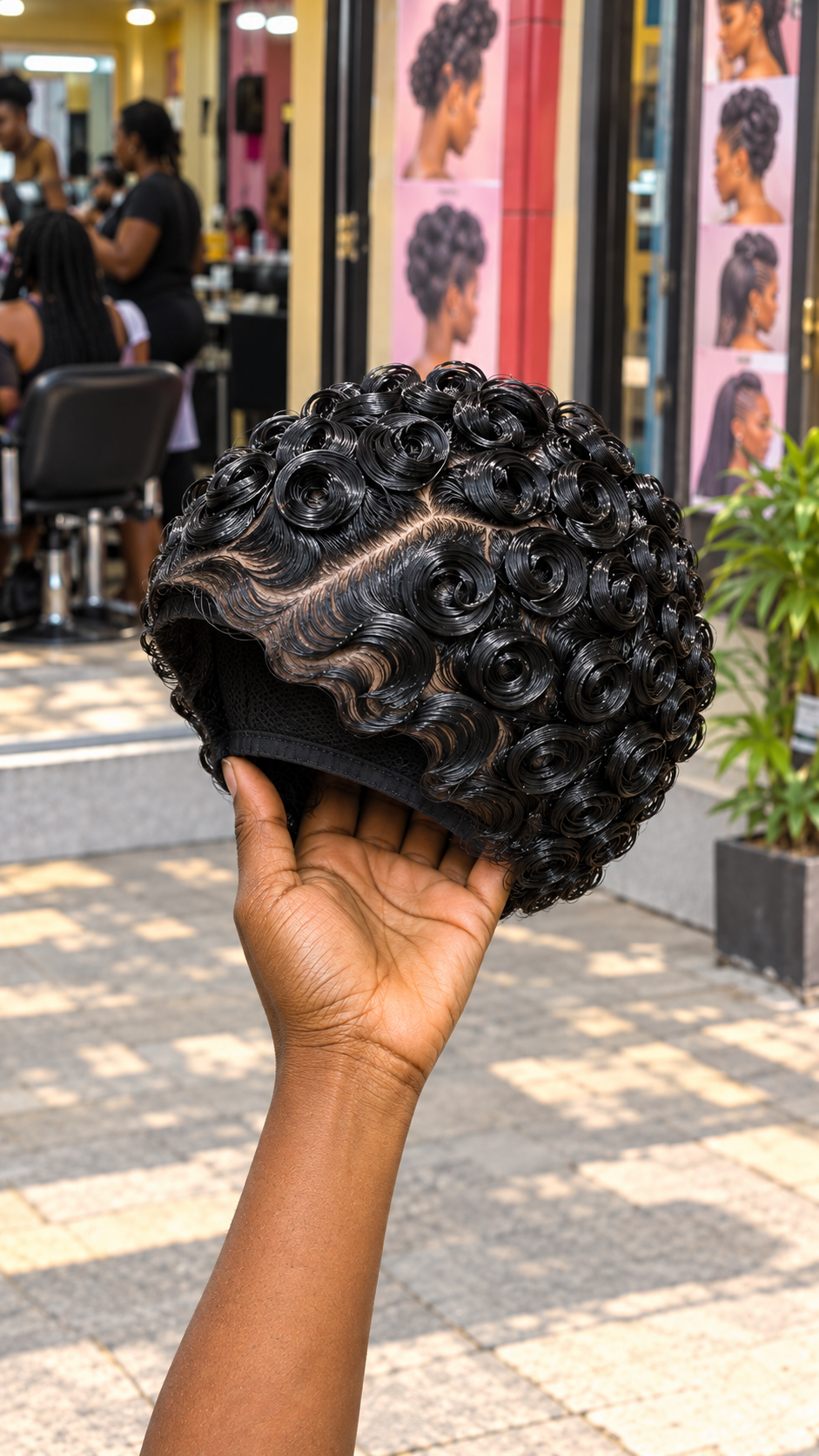
A hairstyle can feel beautifully elaborate without relying on bright colors or dramatic length. This glossy black pixie wig demonstrates that idea through its carefully arranged circular curls and sculpted side sweeps. The upper crown is filled with rounded spiral formations, while the frontal section follows a series of flowing curves that create a graceful transition toward the lower side. A diagonal parting brings the two styling arrangements together, giving the wig an attractive balance between decorative volume and closely arranged hair.
The photograph captures the hairpiece being supported in one hand outside a neighborhood beauty salon. Its dark interior cap is visible through the lower opening, and a small area of lace-like material can be seen near the frontal styling. The hairpiece appears to be photographed before installation, allowing the curl distribution and side design to be examined without the influence of a mannequin head or an individual wearer’s hairstyle.
The visible hair is predominantly deep black, with charcoal reflections across the curved strands. Numerous open-centered spiral curls occupy the crown and continue down the outer side. Beneath the upper ringlets, a narrow diagonal parting separates the crown from a broad sculpted section of finger waves. Several of these waves bend into larger curls near the lower temple, producing a decorative arrangement that differs from simple baby-hair styling.


For women considering a black curly pixie wig, this style offers a useful example of how circular curl placement and directional side waves can create an expressive hairstyle. However, the photograph does not verify whether the wig contains human hair, synthetic fiber, or a blend. It also does not establish the exact lace construction or full cap specifications. These details should be checked with the seller before purchasing.
The Sculpted Side Sweeps Are the Signature Detail
The most distinctive element of the hairstyle is the transition between the upper circular curls and the flowing side section. Rather than simply placing ringlets across the entire wig, the stylist has arranged a substantial area of hair into elongated waves that follow the contour of the frontal foundation.
These strands travel diagonally beneath the crown, forming broad S-shaped curves. Their direction gives the hairstyle a sense of movement while keeping the overall silhouette compact.
Near the lower temple, several wave sections bend into more pronounced curls. These curved formations appear larger than ordinary hairline baby hairs and contribute noticeably to the decorative styling.
The waves are closely arranged, with individual strands following the same direction through each curve. Their glossy surfaces create elongated reflections that contrast with the rounded highlights of the crown curls.
This relationship is important when recreating the hairstyle. A wig with ordinary brushed sides or a few small forehead curls would not reproduce the elaborate sweeping arrangement visible in the photograph.
Why the Side Waves Need Carefully Controlled Direction
The side sweeps depend on the alignment of the strands. Each curved section flows into the next, creating a continuous appearance rather than a series of unrelated curls.
If the hair is brushed in the wrong direction, the wave ridges may become less recognizable. If the strands are separated too aggressively, the carefully arranged curves may lose their shape.
Customers ordering a similar wig should ask the maker to preserve the broad S-shaped movement beneath the diagonal parting.
The reference also shows that the lower waves become more curved toward the temple, so the styling should not remain completely flat throughout the side.
A close photograph of the temple can help the maker understand how these sections are intended to connect.
The Crown Contains Beautiful Open-Centered Spiral Curls
Numerous circular curls occupy the upper crown, creating a rounded and relatively full appearance. Several ringlets have clearly visible openings, while others overlap neighboring curls or turn in different directions.
The curl sizes vary slightly across the crown. Some larger circular formations sit near the upper front, while smaller loops fill the spaces between them and continue toward the outer side.
This variation creates depth without making the hairstyle appear uneven.
The ringlets remain relatively compact, following the rounded contour of the wig rather than hanging downward into long spirals.
The black strands reflect light around their circular surfaces, making the individual formations recognizable despite the monochrome color.
These curls are different from ordinary loose waves or naturally hanging corkscrew curls. Their appearance depends on carefully arranged circular shapes that remain close to the crown.
Choosing the Right Spiral Diameter
The diameter of the curls has a direct influence on the silhouette.
Very small coils may create a dense surface with fewer recognizable openings. Larger rings may produce more dramatic individual shapes but can increase the height and width of the crown.
The reference shows a balance between medium and larger circular curls, supported by smaller formations along the outer sections.
When commissioning a custom wig, customers should request visible circular openings and compact crown proportions rather than simply asking for maximum curl volume.
The photograph does not reveal the original setting method, so the seller should explain how the ringlets are created and whether they can be maintained after washing.
The Diagonal Parting Connects Two Styling Patterns
A narrow scalp-toned parting travels diagonally across the visible frontal area, separating the upper circular curls from the sweeping waves beneath them.
The exposed channel creates an asymmetrical appearance that gives direction to the surrounding strands.
Above the separation, the hair forms circular ringlets. Below it, the strands follow elongated paths toward the frontal edge and lower temple.
The parting is relatively narrow and appears to follow the natural contour of the rounded wig.
Its position is essential because it establishes where the raised curls end and the flatter wave arrangement begins.
The photograph does not confirm the exact technique used to create the parting. It should not automatically be described as a specific lace-ventilation system or specialized construction method.
Preserving the Correct Parting Angle
If the diagonal separation is positioned too far toward the forehead, the area available for the sweeping waves may become smaller.
If it moves too far backward, the frontal wave section could occupy an excessive portion of the hairstyle.
The reference shows a balanced division that allows the crown and side waves to remain individually recognizable.
Customers should provide the wig maker with a photograph showing the parting angle and ask for confirmation before the styling is completed.
Any cutting or thinning near the exposed channel should be approached carefully because removing hair from a wig may be irreversible.
Deep Black Color Gives the Curls Extra Depth
The wig appears predominantly black, with subtle charcoal reflections where the light catches the strands.
There are no clearly distinguishable blonde, copper, burgundy, or silver highlights.
The consistent dark shade allows the curl arrangement and side styling to become the primary visual attractions.
The circular ringlets create rounded highlights, while the flatter side waves reflect light in longer streaks.
This contrast gives the hairstyle dimension without introducing additional colors.
Customers seeking a faithful reproduction should prioritize a consistent black appearance rather than adding highlights that are absent from the reference.
Natural Black, Off-Black, or Jet Black?
Wig suppliers may offer several dark shades, including natural black, jet black, off-black, and blue-black.
These shades can appear similar in photographs, particularly when the hair has a glossy surface.
The reference shows a very dark appearance, but the manufacturer’s exact color code cannot be established visually.
Customers should request photographs under daylight and neutral indoor lighting before approving a custom color match.
A physical sample may also help when coordinating the wig with a preferred shade.
The Outer Curls Complete the Rounded Silhouette
The circular ringlets extend beyond the upper crown and continue toward the visible outer side of the wig.
Several larger rings occupy prominent positions near the upper side, while smaller curls fill the lower outer areas.
The arrangement creates a connected silhouette rather than a crown that ends abruptly at the diagonal parting.
Some of the lower curls appear more compact, helping the wig retain its pixie proportions.
The photograph does not provide a complete rear view, so the exact distribution of curls across the back cannot be confirmed.
Buyers should request an additional rear photograph before assuming that the same curl arrangement continues identically around the entire hairpiece.
What the Frontal Foundation Reveals
The wig is presented before installation, with part of its frontal foundation visible beneath the decorative waves.
A small area of mesh-like material can be seen near the hairline, but the complete lace dimensions and exact grade cannot be established from the photograph.
The frontal styling sits close to this foundation, making careful fitting important.
The presence of a fine-looking mesh edge does not independently establish HD lace.
Likewise, the photograph does not confirm whether the wig is designed for adhesive-free wear.
Buyers should request the cap and lace specifications directly from the seller before choosing an installation method.
Why the Hairline Should Be Positioned Before Trimming
The sweeping waves extend close to the frontal edge, so trimming the foundation without checking the fit could interfere with the hairstyle.
A professional installer should position the wig on the wearer’s head and evaluate the placement of the diagonal parting and temple waves.
Only after confirming the alignment should any excess lace be trimmed.
The mesh color should also be compared with the wearer’s complexion under suitable lighting.
Unnecessary removal of frontal material can be difficult to correct.
The Interior Cap Is Partly Visible
The lower opening reveals a dark interior cap with fabric sections and a broad structural band.
However, the photograph does not show the entire underside, so the exact cap circumference, full attachment arrangement, and number of adjustment components remain unverified.
Buyers should request a photograph showing the wig turned inside out.
This can help identify adjustable straps, attachment combs, elastic sections, and other fastening hardware.
Cap measurements should be compared with the customer’s actual head measurements rather than relying exclusively on generic size labels.
A stable fit is important because the ornamental side waves need to remain correctly positioned during wear.
Where To Buy Similar Black Spiral Pixie Wigs
Women interested in this hairstyle can explore specialist wig boutiques, independent hairpiece makers, and salons experienced in sculpted pixie styling.
Look for suppliers who can demonstrate circular curl construction and carefully arranged directional side waves.
A seller offering ordinary black curly wigs may not necessarily provide the same combination of open-centered ringlets and flowing temple styling.
When contacting a wig maker, send the reference photograph and explain that the desired hairstyle includes glossy black circular curls, a diagonal parting, and broad sculpted side sweeps.
Ask whether a similar unit is available ready-made or requires custom production.
The photograph does not establish a verified manufacturer, current stock availability, or retail price for the hairpiece.
Questions to Ask Before Ordering
Confirm whether the wig contains human hair, synthetic fiber, or a blend.
Ask whether the circular curls and sweeping waves arrive fully styled and how they should be maintained.
Request the cap circumference, lace specifications, and available attachment options.
Find out whether the decorative temple styling is included in the purchase price or requires additional salon work.
Ask for photographs of the actual wig from the front, side, crown, and rear.
For custom production, establish the expected completion time, payment terms, and revision policy.
Ready-Made or Custom: Which Option Works Best?
A ready-made black curly pixie may provide a similar color and rounded crown but lack the elaborate sweeping side waves.
Some products contain ordinary spiral curls or simple hairline styling without the distinctive decorative arrangement.
Custom production may offer greater control over curl diameter, parting placement, side-wave direction, and cap fit.
Before purchasing a basic wig for later customization, consult a specialist to determine whether its density and construction can support the intended hairstyle.
Not every wig can be safely restyled into the same circular curl pattern.
Estimated Prices for Sculpted Black Spiral Pixie Wigs
The cost of recreating this hairstyle may depend on the fiber composition, cap construction, circular curl preparation, diagonal parting, and detailed side-wave styling.
Although the hairstyle does not require visible multicolor processing, the elaborate side arrangement may involve additional specialist labor.
The following USD figures are illustrative planning ranges rather than verified current retail prices or quotations for the photographed wig.
| Wig Category | Illustrative USD Range | Purchasing Considerations |
|---|---|---|
| Premium Custom | $330–$800+ | Individually arranged circular curls, personalized diagonal parting, sculpted side sweeps, custom fitting, and possible lace customization. |
| Standard Custom | $180–$420 | Customized spiral crown and detailed temple-wave styling with selected cap and hairline adjustments. |
| Basic Human Hair | $105–$255 | A possible human-hair foundation requiring additional circular curl setting and specialist side styling. |
| Premium Synthetic | $80–$195 | A potentially pre-styled alternative containing circular ringlets and decorative side waves. |
| Basic Synthetic | $30–$100 | A lower-cost curly pixie option that may resemble the general silhouette without reproducing every styling detail. |
These categories describe possible purchasing options rather than the confirmed material of the photographed wig.
Actual prices may vary considerably depending on the supplier, region, construction quality, styling complexity, and included services.
Before accepting a quotation, confirm whether the amount includes completed curls, side-wave styling, cap adjustments, and any necessary lace preparation.
Professional installation, shipping, and future maintenance may be additional expenses.
Booking a Stylist for Installation
Once the wig arrives, examine the circular curls and side waves before making alterations.
A professional installer should check the cap fit and position the frontal hairline correctly.
The diagonal parting should align naturally with the forehead and visible temple.
If excess lace is present, trimming should take place only after the fit has been evaluated.
The circular curls should be handled carefully because unnecessary pulling may disturb their arrangement.
Any major changes to the sweeping waves should be discussed before cutting or thinning begins.
Maintaining the Circular Curls
The upper ringlets depend on their circular openings remaining recognizable.
Repeated brushing, pulling, or compression may disturb the curls and reduce their individual character.
Maintenance requirements depend on the confirmed fiber type and original styling method.
Synthetic wigs should only be exposed to heated styling tools when the manufacturer confirms suitable temperature limits.
Human-hair wigs may require different care depending on previous processing and strand condition.
Customers should obtain material-specific instructions before washing or restyling the wig.
Keeping the Side Sweeps in Shape
The decorative waves depend on closely aligned strands maintaining their curved direction.
Excessive manipulation or heavy styling products may disturb the wave ridges.
Ask the original stylist which products are appropriate for preserving the arrangement.
When storing the wig, avoid compressing the crown or stretching any frontal lace.
If the waves lose their original shape, professional restyling may be preferable to aggressive home adjustments.
A Beautiful Black Pixie with Graceful Styling
This wig combines a rounded crown of glossy black circular curls with a diagonal parting and sculpted side waves that extend toward the lower temple.
The monochrome color emphasizes the individual curl shapes and the direction of the decorative strands.
For buyers seeking a similar result, accurate curl diameter, parting placement, and side-wave styling should take priority over generic black curly pixie descriptions.
Request photographs of the actual product, confirm the fiber and cap specifications, and discuss customization before placing an order.
A faithful reproduction should preserve the open circular curls, flowing side sweeps, compact crown, and carefully positioned diagonal part without introducing unnecessary colors or additional ornamental patterns.
With suitable construction and professional fitting, this hairstyle offers an attractive option for women who appreciate compact curly wigs with carefully sculpted styling and a classic black appearance.
Search Terms
Elegant black spiral curls pixie wig · Sculpted side sweep lace hairpiece · Glossy open ringlet crown hairstyle · Diagonal part black curly pixie · Broad S wave temple wig · Compact black circular curl hairpiece · Ornamental side wave spiral pixie · Jet black sculpted finger curl wig