
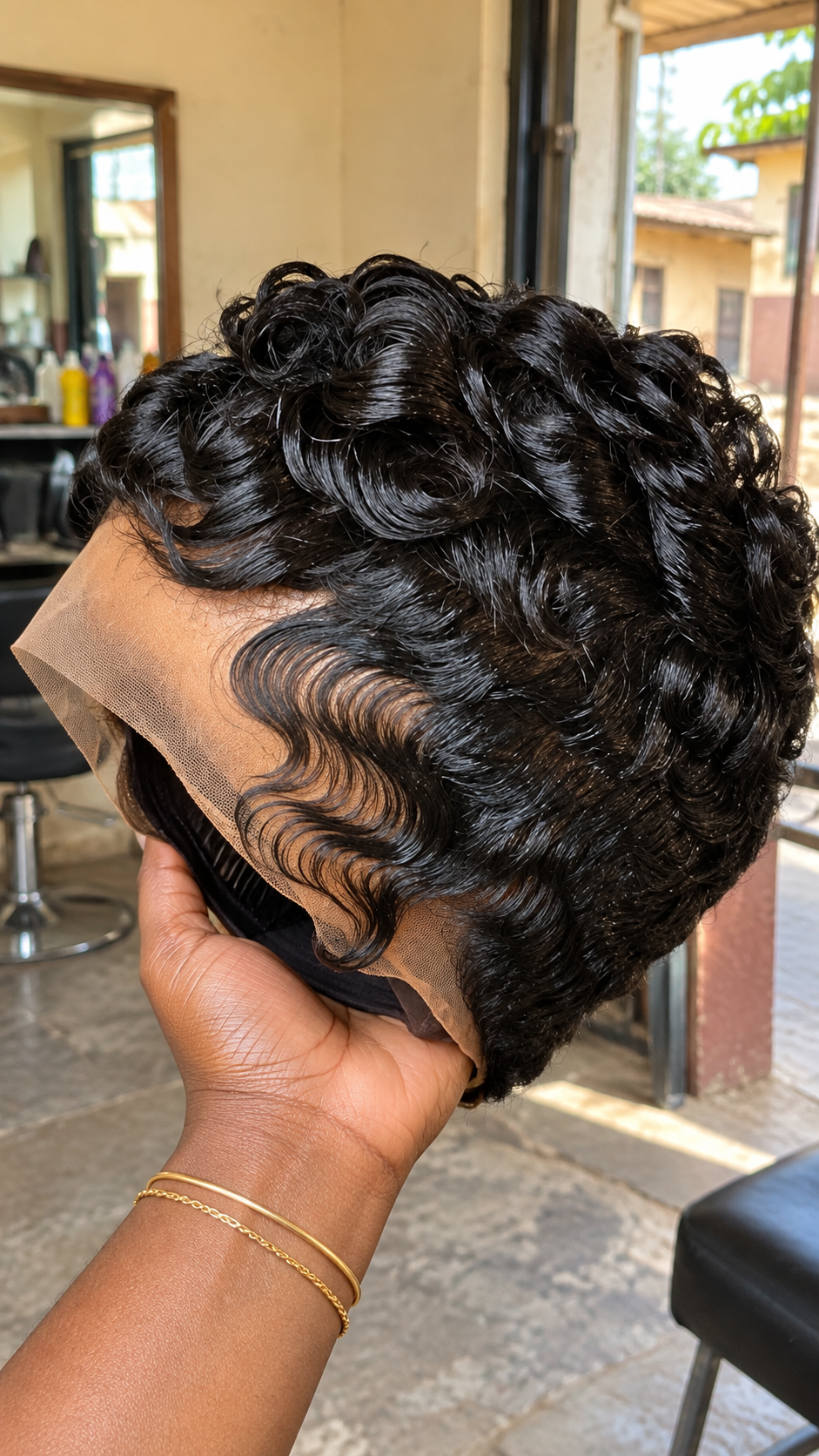
Some pixie hairstyles are memorable because of their color, while others stand out through the way the hair moves. This glossy black wig belongs to the second group. Broad curls fold over one another across the crown, creating a softly elevated silhouette, while a graceful arrangement of finger waves flows down the visible temple. The contrast between the generous upper curls and the closely fitted lower hair gives this hairstyle its distinctive appearance.
The photograph shows a single wig being held in one hand near the entrance of a neighborhood hair salon. Beige lace extends beyond the front and side hairline, and part of a dark interior cap is visible underneath. The upper hair contains large curved sections, loose spiral formations, and overlapping loops. Near the side, the strands become more closely aligned, forming a pronounced S-shaped wave that descends toward the lower temple.
Unlike the tightly arranged circular coil wigs often associated with sculpted pixie styles, this design uses larger, flowing sections. Some upper curls have rounded openings, but others bend into elongated waves that overlap naturally. The hairstyle is fuller through the crown and more compact near the lower side, creating a balanced profile without long hair extending around the shoulders.


The hair appears consistently black, with bright reflections across the outer strands. No separate blonde, copper, burgundy, or silver highlights are visible. Its depth comes from the direction of the hair, the overlapping curls, and the shadows created by the sculpted layers.
For women considering a black curly pixie wig, this hairstyle offers an attractive alternative to ordinary loose curls. Its appearance depends on preserving the broad upper movement and carefully arranged temple waves rather than simply choosing any black curly wig with a similar length.
The Cascading Temple Wave Is the Main Attraction
The most recognizable detail in the photograph is the large finger-wave arrangement near the visible temple.
Fine strands emerge from the upper side and travel downward in a sweeping curve. The movement begins relatively broad, narrows as it approaches the lower hairline, and then bends into another graceful section.
The strands remain closely aligned, creating a clearly visible wave pattern against the beige lace.
Unlike decorative shaved-looking channels, this pattern is produced by the direction of the hair itself. There are no prominent geometric side stripes or intersecting temple lines visible.
The lower portion of the wave approaches the lace perimeter and finishes in a curved arrangement that complements the hairstyle’s rounded crown.
This single decorative section gives the pixie much of its personality. Without it, the hairstyle would resemble a conventional black curly wig with a relatively full upper section.
Why the Temple Wave Should Remain Broad
The wave occupies a noticeable area along the visible side. Its size helps balance the generous upper curls.
If reduced to a very narrow curve, it might become less recognizable beneath the surrounding hair. If made excessively large, it could overwhelm the compact lower section.
A custom stylist should preserve the general curvature, direction, and relationship between the wave and the surrounding strands.
The photograph does not establish the exact styling method or products used. Buyers should ask whether the proposed material can retain the wave after washing and normal handling.
Large Black Curls Give the Crown Beautiful Volume
The upper hair contains several prominent curls arranged in overlapping sections. Some form rounded openings, while others bend backward into broader loops.
The curls are not uniformly small. Several large formations sit near the upper center, creating noticeable height and depth.
Other sections lie closer to the crown, producing a layered arrangement with different levels of elevation.
The curls appear deliberately positioned without forming a rigid collection of identical rings. Their varying sizes contribute to the hairstyle’s flowing appearance.
The crown is full, but the hairstyle remains relatively compact overall. The upper hair provides volume while the lower side follows a closer silhouette.
This makes the wig particularly appealing for women who enjoy decorative curls but prefer shorter-looking hairstyles rather than long, loose spirals.
How These Curls Differ From Compact Ringlets
Compact ringlet hairstyles often contain numerous small circular openings arranged closely together. This wig has a different structure.
Its upper curls are broader and more loosely organized, with several sections resembling folded ribbons or overlapping waves.
Some curls retain recognizable spiral openings, but others bend into elongated shapes.
A seller offering a tightly coiled pixie might provide a similar overall silhouette without reproducing the same flowing crown.
Customers should therefore request large sculpted curls with overlapping movement rather than uniformly small finger coils.
The Hair Flows Backward Across the Upper Head
The upper sections follow a coordinated backward direction. Several curls rise near the front before bending toward the rearward visible portion of the wig.
This gives the hairstyle a natural sense of movement instead of making the crown appear equally raised in every direction.
Some sections overlap in broad curves, while others form smaller spirals that fill spaces between the larger waves.
The arrangement creates visual depth because the reflective outer strands contrast with darker areas beneath.
Maintaining this direction is important. Brushing the hair randomly or separating the large sections could change the hairstyle’s intended shape.
A custom wig maker should consider the direction of the upper curls before adding additional density.
The Lower Side Keeps the Pixie Proportional
Beneath the larger crown curls, the hair becomes more closely arranged.
The lower section follows the contour of the wig, creating a compact appearance that contrasts with the upper volume.
Several smaller waves remain visible near the side, but they do not extend into long hanging curls.
The hairstyle gradually narrows toward the lower edge, producing a tapered-looking silhouette.
This transition is important because excessive fullness around the lower side could make the hairstyle appear heavier and less compact.
The photograph shows much of one side and part of the rearward section, but it does not reveal the complete back.
Customers seeking a faithful reproduction should request a rear photograph before approving a custom order.
Natural Black Hair Makes the Curves Stand Out
The wig appears consistently black throughout the visible crown and side.
Bright reflections create charcoal-gray highlights across the curved strands, particularly where daylight catches the upper curls.
These reflections should not automatically be interpreted as separate gray or silver coloring.
No clearly distinct blonde, brown, copper, or burgundy sections are present.
The hairstyle relies on the contrast between glossy outer surfaces and the darker spaces beneath overlapping curls.
This creates dimension without requiring additional color processing.
Customers seeking a similar appearance should begin with natural black or deep jet black hair and confirm the proposed shade with the seller.
Does the Gloss Mean the Wig Contains Human Hair?
The reflective appearance does not establish whether the wig contains human hair, synthetic fiber, or a blend.
Different materials can appear glossy depending on their surface finish, styling products, and lighting conditions.
The photograph does not confirm the manufacturer, fiber composition, or processing history.
Buyers should request accurate material information before purchasing, particularly if they intend to wash or restyle the curls frequently.
The Front Hairline Has a Soft Sweeping Shape
Near the front, several strands follow gentle curves toward the lace perimeter.
The hairline does not display a prominent straight center part or elaborate carved-looking artwork.
Instead, the upper curls transition into carefully directed waves that follow the visible side.
The front strands appear finer and more closely aligned than the larger curls above.
This difference helps create a gradual transition between the full crown and the lace perimeter.
A wig maker should preserve the relationship between these sections rather than replacing the flowing front arrangement with ordinary loose baby hairs.
What the Exposed Lace Reveals Before Installation
The photograph shows beige lace extending beyond the front and side hairline.
The mesh remains untrimmed, indicating that the wig is being displayed before its final wearing position has been established.
Part of the dark interior cap is visible beneath the hair, including a black lower band.
However, the complete cap construction and attachment system cannot be examined from this angle.
The exact lace grade is also unknown. A fine-looking mesh does not prove that the wig contains HD lace or another specialized material.
Buyers should request complete underside photographs and written product specifications before making a purchase.
Why the Lace Should Not Be Trimmed Immediately
The decorative temple wave approaches the lace perimeter, making correct placement particularly important.
If the wig is positioned too high or too low, the wave may sit differently against the wearer’s face.
The stylist should therefore establish the correct fitting position before trimming the lace.
Measurements such as head circumference, front-to-nape distance, and ear-to-ear width may influence the fit.
The photograph does not establish whether the wig can be worn securely without adhesive. The appropriate method depends on the actual cap construction and the wearer’s needs.
Where To Buy a Similar Black Curly Pixie
Women interested in this hairstyle can begin with specialist wig salons, independent wig makers, beauty supply stores, and online retailers offering sculpted curly pixie wigs.
Useful searches include black curly pixie wigs, sculpted wave pixie hairstyles, and black lace wigs with large side curls.
However, not every black curly wig will reproduce the broad overlapping crown and flowing temple wave shown here.
When contacting a seller, send the reference photograph and explain which details matter most.
The important characteristics are the deep black color, large upper curls, backward movement, compact lower side, and prominent S-shaped temple wave.
Ask whether the business offers a ready-made unit or accepts custom styling requests.
No verified supplier, current stock listing, or live retail price can be established from the photograph alone.
Finding a Stylist for Flowing Pixie Curls
This hairstyle requires experience with larger sculpted curls and carefully arranged finger waves.
A stylist who specializes only in ordinary loose curly wigs may not reproduce the broad upper movement accurately.
Look for portfolios showing compact sculpted pixies, directional curls, and detailed lace hairlines.
Close-up photographs of previous work can help demonstrate whether the maker understands the difference between large curled sections and tightly packed ringlets.
During the consultation, discuss the desired crown height, curl width, side density, and shape of the temple wave.
Questions to Ask Before Ordering
Confirm the proposed hair material and whether the wig will arrive fully styled.
Ask whether the upper curls can be refreshed after washing without losing their broad shape.
Request photographs of the actual unit from the front, sides, complete rear, and underside.
Discuss the cap measurements, lace dimensions, and available fitting components.
For online orders, obtain written confirmation of the agreed hairstyle, production time, shipping arrangements, and revision policy.
Ready-Made or Custom-Made Black Pixie?
A ready-made black curly pixie may provide a similar general silhouette at a lower initial cost.
However, ordinary ready-made wigs may contain small loose curls rather than the broad overlapping sections visible in this reference.
They may also lack the carefully arranged temple wave.
A custom order can offer greater control over the size and direction of the curls, crown height, and front hairline styling.
Before purchasing an unstyled base wig, ask whether its hair length, density, and material can support the intended arrangement.
Not every fiber can be extensively restyled using heat or conventional setting techniques.
Choosing Between Closure, Frontal, and Glueless Options
The appropriate cap construction depends on the desired hairline coverage and fitting preferences.
A closure may provide a more limited lace area, while a frontal construction can offer additional coverage across the front and temples.
Whether either option can support the elaborate side wave depends on the actual cap and hair placement.
Glueless wear requires suitable cap sizing and retention components. It should not be assumed simply because a wig contains lace or adjustment hardware.
Before ordering, customers should provide accurate head measurements according to the maker’s instructions.
During fitting, the stylist should establish the correct hairline position before trimming the lace or altering the decorative side wave.
Estimated Prices for Black Curly Pixie Wigs
The cost of a comparable wig depends on the selected material, cap construction, curl styling, lace preparation, and labor involved in creating the flowing temple wave.
The following USD amounts are illustrative budget-planning ranges only. They are not verified live retail prices or quotations for the photographed wig.
| Wig Category | Illustrative USD Range | Purchasing Considerations |
|---|---|---|
| Premium Custom | $340–$820+ | Individual broad curl placement, detailed temple-wave styling, personalized cap fitting, and custom hairline preparation. |
| Standard Custom | $170–$410 | Custom large curls and flowing side-wave styling on a suitable wig foundation. |
| Basic Human Hair | $95–$260 | A possible base unit requiring additional curl setting, hairline styling, and fitting services. |
| Premium Synthetic | $65–$190 | A potentially suitable pre-styled black curly pixie, depending on fiber properties and curl construction. |
| Basic Synthetic | $25–$90 | An economical curly wig that may not reproduce the broad curls or prominent temple wave. |
These categories describe possible purchasing choices rather than verified characteristics of the photographed unit.
Additional expenses may include shipping, professional installation, cap adjustments, lace trimming, and later styling restoration.
Before paying, request an itemized quotation explaining which services are included.
Maintaining the Large Crown Curls
The upper curls depend on retaining their broad shapes and overlapping arrangement.
Repeated brushing or excessive handling may disturb the curls and change the hairstyle’s overall appearance.
Customers should avoid pulling the large sections apart merely to create additional volume.
Ask the wig maker whether the hairstyle can be refreshed at home or whether professional restyling is recommended after washing.
If the wig contains human hair, its care routine should account for any previous setting techniques or styling products.
If synthetic fiber is used, follow the manufacturer’s instructions and confirm heat compatibility before attempting to restyle the curls.
Protecting the Cascading Side Wave
The temple wave requires careful handling because its appearance depends on fine strands remaining aligned along a specific curved path.
Repeated rubbing, excessive combing, or heavy product application may disturb the arrangement.
The stylist should explain how to refresh the wave without flattening the upper curls.
Any permanent trimming or reshaping should be approached cautiously because the side wave is an essential part of the hairstyle.
Why This Pixie Can Work for Different Occasions
The deep black color creates a versatile foundation, while the broad curls and flowing side wave add decorative detail.
The compact length may appeal to women who prefer pixie wigs rather than long curly hairstyles.
The hairstyle can coordinate with formal clothing, casual outfits, and a variety of accessories.
It may be particularly attractive for celebrations, portrait photography, fashion events, or personal everyday styling.
For frequent wear, customers should consider the maintenance required to preserve the broad upper curls and carefully arranged temple wave.
What to Check Before Wearing the Finished Wig
When the completed wig arrives, compare the crown arrangement with the approved reference photograph.
The upper curls should retain their broad overlapping shapes, while the lower side remains compact.
The temple wave should follow the intended S-shaped path and remain clearly visible.
Inspect the lace and interior cap for visible damage before trimming or fitting.
If the wig was custom-made, significant differences should be discussed with the seller before permanent alterations are made.
A Beautiful Black Pixie with Flowing Movement
This hairstyle demonstrates how a compact black wig can create a distinctive appearance through broad curls and carefully arranged side waves.
The upper hair forms overlapping loops that provide height and depth, while the lower side follows a closer silhouette. The prominent temple wave introduces graceful movement across the front hairline.
The visible beige lace also highlights the importance of correct fitting and construction verification before installation.
For women seeking a faithful reproduction, the most important priorities are the large overlapping curls, backward crown movement, compact lower side, and flowing S-shaped temple wave.
With appropriate customization and careful maintenance, this black pixie wig can offer a beautiful combination of rich dark hair, sculpted curls, and distinctive salon artistry.
Search Terms
Black pixie curls with side waves · Large sculpted black curls · Cascading finger wave temple wig · Black lace front curly pixie · Glossy overlapping crown curls · Black swept back pixie hairstyle · Compact black curl wig with S-wave · Flowing black temple wave hairline