
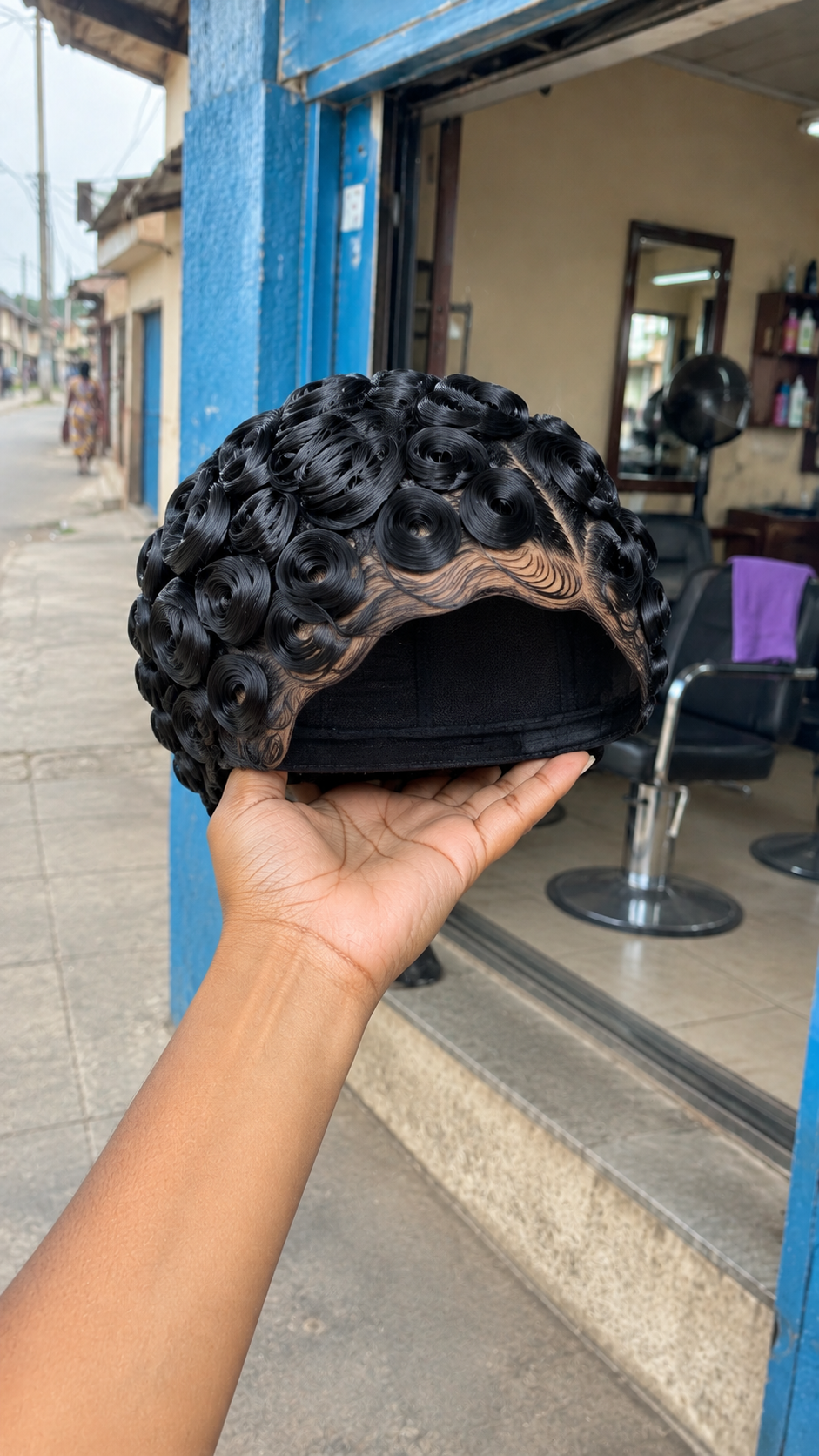
Black curls turn into broad, rounded swirls across this short wig, with finer waves tracing the front edge. The larger curls have open centers and closely arranged strands that make their circular shape easy to follow. Some sit upright enough to show a complete ring, while others tilt sideways and overlap their neighbors. Together, they create a rounded silhouette with fullness across the top and a closer outline around the visible lower sides.
The black swirl curl wig has a gentle sheen that reveals the direction of the hair without overwhelming the shape. Light catches the outside of each curl, then fades toward its center. The strongest contrast comes from the brown base visible between selected sections and beneath the fine front waves. A narrow part appears near the upper right of the photograph, separating a smaller group of curls from the fuller arrangement beside it.
Along the front, the hair becomes much finer and lies close to the base. Several shallow curves follow one another above the opening of the cap, forming a delicate scalloped border. These little waves give the face-framing area a different scale from the substantial swirls above. They are worth studying closely if you want a similar unit, because their placement will determine how the style sits above your brows and around your temples.


The wig is supported from underneath, giving a useful view of its rounded shape and dark interior. On a wearer, its final proportions will depend on the fit and the position of the front edge. A consultation should begin with those two decisions. Once the cap sits comfortably, a stylist can assess whether the larger swirls need to be raised, lowered or turned slightly to frame your face.
Start With the Shape You Want to Wear
The fullness in this style extends across the upper surface rather than rising into a single high section. Larger swirls sit toward the upper left and center, with smaller circles filling the spaces around them. That distribution creates a rounded profile that can be adjusted without losing the main idea. If you prefer a lower crown, ask the stylist to show you a version with the broad curls sitting at a shallower angle. The size of the circle can remain visible even when its height is reduced.
For someone who likes more volume, a little extra lift through the top may be enough. Adding hair everywhere can widen the sides and crowd the front waves. Ask the maker where they would introduce fullness and request a side photograph before approving the set. A straight-on image helps you judge the outline around the face, while a profile reveals whether the top projects farther than you expected. Both views matter when buying a short style online.
The photo gives a clear view of the front and much of the upper surface, so discuss the back separately. You may want the nape close to the head or prefer small curls continuing downward. Explain whether you wear high collars, headscarves or earrings that touch the neckline. Those habits can influence where a stylist leaves length and where a closer finish will feel more comfortable.
The Difference Between a Swirl and a Tight Coil
The most prominent curls here have a broad ribbon-like surface. Their strands travel together around a central opening, producing a visible circular ridge. A tight coil would occupy less space and create a different surface across the crown. When contacting a seller, show the largest curls in the reference and describe their open centers. This helps distinguish the look from short wigs with tiny corkscrew curls, which may be listed under similar names.
Several swirls turn away from the camera, so their openings look narrower. That change in direction prevents the arrangement from becoming a series of identical circles. A maker can use the same principle when adapting the style to your measurements. Ask for a mixture of forward-facing and angled curls, with enough separation for the major shapes to remain visible. The aim is a coordinated set that retains individual detail when viewed from ordinary conversation distance.
The smaller curls near the outer edge help connect the broad upper swirls to the close sides. If you want a custom version, preserve that gradual change in size. Large circles carried all the way to the lower edge can make a short unit appear wider. Smaller curls can finish the perimeter while allowing the top to keep its generous shape. A photograph from slightly above is useful for checking how those sizes are distributed.
Fine Waves Along the Forehead
The front edge contains several thin, parallel curves. They follow the same general direction as the curls above them but lie much closer to the base. Near the center, the waves rise and dip in shallow arcs. Closer to the side, they become smaller and turn downward. This progression gives the hairline a soft outline that works with the fuller swirls. During fitting, ask the stylist to check the curves while you look straight ahead.
You can personalize the amount of forehead coverage without changing the whole hairstyle. A higher front placement leaves more space above the brows, while a slightly lower wave gives a closer frame. Have the stylist show you the proposed position before trimming any lace. If you wear glasses, put them on during this stage. The arms should sit comfortably around the ears, and the front should stay where you want it as you move your head.
Get The Details On This Wig
Similar styles can be found through custom wig makers, short-wig boutiques, professional salons and beauty supply shops with styled units. Look for portfolios that include broad circular curls and fine molded edges. A retailer may have a ready-made unit with the right overall shape, while a custom studio can discuss the exact swirl size and front placement. Send the image with your inquiry and identify the details that matter most to you.
A clear order brief should include your preferred black shade, cap measurements, part direction and desired crown height. Mention whether you want a softer sheen or a more polished finish. Use your own left and right when describing the part, since photographs can be mirrored. If the small front waves are a priority, ask the maker to include a close view of them in the approval photographs. That gives you a chance to assess their size before the wig is delivered.
Request photographs of both sides, the back, the front and the complete inside of the cap. Ask for confirmation of the fiber, lace color, attachment system and available sizing adjustments. A daylight video of the actual unit can help you judge the black tone and how clearly the swirls show away from bright salon lights. Before paying, confirm production time, delivery charges, alteration terms and whether the first styling session is included.
For a salon appointment, search for a stylist experienced in short wig fitting and sculpted curl sets. Send the reference before booking so the salon can allocate enough time for fitting and any reshaping. If you want a related style on your own hair, arrange a consultation with a short-hair specialist. They can assess the length available for the larger swirls and discuss whether your existing haircut needs adjustment around the sides or front.
Choosing Construction Around the Front and Part
The photograph shows a dark cap interior and a brown base beneath the fine front hair. Seller photographs of the full underside are needed to assess the complete construction. Ask where the usable parting area begins and ends, especially if you want to reproduce the narrow line visible near the top. The construction should support the position you intend to wear, with enough room for the stylist to arrange the front waves comfortably.
A lace-front unit can suit this style when its lace depth accommodates the front and chosen part. A frontal can offer more working space across the forehead and toward the temples, depending on its dimensions. A closure may work for a fixed version when the intended part lies within its usable area. Full-lace construction can provide more options for later changes in direction. Compare these choices with your stylist according to the finish you want and how often you expect to restyle the wig.
For a glueless installation, examine the adjustable straps, elastic band and other attachment components. Follow the maker’s measuring method so the cap size matches their specifications. Circumference is useful, and additional front-to-nape or ear-to-ear measurements may help position the front and sides. During fitting, look down, turn your head and speak normally. The cap should stay comfortably in place while the waves remain at the agreed hairline position.
Adhesive-based fitting is another option for a compatible lace unit when extra hold suits your routine. Ask the stylist to demonstrate the final placement before securing the edge. Discuss removal at the same appointment, including the compatible remover and how to release the lace gently. If you prefer to take the wig off frequently, explain that when booking. Your wear schedule can help the stylist recommend an attachment method and show you how to handle the front between appointments.
Length and Density for Broad Circular Curls
A short finished style can require more strand length than its appearance suggests. Hair folds into each swirl, and a broad circle needs enough length to complete its turn. When comparing listings, ask about the finished curl diameter and crown height alongside the advertised length. A profile photograph can show how the largest curls sit. This is particularly helpful if you want the generous circles in the reference while keeping the overall silhouette low.
Density should leave enough room for the centers of the swirls to remain visible. Too much hair can close those openings and make neighboring curls merge together. The front also needs a lighter touch so the fine waves can lie close without becoming thick ridges. Ask a custom maker how they distribute the hair between the crown and hairline. If you want extra fullness, discuss adding it selectively through the upper section while maintaining space around the front.
Planning the Cost of a Finished Swirl Pixie
The following USD ranges are illustrative budgeting examples. Materials, cap construction, customization, supplier and location all affect the final quote. Shipping, installation and future curl resets may be charged separately. Ask whether the listed price covers the finished swirl arrangement, because a basic short unit may still require cutting and professional setting before it resembles the reference.
| Category | Illustrative Price Range | Potential Scope |
|---|---|---|
| Premium Custom | USD 285–580+ | Made-to-measure construction with broad swirl placement, a planned part and individually arranged front waves. |
| Standard Custom | USD 160–285 | Standard-size cap adapted for the requested fullness, part direction and circular curl set. |
| Basic Human Hair | USD 95–175 | Short human-hair unit that may need a separate cut, swirl setting and fitting appointment. |
| Premium Synthetic | USD 45–100 | Pre-styled short wig with distinct circular curls and more detailed front shaping. |
| Basic Synthetic | USD 20–45 | Ready-made short unit with a fixed curl arrangement and simpler hairline detailing. |
Compare the total needed to achieve the hairstyle you want. A ready-made wig with suitable swirls may need only a fitting and small front adjustments. A different curl pattern may require a complete reset, assuming the fiber allows it. Show a proposed purchase to your installer before ordering. For custom work, ask the maker to record the agreed curl size, crown height and front coverage so those details can be checked in the finished photographs.
Keeping the Swirls Open and the Edges Neat
Handle the unit by the stronger areas of the cap when putting it on or taking it off. Avoid pressing directly on the open centers of the larger swirls. If a curl shifts, guide its outer edge in the direction it was set and allow it to settle. Work on the affected curl individually. Repeatedly running your hands across the whole surface can disturb the relationship between the larger circles and the smaller finishing curls.
For regular wear, inspect the cap and front edge weekly for perspiration, residue and changes in shape. Let actual wear, product buildup, fiber type and manufacturer instructions determine the washing schedule. During cleaning, support the fine front area and avoid rubbing the curls together. Blot excess moisture gently and dry the wig on a suitable stand. Leave the front waves free of pressure while drying, and ask your stylist how much of the set will need restoring after a wash.
Human hair may allow a wet reset or another styling method chosen for its condition. Ask the stylist to explain how the broad swirls were formed before attempting touch-ups at home. Synthetic fibers vary in their ability to tolerate heated tools or steam, so use only methods approved for the specific unit. If several curls collapse or the front loses its outline, arrange a professional reset. Repeated layers of styling product can obscure the fine strands and make cleaning more difficult.
Use care products appropriate for the fiber and apply them sparingly. Although the pictured unit is black, a custom colored version would need its own care instructions. Ask about washing and color maintenance before ordering a lighter or processed shade. For daily storage, choose a stand that supports the cap without stretching it. Keep the wig away from prolonged direct sunlight and place it where the front and sides can rest without contact from nearby objects.
When traveling, use a firm case with enough space above the tallest swirls. Light support inside the cap can help retain its shape. Check that the lid clears the curls and that the front edge lies without being folded. Unpack the wig when you arrive and inspect it on a stand. Photographs taken when the style is freshly set can help you identify which curl has moved and give your stylist a reference for later maintenance.
Living With a Detailed Short Style
The rounded swirls make this pixie expressive while keeping the length clear of the shoulders. The fine hairline waves add interest close to the face, and the black shade allows the curl direction to carry the design. It can appeal to someone who likes a consistent finished look and enjoys showing earrings or an open neckline. A comfortable fit makes that consistency easier, because the front returns to the same position each time you wear the unit.
The main commitment is protecting the set. Tight headwear can flatten the upper curls, and repeated friction near the temples may loosen the smaller waves. A fixed part also limits how much the style can be moved from side to side. Before leaving a fitting, practice putting the wig on yourself and check the result in profile. Ask what a reset involves and how to recognize when one is due. Those practical details help you preserve the broad swirls and delicate front that give this short hairstyle its appeal.
Search Terms
black swirl curl pixie · short wig with circular swirls · delicate hairline wave wig · rounded black curl hairstyle · broad swirl curls with side part · short black wig with fine edges · sculpted pixie with open curls · black circular curls and front waves