
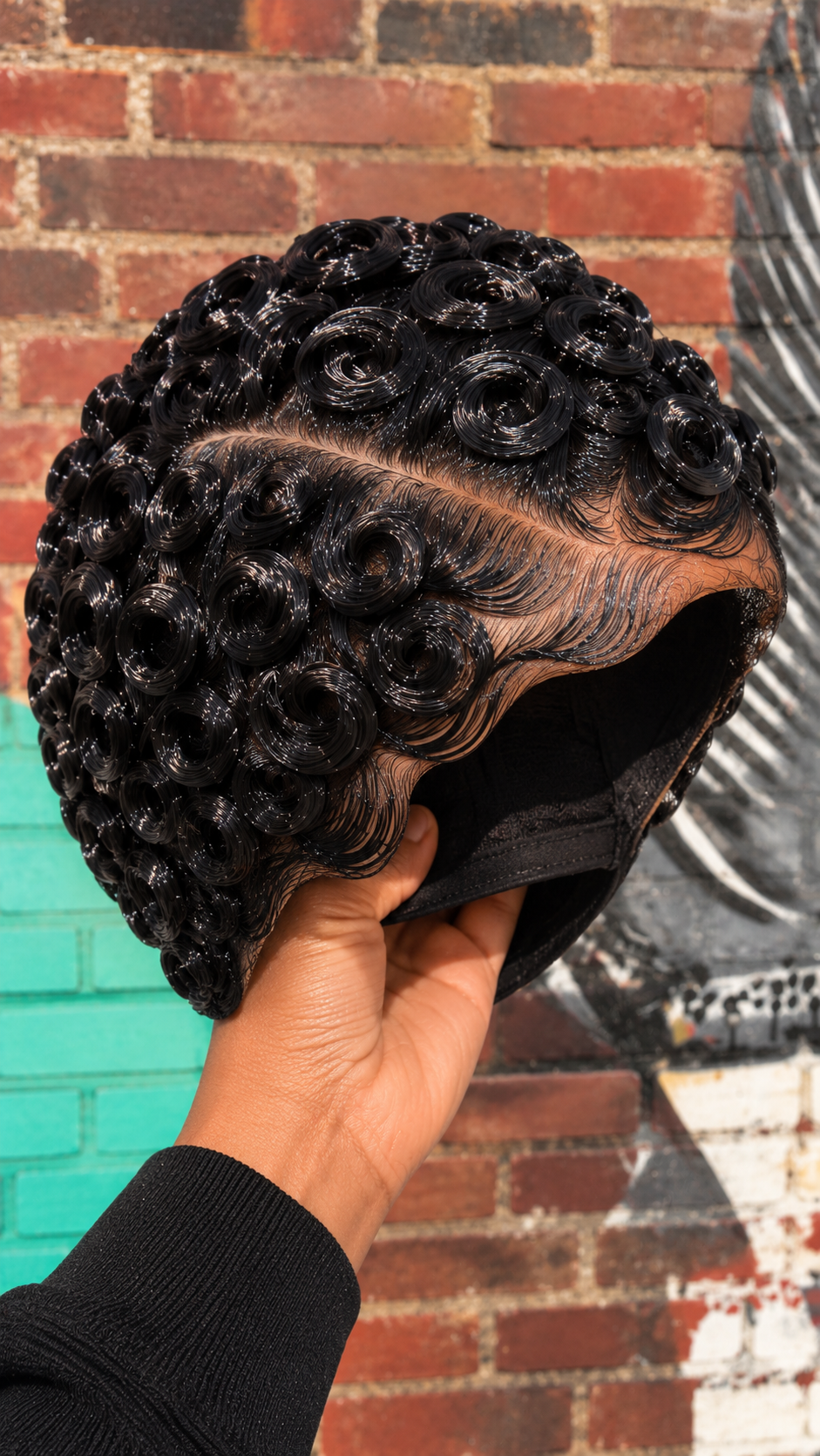
The photograph shows the wig supported in one hand, making its curl arrangement and dark interior cap easy to examine. The rich black color keeps the design cohesive, while reflected light traces the circles across the crown and sides. For someone drawn to a short black pin curl wig, this reference offers more than an attractive finish. It shows the importance of part placement, curl spacing, and the transition between the raised rolls and flatter front sections.
The Sweeping Part Is the Starting Point
The exposed line travels across the visible side in a long curve. Hair above it moves toward the crown curls, while the lower section follows a different direction before joining smaller rolls. This creates an organized arrangement with movement on both sides of the division. When requesting a recreation, identify the curve as an essential feature. A straight part or a much shorter division would change how the surrounding curls relate to one another.


The angle at which the wig is held affects how the part appears in the photograph. Before ordering, ask to see a comparable unit positioned correctly on a stand, with a front view and an overhead view. These help establish where the part begins and how far it continues. During fitting, its position should be checked against the wearer’s forehead and temple so the styling sits where intended rather than simply matching a tilted display angle.
Ask whether the division is fixed within the unit or can be adjusted. Some designs provide limited parting space, while others offer more flexibility. Even when the construction allows a different position, the surrounding curls may require resetting. Decide whether you want to keep this particular arrangement consistently or expect to change it later. That choice helps determine which base and finishing service make sense for your purchase.
Circular Rolls Create the Detail
The curls resemble small rolled ribbons, with dark openings at their centers and closely grouped strands around the edges. Larger circles draw attention across the upper section, while smaller curls fill the lower areas. Their sizes are varied enough to give the surface depth. A supplier should understand that you want recognizable individual rolls, not a mass of loose curls that has been brushed into a general rounded shape.
These curls also sit differently from long spiral ringlets. They are arranged close to the base, creating an intricate surface without hanging down. Search descriptions such as molded pin curls, short rosette curls, and sculpted pixie styling may help identify comparable work. However, sellers use these phrases differently. Photographs of their completed units remain the best way to judge whether their interpretation matches the circular pattern you prefer.
The gaps between curls deserve attention too. Enough separation allows the loops to remain readable, while surrounding hair provides coverage. Adding more hair everywhere could crowd the centers and widen the silhouette. Ask the maker how they plan to balance coverage with visible curl structure. A density label may be useful within their product range, but it does not describe the finished spacing or the amount of lift created by the set.
The Front Waves Should Belong to the Cut
Near the edge, the strands leave the circular pattern and sweep into flatter curves. These sections help the hairstyle meet the forehead and temple without an abrupt transition. They should be discussed as part of the design rather than added as an unspecified finishing touch. If the maker reproduces the crown curls but uses a completely different front arrangement, the wig will have a different character despite sharing the same color and length.
Decide how pronounced you want the front to be. The reference includes visible parallel strands and extended curves, but some wearers may prefer a quieter interpretation. Tell the stylist before the final set is completed. Shortening or reducing a heavily arranged section afterward can require neighboring hair to be reset. A clear preference gives the stylist room to adapt the detail while preserving the relationship between the front, part, and surrounding curls.
The photograph does not establish the final hairline position on a wearer. That should be assessed with the cap fitted correctly. If you wear glasses, bring them to the appointment so their arms can be considered near the temple. The aim is to keep the styling comfortable during ordinary use. An attractive curve on a stand needs to work with the way you actually wear the wig and the accessories you use regularly.
A Rounded Shape From Crown to Lower Edge
The visible outline has fullness through the crown and sides, then narrows toward the lower section. The curls continue around the head instead of forming an isolated cluster on top. This is worth preserving in a recreation. A flat back or an unexpectedly long nape could undermine the compact shape. Ask for the opposite side and rear views before approval, because the hand-held photograph does not reveal every part of the finished haircut.
Discuss crown height in practical terms. If you like this moderately rounded look, show the maker the outline and explain that you want individual curls without an oversized top. More lift may suit another preference, but it should be an intentional change. A useful consultation considers crown height, side width, and lower shaping together. Adjusting only one area can alter the proportions of the entire short style.
Length measurements need an explanation as well. A seller may quote stretched strand length, the original base before cutting, or another measurement. None automatically tells you the height of a finished pin curl. Ask for images of the completed set and clarify whether additional cutting remains. A suitable base that needs professional shaping is a different purchase from a unit already cut and styled for fitting.
Black Color and a Polished Surface
The hair appears black throughout the visible arrangement. Bright reflections follow the rolled strands, but they do not establish a separate highlight color. If you want a consistent black finish, specify that directly. Ask whether the supplier offers a particular black shade and request daylight footage of the proposed unit. A strongly lit photograph can make subtle color differences difficult to judge, especially where the curls reflect surrounding light.
The glossy appearance also cannot verify the hair material. Human hair, synthetic fiber, and blends all require accurate product descriptions rather than visual guesses. Ask what the unit is made from and what products were used to finish it. You should understand whether the shine is mainly the material’s appearance, an applied product, or a combination. That information helps you decide how to maintain the finish without unnecessary product layering.
If you prefer a less reflective version, discuss that with the stylist while keeping the same curl pattern. The surface finish and haircut are related but separate choices. A maker may be able to adjust the finishing approach, depending on the material and setting method. Ask to see examples rather than assuming a simple wash or brush-through will create the result. Those actions could change the carefully arranged rolls as well as their shine.
How To Order This Style
Look for wig boutiques, independent makers, and salon specialists who show short pin curl sets in their portfolios. Search phrases such as “black pin curl pixie wig,” “short molded curl wig,” and “rosette curl wig with side part” can help locate relevant examples. Study whether the maker achieves open circular rolls, a balanced crown, and a deliberate front. A generic short curly product may need substantial customization to resemble this reference.
Ask to see completed units from several angles. The most useful examples show the crown, both sides, front, and nape under ordinary lighting. Establish whether the business supplies a complete wig, customizes a sourced base, or provides styling only. If you need to purchase a base separately, consult the person doing the final work first. They can explain which construction, material, and starting length will support the intended arrangement.
Send a brief that identifies the all-black color, mixed-size circular rolls, sweeping part, flatter front waves, and rounded short outline. Then request the verified material, cap measurements, construction, included services, and total cost. Ask which details can be adapted during fitting. This gives the supplier a clear specification while leaving room for practical adjustments that help the unit sit comfortably on the wearer.
For ready-made stock, request a rotating video of the exact item being supplied. For custom work, agree on an estimated completion window and any review photographs before dispatch. Read return and alteration terms before payment, particularly when cutting or individual styling is involved. Keep the reference and written responses together. If an adjustment is needed, those records make it easier to identify a specific issue such as excessive crown width or an incorrectly placed part.
Understand the Cap Before Choosing an Installation
Part of the dark interior is visible, but the photograph does not establish the complete cap design. Ask for an inside-cap image and a clear explanation of the lace and wefted areas. A closure-based unit offers a different working space from a frontal. The suitable option depends on how the curved part and front are created. Ask the maker to explain why their proposed construction supports the style rather than choosing solely by a familiar label.
If the unit has lace around the front, request its shade and dimensions. The exterior view cannot verify a premium lace grade or establish a match for every wearer. Also ask how much of the parting area can be customized. A visible front section does not mean that the entire cap permits open parting. Knowing the working area helps you understand which changes are realistic and which would require another base.
For regular removal, ask whether a suitable glueless option is available and how the actual cap stays secure. An exterior photograph cannot confirm that feature. If you prefer an installed finish, discuss the method with a wig stylist and follow the relevant product instructions. Either choice should include removal guidance that protects the front and curl set. Convenience depends on the complete routine, including taking the wig off and storing it properly.
A Five-Tier Budget for a Finished Purchase
The figures below are illustrative planning bands in US dollars. They are not verified prices for the pictured wig or a current market price list. Actual quotations depend on documented materials, construction, cutting, setting, fitting, and included services, and may fall outside these bands. Use the table to compare purchasing routes and identify remaining work. A higher price should come with a clear description of what additional materials or services it covers.
| Price Tier | Illustrative Budget | Option to Explore | What to Confirm |
|---|---|---|---|
| Budget Starting Unit | Under $75 | A stock short wig or basic base for further preparation | Whether the circular set, sweeping part, and final cut are included |
| Ready-Styled Stock | $75–$150 | A preset completed unit in a standard color and size | The exact item, verified material, cap measurements, and care directions |
| Salon-Finished Option | $150–$300 | A selected base combined with shaping, setting, or fitting | Which services are covered and whether front customization costs extra |
| Individual Custom Order | $300–$500 | A project with agreed measurements, curl sizes, part, and front detail | The construction, review process, completion terms, and alterations |
| Premium Bespoke Package | Above $500 | An individually specified unit or package with additional appointments | The workmanship, materials, fitting, and aftercare supporting the total |
Compare the total required to reach the same wearable result. One seller may include the cut, set, fitting, and front preparation, while another quotes only for the base. Delivery, taxes, installation, and future resetting may be additional. Ask for a written breakdown when several services are involved. If you need to simplify the purchase, prioritize a suitable cap and accurate styling before optional extras. Presentation packaging will not correct an uncomfortable fit or a poorly balanced crown.
Include maintenance in your personal budget if you expect professional help. Ask whether the original maker offers resetting and whether a local stylist can work with the verified material. You do not need to commit to an arbitrary appointment schedule before trying the wig. However, you should know what cleaning is likely to change and who can restore the arrangement. An accessible care plan helps make a detailed short style practical beyond its first wear.
Make the Fitting Appointment Count
Choose a wig stylist whose work includes molded curls, short shaping, or pin curl sets. Send the reference before booking and explain whether you need a complete unit, fitting, installation, or restyling. If you already own the base, provide its material information and current photographs. The stylist needs enough detail to assess feasibility and reserve appropriate time. A general appointment for curls may not cover the deliberate sectioning and finishing shown here.
Measure using the supplier’s instructions and fit the wig over the hair preparation you intend to use regularly. An uneven base beneath the cap can change the crown height or push one side outward. Check the front, temples, ear-area edges, and nape together. Turn your head and look down to assess stability. A cap that feels tight is not necessarily correctly fitted; the aim is even support and comfortable positioning.
Agree on the outline before the final set, then review the part and front waves. Ask for a back view as well as a front view before the appointment ends. If lace needs trimming, settle placement first. Also confirm whether cutting, lace customization, setting, and securing are separate services. Before leaving, request a demonstration of ordinary handling and a minor curl correction so you understand which adjustments are appropriate at home.
Care for the Set in Stages
Before each wear, check whether any rolls have been compressed and whether the front still follows its intended direction. After wearing, inspect for residue or displaced sections before storage. Cleaning frequency should follow the product’s directions and condition, taking account of wear and product use. Ask the supplier what the unit should look like after washing. A temporary set may require renewal even when the hair itself remains in good condition.
Support the cap when lifting the wig rather than pulling on a curl. Avoid brushing through the entire arrangement as one mass, since that can separate the rolls and obscure the curved part. Use only the refresh method recommended for the verified material. If a small section moves, a targeted correction may preserve the rest of the set. If a large area has flattened, professional resetting may be more useful than repeatedly manipulating surrounding curls.
Obtain specific heat guidance before using heated tools. Synthetic fiber should not be assumed heat-compatible because it has a sculpted finish. If heat is permitted, follow the manufacturer’s directions. For any material, ask which finishing products were used and whether additional product is needed between services. Repeated layers of oil, gel, or spray can affect how the strands sit together. The reflective finish in the photograph is a visual reference, not a product schedule.
Store the unit on a suitable support with room around the crown and front. Avoid a form that stretches the cap or a shelf arrangement that presses against the rolls. For travel, protect the curls from compression and keep delicate front sections from folding beneath other items. Follow drying directions fully before enclosed storage. Once the fit and styling are right, take front, side, and back photographs to support consistent maintenance later.
Choose the Style With Its Upkeep in Mind
The main benefits are a compact length, an open neckline, and a finished hairstyle with considerable detail within a single black color. The curved part creates direction, while the circular rolls bring dimension without long ends. The commitment is preserving their organization. Compression, unsuitable brushing, or a cap that shifts can change the appearance. This style is most convenient when you understand the approved touch-ups or have access to a professional who can maintain the set.
Before accepting a completed purchase, inspect the curl sizes, crown outline, part placement, front waves, and cap fit in ordinary light. Request any missing angles and compare the result with the written specification. For delivered units, do this before alterations that may affect return terms. A convincing recreation should retain the strongest relationship in the photograph: clearly formed black rolls arranged around a sweeping division, with flatter waves bringing the pattern toward the front edge.
Search Terms
black pin curl pixie wig · sweeping side part wig · glossy circular curls · short rosette curl wig · molded front waves · rounded curly pixie · sculpted black hair · short wig with side part