
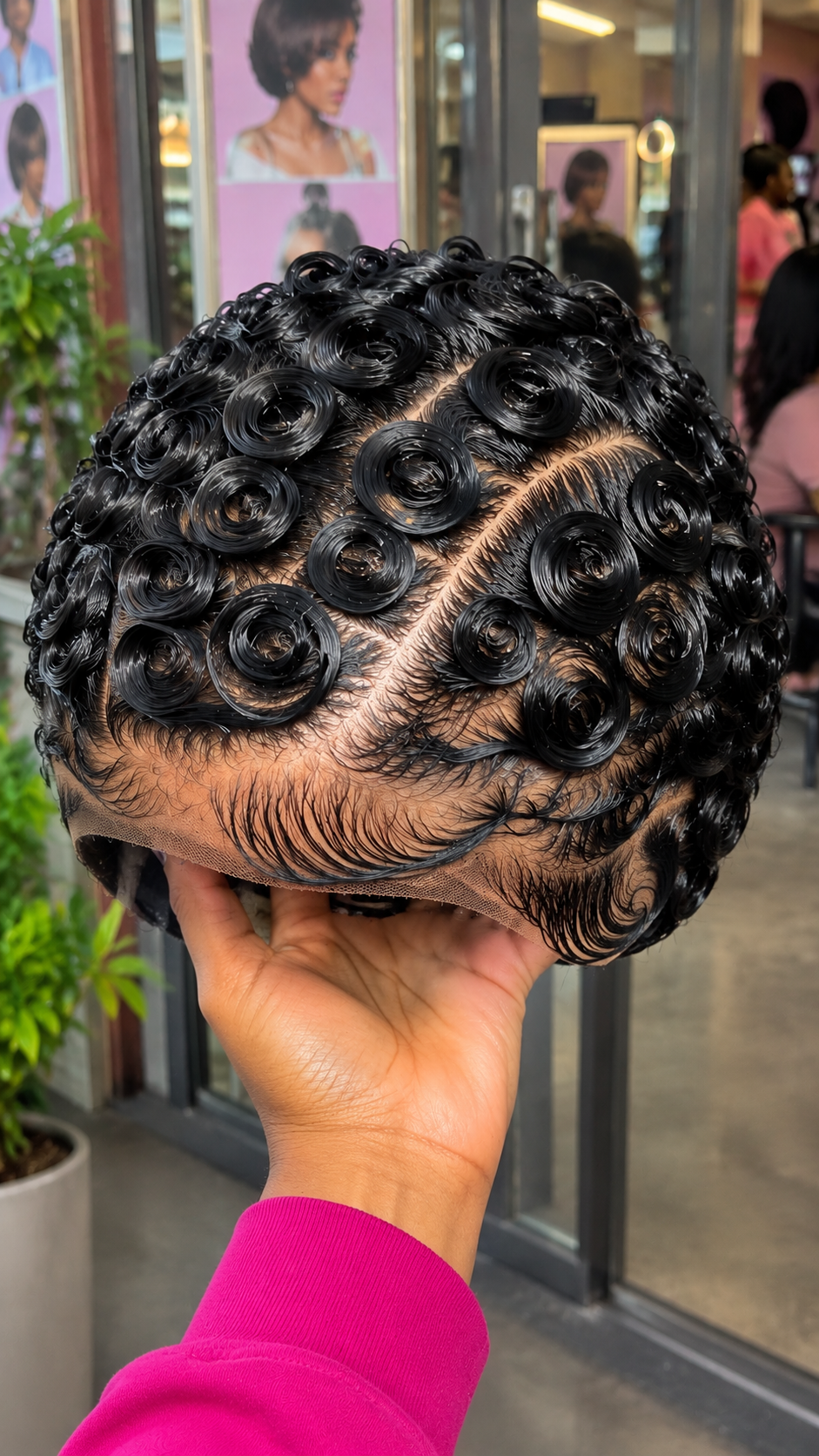
The photograph shows the wig supported in one hand, with front lace extending beyond the styled hair. From this angle, the curl placement and intersecting partings are especially clear. Larger loops sit among smaller rolls, while the front strands sweep into elongated curves near the temples. For anyone considering a black pin curl wig with patterned partings, the most important buying decision is finding a unit whose construction and styling can preserve that arrangement comfortably on the head.
The Partings Form a Map Through the Curls
A prominent curved line runs through the visible upper section, while another branches across the side of the arrangement. Smaller exposed spaces appear between neighboring curls. Together, they create a sectioned pattern without turning the hairstyle into a rigid grid. This is a key distinction when describing the reference to a maker. Asking only for a side part would leave out much of what makes the design recognizable. The placement of the divisions deserves its own discussion.


These lines should be assessed as part of the complete wig layout. Their width, direction, and relationship to the curls all influence the appearance. A very broad exposed strip could make a section look sparse, while a narrow line might disappear beneath adjacent hair. Ask the maker to show how the partings will look from above and from the front. Those views reveal whether the pattern remains intentional when the wig is positioned correctly rather than tilted in the hand.
The photograph does not establish that every visible line can be moved. Some divisions may depend on the placement of hair within the base, while others may be emphasized through setting. Ask how the proposed unit is made and what happens to the pattern after cleaning. If you expect to change the arrangement later, establish that before ordering. A finished design with fixed styling priorities can still be a good choice, provided those priorities suit the way you intend to wear it.
The curls vary in diameter. Several prominent circular rolls draw attention across the crown and front, while smaller curls occupy the spaces beside them. Their open centers make the pattern readable, and the strand direction follows the circular form. This variation gives the surface depth without requiring long hanging pieces. A recreation should retain that balance. Replacing every section with the same curl size would make the hairstyle look more uniform and less like the reference.
Many curls sit close to the base, although their outer edges rise enough to create dimension. They are arranged rolls rather than freely falling ringlets. Useful descriptions include sculpted pin curls, molded circular curls, and a short rosette curl set. Sellers may use those terms differently, so compare actual examples. A wig with loose spiral curls may provide a starting texture, but it should not be assumed to arrive with this deliberately sectioned finish.
The black color supports the detail by creating contrast between reflective strands and the darker centers of the rolls. The bright streaks visible across the hair follow the light; they do not establish a separate highlight color. If you want the unit black throughout, specify that clearly. Ask to see it in ordinary daylight so you can evaluate coverage and shape without relying entirely on a highly reflective finish or a carefully selected camera angle.
The Front Has a Different Rhythm
At the front, longer-looking strands leave the circular pattern and travel into sweeping curves. Fine individual hairs are visible across the lace, with more pronounced turns near the temple area. This lower arrangement connects the curls to the edge of the wig. It is more elaborate than a plain front, so it should be included in the styling brief. A supplier who recreates the crown but leaves the front unarranged will deliver a noticeably different result.
Decide how much of that front detail you want on your own unit. You may prefer the extended sweeps shown here, or you may want shorter, quieter curves. Either choice should be discussed before the final setting. Altering a strongly arranged front afterward can affect neighboring sections and require more extensive restyling. Explain which elements you consider essential and where the stylist can make adjustments for your fit and preferences.
Placement should be settled on the wearer, not inferred from this hand-held view. The front needs to sit appropriately in relation to the forehead, temples, and ear areas. Ask for a fitting before the final lace edge is customized whenever possible. The goal is to preserve the intended flow while making the unit comfortable and proportionate. A close copy of individual waves is less useful if the cap itself sits somewhere you did not intend.
Check the Shape Around the Entire Head
The visible silhouette is rounded and short, with curls continuing down the sides. It has enough fullness to avoid a flat crown, but the photograph does not establish how every section falls when worn. Request a back view and a view of the opposite side. You should be able to see how the crown connects with the lower sections and whether the nape has a deliberate finish. A detailed front cannot compensate for an unbalanced rear outline.
Discuss density through the finished appearance rather than choosing a percentage automatically. The rolled curls already create dimension. Adding substantially more hair could crowd the exposed partings or widen the sides. Ask the supplier how they plan to provide coverage while leaving the section pattern visible. Photographs of their completed work are useful evidence because density labels alone do not describe curl spacing, cap shape, or the way the hair is arranged.
Length measurements also need context. A listing may refer to stretched strands or the base before cutting, while your interest is the height and outline of the finished set. Ask which measurement is being used. If the wig still requires shaping, include that service in your plan and budget. Buying a suitable base for a stylist to finish is a valid route, but it should be distinguished from ordering a unit that already matches the reference.
Choose a Buying Route Before Comparing Prices
There are several ways to approach this style. A ready-made unit may be convenient if its size, construction, and curl arrangement already suit you. A custom order may allow more control over the partings and front details. A third option is purchasing a base approved by your stylist and booking the cut and set separately. Compare these routes according to the result you want, the professionals available to you, and the work that remains after delivery.
For a ready-made purchase, inspect the actual wig. A display image may show the maker’s work without representing the precise unit in stock. Ask for a rotating video that includes the crown, front, both sides, back, and interior. For a custom order, ask to see similar completed projects and agree on which features will be reviewed before dispatch. The most useful reassurance comes from specific examples and clear terms.
If a local stylist will complete the work, consult them before buying the base. They need to know whether its fiber, available length, and construction support the patterned divisions and circular set. An attractive short curly wig may still be unsuitable for a close recreation. Let the person responsible for the final styling explain what they need. That can reduce the risk of paying for a base that limits the result from the beginning.
Where To Buy This Wig
The exact maker is not established by the photograph. Search for wig boutiques, independent wig makers, and salon specialists who show short pin curl sets or molded wave work. Useful search phrases include “black patterned part wig,” “short pin curl lace wig,” and “sculpted curl pixie.” Use the search results to identify candidates, then examine their portfolios for the specific combination of exposed divisions, circular rolls, and an arranged front.
A strong portfolio should show consistency across several units and angles. Look at how the maker handles the spaces between curls, not only the shine of the hair. Check whether the crown remains proportionate from the side and whether the lower sections follow the head. Ask who performs the cutting and setting, and whether the same person will work on your order. These questions help establish what the supplier actually provides.
Send a clear inquiry with the reference attached. Explain that you want a short all-black unit with mixed-size circular curls, curved connected partings, and sweeping front strands. Request the verified material, cap measurements, construction, styling inclusions, and complete price. Ask whether the layout can be adjusted for your size. A concise but specific brief gives the maker a practical basis for responding instead of leaving them to decide which details matter most.
Before payment, read the return, cancellation, and alteration terms. For custom work, establish the expected completion window and any approval stage. For stock units, confirm that the photographed item is the one being supplied. Keep the written specification and seller responses with your order information. If the finished product differs, those records allow a focused discussion about the actual issue, such as missing divisions, oversized curls, or a different front arrangement.
Closure and Frontal Options Need an Explanation
The image shows front lace, but it does not verify the full lace dimensions or cap design. Ask for an interior photograph and a written construction description. A closure-based unit usually provides a more limited area for parting than a frontal, but the exact product specifications matter. The seller should explain which construction supports this particular layout and where the exposed lines can be placed. Choose according to the hairstyle rather than a label alone.
If the proposed base has a limited lace area, ask how the connected partings will be achieved across the visible sections. If a broader lace construction is recommended, ask what it contributes to the design and whether those areas remain usable after customization. You do not necessarily need the most extensive option available. You need a unit that can reproduce the intended arrangement and remain practical for fitting, wear, and later care.
For regular removal, ask whether a suitable glueless version is available and how the actual cap stays secure. An exterior photograph cannot verify that. If you prefer an installed finish, discuss the method with a wig stylist and follow the relevant product directions. Either route should include guidance on removal and handling. The securing method should support the cap’s position without pulling the front waves or shifting the parting pattern.
Five Budget Levels for a Complete Purchase
The following table uses illustrative budget bands in US dollars. These are planning examples, not verified prices for the pictured wig or a current market price list. Actual offers depend on documented materials, construction, cutting, setting, fitting, and included services, and may fall outside these bands. Use the tiers to organize your questions. A higher quote should come with a specific explanation of what additional work or materials it includes.
| Price Tier | Illustrative Budget | Purchase Route | Point to Confirm |
|---|---|---|---|
| Budget Base | Under $75 | A stock short unit or basic base for further preparation | Whether the patterned divisions and circular set require separate styling |
| Ready-Styled Stock | $75–$150 | A completed preset unit in a standard color and cap size | The exact wig, verified material, measurements, and care instructions |
| Salon-Finished Purchase | $150–$300 | A selected base combined with cutting, setting, or fitting | Which preparation tasks are included and which are charged separately |
| Custom Styling Order | $300–$500 | A project with agreed fit, parting layout, curl sizes, and front detail | The construction, review process, completion terms, and alterations |
| Premium Bespoke Package | Above $500 | An individually specified unit or package with additional appointments | The materials, workmanship, fitting, and aftercare supporting the total |
Compare the total needed to achieve a wearable result. One seller may include the cut, set, fitting, and lace preparation, while another quotes only for the base. Delivery, taxes, installation, and later resetting may be additional. Request a breakdown when several services are involved. If your budget is limited, prioritize a suitable cap and accurate arrangement before optional extras. Presentation packaging does not correct poorly placed divisions or an uncomfortable fit.
Leave room for maintenance if you expect professional help with resetting. Ask whether the original maker offers aftercare and whether a local stylist can maintain the verified material and construction. You do not need to commit to an arbitrary service schedule before trying the wig. However, you should understand what cleaning is likely to change and who can restore the style. That makes the initial purchase easier to assess as part of your routine.
Prepare for a Useful Salon Appointment
When booking, ask for experience with short wig molding, pin curls, and detailed parting work. Send the reference in advance and explain whether you need a new unit, fitting, installation, or restyling. If you already own the base, provide its material information and current photographs. The stylist needs enough detail to assess feasibility and reserve appropriate time. A general appointment for short curls may not account for the sectional arrangement shown here.
Measure using the supplier’s instructions and bring the wig to fitting over the hair preparation you plan to use regularly. Check the crown, temples, ear-area edges, and nape together. Turn your head and look down to assess stability. If you wear glasses, bring them so their arms can be considered near the side styling. A cap that feels very tight is not necessarily correctly fitted; positioning and even support matter too.
Agree on the silhouette before the final curl setting, then review the divisions and front waves. Ask for a view of the back as well as the front. If excess lace needs trimming, settle the cap placement first. Also clarify whether cutting, lace customization, setting, and securing are separate services. Before leaving, request a demonstration of ordinary handling and a small curl correction so you understand what can be adjusted at home.
Care for the Arrangement as Well as the Hair
The photograph cannot confirm human hair, synthetic fiber, or a blend. Obtain that information and the unit’s specific care directions from the supplier. Ask whether the circular curls are an underlying pattern or a temporary set, and whether the exposed divisions need to be recreated after cleaning. These details affect the ownership experience. A material label alone does not tell you whether the photographed arrangement will return without further styling.
Before each wear, inspect the front and crown for compressed sections. After wearing, check for residue, displaced curls, and any disturbance around the lower edge. Cleaning frequency should follow the supplier’s instructions and the condition of the wig, considering wear and product use. Ask what the unit is expected to look like after washing. If a reset is necessary, plan that step before an occasion when you need the complete finish ready.
Avoid brushing through the arranged curls as one mass. That can separate the rolls and obscure the pattern between them. Support the cap when lifting the wig, and use only the touch-up method recommended for its verified material. If heat is permitted, follow the specific directions supplied for the product. Do not assume that a sculpted appearance establishes heat compatibility or that adding more gel will restore an arrangement that needs resetting.
Store the unit on a suitable support with room around the curls. Avoid stretching the cap over an oversized form or pressing the front against another object. During travel, protect the crown from compression and keep the lace from folding beneath heavy items. Follow drying instructions fully before enclosed storage. Once the fit and set are correct, take front, side, and back reference photographs to help you or a future stylist preserve the intended design.
A Detailed Short Style With Clear Tradeoffs
The benefits are a compact length, an expressive curl pattern, and visible detail without shoulder-length hair. The partings add interest even within a single black color, while the front waves create a deliberate finish around the edge. The commitment is preserving that organization. Unsuitable brushing, compression, or a shifted cap can change the appearance substantially. This style is most practical when you have either the confidence to perform approved touch-ups or access to a professional who understands the set.
Before accepting the finished unit, inspect it in ordinary light from several angles. Compare the curl sizes, exposed divisions, front waves, and cap fit with the agreed specification. For a delivered purchase, complete that inspection before alterations that could affect return terms. The strongest result will preserve the balance visible in the reference: circular black curls separated by intentional curved lines, with a closely arranged front that connects the pattern to the wearer. Accurate ordering and fitting help those details work together.
Search Terms
black pin curl wig · curved parting pixie · patterned part lace wig · short rosette curls · sculpted black curl set · circular curl hairstyle · sweeping temple waves · black wig with untrimmed lace