
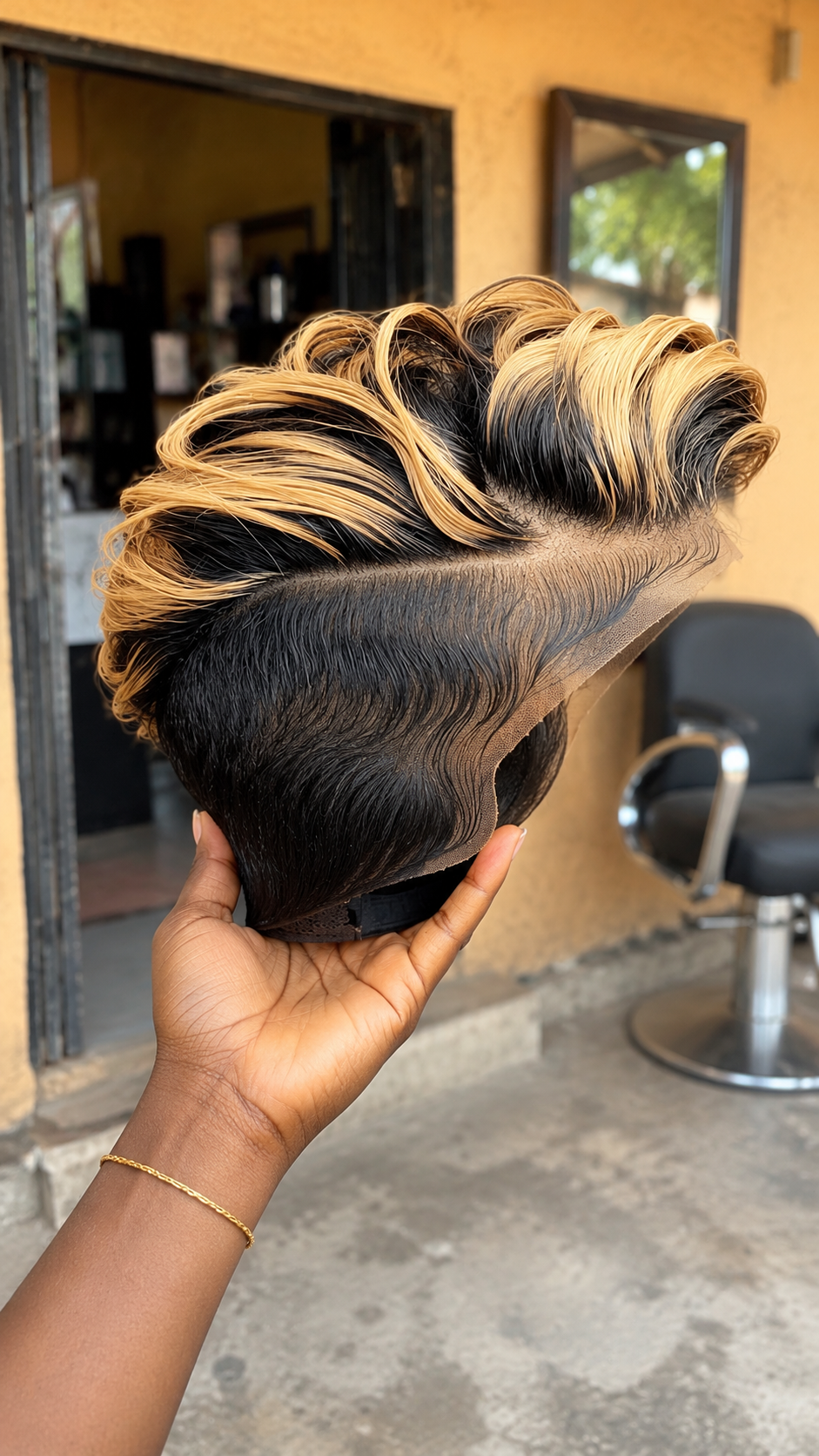
This black and golden blonde pixie wig is especially interesting because its appeal comes from the sweep rather than a dense covering of curls. The upper sections form loose turns and rolled ends, while the side lies much closer to the base. Held in one hand, the unit reveals excess lace and part of its lower cap edge. That makes the photograph a useful buying reference, provided the visible styling is separated from technical details that still need confirmation from a supplier.
The Side View Explains the Haircut
The photograph presents a pronounced side profile, making the difference between the top and lower section easy to study. Longer hair travels across the crown in broad arcs. The shorter dark side follows the head in shallow waves and narrows toward the lower edge. This contrast gives the hairstyle its shape. When requesting a similar unit, explain that you want the lower section to remain close and the upper section to retain movement, rather than asking simply for a short blonde-highlighted wig.


The visible part acts as a boundary between those two areas. It appears to run from the front toward the rear side, although the angle of the held wig affects how that line looks. A fitted front view and an overhead photograph would help establish its exact placement. Ask for those views before approving a custom order. A part that sits attractively on a display can appear different once the cap is positioned around an individual wearer’s forehead and temples.
Only one main side is clearly shown, so the opposite side and complete back should be discussed separately. Do not assume they repeat the visible arrangement. You may want a coordinated close finish on both sides, or a longer sweep that creates a different outline elsewhere. Ask the maker to show how they intend to complete the unseen sections. That conversation turns a strong photographic reference into a complete haircut specification.
Keep Black Visible Between the Golden Sections
The blonde is concentrated through the upper lengths, with substantial black remaining underneath and between the lighter pieces. That distribution creates the striped movement visible in the broad sweeps. It is different from a mostly blonde wig with a small dark root. If you want this contrast preserved, specify that the black base should remain prominent. Too much blonde through the lower sections would change the balance and reduce the distinction between the lifted top and close side.
The lighter strands appear warm and golden in this lighting. They are brighter than the black foundation without looking white or silver. However, a photograph cannot establish an exact commercial shade or coloring formula. Ask the supplier for a daylight sample of the blonde they propose. Clarify whether it leans toward gold, honey, or caramel. Those descriptions are often used broadly, and a more orange or much paler version would create a different impression.
Placement deserves as much attention as shade. The bright strands follow the length of the top sections, emphasizing each change in direction. Ask whether they will appear as distinct panels, finer streaks, or a mixture. Very thin highlights could produce a more blended result, while large pale sections might make the top look predominantly blonde. Use the reference to agree on the amount of contrast you want, including how the color continues through the back.
For a ready-made purchase, request a slow video of the actual wig in ordinary light. For a custom color order, approve a comparable sample before the work is completed where that service is available. Save the agreed reference with your written specification. This is useful if you later need a replacement or ask another stylist to maintain the appearance. A general request for gold highlights leaves more room for interpretation than a clear placement brief.
The Lifted Top Needs Direction, Not Just Volume
The upper hair is arranged into broad flowing sections with loose turns at the ends. It does not form the small, closely packed ringlets associated with many curly pixies. That distinction should guide your search and consultation. Useful descriptions include swept pixie top, highlighted short waves, and a lifted pixie finish. Product titles alone may not capture the difference, so study whether the seller’s examples actually show the same generous movement.
Asking for more volume everywhere could make this hairstyle less balanced. The height works because it is concentrated above the part while the lower section stays compact. Extra bulk through the sides might create a rounded shape that no longer resembles the reference. Show the stylist the outline you like and discuss where lift is necessary. A carefully directed top can look substantial without requiring the highest available density across the entire cap.
The rolled ends also need enough length to turn. A very short base may not support the same sweeping effect, even if the color is accurate. Before purchasing a wig for later restyling, ask the intended stylist whether its cut and material are suitable. It may be easier to begin with a slightly longer top and shape it appropriately, but that decision should come from the person doing the work rather than from a guess based on a listing.
What to Ask About the Close Side
The lower visible section is black and closely waved, with strands arranged in shallow curves. It provides a quiet surface beneath the more expressive top. Preserving this contrast is important. If the lower section is left long or made as raised as the upper hair, the finished unit will have a different silhouette. Ask the maker how they will keep the side close while providing the coverage required for the intended appearance.
The exposed line in the image belongs to a wig design; it should not be treated as proof of shaved natural hair. Ask how the separation is created within the unit and whether it remains visible after cleaning. Some styling details depend on a set that needs renewal. Others are supported more directly by the base and hair placement. Understanding that distinction helps you plan maintenance and choose a stylist who can reproduce the feature later.
Also discuss the finish around the ear and lower edge. The wig is held away from the head, so its final position on a wearer is not established. A side that looks appropriately short in the hand may need adjustment during fitting. Ask to see the unit on a suitable stand or, preferably, assess it during a fitting. The close section should follow the head comfortably while the longer top remains proportionate.
Where This Wig Comes From
The exact supplier cannot be identified from the photograph. Similar work may be available through independent wig makers, wig boutiques, and salons offering short wig customization. Search for businesses that show contrasting color placement and shaped pixie cuts in their existing portfolios. Terms such as “black blonde swept pixie wig,” “gold highlighted short wig,” and “side part wave pixie” can help locate candidates, but the actual examples should determine whether they suit your request.
A useful portfolio will show more than the front. Look for side and back photographs that demonstrate consistent shaping, along with daylight examples of the color. Ask whether the business supplies complete finished units or customizes a base purchased elsewhere. Either route can work, but you need to understand what the quoted service includes. If you must provide the base yourself, consult the stylist before buying it so its construction and length support the intended result.
Send the reference with a practical brief: a black foundation, warm golden sections through the longer top, broad sweeps, a visible side separation, and a close waved lower section. Identify which details are essential and which can be adjusted for fit. Then request the verified fiber, cap measurements, construction, finished length, and complete price. Specific questions give the seller an opportunity to explain their approach and make differences between offers easier to assess.
For stock units, request footage of the exact item being sold. For custom orders, agree on completion expectations, review photographs, and alteration terms before payment. Read the return conditions, particularly when coloring or cutting is involved. Keep the reference and written description together. If the delivered wig differs from the agreement, you can then identify the relevant issue clearly, whether it concerns blonde placement, top length, side bulk, or the position of the part.
Choose Construction for the Hairstyle You Want
The photograph shows excess lace around the front and visible side, but it does not establish its dimensions or grade. Ask the supplier for an interior image and a clear construction description. A closure-based wig offers a different working area from a frontal, and either may be combined with wefted sections elsewhere. The useful question is whether the proposed base supports the visible separation and front styling you want. A premium-sounding label cannot answer that on its own.
If the seller recommends a closure, ask how the side placement will be achieved within its available area. If they propose a frontal, ask which part of that wider front section is needed for the design. Also clarify whether the part can move later. A larger lace area may provide options, but changing direction can still require the top to be restyled. Decide whether you want a consistent finished look or expect to rearrange the hair regularly.
The hair material requires separate confirmation. Shine and visible strands cannot prove human hair, synthetic fiber, or a blend. Obtain the product description in writing and ask how the pictured sweep is created. It may be a temporary set, a manufactured pattern, or a combination of underlying texture and finishing. That information determines what happens after washing and what work is needed to restore the lifted sections. Choose the complete care experience, not just a material category.
Five Price Tiers for Planning an Order
The figures below are illustrative planning bands in US dollars. They are not verified prices for the photographed wig or a current market price list. Actual quotations depend on documented materials, construction, color placement, cutting, setting, and included appointments, and may fall outside these bands. Use the table to organize your questions and compare complete proposals. A higher price should be supported by a clear explanation of what additional work or materials it covers.
| Price Tier | Illustrative Budget | Option to Investigate | Detail to Confirm |
|---|---|---|---|
| Budget Base | Under $75 | A stock short wig or basic unit for further styling | Whether the golden placement and lifted top require separate customization |
| Prepared Stock Wig | $75–$150 | A completed preset style in a standard cap size | The actual unit’s color distribution, material, fit information, and care directions |
| Salon-Finished Option | $150–$300 | A selected base combined with cutting, shaping, or fitting | Which color and styling tasks are included and which cost extra |
| Custom Order | $300–$500 | A project with agreed measurements, top length, and highlight placement | The construction, review stage, alteration terms, and delivery condition |
| Premium Bespoke Package | Above $500 | An individually specified unit or package with additional services | The materials, workmanship, appointments, and aftercare supporting the total |
Compare the amount required to reach a wearable result. One offer may include only the base, while another includes the cut, color, set, and fitting. Delivery, taxes, lace preparation, installation, and future restyling may be additional. Request a written breakdown if several services are involved. If you need to reduce the total, prioritize the correct cap and accurate silhouette before optional extras. Packaging cannot correct a side section that sits too wide or a top that lacks enough length to sweep.
Include maintenance in your personal budget. If you want a stylist to restore the lifted top after cleaning, find out who can provide that service and what it involves. Ask whether the original maker offers aftercare and whether another professional can work with the verified material. You do not need a fixed appointment schedule before trying the unit, but you should understand the likely process. A detailed hairstyle is easier to enjoy when suitable help is accessible.
Use the Fitting to Set the Proportions
Measure according to the supplier’s instructions before choosing a cap size. Circumference may be one requirement, alongside front-to-nape or ear-to-ear measurements. These details matter when the separation needs to sit in a particular place above the temple. Do not rely entirely on a familiar size label from another purchase. Cap shapes differ, and a unit should sit comfortably without being pulled excessively tight to compensate for a mismatch.
Try the wig over the hair preparation you intend to use regularly. An uneven base can lift the close side or alter the apparent crown height. During fitting, assess the front, both temples, lower edges, and back together. Turn your head and look down to check stability. Bring your usual glasses if you wear them. Their arms should sit comfortably near the side section without repeatedly disturbing the cap or pressing against an awkward edge.
The mesh extending beyond the hair should be customized only after placement is settled. If you are unfamiliar with trimming lace, book a professional fitting. Discuss lace shade and any appropriate preparation for your preferred finish. The mesh visible in this photograph does not establish a match for every wearer. A fitted assessment also allows the stylist to judge how the front sweep should sit, rather than cutting the edge before the hairstyle has been positioned correctly.
Book a Pixie Specialist With Color Examples
Look for a wig stylist who can demonstrate short layered cuts, lifted finishes, and contrasting highlights. Send the reference before booking and explain whether you need a new unit, a fitting, installation, or a restyle. If you already own the base, provide its fiber details and current photographs. This gives the stylist enough information to assess feasibility and reserve time. A generic booking for a short curl service may not account for the broad sweeping top shown here.
During consultation, agree on the outline first. Establish how high the top should sit, how close the lower section should remain, and how the back will connect to both. Then review the golden placement and front direction. Ask whether you can inspect the fit before the final set. This order keeps attractive color details within the haircut you actually want. Also confirm whether cutting, coloring, setting, and lace preparation are separate charges or part of one service.
If regular removal is important, ask about a suitable glueless fit and how the actual cap remains secure. That cannot be established from the exterior image. If you prefer an installed finish, discuss the method with the stylist and follow the directions for the products used. Either choice should include removal and handling instructions. The securing system should fit your routine while allowing the front and side separation to remain consistently positioned.
Refresh the Sweep Without Expanding the Sides
The upper and lower sections need different handling because they serve different purposes. The top depends on lift and broad movement; the side depends on staying close. Avoid brushing the entire unit into one uniform shape. Ask the stylist to demonstrate a simple refresh that suits the verified material and setting method. A focused correction to one flattened section may preserve the rest of the style better than repeatedly combing through everything.
Before using heat, obtain the specific instructions for the unit. Synthetic hair should not be assumed heat-compatible simply because it has a rolled finish. If heat is permitted, follow the manufacturer’s limits. For human hair, ask about processing and the recommended approach to restoring the top. The blonde sections also deserve material-specific guidance. Do not apply a toning product automatically; first establish whether it is suitable and whether a color change is actually needed.
Build care around condition and use. Before wearing, check whether the front sweep or close side has shifted. After wearing, inspect for residue and disturbed sections before storage. Wash according to the supplier’s instructions and the condition of the unit, considering product use and frequency of wear. Ask what the hair will look like after cleaning and which finishing steps are required. A temporary set may need renewal even when the underlying hair remains in good condition.
Store the wig on a suitable support with room around the lifted top. Avoid stretching the cap over an oversized form or pressing the front against another object. For travel, protect the upper sweeps from compression and keep the lace from being folded under heavy items. Allow the unit to dry fully according to its care directions before enclosed storage. These habits help preserve the intended contrast between a raised top and a close lower outline.
Decide Whether the Styling Commitment Suits You
The main advantage is a short hairstyle with visible movement and contrast. You get the openness of a cropped lower section together with a longer top that can make a strong impression. The black base keeps the golden pieces distinct, and the sweep creates interest without long shoulder-length ends. The tradeoff is that the direction matters: flattening the top or expanding the sides can change the look substantially. It suits someone willing to protect the set or arrange appropriate maintenance.
Before accepting the finished unit, inspect the color placement, top length, side profile, and back in ordinary light. Compare them with the agreed specification, and check comfort during normal movement. For a delivered order, complete that inspection before alterations that may affect return terms. A convincing version should preserve the relationship visible in the reference: warm golden strands moving across black hair, a clearly separated close side, and a compact base supporting the lifted finish. Accurate ordering and fitting make those details easier to wear well.
Search Terms
black and blonde pixie wig · golden highlighted short wig · swept top pixie · side part lace wig · close waved sides · black wig with golden streaks · lifted short waves · pixie wig with untrimmed lace