
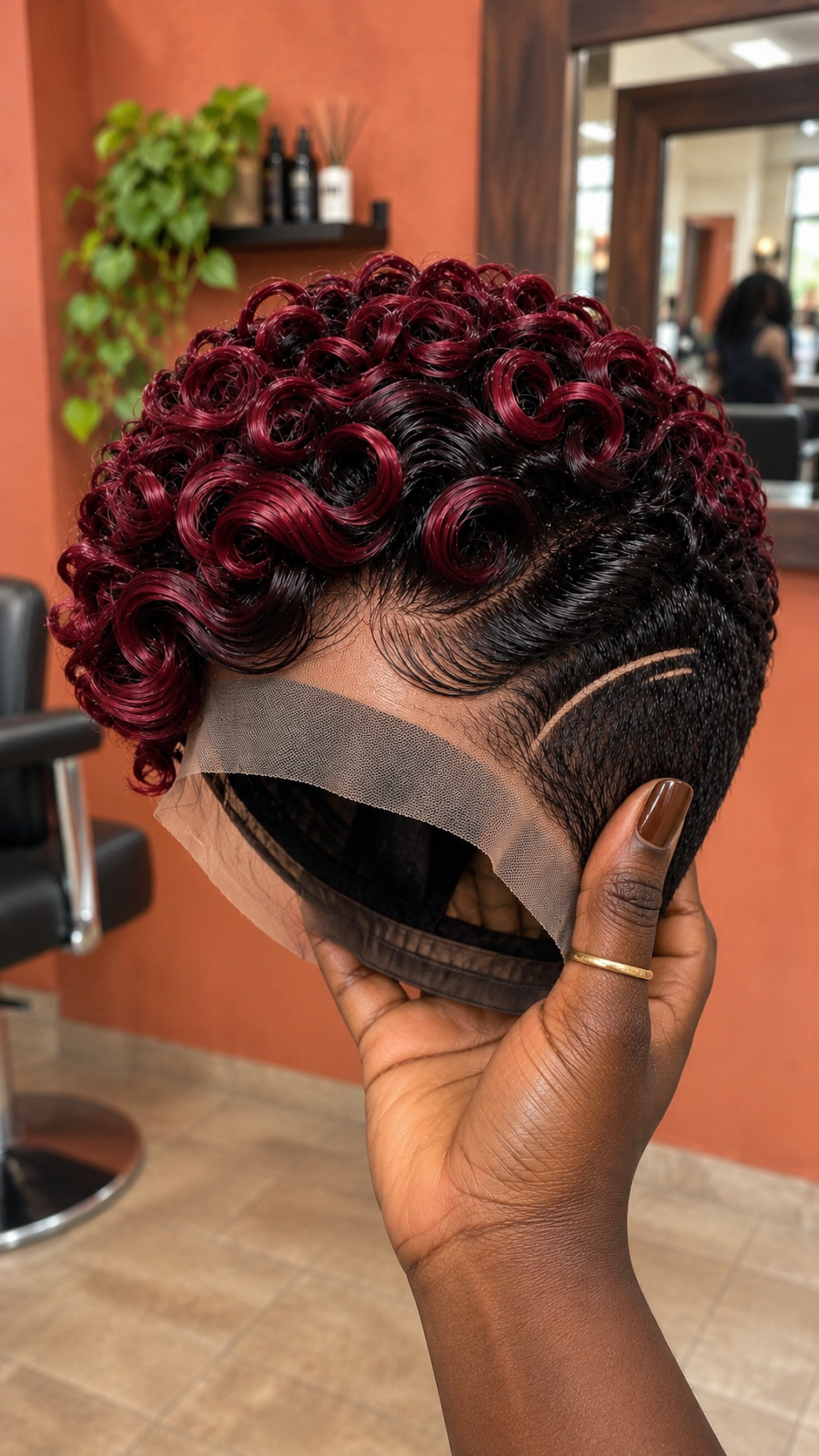
A beautifully arranged short wig can make an unforgettable impression when its color, curls, and side detailing are carefully balanced. This wine-red pixie wig combines glossy burgundy ringlets, deep black roots, a sweeping front hairline, and two narrow curved accents along the temple. The hairstyle brings together the richness of dark red coloring and the precision of sculpted hair, creating a distinctive short look without excessive length or unnecessary decoration.
The wig is photographed inside a beauty salon with warm terracotta walls. It is supported in one hand, allowing the viewer to examine the circular curls, dark tapered side, exposed lace, and part of the interior foundation. The upper crown contains numerous medium and large burgundy loops with visible circular openings. Beneath them, black strands sweep backward from the forehead before transitioning into a compact side section decorated with slender carved lines.
What makes this particular hairstyle appealing is its restrained use of contrast. The upper hair displays rich burgundy, cherry-wine, and dark crimson reflections, while the roots and lower side remain predominantly black. This creates noticeable depth without requiring a large collection of unrelated colors. The curls provide fullness, while the closely arranged temple hair keeps the overall silhouette compact.


For women interested in short curly wigs, this design offers an opportunity to enjoy expressive color and detailed styling in one hairpiece. For wig businesses and salon professionals, it also demonstrates the importance of accurate curl placement, controlled coloring, and well-proportioned side artwork.
The Wine-Red Crown Is the Main Attraction
The upper section contains numerous circular curls arranged into a rounded crown. Some formations resemble open ringlets, while others are rolled more tightly into compact spiral shapes.
The largest curls appear around the upper front and center, creating noticeable volume. Smaller supporting curls continue toward the sides and back, maintaining coverage without making every section equally full.
Unlike traditional long curly wigs, the strands remain positioned close to the crown rather than falling over the shoulders.
This compact arrangement allows the color and individual curls to remain clearly visible. A custom wig maker should preserve the rounded shape and mixture of curl diameters instead of arranging identical curls throughout the hairpiece.
Deep Burgundy Creates Rich Color Dimension
The visible curls display a combination of dark wine red, burgundy, black cherry, and subtle crimson reflections. Their color appears deeper in shadow and brighter where light catches the curved strands.
The result is not a uniform bright red. Darker areas remain visible within the ringlets, helping each circular formation stand out.
This tonal variation is particularly attractive on short sculpted wigs because the individual curls are positioned close together. Different reflections emphasize the direction of the strands without requiring contrasting blonde highlights.
For custom coloring, buyers should request a rich wine-red shade with darker depth rather than bright scarlet or copper-orange hair.
The Dark Roots Make the Burgundy Curls Stand Out
Deep black hair remains visible beneath the red ringlets and along the foundation of the crown. These dark roots create shadows between neighboring curls and connect the upper hairstyle with the lower side.
The contrast is essential to the photographed appearance. Burgundy strands appear more prominent when they bend over a nearly black background.
Uniformly coloring the entire wig bright red could remove much of this depth and make the finished hairstyle look different.
A professional colorist should therefore preserve the darker foundation when recreating the design.
Open Circular Ringlets Give the Crown Its Shape
Several curls have hollow circular centers. These openings allow darker hair to remain visible beneath the reflective outer strands.
The arrangement creates an almost rosette-like appearance across parts of the crown.
The openings are important styling details rather than empty spaces that automatically require additional hair. Overfilling the crown could cause neighboring curls to blend together and obscure their shapes.
For a custom order, customers should request clearly distinguishable circular curls with a mixture of larger and smaller openings.
The Crown Contains Different Curl Sizes
The ringlets are not identical throughout the hairstyle. Some form broad, open loops, while others are smaller and more tightly wound.
The larger curls create focal points near the forward crown, while smaller sections fill the surrounding areas.
This variation gives the hairstyle its rounded appearance and prevents the upper hair from looking like a rigid arrangement of repeated circles.
A custom stylist should use curl sizes that complement one another rather than applying one uniform curl diameter across the entire wig.
The Front Ringlets Form a Beautiful Curly Fringe
Near the front, several burgundy curls curve forward before turning inward. These formations create a decorative fringe without producing long bangs.
Their position gives the upper hairstyle a softer appearance while allowing the dark hairline beneath to remain visible.
The forward curls are especially noticeable because their wine-red surfaces contrast with the deeper black roots.
A professional recreating the hairstyle should preserve this placement rather than allowing the curls to hang excessively low across the forehead.
The Curly Crown Remains Compact
Although the crown contains substantial curl detail, the overall hairstyle remains short and rounded. The upper hair creates fullness without forming an exaggerated vertical crest.
The lower side is much closer to the foundation, producing contrast between the raised ringlets and the flatter hair.
This difference in volume is one of the defining characteristics of the design.
Increasing the height of every curl or extending large ringlets throughout the side could change the proportions and obscure the decorative temple details.
The Hairline Uses Fine Sweeping Black Strands
Beneath the circular burgundy curls, fine black strands travel backward from the front hairline. Their arrangement creates a gradual transition between the lace and the raised upper hair.
These strands are comparatively flat and closely aligned. They do not form the same large circular curls found across the crown.
The different styling techniques create an attractive contrast in movement.
During professional installation, these finer strands should be examined before trimming or thinning. Removing them automatically could change the appearance of the front.
The Sweeping Side Wave Connects the Crown and Temple
Along the upper side, black hair follows a flowing backward direction. Its closely arranged strands create a broad curved section beneath the burgundy curls.
This side wave is flatter than the crown and produces narrow glossy reflections across the dark hair.
The movement helps connect the raised ringlets to the shorter temple section.
A custom stylist should preserve the backward direction rather than adding circular curls across the entire side.
Two Curved Temple Accents Complete the Design
The visible temple contains a pair of narrow exposed lines within the closely arranged black hair. One prominent curve travels backward above the ear, while a shorter neighboring accent follows a related direction.
These markings create a restrained barber-inspired appearance without dominating the hairstyle.
The narrow lines contrast with the darker surrounding strands, making their shape recognizable.
A faithful recreation should preserve the curved arrangement and approximate spacing rather than replacing the accents with unrelated zigzags or extensive shaved artwork.
The Temple Lines Need Accurate Spacing
The exposed lines depend on retaining enough dark hair around and between them. This hair creates the boundaries that keep the markings visible.
If the channels are widened excessively, their shapes may become less precise.
Because hair removed from a wig cannot naturally grow back, cutting should be planned carefully.
For custom production, the stylist should map the artwork on the correctly sized wig foundation before making permanent changes.
The Lower Side Has a Tapered Appearance
Beneath the curved accents, the hair becomes shorter in appearance and follows the foundation closely.
The lower section remains predominantly black, with fine strands creating coverage along the perimeter.
It should not be interpreted as a completely shaved area.
This compact side helps balance the fuller burgundy crown and keeps the hairstyle within the proportions of a short pixie.
The Dark Side Should Remain Visually Separate
The contrast between burgundy curls and black side hair is central to the design.
Allowing large red ringlets to cover the entire temple could obscure the decorative lines and reduce the precision of the side.
Similarly, coloring every section burgundy would remove the contrast that makes the upper curls particularly noticeable.
A professional should therefore preserve the darker side and its closely arranged strands during both production and later maintenance.
The Rear Should Continue the Rounded Curl Pattern
The photograph provides a detailed view of the crown and visible temple, but the complete rear is not shown.
Before approving a custom wig, buyers should request a direct back photograph.
The rear should continue the circular curl arrangement while becoming appropriately compact toward the nape.
A balanced back is important because a wig that looks full from the front may have a different silhouette when viewed from behind.
The Wig Has a Strong Color-to-Shape Relationship
The dark red color is concentrated around the areas with the greatest curl volume. The lower side remains darker and flatter.
This gives the hairstyle a clear visual structure. The eye is drawn first to the glossy burgundy crown and then to the smaller decorative details beneath it.
A custom maker should coordinate color placement with the curl arrangement rather than treating the coloring and styling as unrelated processes.
The finished result should preserve both the dark root foundation and the compact black temple.
The Lace Remains Extended Around the Front
Beige-toned lace extends beyond the front hair-bearing area and along the visible side.
This indicates that the wig has not yet been trimmed for an individual wearer.
The extra material allows a professional installer to position the unit before establishing its final perimeter.
The photograph does not verify HD lace or another specific commercial grade. Buyers should request the actual lace specification from the supplier rather than relying on visual assumptions.
The Interior Cap Is Partially Visible
The open underside reveals a dark interior foundation with fabric sections and stitching.
However, the complete fastening arrangement cannot be established from the photograph.
Before purchasing, request a full underside image of the actual wig.
The seller should confirm cap size, adjustment components, available attachments, and the recommended installation method.
Glueless Installation Requires Confirmation
Some wig foundations support adhesive-free wear through a combination of suitable sizing and fastening components.
However, the presence of lace or an interior cap does not automatically establish that a particular unit can be worn securely without adhesive.
Customers who prefer glueless installation should request explicit confirmation from the seller.
The chosen method should also take comfort, fit, and the condition of the wearer’s hairline into account.
Correct Cap Sizing Protects the Side Design
The front curls, temple accents, and lower side hair are fixed to the wig foundation.
If the cap sits too far forward or backward, the decorative lines may appear in an unintended position relative to the temple.
Correct sizing therefore influences both appearance and comfort.
For custom orders, follow the manufacturer’s measuring instructions. Head circumference, front-to-nape, and ear-to-ear measurements may be requested depending on construction.
Choosing Between Lace Front and Full Lace Construction
Lace-front wigs typically place lace along the front hairline, while full-lace constructions use a more extensive lace foundation.
Closure wigs offer another option, usually with a more limited lace area, and frontal constructions may provide additional front hairline coverage.
The best choice depends on the desired styling flexibility, available budget, and the position of the decorative hairline.
The photograph does not establish the full construction of this particular wig, so buyers should confirm the actual cap design before selecting an installation plan.
Hair Density Should Support the Circular Curls
This hairstyle requires enough hair to create a full rounded crown, but excessive density could obscure the individual circular openings.
The most appropriate density depends on the chosen hair material, cap construction, and curl diameter.
A supplier may offer standardized density choices, but the percentages used by different manufacturers do not always produce identical results.
Buyers should evaluate photographs of completed wigs rather than choosing density based on a number alone.
Why Short Length Still Requires Skilled Styling
The wig is compact, but short hair does not automatically mean simple construction.
Its crown contains numerous deliberately rolled curls, and its front requires careful directional styling.
The side also contains narrow decorative lines that must be created without removing excessive surrounding hair.
These details may require specialist labor even though the finished wig is relatively short.
Who Might Enjoy This Burgundy Pixie Wig?
This hairstyle can appeal to women who enjoy rich red colors but prefer short hair.
The compact silhouette provides noticeable curl detail without long strands falling around the shoulders.
The dark side creates an elegant contrast, while the curved temple accents give the hairstyle an individual finish.
It may be particularly suitable for customers who enjoy maintaining a carefully set hairstyle rather than changing their curl pattern frequently.
Where to Find a Stylist for Burgundy Ringlets
Custom wig studios, specialist lace-wig makers, and salons experienced with sculpted pixie hairstyles are practical places to begin.
The professional should understand how to create circular ringlets with open centers while preserving the dark roots.
Experience with precision wig-side cutting is also useful because of the narrow curved temple accents.
When evaluating portfolios, look for detailed crown photographs, accurate side artwork, and examples of rich burgundy coloring.
Where To Buy This Wig
Comparable hairpieces may be available through specialist wig retailers, beauty supply stores, custom wig makers, and salons offering reference-based production.
A ready-made burgundy curly wig may provide a suitable foundation, but it might not reproduce the exact crown or side lines.
Custom production offers greater control over curl diameter, root depth, hairline direction, and temple detailing.
Before purchasing, confirm whether the supplier offers a completed wig or an unfinished foundation requiring additional services.
How to Order the Correct Burgundy Shade
Begin by identifying the desired color as dark wine red with black-cherry reflections and a deep root foundation.
Ask the seller for a photograph of the actual available color under neutral lighting.
Color descriptions alone may not be sufficient because burgundy, cherry red, and auburn can differ substantially between manufacturers.
If the wig is made from human hair, discuss the condition and processing history before requesting additional coloring.
Booking a Salon Appointment for the Complete Look
The required appointment depends on whether the wig arrives fully styled.
A finished unit may need professional fitting, lace trimming, and minor restoration of displaced curls.
An unfinished wig may require color work, circular curl setting, hairline preparation, and precision side detailing.
When contacting the stylist, provide the reference photograph and explain that the design includes dark burgundy ringlets with a compact black temple.
Preparing a Custom Production Brief
The crown should contain medium and large wine-red ringlets with visible circular openings.
The roots and lower side should remain dark black or very deep brown.
Fine front strands should sweep backward beneath the curls.
The temple should contain two narrow curved accents within the closely arranged dark hair.
The lower side should remain compact, with the rear continuing into a proportionate short silhouette.
Finally, confirm the hair material, cap size, lace specifications, and installation preferences.
Approval Photographs Should Reveal the Side Details
A direct side photograph should show the curved temple lines and the dark hair surrounding them.
An elevated crown image should reveal the distribution of burgundy ringlets and their open centers.
A frontal photograph should document the position of the curls and fine hairline strands.
A rear view should confirm complete coverage, while an underside photograph should establish the actual cap construction.
What Determines the Cost of This Wig?
The total price may depend on fiber quality, color processing, the number of curls requiring individual setting, cap construction, and the precision of the temple detailing.
Installation and shipping may be additional expenses.
Customers should compare fully completed wig prices rather than assuming every inexpensive burgundy curly foundation includes the same professional styling.
Estimated Pricing for Wine-Red Pixie Curl Wigs
| Category | Illustrative Price Range | Potential Scope |
|---|---|---|
| Premium Custom | $340–$625+ | Higher-grade hair, personalized cap sizing, deep burgundy coloring, individually arranged circular curls, detailed temple work, and professional lace preparation. |
| Standard Custom | $205–$380 | Prepared wine-red ringlet crown, dark roots, curved side accents, and standard cap options. |
| Basic Human Hair | $120–$230 | A human-hair foundation requiring coloring, curl setting, hairline styling, and fitting. |
| Premium Synthetic | $80–$170 | A quality pre-colored alternative with set circular curls and potentially reduced routine restyling. |
| Basic Synthetic | $40–$100 | A budget interpretation with potentially simpler curl placement, color depth, side detail, or cap finishing. |
These figures are illustrative budgeting estimates rather than verified market quotations for the photographed wig. Actual costs vary by supplier, location, material, styling labor, shipping, and installation.
Understanding the Advantages of Human Hair
A human-hair version may offer flexibility for professional restyling, depending on its quality and processing history.
Individual circular curls may be reset if they loosen, and selected sections of the hairline may be restored separately.
However, burgundy-colored human hair may have undergone chemical treatment, making its condition particularly important.
Professional assessment is advisable before repeated heat styling or additional color processing.
Synthetic Hair May Retain Its Original Curl Pattern
Some quality synthetic fibers can maintain pre-set ringlets with comparatively limited daily manipulation.
This may appeal to customers who prefer maintaining one specific hairstyle.
However, heat tolerance varies by fiber, and conventional permanent hair dye should not be assumed suitable.
Always follow the manufacturer’s recommendations for cleansing, drying, and styling.
Daily Care for the Circular Burgundy Curls
The circular curls should be handled gently to preserve their individual shapes.
Avoid repeatedly pulling apart neighboring ringlets or brushing the entire crown aggressively.
If individual curls become displaced, targeted restoration may help preserve the overall appearance.
The correct method depends on whether the hair is human or synthetic and how the curls were originally set.
Washing Without Disturbing the Crown
Before cleansing, photograph the crown from above to document the original curl arrangement.
Use cleansing products suitable for the confirmed fiber and avoid aggressive rubbing.
The wig should be allowed to dry without pressure flattening the circular ringlets.
If necessary, individual curls can be restored using techniques appropriate for the actual material.
Maintaining the Deep Burgundy Color
Wine-red shades may change in intensity through washing, heat exposure, and normal use, particularly when the hair has been chemically colored.
For a human-hair version, a professional colorist can assess whether a color refresh is appropriate.
The dark roots should remain part of the intended design rather than being covered uniformly with brighter red.
Synthetic wigs should not be recolored with conventional permanent dye unless the manufacturer confirms compatibility.
Protecting the Black Root Foundation
The dark roots provide contrast beneath the burgundy ringlets.
They also connect the upper curls with the lower temple hair.
When restoring color, the original distribution should be preserved rather than applying one bright shade across the entire unit.
This helps maintain the depth and circular definition of the crown.
The Temple Accents Require Gentle Maintenance
The narrow exposed lines are permanent parts of the wig’s side design.
They should not be widened automatically during routine maintenance.
Fine strands covering the exposed paths may be carefully repositioned without cutting additional hair.
If professional refinement becomes necessary, use the original side photograph to preserve the curvature and spacing.
Avoid Excessive Styling Product
The burgundy ringlets already reflect light strongly. Heavy oils and waxes may cause neighboring curls to adhere together and lose their separation.
Product buildup may also make the color appear less distinct.
Choose styling products appropriate for the confirmed fiber and apply them conservatively.
Protecting the Lace During Installation
Before trimming, the installer should position the wig and evaluate the front hairline.
The dark temple accents should also be checked to ensure they fall in the intended location.
Avoid pulling directly on the lace or delicate curl sections while adjusting the cap.
Only after the fit is approved should excess material be removed.
Storing the Wig Correctly
A suitable wig stand or mannequin head can help preserve the rounded crown between wears.
Avoid stacking the wig under other hairpieces or compressing the curls against hard surfaces.
The decorated side should remain free from pressure that could shift hair across the exposed lines.
Make sure the hair and cap are fully dry before storage.
Benefits and Limitations of This Style
The main advantages include its compact length, distinctive burgundy color, full circular crown, and precise decorative temple accents.
It offers the visual richness of a curled hairstyle without the length of a traditional curly bob.
However, the ringlets may require careful maintenance to preserve their sculpted openings. The dark red color may also need additional attention if the wig is made from processed human hair.
Buyers should weigh the visual appeal against their preferred styling routine and maintenance budget.
The Appeal of a Wine-Red Sculpted Pixie
This hairstyle brings together a rounded crown of glossy burgundy ringlets, dark black roots, finely arranged front strands, and restrained curved temple detailing. The red curls provide warmth and volume, while the closely arranged dark side creates contrast and precision.
For buyers, the most important checks are curl diameter, visible circular centers, color depth, root placement, temple-line accuracy, cap fit, and verified material information.
For wig businesses, detailed crown and side photographs are particularly useful because they reveal the craftsmanship more clearly than a general description of a burgundy curly wig.
A faithful recreation should maintain the wine-red crown and dark compact side without unnecessary highlights, excessive volume, or unrelated carved patterns. The hairstyle’s strongest quality comes from its combination of rich color, circular curls, and precisely arranged side details.
Search Terms
wine red pixie curl wig · burgundy ringlet crown · curved temple accent wig · black cherry short curls · dark root red lace wig · sculpted burgundy pixie · glossy wine red hairpiece · short red circular curls