
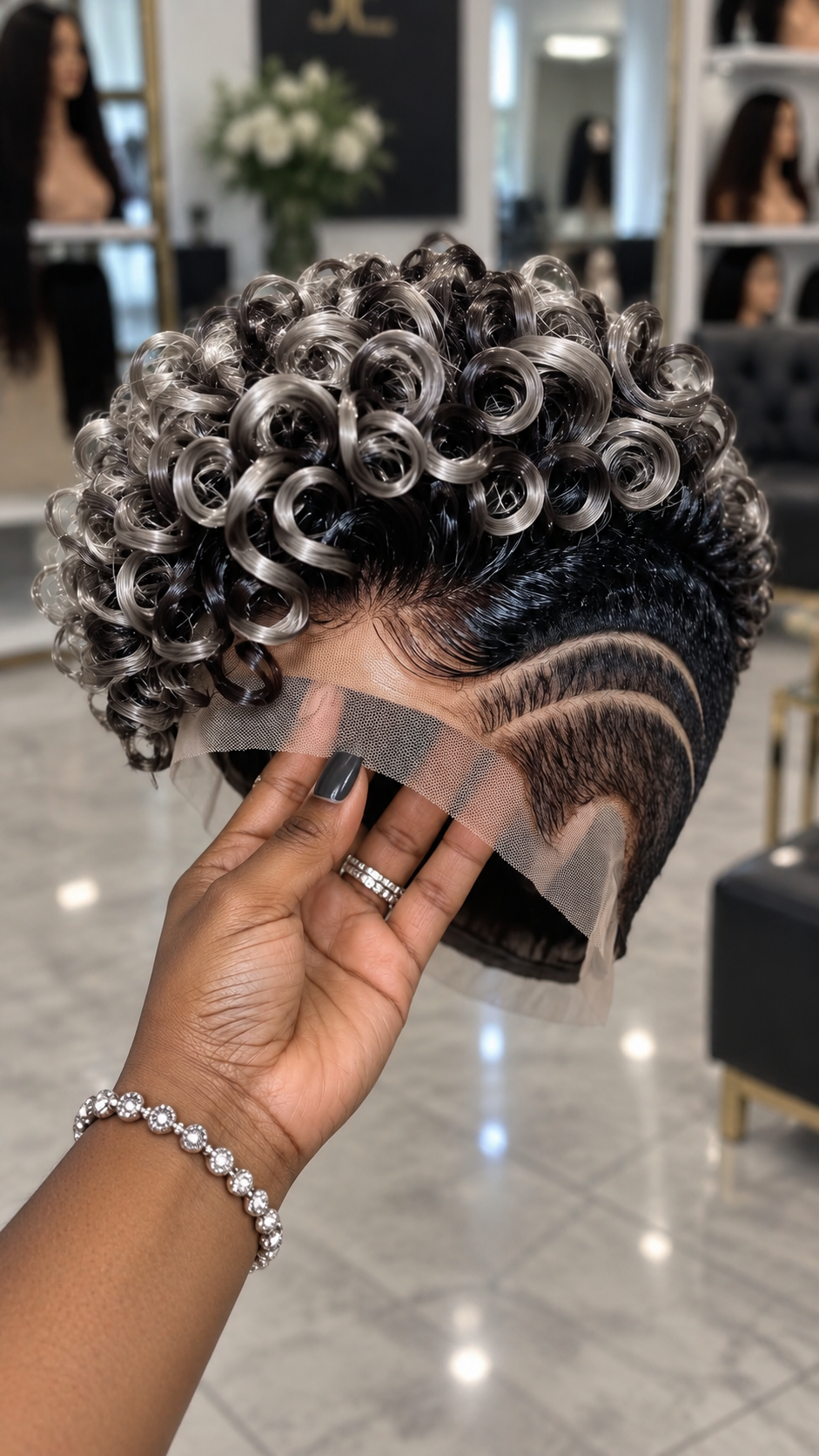
This is a useful reference for anyone who wants a short wig with noticeable color placement and deliberate side detailing. The photograph shows the unit held in one hand, with excess lace still attached around the front and temple area. Its finished appearance on a wearer will depend on fitting, positioning, and customization. However, the visible styling already establishes the main priorities for an order: preserve the black foundation, retain the silver-tipped ringlets, and keep the two side curves separate and clearly visible.
Silver Placement Makes the Difference
The light color is concentrated through the upper curls, where it outlines their open centers and rounded edges. Darker hair remains visible between the silver sections, giving the crown depth. This is different from an all-over silver wig or a uniformly blended gray style. When discussing a recreation, explain that you want contrast within the curls. If the maker replaces too much of the black with silver, the hairstyle will lose the dark structure that makes the lighter pieces stand out.


Several ringlets appear light along their outer lengths while remaining darker closer to the base. Other pale strands sit among predominantly black curls. The photograph does not establish the precise coloring method used, so the safest approach is to describe the placement you want reproduced. Ask the supplier whether they can show a comparable result in ordinary light. Color technique names can be interpreted differently, while a clear visual agreement helps establish how much silver should appear across the finished crown.
The shade itself reads as a cool, reflective silver, with some sections appearing pale gray where the light is strongest. It does not look like a warm blonde accent. Request a color sample or daylight video before ordering, particularly if you want to avoid beige or yellow tones. Ask whether the proposed shade is silver, platinum, gray, or a mixture, and confirm the appearance against the black base. Those terms overlap in product listings, but they can produce noticeably different results.
Decide how the lighter color should continue beyond the visible front and side. The image provides a strong view of the crown, but it does not reveal every section at the back. For a custom order, specify whether the silver should remain concentrated on top or continue into the rear curls. This prevents an otherwise close recreation from arriving with an unexpected pale back section. Color distribution should be agreed around the whole wig, not only across its most photogenic angle.
Two Curves Give the Side Its Structure
The visible side contains two exposed curved lines separated by a narrow band of dark hair. Their direction follows the head above the ear-area opening. They are an important part of the design because they introduce spacing into an otherwise dark, close-fitting section. The curves also connect visually with the rounded curls above them. When requesting this detail, identify both lines and the hair between them rather than asking generally for a patterned side.
The photograph shows a wig, so these details should not be mistaken for proof of shaved natural hair. Their appearance depends on how the unit has been constructed and styled. Ask the maker how the exposed lines are created and whether they remain visible after cleaning. You should also know whether their position can be adjusted during fitting or is fixed within the design. Those answers help you choose an appropriate base and understand the maintenance involved.
Spacing is especially important. If the two lines sit too close together, the dark band between them may become difficult to distinguish. If they are too far apart, the patterned section may occupy more of the side than you intended. Ask for a fitted side photograph before the final setting is approved. A design that looks proportionate in the hand may sit differently around an individual temple, particularly if the cap size or front placement changes.
Do not assume the opposite side repeats this treatment. It is not fully shown. Some wearers may prefer the twin curves on one side with a quieter finish on the other; others may want a coordinated design across both sides. Discuss that choice explicitly. The maker should also explain how the patterned area transitions into the back. Agreeing on those unseen sections creates a complete specification rather than leaving half the haircut to interpretation.
Keep the Ringlets Open and the Silhouette Balanced
The crown curls are rounded spirals with visible open centers. They have more lift and separation than the closely styled hair beneath them. Some turn forward, while others face outward or overlap neighboring sections. This variation gives the top movement without requiring long strands. A recreation should preserve recognizable ringlets rather than becoming a brushed-out mass. Tell the stylist that the individual curl shapes matter as much as the overall fullness.
The contrast in height supports the cropped outline. Fuller curls sit above close sides, allowing the wig to look substantial without becoming equally wide everywhere. Increasing density across the entire cap could change that balance. Instead of choosing the highest advertised percentage automatically, show the maker the outline you want. Ask how they will provide coverage while keeping the side section compact and leaving enough space for the silver curls to remain distinct.
Length should also be discussed in terms of the finished set. A strand measurement does not tell you how high a ringlet will sit once it is shaped. Ask whether the supplier’s stated length refers to stretched hair, the original base, or the completed cut. For this style, the important result is a short, rounded crown with controlled sides. A longer curly unit may be a possible starting point, but it should not be presented as an equivalent finished product without the necessary cutting and setting.
Get The Details On This Wig
The exact maker cannot be established from the photograph. To find a similar black and silver curly pixie wig, begin with wig specialists whose portfolios show short shaped cuts, contrasting crown colors, and detailed side work. Search phrases such as “silver tipped curly pixie wig,” “black wig with silver ringlets,” and “short curl wig with curved side lines” can help locate relevant examples. Use the results as a shortlist, then compare the actual styling rather than relying on product titles.
Look for clear views of the front, both sides, crown, and back. The most relevant portfolio examples will show consistent curl work and balanced shaping beyond a single flattering angle. Ask whether the business supplies complete wigs or customizes units purchased elsewhere. If you are buying a base separately, consult the person who will finish it before placing that order. They can explain whether its fiber, construction, and length are suitable for the silver placement and close side detailing you want.
Send the reference with a brief written specification. Identify the dark base, silver concentrated through the crown curls, open ringlets, compact side section, and two curved lines. Then list the choices that remain personal, such as cap size, exact crown height, and whether the opposite side should repeat the design. This gives the supplier a clear starting point without asking them to guess which parts of the photograph are essential to you.
Before paying, request the verified fiber description, cap construction, color details, included services, and total cost. Ask whether the wig arrives fully styled and whether lace preparation is included. For a custom order, agree on a completion estimate and a review stage before dispatch. For a ready-made unit, request a video of the actual item. Keep the written terms and specification together so the finished purchase can be checked against something more precise than a general promise of similarity.
Choose Construction Around the Patterned Area
Excess lace is visible around the front and side, but the photograph does not establish its dimensions or grade. Ask the seller for an interior image and a description of where the lace begins and ends. A closure-based wig provides a different working area from a frontal, and either may be combined with wefted sections elsewhere. The appropriate construction depends on how the front and curved side details will be achieved. A familiar label should lead to an explanation, not replace one.
If a supplier proposes a closure unit, ask whether it can support the specific visible side arrangement. If they recommend a frontal, ask which part of the broader lace area is needed for the design. You do not necessarily need the most extensive construction available, but you do need one that supports the intended result. Also ask whether the lines are permanent features of the unit or part of a set that another stylist will need to recreate later.
For a glueless option, request a clear explanation of how the cap stays secure. An adjustable band, straps, and other components should be described according to the actual unit. The exterior image alone cannot verify glueless suitability. If you prefer an installed finish, discuss that with a wig stylist and follow the directions for the products used. Either approach should preserve the placement of the patterned side while keeping the cap comfortable during ordinary movement.
Fit Determines Where the Curves Land
Measure using the supplier’s instructions before choosing a size. Circumference may be only one of the measurements required; some makers also ask for ear-to-ear and front-to-nape dimensions. These details matter when a design needs to sit above the ear rather than drifting too low or too far backward. A cap that is merely tight is not necessarily well fitted. The aim is even positioning that supports both the front hairline and the side pattern.
Assess the wig over the hair preparation you expect to use regularly. An uneven base can lift the crown or push one side outward. During fitting, check the front, temples, ear-area openings, and nape together. Turn your head and look down before deciding that the position is correct. If you wear glasses, bring them. The arms should be considered around the patterned section so that daily accessories do not repeatedly disturb the placement you have chosen.
Trim lace only after the position is settled. The mesh visible here extends beyond the styled hair and has not been customized to a particular wearer. If you are unfamiliar with that process, book a professional fitting. Ask about lace shade and any appropriate preparation for your preferred finish. Its appearance against the background of a hand-held photograph cannot establish how it will look on your skin. A fitted assessment provides more useful information than an isolated mesh close-up.
Five Budget Tiers for Planning the Purchase
The table below uses illustrative budget bands in US dollars. These figures are planning examples, not verified market quotations or a price for the pictured wig. Actual offers depend on documented materials, construction, color work, cutting, setting, and included appointments. They may fall outside these bands. Compare the complete specifications and demonstrated workmanship before deciding whether a quote represents value, especially when several services are combined.
| Tier | Illustrative Budget | Purchase Route | Important Detail |
|---|---|---|---|
| Budget Starting Point | Under $75 | A basic short wig or stock base for additional styling | Confirm whether silver placement and side detailing require separate work. |
| Styled Stock Option | $75–$150 | A completed unit in a preset color arrangement and cap size | Request footage of the exact wig, including the opposite side and back. |
| Personalized Salon Finish | $150–$300 | A selected base combined with cutting, setting, or fitting services | Check which color, shaping, and lace preparation tasks are included. |
| Custom Design Order | $300–$500 | A project with agreed measurements, silver distribution, and curve placement | Establish a review process and written alteration terms. |
| Premium Bespoke Package | Above $500 | An individually specified unit or package with additional appointments | Ask what materials, construction, workmanship, and aftercare justify the total. |
Calculate the cost of reaching the same wearable result when comparing suppliers. One price may include the wig but exclude the final cut, color accents, lace customization, or fitting. Another may cover all of those tasks. Shipping, taxes, installation, and future resetting may still be additional. Request a written breakdown where needed. If you have to simplify the order, prioritize a suitable cap, accurate color placement, and convincing curl work before optional presentation extras.
Maintenance deserves a place in the budget too. If you want a professional to restore the ringlets or maintain the silver tone, find out who can provide that service and what it involves. You do not need an arbitrary appointment schedule before trying the wig. However, you should know whether the original maker offers aftercare and whether a local stylist can work with the verified fiber and construction. An accessible care plan makes a detailed short style easier to own.
Book Separate Decisions Into One Clear Consultation
Look for a stylist who can demonstrate short wig shaping, controlled ringlets, and contrasting color placement. Send the image before booking and explain whether you need a new unit, a fitting, or a restyle. If you already own the base, provide its fiber information and current photographs. This allows the stylist to assess what is feasible and reserve enough time. A general booking for curls may not account for the work needed around the side lines or silver sections.
During consultation, agree on the outline first, followed by the curve placement and color distribution. Then review the individual curl shapes. This sequence keeps the decorative details within a balanced cut. Ask whether the wig can be checked on your head before the final setting is completed. Also clarify how the front will be finished. The reference shows a close front sweep, but your preference may be for a subtler or slightly more pronounced arrangement.
Confirm which services belong to the appointment and what preparation is expected. Cutting, coloring, lace customization, fitting, and setting may be priced separately. Ask whether the wig must be left at the salon and when it will be ready to wear. Before leaving with the completed unit, request a demonstration of ordinary handling and a small curl correction. Knowing what you can safely adjust at home is more useful than being given a list of products without an explanation.
Care for the Dark Base and Light Curls Together
The photograph cannot verify the hair material, so care should begin with the supplier’s written instructions. Ask whether the unit is human hair, synthetic, or a blend, and whether the ringlets are a lasting fiber pattern or a temporary set. For synthetic hair, obtain specific heat directions if heat is permitted. For human hair, ask about processing and the recommended resetting method. The right routine depends on the actual unit, not its appearance alone.
Do not automatically apply a toning product because the accents are silver. First confirm whether it is suitable for the material and whether a color adjustment is needed. A product intended to change tone may alter a shade you already like. If the pale sections look different over time, compare them under consistent lighting and consult someone familiar with the wig. Keeping the contrast intentional is the goal; unnecessary correction can complicate both the color and the curl set.
Before each wear, inspect the crown for compressed loops and check that the side pattern remains clear. After wearing, look for residue or disturbed sections before storage. Washing frequency should follow the supplier’s directions and the condition of the unit, taking account of wear and product use. Ask what the wig should look like after cleaning and which elements need resetting. A temporary finish may require renewal even when the underlying hair remains in good condition.
Handle the unit by supporting the cap rather than pulling individual curls. Avoid brushing through the entire crown as one mass, since that can separate the ringlets and blend the silver pieces into a different arrangement. Use only the refresh method recommended for the verified fiber. Store the wig with space around the raised curls, and protect it from pressure during travel. Compression can change the silhouette even when the hair has not become tangled.
What Makes This a Worthwhile Choice
The main benefit is a distinctive short silhouette with enough contrast to remain interesting from several angles. The black base gives the light curls a clear setting, while the close sides keep the crown from making the whole wig look oversized. The patterned side adds detail without requiring extra length. For someone who enjoys a finished, recognizable style, that combination can be appealing. It also leaves the neckline open and allows earrings or glasses to become part of the overall presentation.
The tradeoff is that the defining details need to stay organized. A flattened crown, silver distributed differently from the brief, or poorly positioned side lines can change the result substantially. This is therefore a style to buy with a clear specification and a realistic care plan. Inspect the finished unit from both sides and the back before accepting it. A successful version should preserve the balance shown here: bright ringlets above a dark foundation, with two curved lines giving the cropped side its structure.
Search Terms
silver tipped curly pixie wig · black and silver ringlets · twin curved side lines · short highlighted curl wig · silver crown black wig · tapered curly lace wig · sculpted black side waves · pixie wig with untrimmed lace