
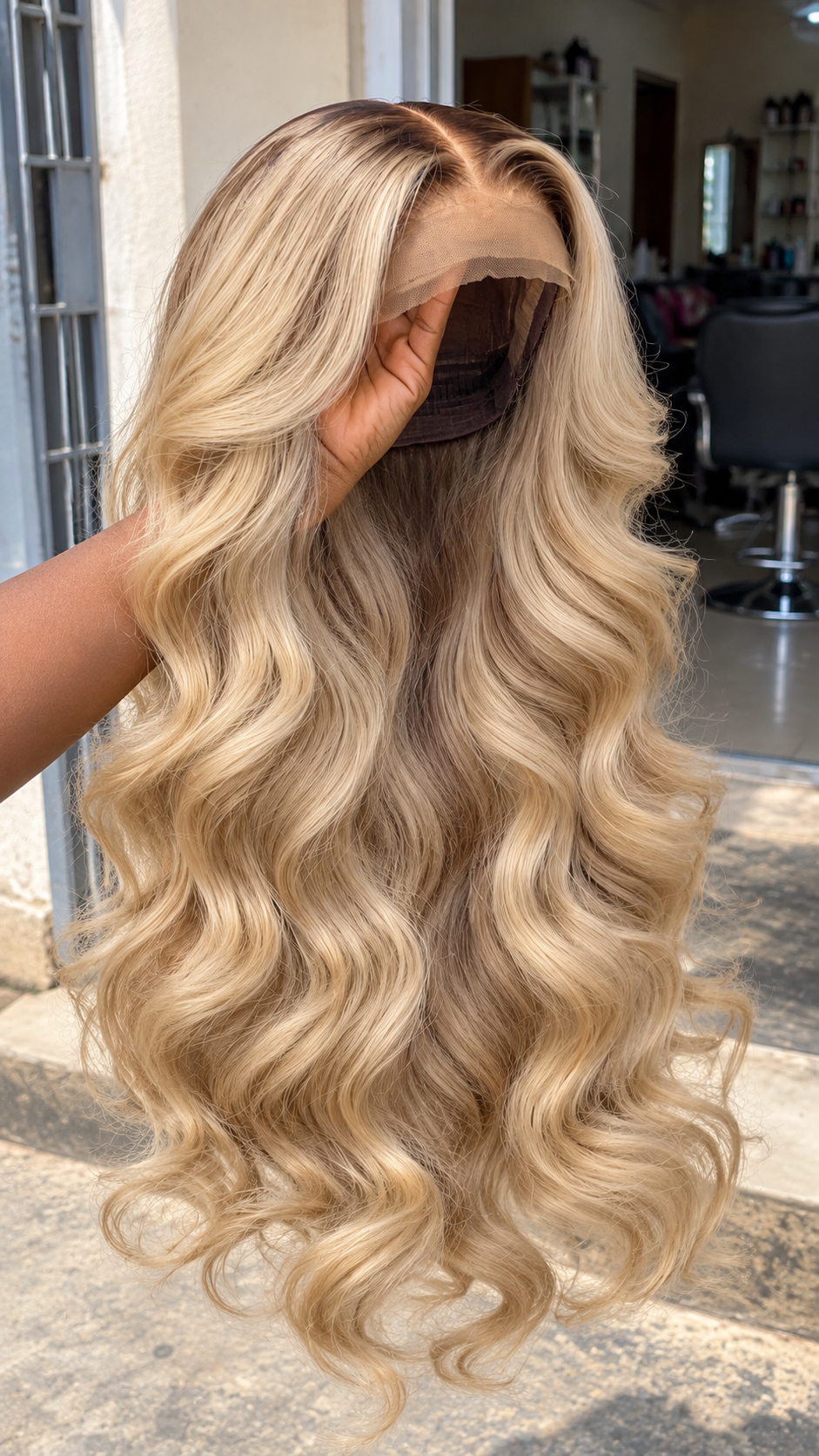
Shown in one hand outside a salon, the wig also reveals untrimmed front lace and part of its interior. Those visible construction details are useful when considering a purchase, but they do not establish the fiber, lace grade, or exact cap dimensions. What the photograph clearly offers is a reference for color, length, layering, and styling. Turning that reference into a successful order means identifying which of those elements matter most to you, then finding a supplier who can explain how their unit will deliver them.
The Blonde Is More Than One Flat Shade
The lighter lengths appear creamy and beige-gold, with some strands reading brighter than others. This variation gives the waves depth as they turn toward and away from the light. The color does not look uniformly white or strongly yellow in this photograph. If you want a close match, describe it as a dimensional blonde with a darker brown root, then ask the seller for their own color sample. A name such as champagne, beige, or honey can mean different things across suppliers.


The root area remains visible along the part and through the upper crown. It creates a gradual change rather than an abrupt block of dark color. That distinction is important when ordering. A long, strongly contrasting dark section would produce a different result, as would an all-over pale blonde with almost no root shading. Ask how far the darker color extends and how it blends into the lighter strands. A photograph taken from above can be especially useful for assessing that transition.
Do not assume that the bright strands are separately applied highlights just because they stand out in the image. Light, strand direction, and color variation all influence the appearance. Ask whether the proposed wig uses an overall blended shade, individual lighter pieces, or another coloring arrangement. If you want brighter sections around the face, specify their placement. The aim is to agree on the visible result rather than depend on a color technique name that may be interpreted differently.
For a remote purchase, request daylight footage of the exact unit or an approved sample. Ask the seller to turn it slowly so you can see the root, upper lengths, mid-lengths, and ends. Indoor lighting can make a blonde appear warmer or cooler than expected. Save the agreed color reference with your order details. That record is particularly helpful if you later need a replacement unit or want a stylist to maintain the same overall shade.
Broad Waves Give the Length Its Shape
The wave pattern is open and elongated, with generous bends rather than small ringlets. The curves begin through the upper lengths and continue downward, creating repeated movement. Individual sections overlap without looking tightly packed into identical spirals. When searching for a similar wig, useful descriptions include long loose waves, layered blonde waves, and a blowout-style finish. Compare photographs carefully, because a product sold as a body wave may have a different pattern from the styled result shown here.
The upper sections near the front sweep away from the opening of the cap. These curves help keep the hairstyle from looking heavy around the face. They also connect the crown to the fuller lengths below. If you want that effect, ask whether face-framing layers and a finishing service are included. A long blonde base with all strands cut to the same length will not necessarily fall in the same way, even if the seller curls it before taking a photograph.
The ends have a softer, more separated appearance than a blunt horizontal edge. Some sections curl inward, while others turn outward or fall into longer bends. This supports the layered look and gives the lower silhouette movement. Ask the seller to show the ends before purchase. You want to understand whether the photographed fullness continues through the length, how the perimeter is cut, and whether any additional trimming is expected after fitting.
Choose Length According to How You Will Wear It
The wig appears long in the photograph, but an exact measurement cannot be established from a hand-held image. Ask how the supplier measures length and whether the listed figure refers to stretched hair or the finished waved fall. Those measurements can differ visually. Request a photograph on a stand or wearer with the length identified clearly. If you are comparing two sizes, ask to see both styled in a similar way rather than trying to estimate the difference from unrelated listings.
Consider where you want the ends to sit on your own body. Height, torso length, cap placement, and the wave pattern all affect the final position. A measurement that looks moderate on one person may appear much longer on another. If you have a preferred endpoint, describe that during a fitting or consultation. A stylist can help relate the advertised length to the shape you want and explain how much may be removed during layering.
Longer hair also interacts with clothing, bags, and seating more often. Think about whether you want this wig mainly for occasions, regular workdays, or a rotation with shorter units. That does not mean you must avoid length for daily wear. It means the purchase should match the amount of detangling, storage, and styling you are prepared to manage. A slightly shorter version may be more practical for one wearer, while another will consider the extra length central to the appeal.
Plan the Front Before Altering the Lace
The part sits close to the center, with the darker roots helping make its position clear. However, the wig is held at an angle, so a fitted front view is needed to judge the exact placement. If you want a center part, state that explicitly. If you prefer a slight offset, ask whether the cap supports it. Moving the part can change how the front layers sweep, so it should be discussed as part of the complete styling rather than treated as a separate detail.
The mesh extends beyond the front hairline and remains untrimmed. Its final outline needs to be adapted after the wig has been positioned on the wearer. Before cutting, check the cap placement, temple areas, part, and front layers together. If you are unfamiliar with lace preparation, book a fitting with a wig stylist. Keeping enough workable material during the initial assessment allows the stylist to make informed adjustments instead of trying to correct an edge that has already been cut too far.
Ask the seller for the lace shade, dimensions, and construction description. The visible mesh cannot verify a particular premium grade, and its appearance in this photograph does not establish a match for every skin tone. Request a closer view against an appropriate background and discuss customization with the person doing the fitting. Also confirm how far the parting area extends behind the front. A lace edge alone does not tell you how freely the hair can be separated elsewhere.
Where To Buy This Wig
Look for wig boutiques and independent makers whose portfolios include rooted blonde units with long layers and broad waves. A seller who regularly works with dimensional blondes should be able to discuss the root transition, tonal balance, and available color options. Study examples in ordinary light as well as polished studio photographs. You are looking for consistency between the advertised color, the completed unit, and the written description of what the buyer receives.
Search phrases such as “rooted blonde lace wig,” “long beige blonde wave wig,” and “dark root blonde layered wig” can help locate relevant options. Use those results to build a shortlist, then inspect the actual products. Some listings may show tightly curled finishes, very dark roots, or nearly white lengths. Those can be attractive styles, but they differ from this reference. The closer your visual comparison, the easier it becomes to ask useful questions and avoid a purchase based only on a familiar product title.
Contact potential suppliers with a concise specification. Explain that you want a brown-rooted blonde unit, broad waves, front layers that turn away from the face, and a similar long silhouette. Ask whether the image represents a ready-made product or requires custom coloring and styling. Request the material description, cap measurements, lace area, finished length, and total price. If the maker suggests a different base, ask how that choice affects the final appearance and care.
For a stock purchase, request a video of the exact wig being sold. For a custom order, agree on the color sample, styling reference, completion window, and review process. Read the return and alteration terms before paying, especially if the unit will be individually colored or cut. Keep the specification and seller responses together. A clearly documented order is easier to assess when the wig arrives and gives both parties a practical reference if an adjustment is needed.
Separate the Hair Material From the Styling Finish
The photograph cannot confirm whether the wig is human hair, synthetic, or a blend. Ask for that information in writing and request care instructions for the specific product. The broad waves may be a lasting fiber pattern, a temporary salon set, or a combination of an underlying texture and finishing work. Those possibilities have different implications after washing. Knowing how the pictured finish was created helps you understand what you can maintain at home and what may need professional restyling.
If the unit is synthetic, ask whether heat is permitted and obtain the manufacturer’s directions rather than relying on a general claim that it is heat-friendly. If it is human hair, ask about processing and the recommended approach to cleaning and restyling the blonde lengths. Material choice should reflect your priorities: keeping a consistent style, changing the waves, using heated tools where permitted, or minimizing the need for appointments. The most expensive category is not automatically the most useful one for your routine.
Ask what the hair looks like after washing according to its instructions. A supplier may be able to show a washed sample or explain which styling steps are needed to restore the broad waves. This is particularly relevant if the display finish is central to your purchase. A wig can be accurately described by material and length while still arriving with a temporary set that changes later. Understanding that distinction helps you plan care without assuming the photograph shows its permanent texture.
Compare Density Through the Ends
A density percentage does not fully describe how this hairstyle will look. The layering, strand thickness, cap construction, and finishing all affect the impression of fullness. Ask for photographs that show the wig from the back and with the lengths spread naturally. Look at the mid-lengths and ends as well as the crown. A unit can appear full around the top while becoming much lighter farther down, which may or may not suit the silhouette you want.
More hair is not always necessary to recreate generous waves. Excessive bulk can make the front layers heavy or change how the sides sit near the face. Show the maker the outline you like and ask how they would achieve it. If you prefer a lighter everyday version, discuss where fullness can be reduced without losing the broad curves. A good consultation connects density to the finished shape instead of treating a higher number as the only route to a better result.
A Five-Tier Purchase Budget
The table below provides illustrative planning bands in US dollars. It is not a current market price list or a verified quotation for the photographed wig. Actual prices depend on documented materials, length, cap construction, color work, and included services, and may fall outside these bands. Use the categories to compare purchasing routes and identify additional costs. The price alone does not prove quality, accuracy of color, or the amount of customization supplied.
| Budget Tier | Illustrative Allocation | Purchase Route to Explore | What to Confirm |
|---|---|---|---|
| Basic Blonde Option | Under $100 | A stock long wig in a preset rooted blonde shade | The verified fiber, cap size, and whether the waves are included |
| Prepared Stock Unit | $100–$250 | A ready-styled wig with documented color and construction details | The exact root shade, finished length, front layers, and care method |
| Personalized Styling Package | $250–$500 | A suitable base combined with cutting, fitting, or additional styling | Which services are included and whether color adjustments cost extra |
| Custom Blonde Order | $500–$800 | An individually specified project with agreed color, length, and cap details | The materials, color approval process, alterations, and delivery condition |
| Extended Bespoke Package | Above $800 | A bespoke unit or a package with additional appointments and services | The specific workmanship, construction, and aftercare supporting the total |
Request a complete quote before comparing sellers. One amount may include only the wig, while another includes layering, finishing, lace preparation, and fitting. Shipping, taxes, installation, and later color services may be separate. Write down the differences so you can compare the same outcome. If your budget is limited, prioritize a suitable cap, the correct color family, and adequate length before optional extras. Those choices have a more direct effect on the finished hairstyle.
Consider how much professional maintenance you expect to use. If you want a stylist to restore the waves after cleaning or maintain the blonde tone, include that in your personal budget. Ask what those services involve without assuming a fixed schedule applies to every unit. The aim is to choose a purchase whose upkeep remains manageable. A clear care plan makes it easier to enjoy a long blonde style beyond its first carefully arranged appearance.
Book a Fitting and Layering Consultation
Choose a stylist who works with wigs and can show long layered finishes or dimensional blonde units. Send the reference before the appointment and explain whether you need a new unit, a fitting, or customization of an existing wig. If you already own the base, provide its fiber information and current photographs. This gives the stylist a chance to assess the request and identify any limits before reserving time for cutting, coloring, or setting.
During the fitting, establish the cap position before deciding where the front layers should fall. The part, hairline, and shortest sweeping sections influence one another. Ask to view the wig from the front and both sides while it sits over your usual hair preparation. If you wear glasses regularly, bring them. Discuss how much length you want to keep, since layering and perimeter shaping can remove some of the advertised length even when the overall look remains long.
For regular removal, ask whether a suitable glueless version is available and how it stays secure. The photograph does not verify that construction. If you prefer an installed finish, discuss the method with the stylist and follow the relevant product instructions. Either choice should include removal and handling guidance. A well-fitted unit should remain comfortable during normal movement, with the front layers falling consistently rather than requiring repeated repositioning throughout the day.
Keep the Lengths Organized Between Wears
Follow the detangling method recommended for the verified fiber. Work in manageable sections and support the hair so you are not pulling directly against the cap or lace. The goal is to remove tangles while preserving the broad wave arrangement as much as the material allows. Ask whether fingers, a particular comb, or a suitable brush is recommended for the finished unit. Different tools can separate the waves differently, so the preferred method should match the result you want.
Before washing, read the product-specific instructions and clarify any uncertainty with the supplier. Use appropriate products, water temperature, and drying methods for the unit. Long lengths need careful handling while wet, particularly around the lace and attachment points. Do not assume that the finished waves will return unchanged after cleaning. If they require resetting, plan that step as part of the process so the wig is ready when you next intend to wear it.
Blonde color care should also be specific to the material and finish. Do not automatically apply a toning product because the hair is light. Ask whether it is appropriate for the unit and what result it is intended to achieve. A product chosen without guidance could change a shade you already like. If the color begins to look different, compare it in consistent lighting and consult the supplier or a stylist familiar with the wig before making a broad correction.
Store the wig on a suitable support that allows the lengths to fall without being crushed or dragged across the floor. For travel, arrange the hair according to the supplier’s packing advice and protect the lace from folding under pressure. Avoid enclosing the unit before it has dried fully according to its care directions. Organized storage reduces unnecessary tangling and makes it easier to assess the waves before the next wear instead of starting with compressed, tangled lengths.
Check the Finished Result Before Altering It Further
When the wig arrives or the salon service is complete, inspect the root transition, blonde tone, front layers, and ends in ordinary light. Check the back as well as the front. Compare the unit with the agreed specification and establish whether any final fitting remains. For an online order, complete that inspection before cutting or coloring in ways that may affect return terms. If something differs, photograph it clearly and discuss the specific section that needs attention.
This hairstyle relies on a few well-balanced elements: darker roots, dimensional blonde lengths, broad waves, and layers that open around the face. A successful purchase keeps those relationships intact while adapting the cap and final cut to the wearer. Give the supplier a clear reference, ask for material and construction details, and plan the care that the actual unit needs. Those decisions help turn a striking long blonde wig into a wearable style with a finish you understand.
Search Terms
rooted blonde wave wig · long blonde lace front wig · brown root blonde wig · layered loose wave wig · beige blonde hair · face framing blonde layers · long body wave style · blonde wig with untrimmed lace