
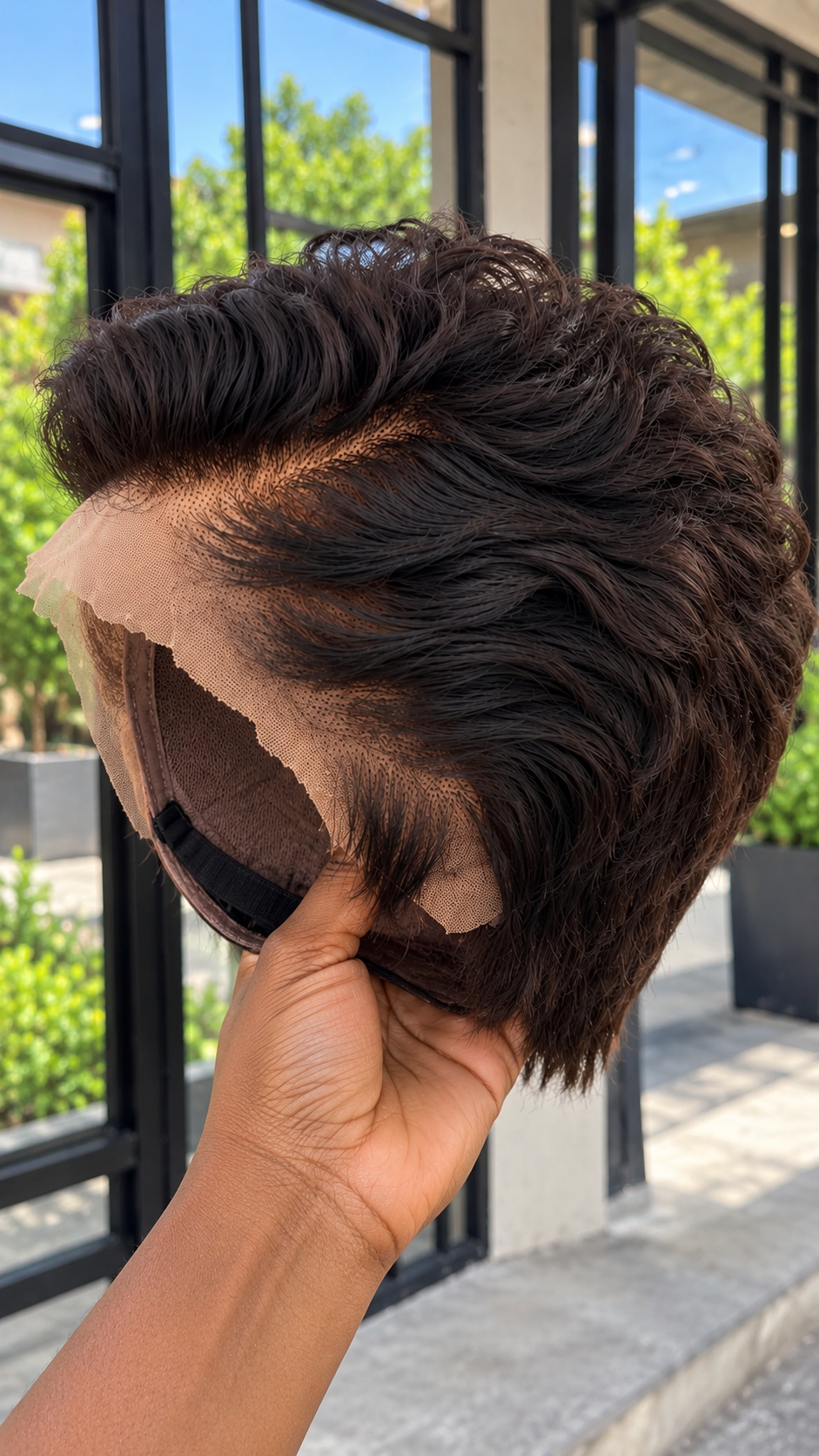
Not every pixie wig needs perfectly arranged finger curls, sharp barber lines, or an elaborate color combination to make a lasting impression. Some hairstyles stand out because of their natural-looking movement, carefully balanced volume, and relaxed arrangement. The dark chocolate pixie wig shown in this photograph offers exactly that combination, with lifted waves across the front, loosely arranged strands through the crown, and a softly tapered silhouette toward the visible back.
The wig is photographed in one hand near a glass-fronted building, with daylight illuminating the dark brown strands and the exposed lace construction. Unlike the heavily sculpted circular-coil hairstyles often displayed in wig shops, this design has a softer, less rigid appearance. Its upper hair moves backward in broad, irregular waves, while the side follows a directional pattern that blends into the fuller rear.
The photograph also reveals practical construction details. An extended beige lace section is visible along the front, part of the brown interior cap is exposed, and a black adjustable strap can be seen inside. These observations help potential buyers understand the unit before installation, although its fiber composition, lace grade, and complete fastening system cannot be confirmed from the image alone.


For anyone considering a dark brown pixie lace wig, the defining quality of this style is its carefully controlled informality. The hair looks airy and movable rather than pressed into identical curls. Achieving that appearance requires the right balance of length, density, layering, and styling direction.
The Difference Between Tousled Waves and Sculpted Curls
The upper hairstyle does not contain the circular ringlets or glossy rosettes commonly associated with tightly styled pixie wigs. Instead, the strands form elongated bends, loose waves, and irregular curves that overlap across the crown.
At the front, several sections rise noticeably before turning backward. These lifted strands create height without forming a rigid pompadour. The hair continues into a fuller upper section where different strands move at slightly different angles.
Some sections curve upward, others bend toward the back, and a few appear loosely separated near their ends. These differences produce a more relaxed appearance than a crown built from identical circular formations.
The upper surface also appears less heavily separated into individual styled ribbons. Instead, the strands overlap naturally, creating movement through changes in direction and elevation.
This distinction is especially important when shopping online. A wig advertised as a curly pixie may have tight coils, defined spiral ringlets, or sculpted finger waves. Those alternatives will not necessarily resemble the loose, swept-back movement shown here.
Why the Waves Should Not Be Made Too Uniform
The appeal of this hairstyle depends partly on variation. The front is elevated, the crown is fuller, and the visible rear has a more relaxed arrangement.
If every strand is curled into an identical shape, the result may look more structured than the reference. Conversely, leaving the entire hairstyle straight would remove the waves that give the crown its dimension.
A stylist recreating this look should focus on preserving irregular but coordinated movement. The strands need enough direction to create a cohesive pixie silhouette without appearing rigidly arranged.
When communicating with a wig maker, describe the desired result as a tousled, layered pixie with lifted front waves and a fuller, loosely waved crown.
Request a side photograph of the completed unit before shipment. The silhouette is easier to evaluate from this angle than from a straight front portrait.
Dark Chocolate Brown With Espresso Undertones
The visible hair belongs to a deep brown color family. Under daylight, several strands reveal chocolate-brown reflections, while shaded sections appear closer to dark espresso.
The color is not uniformly jet black. Warm brown tones become noticeable where the front waves rise toward the light and where the upper strands separate around the crown.
There are no clearly visible blonde, copper, burgundy, or other contrasting highlights. The tonal variation appears to come primarily from the interaction between the dark brown hair and natural lighting.
This makes the color relatively understated compared with multi-tone wigs. Rather than creating contrast through dyed streaks, the hairstyle uses the movement of the strands to reveal subtle differences in shade.
The darker lower sections also help emphasize the elevation of the crown. Where the hair lies closer to the cap, the color appears deeper, while the lifted waves show warmer reflections.
Choosing Between Chocolate Brown and Natural Black
Dark brown and natural black wigs can appear surprisingly similar in photographs taken indoors. Under daylight, however, chocolate-brown hair may reveal warmer undertones.
Customers seeking this particular appearance should ask for photographs of the actual product in natural lighting.
A seller’s color chart may use descriptions such as dark chocolate, espresso, off-black, or natural brown. These names can overlap, so the reference image is more useful than a color label alone.
Ask whether the shade is consistent across the unit or contains intentional color variation. The photograph does not provide clear evidence of separately dyed highlights.
It is also important to confirm whether the wig contains human hair, synthetic fibers, or a blend. Color appearance and shine cannot establish material composition reliably.
The Front Lift Gives the Pixie Its Shape
One of the most distinctive details is the elevated front section. The strands rise from the hairline before bending backward, creating a soft wave that frames the upper forehead area.
This lift produces a more open front profile than a pixie with a fringe falling downward.
The hair is not pressed flat against the cap, but neither does it form an excessively tall structure. Its height remains proportionate to the rest of the wig.
The lifted strands also create an impression of movement. Several sections separate slightly near the upper front, allowing light to pass between them and reveal their individual direction.
A custom wig maker should pay close attention to this feature because excessive trimming could reduce the front elevation.
Likewise, overly aggressive curling could transform the loose waves into tighter formations that no longer resemble the original design.
How Front Length Influences Styling Options
The visible front strands appear long enough to bend backward and create a raised wave.
A much shorter front may not provide the same movement, while an excessively long front could fall forward and require heavier styling to remain elevated.
When ordering a ready-made pixie, ask for the approximate front hair length and whether the hairstyle is supplied already arranged.
If the unit requires salon finishing, discuss how the front lift will be achieved using methods appropriate for the actual fiber.
The photograph does not establish whether heat, setting products, or another technique was used to create the waves.
The Side Uses Direction Rather Than Decorative Carving
The visible side is especially interesting because it does not contain obvious razor-cut stripes, elaborate temple drawings, or multiple carved channels.
Instead, the hair follows a sweeping direction from the front toward the back. Several strands curve through the side before merging into the fuller rear section.
A lighter scalp-like area is visible beneath the upper front, but it does not form a prominent long, sharply carved channel. The hairstyle relies more on the relationship between the hairline, density, and sweeping strands than on exposed geometry.
This gives the side a softer appearance than a traditional barber-inspired pixie with distinct shaved patterns.
The hair becomes longer and fuller toward the rear, while the front side appears more closely arranged against the lace.
Why Adding Razor Lines Would Change the Design
Customers sometimes request decorative side patterns when customizing a pixie wig. However, this photograph does not show such a pattern as a central styling element.
Adding sharp parallel lines or curved carvings would change the visual character of the hairstyle.
The reference depends on movement and layered volume rather than exposed shaved designs.
If the goal is an accurate reproduction, ask the stylist to preserve the softly swept side and avoid unnecessary cutting.
Any proposed modification should be evaluated against the wig’s construction because removing attached hair may expose the cap or create permanent gaps.
The Crown Has a Fuller, More Relaxed Arrangement
The upper middle section contains overlapping waves that move in slightly different directions. This creates a fuller appearance without relying on densely packed circular curls.
Some strands appear lifted away from the cap, while others curve backward and settle into neighboring sections.
The hairstyle therefore combines elevation at the front with increased fullness through the crown.
Unlike a highly sculpted finger-wave unit, the individual strands are not arranged into repeated identical ridges.
The irregular waves create a more casual appearance that can be appealing to customers who prefer softer styling.
However, the photograph does not establish how easily the hairstyle can be reshaped after washing. Its flexibility depends on the actual fiber and styling method.
The Visible Rear Has a Fuller, Layered Profile
The photograph provides a partial view of the wig’s rear section, where the hair appears fuller and more loosely arranged than the front side.
Several strands curve downward, creating a rounded continuation of the crown.
The lower rear appears slightly tapered, with shorter-looking ends following the outline of the wig.
The back is not completely visible, so its exact length and layering cannot be measured reliably.
Buyers should request a full rear photograph before purchasing, particularly if the back silhouette is important to their preferred hairstyle.
A unit that looks similar from the side may have a significantly different rear shape.
What the Untrimmed Lace Reveals
The wig is shown with beige lace extending beyond the front hairline and around part of the visible side.
The lace has not yet been trimmed to the final wearing shape.
Fine dark strands are visible near the front, where the hair begins transitioning into the lifted upper waves.
The exposed mesh provides a useful view of the pre-installation condition, but it does not establish the exact lace grade or manufacturing technique.
Although the lace appears relatively fine, buyers should request the manufacturer’s specifications rather than assuming a particular premium lace category.
Evaluating the Hairline Before Trimming
During the first fitting, the stylist should establish the correct cap position before removing any lace.
The lifted front waves depend on the hairline sitting at an appropriate position relative to the wearer’s forehead.
If the cap is shifted too far forward, the front may appear lower than intended. If it sits too far back, the natural hairline may become more visible.
Careless trimming can damage the fine strands or reduce the available fitting margin.
Any lace adjustment should therefore be made conservatively after the cap has been positioned correctly.
The Interior Shows an Adjustment Strap
Part of the brown interior cap is visible beneath the lace. A black adjustable strap runs across the lower opening, providing evidence of at least some adjustable fastening hardware.
The cap also contains fabric edging and visible stitched sections.
However, the photograph does not reveal every component of the fastening system. Additional combs, clips, or elastic bands should not be assumed without further evidence.
The presence of an adjustment strap also does not automatically confirm that the wig is suitable for adhesive-free installation.
Questions About the Cap Before Ordering
Request a complete interior photograph showing the cap opened fully.
Ask the supplier to identify all included adjustment components, attachment points, and security hardware.
Confirm the available cap sizes and provide the measurements requested by the manufacturer.
If adhesive-free wear is preferred, request explicit confirmation that the wig is designed for that method.
Also ask whether the cap can be adjusted without disturbing the hairstyle’s front lift or side placement.
Get The Details On This Wig Before Buying
The photograph does not identify a verified manufacturer, brand, or product listing. However, the hairstyle can be used as a reference when searching for a similar unit.
Look for wig boutiques and custom wig makers specializing in layered pixie lace wigs, soft waved crowns, and natural-looking dark brown hairstyles.
Online retailers may offer ready-made dark brown pixies, but product photographs should be examined carefully.
A listing described as a curly pixie may contain small coils or tight ringlets rather than the loose, tousled waves shown here.
Local wig shops can be useful when buyers want to inspect the cap and color in person.
Custom wig makers may offer greater control over the front elevation, crown layering, and rear silhouette.
How to Describe This Hairstyle to a Supplier
Request a dark chocolate-brown pixie lace wig with a lifted, backward-swept front, loose layered waves across the crown, softly directed side strands, and a fuller rounded rear.
Specify that the style should not contain tightly packed circular ringlets or decorative shaved lines.
Ask whether the wig arrives fully styled or requires professional finishing after delivery.
Confirm the hair fiber, cap measurements, lace specifications, and included fastening components.
For custom orders, request photographs of the finished wig from the front, side, crown, and rear before shipment.
Ready-Made Pixie Versus Custom Layered Styling
A ready-made dark brown pixie may be sufficient for customers who primarily want a compact hairstyle with soft waves.
However, the exact front lift and layered crown movement may vary between products.
Some ready-made units have flatter upper sections, while others contain tighter curls or more pronounced volume.
Custom construction can offer additional control over the shape and direction of the hair.
Before purchasing a base wig for modification, ask a professional whether its length and density are suitable for the desired result.
A unit that requires extensive cutting and restyling may not be economical compared with a properly finished custom wig.
Illustrative Pricing for Dark Brown Layered Pixie Wigs
The following USD amounts are illustrative budgeting ranges, not verified live prices. The photographed wig’s actual fiber, manufacturer, and selling price are unknown.
| Wig Category | Illustrative USD Range | Potential Cost Considerations |
|---|---|---|
| Premium Custom | $260–$620+ | Personalized cap sizing, layered crown construction, lifted front styling, and carefully adjusted rear volume. |
| Standard Custom | $145–$335 | Selected cap options with customized layers, front elevation, and soft wave styling. |
| Basic Human Hair | $85–$235 | A human-hair starting unit that may require professional layering, cutting, and wave setting. |
| Premium Synthetic | $60–$155 | A manufactured dark brown pixie with prearranged waves and available cap options. |
| Basic Synthetic | $25–$80 | A lower-cost pixie alternative that may not reproduce the front lift or layered movement accurately. |
The cost of this hairstyle may depend more on cutting and layering precision than on elaborate color processing.
Because the visible color is predominantly dark brown, reproducing the shade may require less specialized coloring than a multi-tone wig, depending on the materials available.
However, achieving the intended balance between front height, crown fullness, and rear shape may still require professional styling.
Cap construction, lace dimensions, hairline customization, and installation services can affect the total quotation.
Shipping, taxes, and future maintenance may be charged separately.
Ask whether the listed price includes the finished hairstyle or only the base unit.
Planning the First Installation
The first fitting should begin with cap placement and hairline alignment.
A professional wig stylist can assess whether the front waves sit at the intended height and whether the sides follow the natural contour of the head.
The cap should fit comfortably without excessive tension.
Only after the wearing position has been established should the stylist consider trimming the excess lace.
The front lift should be inspected after fitting because cap position can affect the apparent height and direction of the waves.
If the hairstyle has been compressed during shipping, the appropriate restoration method should be selected according to the confirmed fiber.
Do not assume that heated tools are suitable without checking the manufacturer’s instructions.
Maintaining the Relaxed Wave Arrangement
The main maintenance challenge is preserving movement without turning the hairstyle into a rigidly arranged set of curls.
Repeated aggressive brushing can flatten the front lift and disturb the layered arrangement.
At the same time, excessive styling products may weigh down the hair and reduce its airy appearance.
Handle the wig gently, supporting the cap rather than pulling on the lifted strands.
If the wig contains human hair, an experienced stylist may be able to restore the waves using suitable techniques.
If the wig contains synthetic fibers, the manufacturer’s heat and styling recommendations should determine what adjustments are safe.
Protecting the Front Elevation
The lifted front section is one of the hairstyle’s most recognizable characteristics.
Avoid pressing it flat during storage or placing heavy objects against the upper hair.
If the waves lose their shape, determine whether they can be reset without changing the overall silhouette.
Do not apply excessive heat or strong styling products without establishing material compatibility.
The objective is to preserve the relaxed backward movement rather than create stiff, identical curls.
Storage and Travel Considerations
Use an appropriately sized wig stand to support the cap between wears.
The stand should allow the upper waves to retain their height without being compressed.
For travel, choose packaging that provides enough space around the crown and protects the lace from snagging.
Avoid folding the wig tightly or placing heavy objects on top of it.
If the unit will be stored for an extended period, follow the supplier’s recommendations for cleanliness, humidity, and temperature.
Who Will Appreciate This Dark Chocolate Pixie?
This hairstyle may appeal to customers who prefer natural-looking movement over highly sculpted curls.
The dark chocolate color provides subtle warmth, while the lifted waves add shape without requiring contrasting highlights.
The softly swept side and fuller rear contribute to a compact silhouette that remains visually relaxed.
For everyday wear, the buyer should consider cap comfort, installation requirements, and how much restyling the waves need after washing.
For special occasions, the lifted front and layered crown can provide a polished appearance without requiring elaborate decorative patterns.
Final Considerations Before Purchasing
The strongest characteristic of this wig is the relationship between the lifted front waves, fuller crown, and softly tapered rear.
The dark chocolate color enhances the movement of the strands without introducing dramatic highlights.
Unlike highly structured finger-coil designs, this hairstyle depends on a more relaxed arrangement that should not be overstyled.
Before ordering, verify the fiber, cap measurements, lace specifications, fastening system, and whether the wig is delivered ready for installation.
Request additional photographs of the front, rear, opposite side, and complete interior to confirm details not visible in the reference.
A successful reproduction should preserve the deep brown shade, lifted backward front, loose layered waves, and compact rear silhouette. These characteristics provide a useful foundation for comparing ready-made products, commissioning a custom wig, and planning professional styling.
Search Terms
Dark chocolate tousled pixie lace wig · Espresso brown lifted front hairstyle · Loose layered wave pixie wig · Backward swept dark brown crown · Beige untrimmed lace brown wig · Adjustable strap layered pixie unit · Fuller rear soft wave lace wig · Natural dark brown tousled pixie