
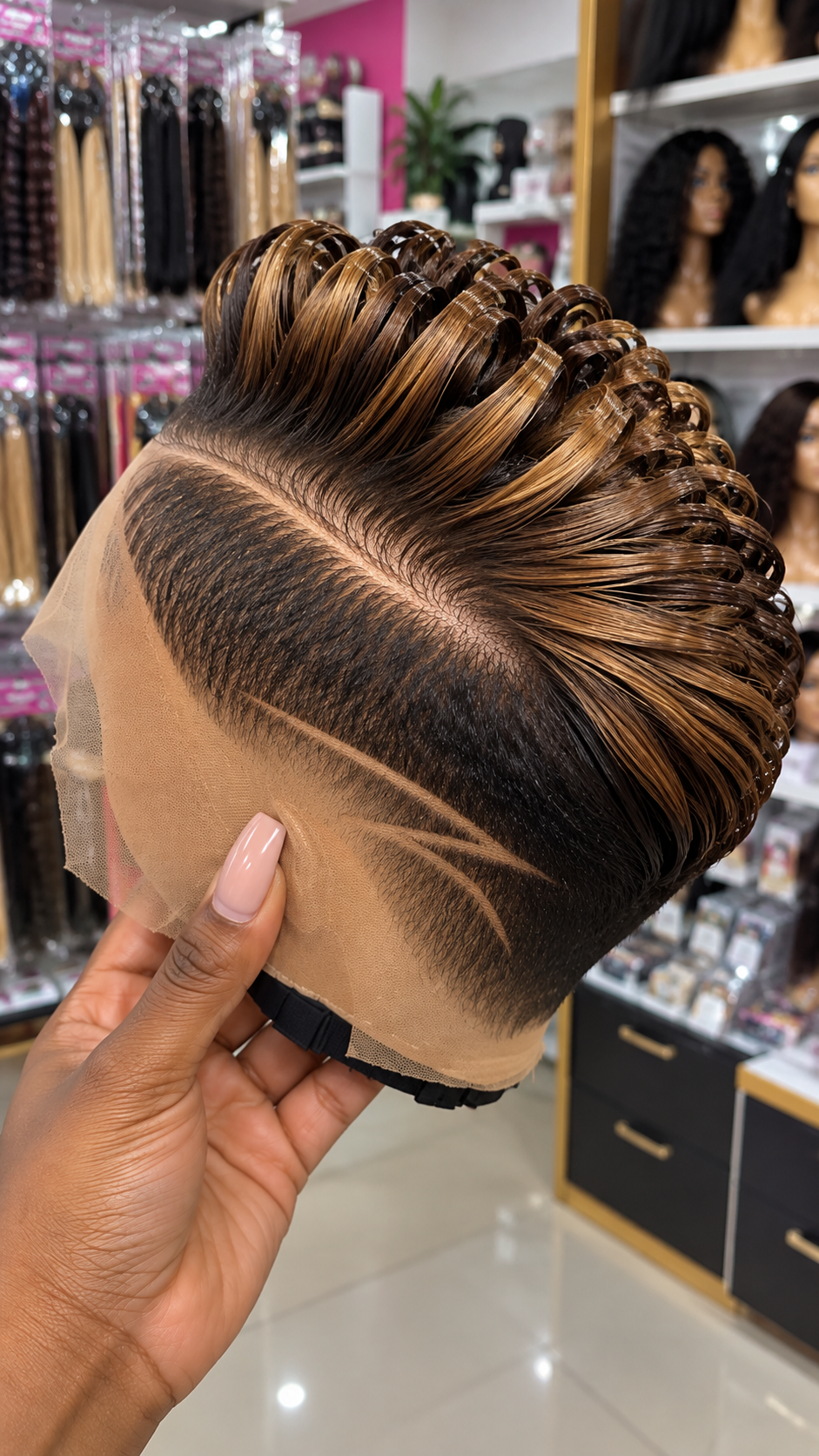
There is a considerable difference between buying a blonde pixie wig and choosing one whose color has been arranged to follow every curve of the hairstyle. The wig pictured here demonstrates that distinction through elongated honey-blonde ribbons rising from an espresso-brown foundation. Across the visible side, two narrow diagonal separation channels divide the closely arranged hair into distinct panels. The result is a compact, carefully sculpted design that uses contrasting hair directions and selective color placement rather than a large collection of ordinary loose curls.
The photograph shows the wig before installation, held in one hand inside a beauty supply shop. Its front lace is untrimmed, a dark lower cap attachment is partially visible, and the hairstyle is photographed from an elevated side angle. This perspective reveals the transition between the raised upper curls and the darker, flatter side sections.
The most noticeable color variation appears across the upper hairstyle. Honey-blonde and caramel-gold strands follow the length of several broad ribbon curls, while darker chocolate and nearly black strands remain visible between them. Toward the rear, the sections bend into overlapping rounded loops. Beneath the main parting, the hair retains a dark brown appearance, making the pale channels more prominent.


For women considering a highlighted pixie lace wig, the design offers a useful lesson in evaluating a purchase: the upper curl direction, the narrow blonde placement, the proportions of the dark side panels, and the fit of the lace all contribute to the finished appearance. None should be overlooked simply because the color is attractive.
The Highlighted Ribbons Follow a Distinct Backward Direction
The upper hairstyle contains a succession of elongated sections rising from the front-side area before bending backward into rounded loops. These sections resemble broad ribbons of hair rather than loose spirals or small circular ringlets.
Several of the larger sections have honey-blonde strands concentrated along their upper surfaces. The lighter hair follows the same curved direction as the surrounding dark strands, emphasizing each backward bend.
Near the front, the ribbons rise relatively steeply. Farther toward the visible rear, they become increasingly curved and closely overlapping. This creates a gradual progression from elevated front sections into rounded rearward loops.
The blonde placement is not identical across every section. Some ribbons contain substantial lighter areas, while others remain predominantly dark brown. This variation prevents the upper hairstyle from appearing uniformly striped.
The crown has noticeable height but remains compact. It does not resemble a long curly bob or a tall, loosely arranged hairstyle. The raised ribbons provide their own volume without requiring excessive hair length.
For a custom reproduction, the direction of the ribbons should be treated as an essential styling requirement. A wig maker who substitutes ordinary tight curls may produce an attractive unit, but it will not recreate the photographed silhouette.
Why Ribbon Width Changes the Finished Appearance
The visible upper sections are relatively broad, allowing numerous strands to travel together through each curve. Their grouped arrangement creates a continuous reflective surface.
If a stylist divides the hair into much narrower sections, the hairstyle may develop numerous small curls rather than the intended elongated ribbons.
If the sections become excessively wide, they may overlap too heavily and conceal the individual arches.
The reference achieves its appearance through a combination of broad front ribbons and somewhat smaller overlapping loops toward the rear.
When commissioning a wig, ask the maker to show examples of directional ribbon styling rather than conventional spiral curls. A photograph from above can help establish whether the sections are distributed correctly.
Honey Blonde Is Concentrated Across the Raised Hair
The color arrangement deserves careful attention because the lighter strands are not evenly distributed throughout the wig.
The most prominent blonde areas appear across the raised upper ribbons. They range from warm honey blonde to beige-gold and caramel reflections under the shop lighting.
Near the roots and between the elevated sections, the hair remains significantly darker. The lower side appears predominantly espresso brown to nearly black.
This color difference helps separate the upper hairstyle from the compact side panels.
The photograph clearly shows lighter and darker strands, but it cannot establish the exact dye formula, manufacturing process, or fiber composition.
Some variations in brightness may also be influenced by overhead lighting. Before approving a custom shade, customers should request photographs under indirect daylight.
The desired appearance is not a uniformly blonde pixie. It is a dark-rooted hairstyle in which lighter strands trace selected upper curves.
Choosing Between Honey, Caramel, and Champagne Accents
Commercial color descriptions are not standardized between wig suppliers. One manufacturer’s honey blonde may appear golden yellow, while another’s may resemble a muted beige blonde.
The reference contains warm golden strands without appearing uniformly pale or platinum-colored.
When contacting a supplier, explain that the dark brown foundation should remain visible and that the blonde should be concentrated along selected upper ribbons.
Ask whether the maker can reproduce the desired relationship using available pre-colored fibers or an appropriate coloring process.
If the proposed wig contains human hair, its previous chemical processing should be considered before additional lightening. If synthetic fibers are used, ordinary bleaching and dyeing should not be assumed suitable.
Request an actual color sample or an unedited photograph of completed work before making the final selection.
The Main Diagonal Parting Separates Two Styling Zones
A prominent pale channel runs diagonally beneath the raised upper hairstyle. It begins near the front-side area and extends backward, separating the elevated ribbon curls from the dark, closely arranged middle panel.
This parting plays an important structural role. Above it, the hair rises toward the highlighted upper curls. Below it, the strands lie considerably flatter and follow a descending direction.
The contrast creates a distinct layered appearance without requiring a completely shaved side.
The channel appears widest where the surrounding strands are directed away from the separation. Its visible width narrows along portions of the side.
The photograph does not establish whether it was produced using a razor, deliberate parting, or another construction technique.
For an accurate custom order, the maker should reproduce the visible direction and proportions of the parting rather than assume a particular cutting method.
The Second Side Channel Creates a Tapered Lower Panel
Below the main diagonal separation, another narrow channel travels across the lower side. This second division follows a related direction before bending toward the lower rearward portion.
The hair between the channels forms a broad dark panel. Its strands are arranged close to the cap, creating a flattened surface beneath the more elevated crown.
The lower channel gradually narrows as it approaches its ending, contributing to a tapered appearance.
This pattern differs from a collection of multiple parallel decorative stripes. The visible side is organized around two principal separations, with smaller changes in hair direction within the surrounding panels.
The lower section retains substantial hair coverage. It should not be described as a bare skin fade.
For buyers considering a reproduction, the lower channel is important because its curve helps determine the proportions of the entire side.
Why the Side Should Not Be Cut Too Aggressively
Unlike natural hair growing directly from the scalp, a wig contains supporting material beneath its strands. Cutting too much hair from the side can expose lace, mesh, or fabric.
The reference retains visible dark hair throughout the middle and lower panels.
A stylist should therefore inspect the cap before attempting additional tapering or decorative cutting.
If the buyer wants the same appearance, the priority should be preserving the dark coverage and the two narrow channels rather than removing more hair.
Any irreversible alteration should be discussed before it is performed.
Fine Front Strands Connect the Upper Curls to the Lace
Near the front, the dark hair is arranged in a backward direction before rising into the highlighted ribbons.
Fine strands create a gradual transition between the densely styled upper section and the untrimmed lace.
The front hairline does not display large circular baby-hair swirls or an elaborate series of decorative forehead patterns. Instead, its appearance is relatively restrained compared with the raised upper curls.
This difference helps the blonde ribbons remain the dominant feature.
Because the wig is photographed before installation, its final hairline placement cannot be established. The wearer’s forehead shape, cap position, and any additional customization will influence the finished appearance.
A stylist should evaluate the front hairline before trimming the lace or altering the direction of the existing strands.
Untrimmed Lace Makes the Pre-Installation Condition Visible
A broad beige-toned lace section extends beyond the front and visible lower side. The mesh remains uncut and hangs freely beneath the styled hair.
The lace contrasts with the darker strands, making its boundary easy to identify in the photograph.
This does not establish whether the material is HD lace, Swiss lace, transparent lace, or another marketed type. Such classifications require reliable seller specifications.
The photograph also cannot demonstrate how the lace will blend with the skin of a particular wearer.
Before purchasing, ask whether different lace shades are available and what installation methods are recommended.
The lace should remain untrimmed until the wig has been positioned correctly. Cutting too much material prematurely can reduce fitting flexibility.
The Visible Cap Hardware Requires Further Verification
Along the lower edge, part of a black strap or fastening component can be seen beneath the lace.
This provides limited evidence of the cap’s attachment or adjustment system, but the complete interior is not exposed.
The photograph does not confirm the total number of combs, the precise strap configuration, or the full rear construction.
It also does not prove that the wig can be worn securely without adhesive.
Buyers should request a complete inside-out photograph showing the front, sides, and rear of the cap.
Ask for circumference, front-to-back, and ear-to-ear measurements. If adjustable hardware is included, confirm how it operates and whether the manufacturer offers different cap sizes.
A visually accurate hairstyle may still be unsuitable if the cap does not fit comfortably.
Find Out Where To Buy This Design
Specialized wig boutiques, custom wig makers, and salons experienced in sculpted pixie hairstyles are reasonable places to begin searching for a comparable unit.
Useful search descriptions include honey blonde ribbon curl pixie wig, dark-rooted sculpted lace wig, black-and-blonde directional curl hairpiece, and highlighted pixie with double side parting.
When evaluating online listings, compare the actual hairstyle rather than relying solely on product titles.
A generic blonde curly pixie may use much smaller curls. Another highlighted wig may have the right color combination but lack the diagonal parting and compact lower side.
For ready-made products, request photographs of the actual wig available for shipment.
For custom production, review the maker’s previous work involving broad ribbon curls and carefully arranged side panels.
Commissioning a Custom Unit With Accurate Color Placement
The custom-order process should begin with the relationship between the dark foundation and the lighter upper ribbons.
Send the reference photograph and explain that the honey-blonde strands should follow selected backward-bending curls rather than appear randomly throughout the wig.
Next, identify the main diagonal parting and the lower curved channel.
Ask the maker to preserve the broad dark side panel and tapered lower silhouette.
Specify the desired crown height, keeping it compact rather than excessively elevated.
Finally, confirm the hair material, cap measurements, lace specifications, and intended installation method.
If possible, request a progress photograph before final styling is completed. This can help identify major differences while adjustments remain feasible.
Ready-Made Versus Custom Construction
A ready-made wig may offer faster delivery and lower initial cost, particularly if a closely matching style is already available.
However, the precise blonde placement and backward ribbon direction may be difficult to find in ordinary catalog products.
Custom construction offers greater control over hair color, curl width, parting position, and cap sizing.
The trade-off may involve higher labor costs and additional production time.
Before choosing either route, determine which details are essential and which variations would be acceptable.
For this design, the honey-blonde ribbon placement, dark side coverage, double-channel geometry, and compact upper silhouette deserve priority.
Illustrative Pricing for a Highlighted Ribbon Curl Pixie
The price of a comparable wig may depend on the fiber material, cap construction, lace coverage, color processing, and labor required to arrange the upper ribbons and side channels.
The photograph does not establish the actual manufacturer, hair material, or selling price.
The following US dollar amounts are illustrative budgeting estimates rather than verified live retail prices.
| Wig Category | Illustrative USD Range | Potential Purchase Scope |
|---|---|---|
| Premium Custom | $360–$840+ | Individual cap measurements, directional honey-blonde placement, detailed ribbon curl setting, and precision side styling. |
| Standard Custom | $190–$440 | Selected customization of blonde streak placement, upper curl direction, cap fit, and side-channel position. |
| Basic Human Hair | $110–$290 | A human-hair base unit that may require separate highlighting and specialist styling. |
| Premium Synthetic | $75–$215 | A higher-grade synthetic option with potentially prearranged highlighted ribbons and a prepared lace front. |
| Basic Synthetic | $30–$115 | A budget alternative where exact highlight placement and curl direction may vary. |
These categories describe possible purchasing approaches, not confirmed versions of the photographed wig.
Shipping, installation, lace trimming, color customization, cap alterations, and future restyling may be charged separately.
Ask for an itemized quotation that clearly identifies what is included in the purchase price.
Scheduling Installation Around the Side Parting
Once the wig arrives, inspect the upper ribbons, color placement, lace, and side channels before making any adjustments.
At the salon, the stylist should first position the cap and evaluate the relationship between the diagonal parting and the temple.
The upper curls should remain balanced relative to the forehead, while the lower channels should follow the intended side contour.
Only after confirming the fit should excess lace be trimmed where necessary.
If the lower hair requires minor adjustment, the stylist should inspect the cap construction before using cutting tools.
When booking, ask whether the salon has experience with sculpted pixie wigs, directional curl setting, and lace fitting.
Not every wig installer specializes in restoring elaborate ribbon arrangements, so confirming that expertise beforehand is useful.
Maintaining the Highlighted Ribbons Without Losing Their Shape
The upper hairstyle depends on grouped strands remaining directed backward through broad curves.
Brushing aggressively across the ribbons may separate the hair and reduce the visible wave pattern.
Before washing, ask the supplier whether the curls are intended to retain their arrangement or require professional resetting afterward.
If the unit contains synthetic fibers, heat tools should only be used within manufacturer-confirmed temperature limits.
If the wig contains human hair, restyling may be possible, but the method should account for previous color processing and the original setting technique.
The blonde sections may also need particular attention. Depending on the material, repeated washing, excessive heat, or sunlight may influence their appearance.
The lower side channels should be handled separately from the upper curls. Repeated brushing across the narrow separations may move strands into the exposed areas.
Ask the maker how to store the wig without compressing the raised ribbons or disturbing the side geometry.
Photographs to Request Before Accepting the Finished Wig
The supplied reference provides a clear view of the highlighted upper curls and one side, but it does not show the entire hairstyle.
A front photograph would establish how the ribbons frame the forehead.
An opposite-side view would show whether the parting and side styling are repeated or intentionally different.
A rear photograph would reveal how the highlighted loops transition toward the nape.
A complete underside photograph would clarify the cap construction and securing components.
A short video under neutral lighting could also help establish the actual blonde-brown color distribution.
These additional views are particularly useful when commissioning a custom wig from a remote supplier.
The Appeal of Blonde Ribbons Against a Dark Foundation
This wig demonstrates how selective color placement can emphasize the shape of a sculpted pixie hairstyle. Honey-blonde strands travel through broad backward-bending curls, while darker roots and lower side panels provide contrast.
The main diagonal parting and lower curved channel divide the hairstyle into distinct sections without requiring a completely shaved side.
The untrimmed lace and partially visible cap hardware provide useful pre-installation information, although they do not establish the complete specifications or fiber composition.
For buyers seeking a comparable hairstyle, the strongest approach is to prioritize the direction of the upper ribbons, the placement of the blonde accents, the side-channel geometry, and the cap fit.
A successful reproduction should preserve these elements rather than transforming the hairstyle into an ordinary highlighted curly pixie.
Careful supplier communication, accurate product photographs, and professional fitting can help achieve a finished result that reflects the reference while remaining practical for the intended wearer.
Search Terms
Honey blonde ribbon curl pixie wig · Espresso black blonde highlighted lace wig · Double diagonal side channel hairpiece · Caramel gold backward loop hairstyle · Dark rooted blonde sculpted pixie · Beige untrimmed lace highlighted wig · Black lower side honey blonde crown · Broad ribbon curls with tapered temple