
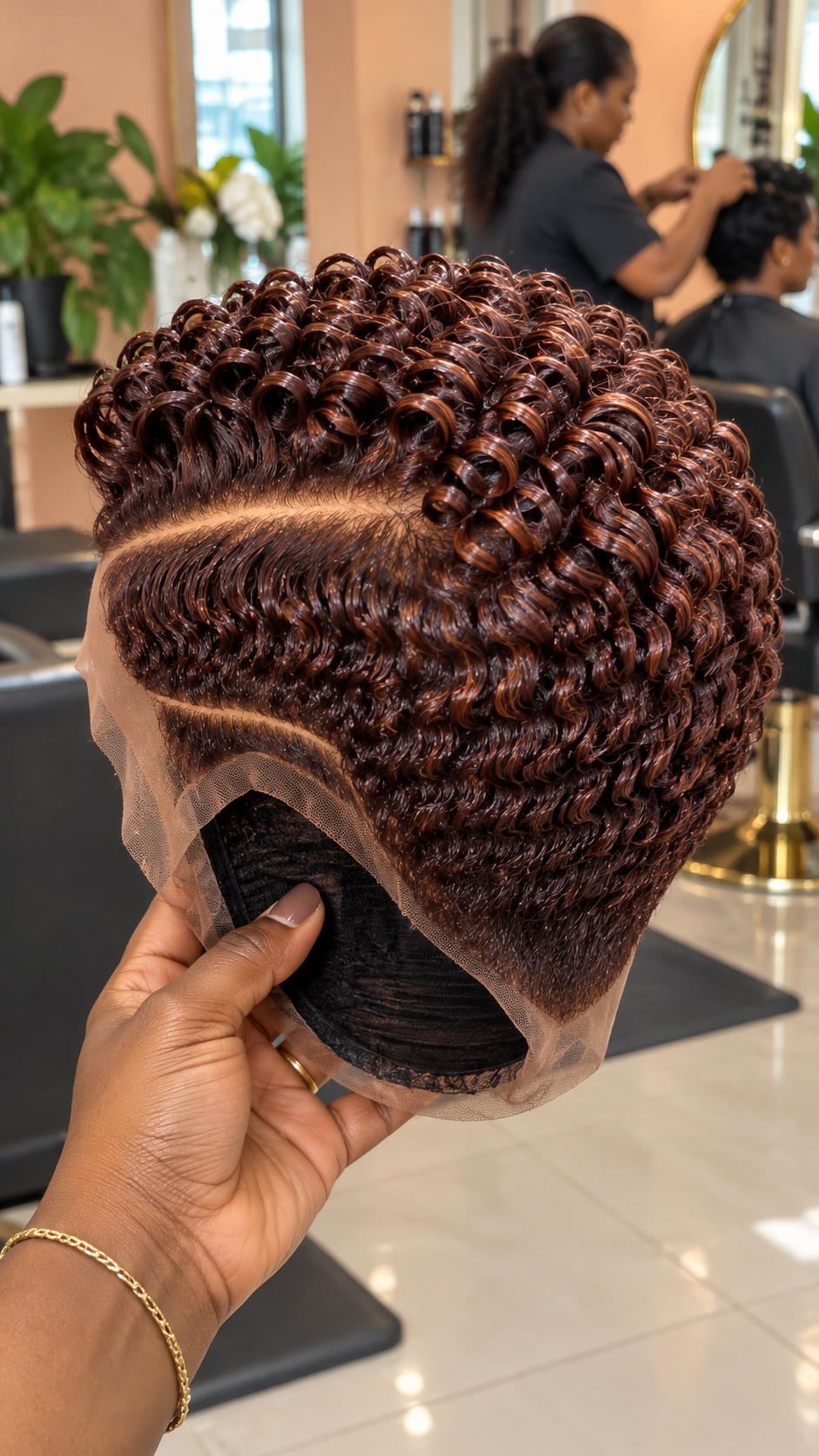
Held away from the head, this chestnut curly pixie wig offers a useful view of its silhouette, untrimmed lace, and contrasting curl sizes. The color appears deep reddish brown with brighter copper reflections where the light catches individual strands. The crown has lift, while the lower section narrows toward the edge. For someone considering a similar purchase, the important questions are how closely the maker can reproduce that graduated shape, where the curved lines will sit, and what maintenance the finished arrangement requires.
A Short Style Built Around Changing Curl Sizes
The crown is composed of open ringlets that project away from the base. Their spiral shape gives the top dimension without requiring long hanging ends. Some curls face forward, while others turn outward or lie across neighboring sections. That variation helps create a rounded upper outline. When discussing the style with a wig maker, describe the curl structure rather than asking only for volume. A dense, fluffy crown would produce a different effect from these individually arranged spirals.


Below the crown, the hair becomes more closely waved. The side section has a lower profile, and the bottom follows a tighter, more compact pattern. This gradual reduction is what gives the unit its tapered appearance. The shorter lower section supports the fuller top without making the whole wig look equally wide. If you want a close recreation, ask the stylist to preserve that transition. Cutting the lower area short while leaving a sudden bulky shelf above it would change the intended outline.
The visible upper curls also appear larger than the small turns near the bottom. That difference affects how the hairstyle reads from a distance. The top remains expressive, while the lower portion looks controlled and close to the head. Before ordering, decide whether you want this level of crown lift or a slightly lower version. A modest adjustment may suit your preferences, but it should be discussed alongside the side shaping so the proportions remain balanced.
The Curved Lines Need Precise Placement
Two exposed lines are visible across the side shown in the photograph. The upper line separates the raised crown curls from a flatter waved band, while the lower curve outlines that band above the ear-area opening. These lines are a defining part of the design. They should not be described as proof of shaved natural hair, because the image shows a wig held in the hand. What can be seen is a deliberate separation between styled sections on the unit.
The relationship between the curves matters more than making either one unusually wide. Their spacing gives the central wave band enough room to remain visible. If the lines were crowded together, that section could lose its shape. If they were much farther apart, the side could become too dominant. Send the reference to the maker and ask how they will position the curves on your cap size. A design copied without considering fit may land differently around your temple.
Request photographs of the opposite side and back before assuming the detailing continues symmetrically. Only one main side is clearly presented here. The other side could have a different arrangement, and the photograph does not establish the complete nape design. For a custom order, decide whether you want the visible side copied alone or a coordinated treatment elsewhere. Having that conversation early prevents the maker from filling in unseen areas according to preferences you have not discussed.
Chestnut Color With Copper Reflections
The shade sits within a warm brown range, with reddish and copper-looking reflections across the ringlets. Those brighter areas follow the light on the curved strands. The photograph does not establish whether they come from a separate highlight color, an overall warm shade, or a combination of coloring and lighting. When requesting a match, describe the overall appearance as well as the reflections. Ask the supplier to show their proposed color in daylight rather than selecting from a name alone.
A uniform chestnut shade and a dark base with copper highlights can look similar in one photograph but different in movement. Clarify which result you want. If you prefer a single color throughout, say that explicitly. If you want lighter strands, ask about their placement, thickness, and distribution. Keeping them concentrated around the crown would create a different result from spreading them evenly through the short sides. The color specification should be as intentional as the cut.
For remote ordering, request a slow video with the wig turned through several angles in ordinary light. This can reveal whether the shade stays brown in shadow and how bright it becomes where light hits the curls. Avoid relying entirely on heavily lit close-ups. Save the supplier’s color reference with your order, particularly if you might purchase another unit later. A written shade description and an agreed visual sample provide a clearer record than simply asking for “the brown one.”
Deciding Whether This Fits Your Everyday Routine
The compact length leaves the shoulders and collar area free, which may appeal if you dislike managing longer ends. The hairstyle also has enough structure to look intentional without being arranged into a new shape every morning. However, short length does not automatically mean minimal maintenance. The crown ringlets, waved side band, and exposed lines all contribute to the appearance. Your routine needs to protect those details rather than treating the wig like an unstyled cropped unit.
Consider how often you expect to wear it and how much styling you are comfortable doing. Someone who can refresh ringlets at home may have different needs from someone who wants every reset handled by a salon. Discuss that preference before buying. Ask what the maker considers a normal between-wear touch-up and what requires more extensive work. The right purchase is one whose care you understand and can realistically manage, rather than one that looks appealing only when freshly presented.
Also think about the items that sit near the wig during daily wear. Glasses, high collars, hats, and tightly wrapped scarves can interact with the temples or compress the crown. Bring your usual glasses to a fitting and explain if you often cover your hair while traveling. You may still choose the same style, but the stylist can discuss placement and practical handling. A fitting is more useful when it reflects the way you will actually wear the unit.
Where This Wig Comes From
The exact maker and product source cannot be established from the photograph. To find a comparable unit, search for wig specialists who show tapered curly pixies, short ringlet wigs, and shaped side detailing in their portfolios. Wig boutiques may offer finished stock units, while independent makers or salon-based wig stylists may accept a reference-led custom order. Focus on examples that demonstrate a graduated outline and deliberate section placement, since those are central to this particular design.
Search phrases such as “chestnut curly pixie wig,” “short ringlet wig with side lines,” and “tapered curl lace wig” can help identify candidates. Product titles are only a starting point. Inspect whether the photographed wigs have actual open spirals at the crown or a looser, brushed-out texture. Check whether the sides narrow gradually and whether the maker shows clear views around the ears. A similar color does not make a different cut an accurate match.
When contacting a supplier, attach the reference and identify your priorities: the warm chestnut appearance, raised crown ringlets, lower waved section, and two curved side lines. Ask whether they can provide a ready-made match or need to create it. Request previous examples, an inside-cap photograph, and a written explanation of the fiber and construction. This gives you a useful basis for comparing responses instead of choosing solely by the most confident promise.
Confirm whether the quoted amount includes the wig itself, cutting, color work, curl setting, lace preparation, and fitting. Some businesses supply a complete finished unit; others offer a styling service for a base purchased separately. Ask about delivery condition and any review photographs for a custom order. Read the alteration and return terms before paying. Knowing the scope of the purchase makes it easier to plan the remaining work and assess the unit when it arrives.
Choose the Base With the Final Shape in Mind
The exposed lace and visible dark interior do not establish the full cap construction. Ask the seller to identify which areas are lace, which are wefted, and where the parting or side detailing can be placed. A lace-front unit, a unit with a limited lace area, and a more extensively lace-based construction offer different styling possibilities. The useful question is whether the proposed base supports this design comfortably. A construction label alone does not answer that.
If the curved lines are central to your order, have the maker explain how they are formed and maintained. Their appearance may depend on the base, hair placement, and styling technique. Ask whether they remain visible after washing or need to be recreated during setting. Also confirm whether their location can be adjusted. These details influence both the finished look and the care plan, especially if you intend to use a different stylist for future maintenance.
The hair material also needs written confirmation. The photograph cannot verify human hair, synthetic fiber, or a blend. Ask for care instructions specific to the actual unit, including whether heated tools are permitted. If a supplier describes synthetic hair as heat-friendly, request the relevant manufacturer’s limits rather than making assumptions. If the unit uses human hair, ask about processing and the recommended method for restoring the ringlets. Choose based on the ownership experience you want, including cleaning, styling flexibility, and access to professional help.
A Fitting That Preserves the Taper
Measure according to the supplier’s instructions before selecting a cap size. Circumference is useful, but the maker may also need front-to-nape and ear-to-ear measurements to place the lower edges correctly. A short wig depends on accurate positioning because there is little length to disguise a cap sitting too high or too low. Do not assume that tightening the straps can correct every mismatch. Ask how the cap should sit and what adjustment range is available.
Try the wig over the hair preparation you expect to use regularly. An uneven base can raise the crown, push the sides outward, or distort the apparent taper. If you are booking a fitting, ask how to prepare beforehand. Once the unit is positioned, inspect the temple area, lower curve, and back together. The crown should have its intended lift while the lower sections follow the head. Check comfort during ordinary head movements before making permanent alterations.
The lace in this image extends beyond the hair-bearing area and remains untrimmed. Its final edge should be assessed after placement is settled. A wig stylist can help customize it while protecting the shaped sections beside it. Discuss how much front and temple detail you want to keep, particularly if you prefer a quieter outline than the reference. Fitting should establish both where the cap sits and how the visible design relates to your own features.
Five Ways to Organize the Budget
The figures below are illustrative budget allocations in US dollars, not current market quotations or verified prices for the photographed wig. They show how different purchasing routes might be planned. Actual offers can fall outside these bands, and the amount alone does not establish material quality or styling skill. Compare documented specifications and included services before deciding what represents value. Delivery, taxes, installation, and later maintenance may need separate allowances.
| Budget Level | Illustrative Allocation | Route to Investigate | Main Point to Confirm |
|---|---|---|---|
| Basic Starting Unit | Under $75 | A stock cropped wig or an entry-level base | Whether the taper, ringlets, and curved lines are already included |
| Prepared Stock Wig | $75–$150 | A ready-styled unit in a standard shade and cap size | The actual finished shape and the documented fiber and cap details |
| Dedicated Styling Order | $150–$300 | A suitable base with cutting and a specific curl-setting service | Which shaping, color, and fitting tasks the price covers |
| Personalized Construction | $300–$500 | A custom project with agreed measurements and design placement | The construction, review photographs, and alteration terms |
| Extended Bespoke Service | Above $500 | An individually specified unit or a package with additional appointments | The materials, workmanship, and aftercare services supporting the total |
For a meaningful comparison, calculate the amount needed to reach the same finished result. A lower base price may be appropriate if you already have a trusted stylist, while an inclusive quote may be easier if you want the unit prepared by one provider. Ask for a breakdown when the order combines several services. Prioritize a suitable cap and accurate shaping before optional extras. The distinctive side sections will matter more in wear than elaborate packaging.
Leave room for ongoing care if the set requires professional renewal. Ask who can recreate the crown ringlets and side waves after cleaning, and whether the original maker offers that service. You do not need an exact maintenance schedule before owning the wig, but you should understand the process. A purchase becomes more practical when the people and services needed to keep it looking right are accessible within your normal routine.
Booking a Stylist for Ringlets and Side Detailing
Look for a stylist whose work includes short wig cutting, curl setting, and close shaping around the ears and nape. Send the image before booking and explain whether you are bringing a new base, an existing wig, or requesting a complete unit. Provide the fiber information if you already own it. The stylist needs to assess whether the material and current cut can support the requested finish before accepting a close recreation.
During the consultation, agree on the overall outline before refining the lines. Establish the crown height, side fullness, and lower taper, then discuss the width and placement of the curved sections. Ask whether the unit can be checked on your head before the final set is completed. This makes it easier to identify a section that sits differently from the reference. Confirm how the unseen side and back will be finished rather than leaving those areas unspecified.
If you prefer daily removal, ask whether an appropriate glueless version is available and how its cap stays secure. That cannot be verified from the image. If you want an installed finish, discuss the method with the stylist and follow the relevant product directions. Either approach should include handling and removal guidance that protects the lace and shaped sections. The securing method should suit your routine while allowing the cap to remain comfortable and properly positioned.
Maintaining Lift Without Losing the Side Shape
The crown and sides need different attention because they have different profiles. Avoid brushing through the whole wig as one section. That could separate the ringlets and disturb the flatter wave band at the same time. Ask the stylist to demonstrate a suitable refresh for the verified fiber and setting method. If an individual curl moves, correct only what needs attention. Repeatedly rearranging unaffected sections can gradually change the shape you were trying to preserve.
Before washing, establish which details are likely to remain and which need restyling. Follow the unit’s specific cleaning and drying instructions, including appropriate products and temperatures. A temporary salon set may change even when the underlying hair remains in good condition. Plan for that possibility before an occasion when you need the wig ready to wear. Knowing how the side lines and ringlets are restored is part of understanding the product.
Use finishing products with restraint and according to the supplier’s directions. The copper-looking reflections do not mean that additional shine spray is necessary. Repeated layers can leave residue and affect how the strands group together. Store the wig on a support that does not stretch the cap, with enough space around the crown to avoid compression. For travel, protect the upper curls and keep pressure off the shaped sides so the taper arrives looking as intended.
After wearing, check the unit before putting it away. Small adjustments are easier to notice when you compare the shape with a clear photograph taken after fitting. Keep a front, side, and back reference once you are happy with the result. These images can also help a future stylist understand the intended arrangement. They are especially useful for a design whose identity depends on the relationship between several sections rather than one general curl pattern.
Inspect the Finished Wig From More Than One Angle
A final review should confirm the details you agreed on: warm chestnut color, open crown ringlets, compact lower waves, and accurately placed curved lines. Check both sides and the back in ordinary light. If the wig was delivered, inspect it before trimming or restyling in ways that could affect the seller’s return terms. If the work was completed at a salon, raise fit or shape concerns while the stylist can see the unit on your head.
This hairstyle makes its strongest impression through proportion. The crown needs enough lift to show the spirals, the side band needs room to reveal its waves, and the lower section needs to remain close enough to support the taper. A clear order brief and careful fitting help preserve those relationships. Choose a maker who can explain the construction and care as clearly as the styling, so the finished wig remains a practical part of your wardrobe as well as an appealing short cut.
Search Terms
chestnut curly pixie wig · short ringlet lace wig · curved side line wig · copper brown curls · tapered curly wig · sculpted wave sides · short spiral curl crown · curly wig with untrimmed lace