
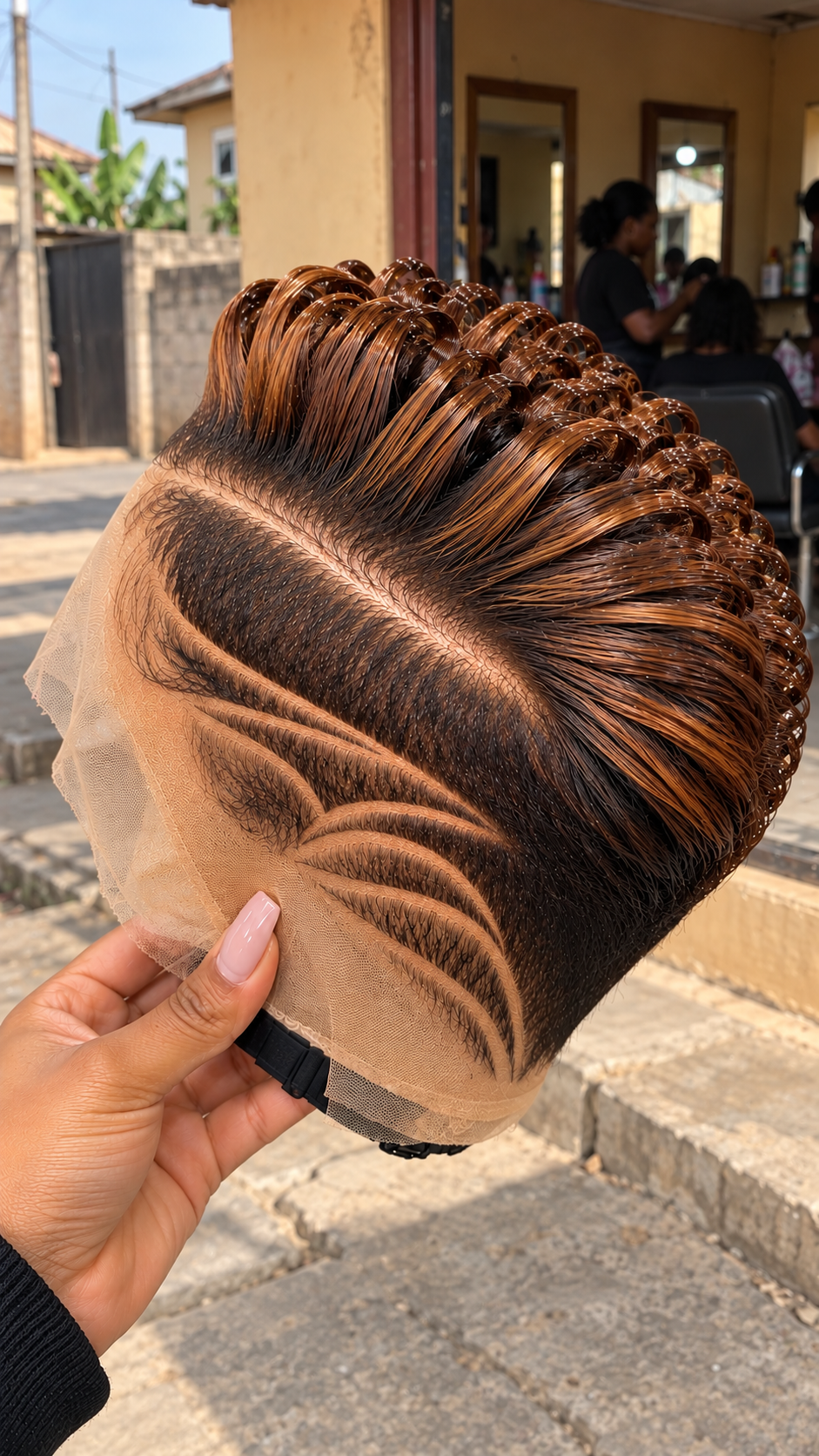
A beautiful pixie wig can make an impression without relying on a towering crown or dozens of tiny curls. Sometimes the most memorable hairstyles are built around movement, contrast, and the careful placement of a few striking details. This caramel-brown lace wig brings those elements together through a series of raised ribbon waves, a dark closely arranged side, and an intricate pattern of curved channels that sweep toward the lower perimeter.
Photographed outside a neighborhood hair salon in natural daylight, the wig is held at an angle that reveals its most distinctive side. The upper hair rises into broad, elongated arches, with warm caramel and copper-brown strands following the direction of the waves. Beneath the crown, a long diagonal separation creates a strong boundary between the elevated styling and the darker side section. Additional curved channels branch across the lower area, producing an almost feather-like geometric arrangement.
The wig is shown before installation. Beige-tan lace extends beyond the visible hairline, and part of a black fastening component can be seen near the lower cap opening. The photograph provides a particularly useful view of the relationship between the upper waves and the lower design, although it does not reveal the complete back, opposite side, or underside.


What makes this hairstyle especially interesting is the way its different sections work together. The raised crown introduces warmth and height, the dark middle section creates visual depth, and the curved channels provide intricate detailing without requiring long hair. For buyers considering a custom pixie wig, these proportions are just as important as the caramel color itself.
A Hairstyle Built Around Three Distinctive Elements
The design can be understood through three main areas: the raised ribbon-wave crown, the closely arranged dark side, and the decorative curved channels beneath it.
Unlike a conventional curly pixie, the upper section does not contain a uniform collection of small circular coils. Instead, the hair forms broad, elongated loops that travel backward across the head. Several arches have visible openings, while others overlap more closely near the rear.
The middle section lies much flatter against the wig foundation. Its dark brown to near-black strands follow a backward and downward direction, creating a strong contrast with the elevated crown.
The lower area contains multiple curved separations. These channels are not simply parallel lines. Their shapes change direction, with several curves approaching one another and creating a layered, pointed design.
Together, these elements produce a hairstyle that feels carefully planned rather than randomly curled. Removing any one of them would change the overall appearance considerably.
The Caramel Crown Has a Beautiful Ribbon-Like Flow
The upper hair is arranged into broad sections that rise from the forward crown before bending backward. The strands travel together in coordinated directions, creating long, glossy arches rather than tightly compressed spirals.
Several of the loops near the upper front appear relatively tall, while the arches become more closely grouped toward the rear. Smaller curled sections are visible along the outer edge, helping the crown transition into the surrounding hair.
The warm caramel color follows the direction of these raised strands. Darker roots and underlying sections remain visible, particularly near the base of the waves.
This arrangement gives the hairstyle a distinctive sense of movement. The eye follows the strands from their darker foundation upward into the caramel arches and backward toward the crown.
For a custom recreation, the stylist should preserve the backward direction of the waves. Replacing them with upright circular ringlets or loose hanging curls would produce a different silhouette.
Why the Height of the Arches Matters
The upper loops have noticeable height, but they remain proportionate to the rest of the wig. They do not extend into an excessively tall pompadour or a large rounded afro.
The height is concentrated near the upper front and central crown, while the surrounding sections gradually become more compact.
This progression creates a balanced profile. If every loop were raised to the same height, the crown could appear too bulky. If the waves were flattened excessively, the hairstyle would lose its distinctive ribbon-like character.
When ordering a custom wig, ask for a side-view approval photograph before the final styling is completed. This allows the buyer to evaluate the crown height and overall proportions before any permanent adjustments are made.
Caramel and Copper Reflections Over a Dark Foundation
The color arrangement is more complex than a simple light-brown wig. The upper strands contain warm caramel, copper-brown, and chestnut reflections, while darker brown and near-black sections remain visible beneath them.
The lighter color is especially noticeable along the raised arches. As the strands bend backward, the warm reflections follow their curved surfaces.
Near the roots, the hair appears considerably darker. This creates depth between the upper waves and the foundation.
The side section is predominantly dark, with little of the bright caramel color extending into the lower geometric design.
This contrast is essential to the hairstyle’s appearance. A uniformly caramel-colored wig would make the side channels less visually distinct, while a completely dark crown would lose the warmth that emphasizes the ribbon waves.
Getting the Color Right Before Ordering
Caramel, copper brown, cinnamon, and auburn are often used interchangeably in online product descriptions, but they can represent noticeably different shades.
The photographed wig appears to combine golden-copper warmth with a darker brown foundation. It does not show a uniformly bright orange crown or pale blonde highlights.
Ask the seller for photographs under natural daylight and indoor lighting. The outdoor image provides useful color information, but camera processing and direct sunlight can still influence the appearance of warm tones.
The photograph cannot establish whether the lighter strands were chemically colored or manufactured in their current shades. That distinction matters when choosing future coloring and maintenance methods.
The Long Diagonal Channel Separates Crown From Side
Beneath the raised ribbon waves, a prominent diagonal separation runs from the forward side toward the rear. The channel exposes a lighter-looking foundation between the upper hair and the closely arranged dark section below.
The line follows the general backward direction of the crown, creating a visual connection between the two areas.
Its width remains relatively restrained, allowing the surrounding dark hair to maintain sufficient density.
The exposed channel should not automatically be described as a shaved razor line. The photograph shows a wig, and the exact technique used to create the separation cannot be confirmed from the image alone.
For a custom reproduction, the important requirement is the position and direction of the channel rather than an assumed construction method.
The separation should remain clearly visible beneath the upper waves without becoming excessively wide.
The Lower Curves Create an Intricate Feather-Like Pattern
The most distinctive section of the visible side appears beneath the long diagonal channel. Several curved separations travel across the lower hair, creating a layered pattern that resembles overlapping feathers or sweeping leaves.
One upper curve extends backward beneath the dark middle band. Below it, additional channels bend toward the lower side, with their ends approaching one another near a pointed intersection.
The curves are not identical in length or angle. Their changing direction gives the design a more intricate appearance than ordinary parallel stripes.
Fine dark strands remain between the exposed channels, preserving the individual sections of the pattern.
Near the lower perimeter, the hair becomes progressively finer, allowing the tan foundation to show more clearly through the strands.
This creates a tapered-looking effect without proving that a conventional barber fade was used.
Why the Spacing Between the Curves Is Important
The exposed channels need enough separation to remain individually recognizable. If the surrounding dark sections become too narrow, the pattern could lose its layered appearance.
Conversely, placing the channels too far apart could make the design appear disconnected.
The photographed arrangement balances several closely related curves with sufficient dark hair between them.
For custom work, ask the stylist to establish the entire lower pattern before making irreversible changes. The pointed intersections and sweeping direction should be agreed upon using a clear reference photograph.
A direct side-view image of the finished wig is particularly useful because the design may look different when photographed from above or below.
The Middle Hair Section Gives the Pattern Its Depth
Between the long upper diagonal separation and the lower curved channels, the wig contains a substantial band of closely arranged dark hair.
The strands follow a backward and downward direction, creating a relatively flat surface beneath the raised crown.
This section is important because it provides the visual contrast that makes the exposed channels noticeable.
It also prevents the upper waves from appearing disconnected from the lower styling.
The middle band is not uniformly thin. Its apparent width changes along the side, following the direction of the surrounding channels.
For a custom recreation, maintaining the density and direction of this section is just as important as reproducing the caramel color.
A wig with an overly sparse middle band could reveal too much of the foundation, while excessive density might obscure the intended separations.
The Lace Extends Beyond the Finished Hair Design
A broad section of beige-tan lace is visible around the forward side and lower perimeter. The mesh extends beyond the arranged hair, indicating that the wig is being displayed before final trimming and installation.
The lace appears especially prominent beneath the curved side design, where the dark strands contrast with the lighter mesh.
The photograph does not establish the exact lace grade, thickness, transparency, or dimensions.
Visible lace should not automatically be classified as HD lace. That specification requires confirmation from the seller or manufacturer.
The lace color may also appear different against an individual’s skin than it does in the photograph.
Because the decorative side channels extend close to the perimeter, careful fitting is essential. Cutting too much lace could interfere with the intended hairline arrangement.
Visible Fastening Hardware and Cap Questions
Near the lower opening, part of a black fastening component is visible beneath the lace. This provides limited information about the wig’s construction.
However, the complete interior cap is not shown. The photograph cannot confirm the full number of combs, adjustment straps, or other attachment components.
It also cannot establish whether the wig is designed for adhesive-free installation.
Before purchasing, request a complete underside photograph and the actual cap measurements.
Ask for the circumference, front-to-nape length, and ear-to-ear dimensions.
The seller should also confirm the fiber composition, lace specifications, and recommended attachment method.
These details are especially important because the curved side design must align correctly with the wearer’s head.
Where This Wig Comes From and How to Find a Similar Design
The photograph shows the wig outside a neighborhood salon, but it does not identify a verified manufacturer, supplier, or retail listing.
Women interested in a similar hairstyle can explore independent wig makers, specialized beauty supply stores, and salons experienced in sculpted pixie wigs.
Search descriptions should emphasize the actual construction: caramel ribbon waves, dark side styling, and multiple curved geometric channels.
Generic searches for caramel curly pixie wigs may return products with small circular coils, loose ringlets, or ordinary side partings.
Those alternatives may share the color but not the distinctive structure of the photographed hairstyle.
A ready-made wig may be suitable if the existing design closely matches the reference.
Custom work may be preferable when the buyer wants precise control over the crown height, color distribution, and lower curved pattern.
Choosing a Wig Maker for This Particular Hairstyle
The most relevant professional is someone experienced in directional wave styling, precision side detailing, and lace-front customization.
When contacting a wig maker, provide the reference photograph and identify the elements that must remain unchanged.
The crown should contain broad backward-flowing ribbon waves rather than small circular coils.
The caramel and copper-brown accents should remain concentrated in the raised upper hair, with a darker foundation beneath.
The side should contain the long diagonal separation and the layered lower curves, including their pointed intersections.
Ask whether the stylist can provide progress photographs before the design is finalized.
This is particularly useful when the lower pattern involves permanent changes to the hair arrangement or foundation.
Ready-Made or Custom: Which Purchase Makes More Sense?
A ready-made wig can be convenient when the desired hairstyle is already available in the correct size and color.
However, the specific side geometry in this design may be difficult to find in a standard product.
Many ready-made pixie wigs use simple straight partings or closely tapered sides rather than multiple intersecting curves.
Custom construction may allow the buyer to specify the exact direction of the upper waves and the spacing of the lower channels.
It may also offer more control over cap measurements and color placement, depending on the maker’s services.
The trade-off is that custom orders may require more production time and have different cancellation or return conditions.
Before paying a deposit, confirm the agreed design, materials, cap measurements, production schedule, shipping arrangements, and approval process.
Preparing the Wig for Its First Fitting
When the wig arrives, inspect the upper waves and side channels before making permanent changes.
Check that the caramel strands retain their backward direction and that the lower geometric pattern remains clearly visible.
Inspect the lace for damage and confirm that the cap matches the ordered measurements.
The stylist should then position the wig on the intended wearer and evaluate how the side design follows the head contour.
The long diagonal channel should sit naturally beneath the crown, while the lower curves should remain proportionate to the temple and side of the head.
If the wig sits too far forward or backward, the entire pattern may appear misaligned.
Only after the correct position has been established should unnecessary lace be removed.
Trimming is irreversible, so the stylist should avoid cutting into the decorative hair sections.
The attachment method should follow the verified cap construction and the wearer’s comfort requirements.
What a Professional Should Check After Installation
The finished wig should be examined from several angles rather than only from the front.
From the visible side, the raised caramel waves should retain their height and backward movement.
The long diagonal separation should remain recognizable beneath the crown.
The lower curved channels should appear distinct, with sufficient dark hair between them.
The lower perimeter should follow the head contour without creating unnecessary bulk.
A rear view is also important because the photograph does not establish how the upper waves and lower taper continue around the back.
If the stylist needs to make adjustments, the priority should be preserving the original design rather than introducing unrelated curls, highlights, or additional side lines.
Illustrative Prices for a Caramel Ribbon Wave Pixie Wig
The cost of recreating this hairstyle may depend on the fiber composition, cap construction, color placement, complexity of the raised waves, and precision required for the lower curved channels.
The following USD ranges are illustrative planning estimates rather than verified live selling prices. The photographed wig’s actual material and retail price are unknown.
| Wig Category | Illustrative USD Range | Potential Cost Considerations |
|---|---|---|
| Premium Custom | $430–$1,050+ | Individual cap fitting, specialist ribbon-wave construction, caramel color placement, and intricate curved side customization. |
| Standard Custom | $220–$510 | Selected cap options, customized upper waves, and adjustments to the layered side-channel arrangement. |
| Basic Human Hair | $120–$325 | Human-hair base unit that may require separate coloring, wave setting, and lace preparation. |
| Premium Synthetic | $80–$225 | Higher-grade synthetic alternatives with prearranged waves and material-dependent styling flexibility. |
| Basic Synthetic | $35–$110 | Budget alternatives that may differ in color placement, wave precision, and cap construction. |
These categories describe possible purchasing routes rather than confirmed classifications of the photographed product.
Actual prices vary by supplier, country, materials, workmanship, and included services.
The caramel color placement may increase the cost if the desired shade requires additional processing or specialized fiber selection.
The raised ribbon waves and layered geometric channels may also require substantial styling labor.
Ask whether the quotation includes the completed hairstyle, lace preparation, fitting, installation, shipping, and future maintenance appointments.
A lower-priced base wig may require additional customization before it resembles the reference accurately.
Maintaining the Direction of the Ribbon Waves
The upper waves depend on coordinated strand direction. Repeated brushing, aggressive finger separation, or compression can disturb their arrangement.
Unlike small spring curls, the broad arches should retain their elongated shape rather than being separated into numerous individual coils.
Ask the supplier how the waves were formed and whether they can be safely repositioned.
Some constructions may require professional resetting after significant disturbance.
When handling the wig, support the cap rather than pulling on individual waves.
A suitable storage support can help preserve the raised crown and prevent unnecessary pressure on the lace.
Protecting the Curved Side Channels
The lower geometric pattern requires careful handling because its appearance depends on the direction and spacing of the surrounding dark strands.
Hair crossing the exposed channels can reduce their visibility.
Repeated combing against the intended direction may disturb the arrangement, particularly near the pointed intersections.
Ask